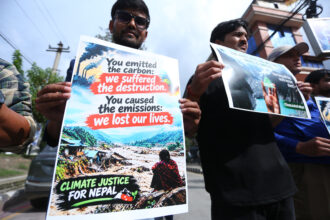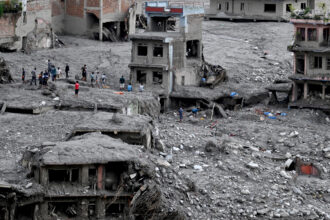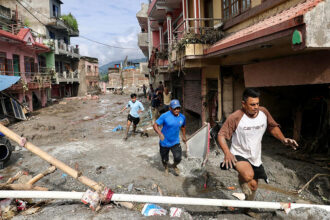


From our collaborating partner Living on Earth, public radio’s environmental news magazine, an interview by Paloma Beltran with Tanuja Pandey, a climate justice activist in Nepal.
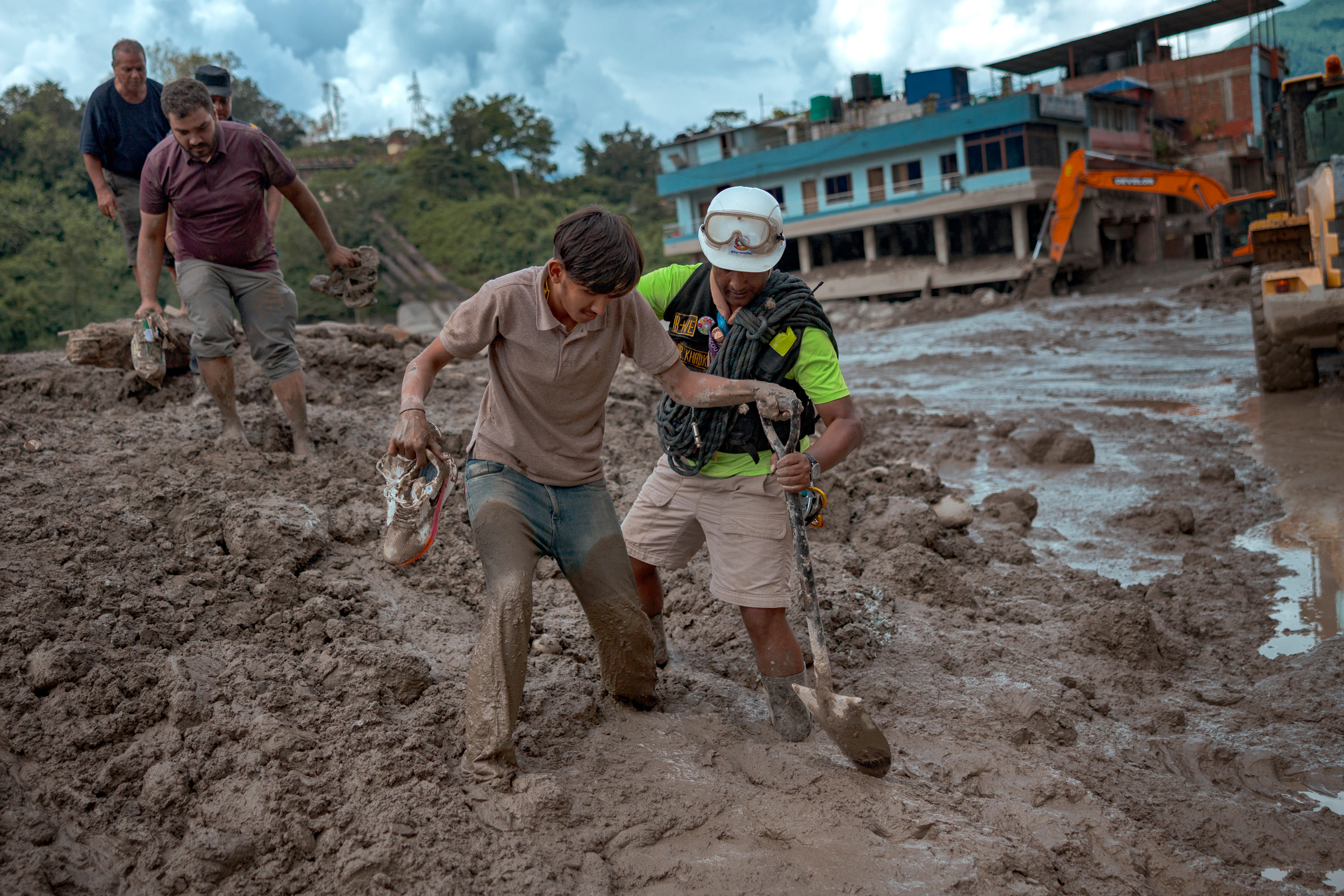
In the weeks following the deadly glacier collapse and floods in Nepal this August, researchers from the World Weather Attribution group rapidly assessed the event and concluded that climate change played a “very strong” role in the catastrophe.
Warmer weather melted ice, thawed permafrost and increased rainfall, destabilizing a glacier before its collapse. Nepal estimates that damages from the floods—which killed at least 1,300 people—could exceed $4 billion, over a tenth of the country’s total gross domestic product.
Tanuja Pandey is a climate justice activist and lawyer based in Kathmandu, Nepal. She originally hails from Sudur Paschim, a region affected by the floods, and is co-founder and chair of Harin Nepal, an intersectional climate justice organization. This interview has been edited for length and clarity.
PALOMA BELTRAN: It’s been nearly a month since devastating floods hit Nepal and Tibet due to glacial collapse in the Himalayas. What have you seen in the weeks since the disaster? How are you and your community holding up?
TANUJA PANDEY: Life after a flood is incredibly difficult, especially for those who have lost someone they love. The water may eventually recede, but the grief does not. Imagine waking up every morning knowing that the person you share your room, your home, your meals, your life with is no longer there. Some of the families are still waiting for their loved ones to be found, while others are trying to give a final farewell without having the chance to properly say goodbye. Then they are expected to rebuild their home, return to their work and somehow continue with their lives.
We often see the images of flood when the water is rising, but we don’t see enough of what happens afterward. It’s quite traumatizing to see everything. When we talk about floods, we talk about the water, the death toll, the missing persons. But for communities, the real story continues long after the water disappears. They are left rebuilding the homes and livelihoods, memories, dignity and sometimes their entire sense of security. That is what Nepal is going through right now, and it’s really traumatizing to see everything and to feel helpless because all we can give is sympathy at the moment, even though we want to help with everything.
BELTRAN: You visited the affected zones in Nepal. What did you see?

PANDEY: I saw the life fading away. I saw the children waiting for their parents. I saw the wife waiting for her husband, a mother waiting for their child and I saw the entire community swept away. It used to be one of the Indigenous lands of Nepal, and the community—who did nothing to contribute to climate change—lost everything within seconds.
Nepal is a very religious country. They worship nature. Even today, a lot of climatic disaster is related not to the anthropologic reason, but to the demonic factor. People don’t know what climate change actually is, and I saw people not praying this time. It was quite heavy for us to see everything, and even heavy for us to talk about it now.
BELTRAN: Nepal estimates that the recovery from the disaster will cost more than $4 billion. What are the non-economic costs that the world should consider regarding this catastrophe?
PANDEY: Economic cost is important, but we don’t talk about the amount of anxiety the community has gone through, the amount of fear we have. A lot of people in mountain communities who live downstream are migrating after the event because people are scared to live near the water resources. Nepal’s traditional settlements have always been near the riverside. It’s quite hard to talk about it because we are giving up on our identity, our traditional way of living, just because few countries refuse to stick to their commitment.
BELTRAN: In the days following the flood, Nepal’s government wrote to the United Nations Fund for Responding to Loss and Damage; Nepal is requesting $20 million. That’s the maximum amount a country can request, and Nepal framed the request in terms of climate justice rather than a request for aid. Tell us about that distinction.
PANDEY: The problem is that Nepal’s climate story often becomes internationally visible only after a disaster reaches a catastrophic death toll. But in fact, we lose our people—amounting to hundreds— every year. It has become a new normal to us, and that creates a dangerous cycle. The world responds to the headline event rather than to [the] underlying accumulating loss and damage.
“We are giving up on our identity, our traditional way of living, just because few countries refuse to stick to their commitment.”
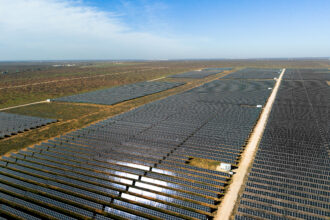
Nepal has done its part. We have restored our forests on an impressive scale, and we are rapidly moving toward clean energy, even though people don’t know what clean energy actually is. We are promoting electric mobility and implementing the climate adaptation plan at the local level. We are even going back to our traditional knowledge, Indigenous practices.
A country responsible for less than 0.02 percent of global greenhouse gas emissions is paying an even higher price for a crisis it did not create. … We are not here to blame any nation, but demand what is rightfully ours. We demand solidarity and to seek the solution because at this moment, we want international communities and polluting countries to stick to it.
BELTRAN: From what I understand, Nepal has still not received any money from the U.N. fund. This pot of money is severely underfunded because wealthy nations have not contributed what they initially pledged. For example, the United States withdrew from the fund in 2025. What role do wealthier nations have to play in addressing this crisis?
PANDEY: To bounce back from this event like this, we need money. We could have saved our people if we had an early warning system … if we had good infrastructure. Financial resources play a huge and most important role when it comes to adaptation.
This story is funded by readers like you.
Our nonprofit newsroom provides award-winning climate coverage free of charge and advertising. We rely on donations from readers like you to keep going. Please donate now to support our work.
Donate NowAll these polluting countries are making the most out of the fossil fuel industry, and all they are doing is increasing their wealth. But at the cost of that, countries like Nepal are suffering, and it is just against the basic principle of environmental justice. Transitioning away from fossil fuel might not be easy for them to do overnight, but they are in the position to compensate the communities that are being affected by their actions.
BELTRAN: Alongside other damages to infrastructure, Nepal estimates that 10 percent of the country’s hydropower capacity was destroyed in the floods. How significant was that energy infrastructure to Nepal?
PANDEY: It’s not the first time it’s happened in Nepal. Two years ago, we lost our major hydropower plants. That’s why we’ve been saying that no investment is good for Nepal if it is not sustainable or if it is not green, because you’re building hydro plants one day and another day it is being swept away by landslides and floods. … We of course need development, but it’s high time we should start practicing sustainable development rather than colonial practices of development. We should redefine what development looks like to us, rather than just feeding ourselves the idea of development from the Global North.
“It will impact everyone eventually. It’s a fight for humanity as a whole.”
BELTRAN: This moment feels like a turning point for many people. The floods in Nepal, the hottest summers on record, and the recent U.N. report warning about the trajectory of future warming. How, in your view, can we turn this moment into action?
PANDEY: For Nepal, even though we have lost thousands of people, thousands are still missing. It’s a very sad event. It’s a very traumatizing event. But it’s also a good opportunity for everyone to get united, because what happened today with us could happen to anyone tomorrow. It’s not an isolated event. It is not something that will happen for the last time.
We’ve been seeing the flooding everywhere in the Global South. We’ve been seeing the heat waves in the Global North. We need to hear what the scientists are saying, and we need to actually act with urgency, rather than denying the facts, because the clock is ticking and it does not wait for anyone. It didn’t wait for Nepal and it will not wait for any other world. It will impact everyone eventually. It’s a fight for humanity as a whole.
BELTRAN: What gives you hope?
PANDEY: Hope is a very political thing to have. It is something that [not only] helps you to survive, but also to thrive. Hope is a very powerful thing. Looking at young people confronting their leaders, looking at children trying to educate their parents on what is right and what is wrong, looking at grassroots mobilizers working tirelessly, looking at a journalist having the courage to cover an issue that is quite hard and challenging for them, and basically looking at humanity to save humanity itself is something that gives me hope.
About This Story
Perhaps you noticed: This story, like all the news we publish, is free to read. That’s because Inside Climate News is a 501c3 nonprofit organization. We do not charge a subscription fee, lock our news behind a paywall, or clutter our website with ads. We make our news on climate and the environment freely available to you and anyone who wants it.
That’s not all. We also share our news for free with scores of other media organizations around the country. Many of them can’t afford to do environmental journalism of their own. We’ve built bureaus from coast to coast to report local stories, collaborate with local newsrooms and co-publish articles so that this vital work is shared as widely as possible.
Two of us launched ICN in 2007. Six years later we earned a Pulitzer Prize for National Reporting, and now we run the oldest and largest dedicated climate newsroom in the nation. We tell the story in all its complexity. We hold polluters accountable. We expose environmental injustice. We debunk misinformation. We scrutinize solutions and inspire action.
Donations from readers like you fund every aspect of what we do. If you don’t already, will you support our ongoing work, our reporting on the biggest crisis facing our planet, and help us reach even more readers in more places?
Please take a moment to make a tax-deductible donation. Every one of them makes a difference.
Thank you,