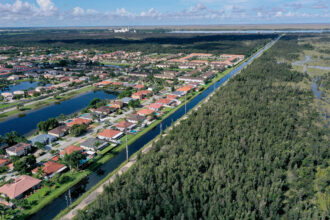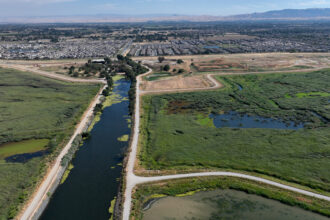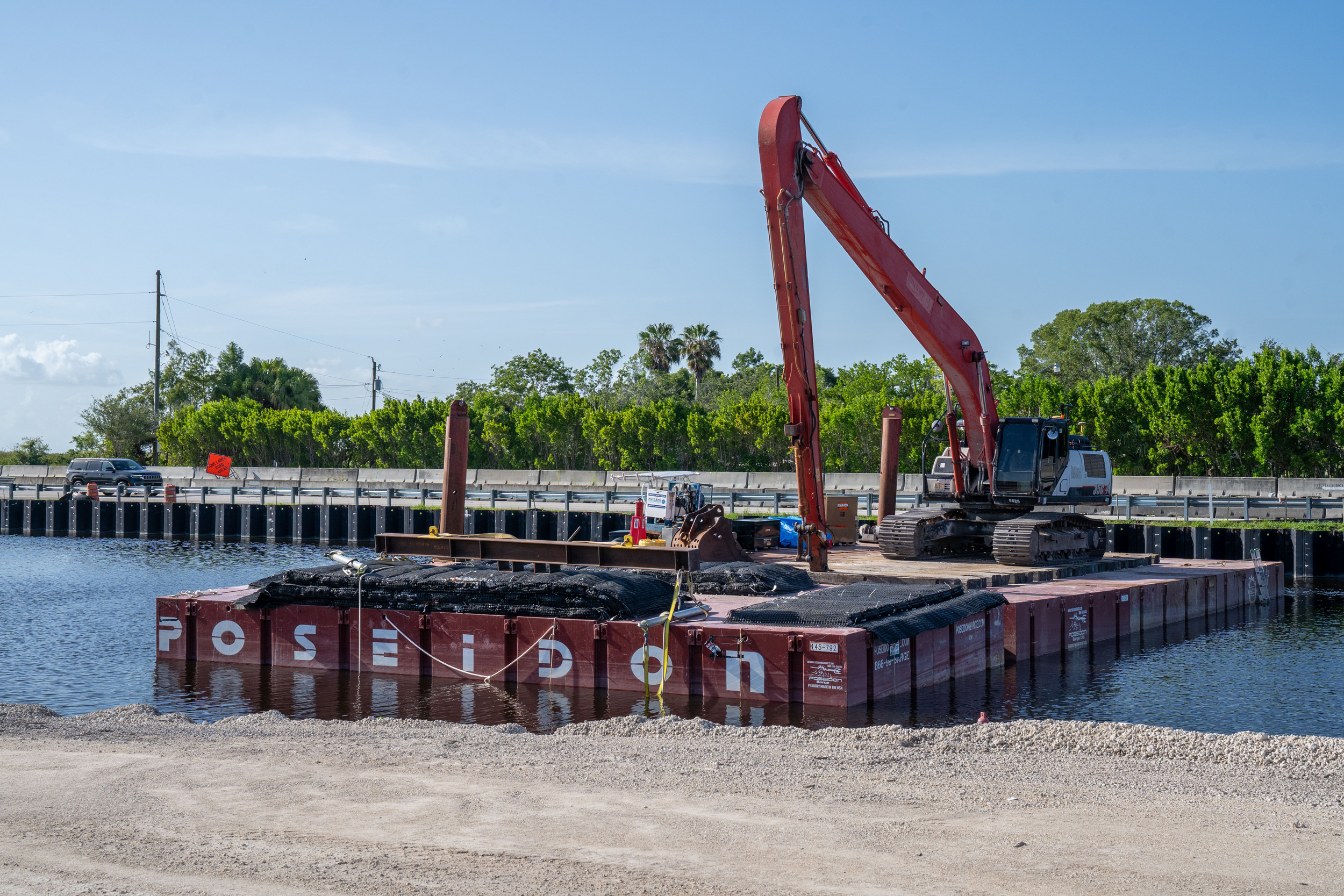


A sprawling reservoir under construction south of Lake Okeechobee that Gov. Ron DeSantis has characterized as the “crown jewel” of Everglades restoration will not be enough to save Florida’s treasured and troubled river of grass, according to a new report.
The report, prepared by Friends of the Everglades, an advocacy group, suggests the Everglades needs an even larger reservoir in the Everglades Agricultural Area that at 77,000 acres and 13 feet deep would dwarf the EAA reservoir already under construction among the vast sugarcane fields in the region. That $3.5 billion reservoir, once complete, will be the largest of its kind the U.S. Army Corps of Engineers has built anywhere in the country.
The report was based on an expansive review of the existing scientific literature, which taken together suggests 1 million acre-feet of water storage, in addition to the EAA reservoir, is needed in the Everglades Agricultural Area to replenish the river of grass, said Tom Van Lent, science advisor for Friends of the Everglades, who prepared the report. The water storage also would help spare fragile coastal estuaries in the region from harmful flows of polluted water from Lake Okeechobee.
“It would look like a very large but relatively shallow lake on the landscape, so it would be like a much smaller Lake Okeechobee,” Van Lent said. “I’m not oblivious to this is a difficult ask. Short-term considerations always seem to dominate longer-term investments, and that is what this would be, is a long-term investment in the viability of south Florida.”
The EAA reservoir is the centerpiece of the $27 billion effort to restore the Everglades, the watershed that spans much of the peninsula, from the headwaters of the Kissimmee River to Florida Bay at the state’s southernmost tip, and supports the drinking water supply for millions of Floridians. A series of historic attempts to drain the river of grass has made modern Florida possible and caused a litany of problems across the state’s most important freshwater resource.
In 2018, the lake’s flows to coastal estuaries contributed to a widespread outbreak of toxic algae that sickened Floridians and wiped out wildlife statewide. The calamity coincided with DeSantis’ gubernatorial campaign that year, and during his two terms in office the Republican governor has made Everglades restoration and particularly the EAA reservoir a priority.
Under his leadership, the state has invested billions of dollars toward the massive restoration effort, even as his administration has faced widespread condemnation and federal litigation over Alligator Alcatraz, the migrant detention facility that operated for a year in the Everglades before closing this summer. DeSantis announced a deal last year with the Trump administration to expedite the reservoir’s construction, with completion now scheduled for 2029.
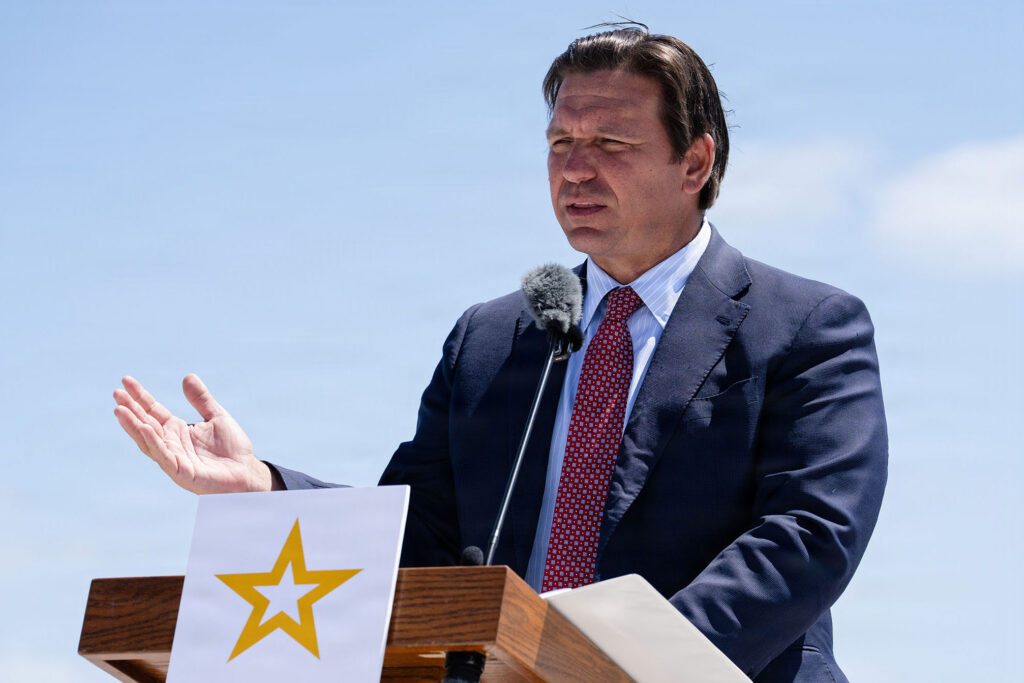
“These historic investments have tripled water storage capacity in South Florida, accelerated critical restoration efforts, and produced measurable environmental results, including Florida Bay reaching its salinity targets for the first time in decades,” according to a statement the South Florida Water Management District, the state agency overseeing Everglades restoration, provided to Inside Climate News.
In a statement, the U.S. Army Corps of Engineers, the federal agency overseeing the restoration effort, characterized the EAA reservoir as a key project “designed to improve the quantity, quality, timing and distribution of water moving south from Lake Okeechobee to the Everglades while helping reduce harmful discharges to the northern estuaries.”
The corps statement says that “construction milestones this year have included significant progress on the reservoir foundation and embankment, as well as completion of a major controlled construction operation at the reservoir site. The accelerated project is a clear example of Building Infrastructure, Not Paperwork in action.”
Historically, the Everglades’ freshwater coursed lazily and shallow among the sawgrass south of Lake Okeechobee, between the banks of the Atlantic Coastal Ridge to the east and highlands of what now are part of the Big Cypress National Preserve to the west. Recapturing as much of this water as possible is at the heart of the restoration effort.
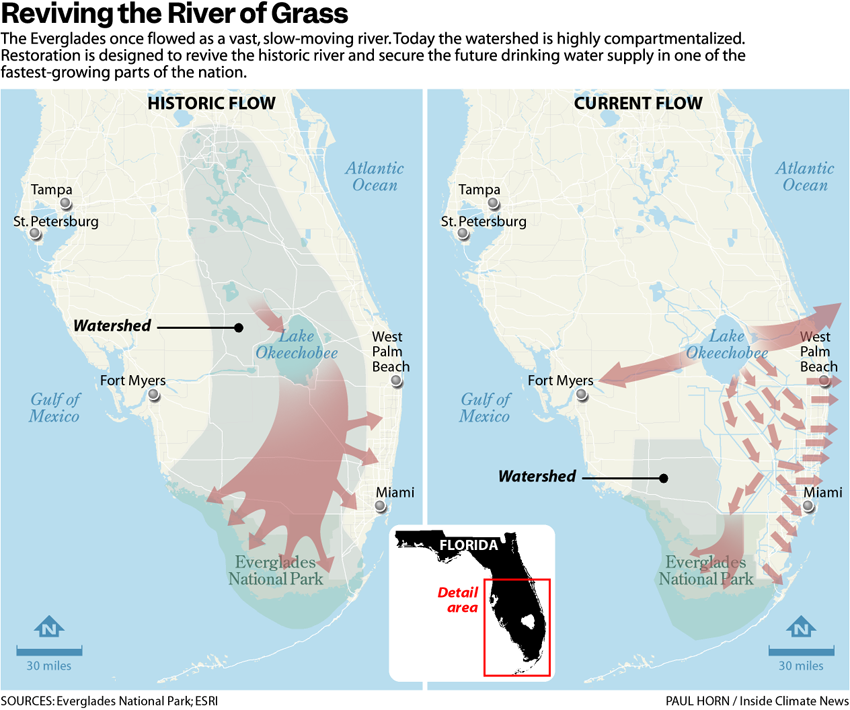
The Friends of the Everglades’ report said locating more water storage in the Everglades Agricultural Area would replicate the natural flow of the river of grass, while north of Lake Okeechobee the water storage would benefit primarily the lake and coastal estuaries but not the Everglades. The mind-boggling size of the additional reservoir proposed in the report was based on an analysis of land and levee costs and ecological function. By comparison the EAA reservoir, at 10,000 acres and 24 feet deep, is designed to hold 240,000 acre-feet of water, a quarter of what the report recommended.
The findings were similar to those of a 2015 University of Florida Water Institute report authorized by the Florida Senate to identify alternatives to the damaging lake flows to the coastal estuaries. That report called for 1 million acre-feet of water storage north and south of the lake, along with 400,000 acre-feet to the west and 200,000 acre-feet to the east.
The report was produced before the EAA reservoir was conceptualized, additional reservoirs were constructed on either side of the lake and a new management plan was implemented for Lake Okeechobee. “The path forward requires significant long-term investment in the infrastructure of the South Florida hydrologic system,” the report said.
Van Lent and other environmental groups had raised concerns about the EAA reservoir’s design before construction began in 2023. The groups voiced reservations about whether the reservoir would convey enough water south or clean the water to established standards. The groups also said the design failed to factor in climate change, among other issues.
This story is funded by readers like you.
Our nonprofit newsroom provides award-winning climate coverage free of charge and advertising. We rely on donations from readers like you to keep going. Please donate now to support our work.
Donate NowVan Lent’s position put him at odds with his former employer, the Everglades Foundation. After his departure, the foundation accused Van Lent of stealing “trade secrets,” sparking a bitter legal battle that forced Van Lent last year to serve a 10-day jail sentence in Miami. Van Lent denied the allegations and said the foundation constructed a politically motivated smear campaign related to his concerns over the reservoir championed by DeSantis. The foundation said the only motivation behind the litigation was to recover materials it said Van Lent destroyed.
“If you look to the future at the challenges that south Florida will face from rising sea levels, higher temperatures, a number of factors related to climate change, the amount of storage you have in the system is going to be the single biggest determinant of how well you can cope,” Van Lent said. “So by any metric, any analysis, the storage is the thing. And if you look at where are you going to put that storage, it’s really one place that stands out, and it’s the EAA. So it’s not hyperbole to say that what you do in the EAA will determine the fate of south Florida.”
Much more water must flow south from Lake Okeechobee to the Everglades for the restoration effort to succeed, said Paul Gray, an environmental scientist who has studied the lake for 38 years. He said the monumental restoration effort, now in its 26th year, will not be complete once the EAA reservoir is finished, but he recommended a stepwise approach.
“It’s kind of like a road network. We’re never done building roads. But we have new needs and things change, and water is the same way,” he said. “You put in some fixes and you see how they work, and then if they don’t work well enough then you put in some more. But I’m not looking at the end game. I’m looking at progress.”
DeSantis’ second term concludes in January 2027, and he is prevented from running for reelection because of the state’s term limit. Eve Samples, executive director of Friends of the Everglades, said the incoming governor has a “historic opportunity” to acquire more land in the Everglades Agricultural Area to advance the restoration of the river of grass.
“We have a long way to go, and anyone who’s saying Everglades restoration is done or almost done is glossing over the facts,” she said. “There is a great opportunity for the next governor, whoever that may be, and it will be very important for the governor to come in with fresh eyes and follow the science and have a clear view on what the EAA reservoir does and doesn’t do.”
About This Story
Perhaps you noticed: This story, like all the news we publish, is free to read. That’s because Inside Climate News is a 501c3 nonprofit organization. We do not charge a subscription fee, lock our news behind a paywall, or clutter our website with ads. We make our news on climate and the environment freely available to you and anyone who wants it.
That’s not all. We also share our news for free with scores of other media organizations around the country. Many of them can’t afford to do environmental journalism of their own. We’ve built bureaus from coast to coast to report local stories, collaborate with local newsrooms and co-publish articles so that this vital work is shared as widely as possible.
Two of us launched ICN in 2007. Six years later we earned a Pulitzer Prize for National Reporting, and now we run the oldest and largest dedicated climate newsroom in the nation. We tell the story in all its complexity. We hold polluters accountable. We expose environmental injustice. We debunk misinformation. We scrutinize solutions and inspire action.
Donations from readers like you fund every aspect of what we do. If you don’t already, will you support our ongoing work, our reporting on the biggest crisis facing our planet, and help us reach even more readers in more places?
Please take a moment to make a tax-deductible donation. Every one of them makes a difference.
Thank you,

Amy Green
Reporter, Florida
Amy Green covers the environment and climate change from Orlando, Florida. She is a mid-career journalist and author whose extensive reporting on the Everglades is featured in the book MOVING WATER, published by Johns Hopkins University Press, and podcast DRAINED, available wherever you get your podcasts. Amy’s work has been recognized with many awards, including a prestigious Edward R. Murrow Award and Public Media Journalists Association award.