

A few days before Christmas in 2023, the U.S. Environmental Protection Agency received a complaint through its National Response Center: “There has been a horrible smell in the air for almost a week,” the caller said, according to state records. “It’s so bad it’s making people throw up.”
The caller thought the odor was emanating from Smithfield’s enormous hog slaughterhouse in Tarheel. But the rendering plant wasn’t the culprit. The stench instead came from poultry manure that farmers were slathering on agricultural fields throughout Bladen County, an investigation by the North Carolina Division of Air Quality found.
Spreading dry poultry feces on fields is legal, as is the secrecy underpinning North Carolina’s poultry industry.
With a few exceptions, state law allows poultry CAFOs, or concentrated animal feeding operations, to operate without a permit.
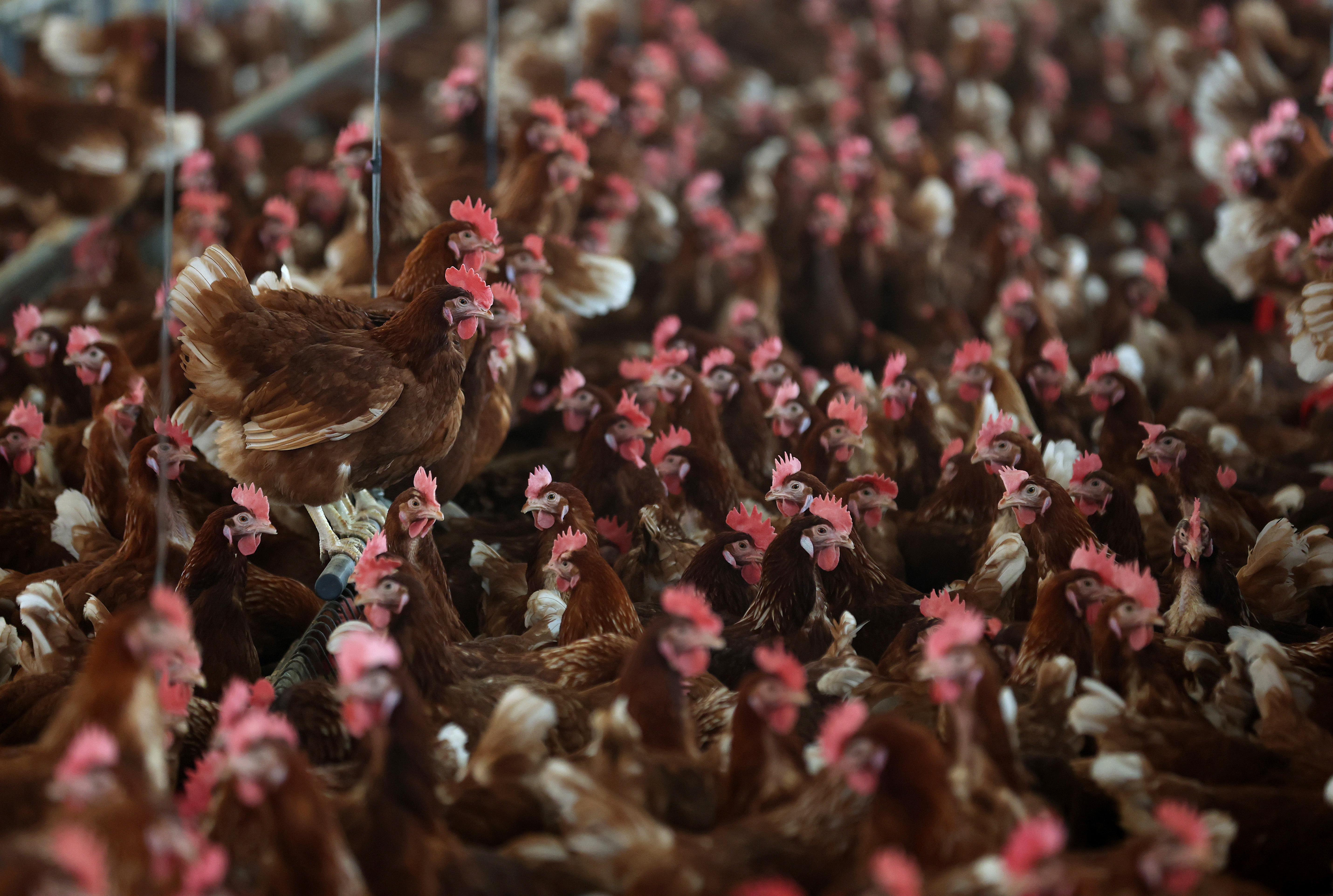
Many poultry CAFOs raise millions of birds each year, in as many as 48 barns per farm. The law also keeps their locations confidential, known only to the N.C. Department of Agriculture.
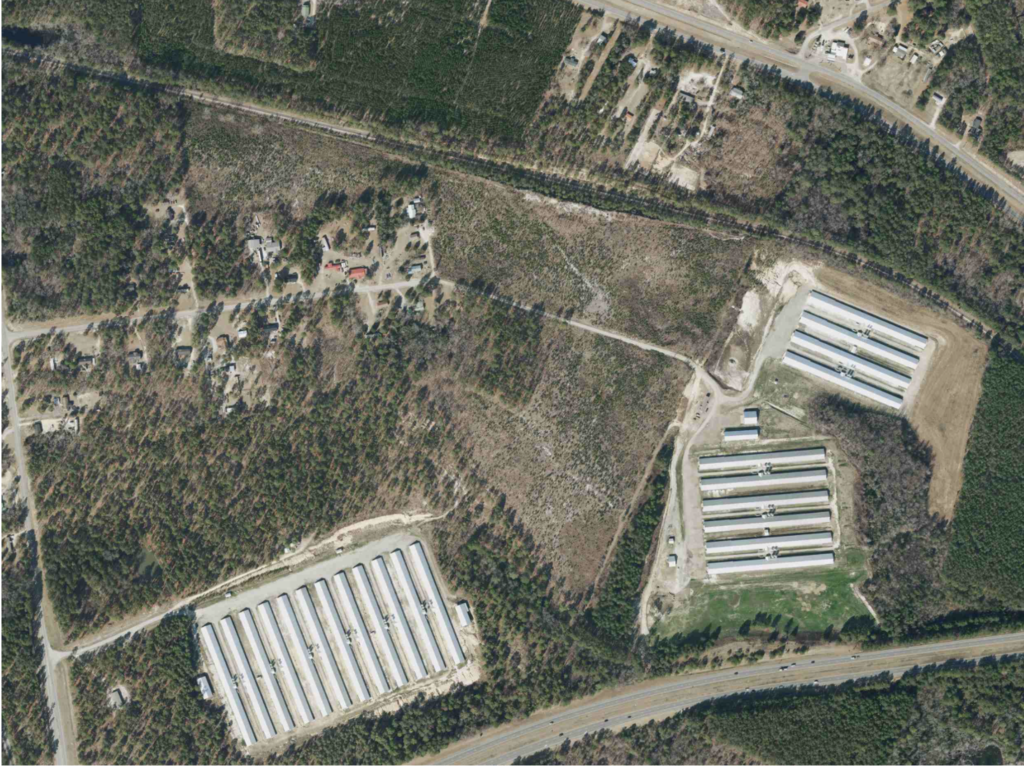
Now three environmental nonprofits, CleanAIRE Carolina, Rural Empowerment Association for Community Help and the N.C. Environmental Justice Network, have launched a community science project—E-I-E-I-O No!—to identify and monitor poultry CAFOs and swine biogas projects. The project relies on state government satellite imagery, analyzed by volunteers and then verified by “ground truthing”—driving to the sites themselves.
Several universities are assisting with the project, which aims to provide a public accounting of the CAFOs and their potential harms to air and water quality.
“People are inundated” with the waste, said Chris Lamont Brown, director of research and education with NCEJN. “There are real public health issues.”
An Alternative to Doomscrolling
An aerial photo of three long, narrow barns displayed on a large screen.
“Raise your hand if you think this is a swine CAFO,” Brown asked the crowd of 200-plus people.
No one did.
“Raise your hand if you think it’s poultry.”
Every hand went up.
“Look at you–you’re ready,” Brown said.
The N.C. Environmental Justice summit is held every October at the Franklinton Center at Bricks, a former school for previously enslaved people after the Civil War. Here, project leaders Brown and Z Strawderman, AirKeeper Dashboard & GIS manager for CleanAIRE Carolina, publicly debuted E-I-E-I-O-No, which launched in late July.
Throughout the summer, more than 1,600 volunteers logged on to Zooniverse, an online platform for community research. The task was simple, if tedious: Scan satellite images of every land parcel in Sampson County and identify whether it contained a poultry CAFO, a swine CAFO, both or neither.
Volunteers also scrutinized the images for covered swine lagoons that could indicate the presence of biogas anaerobic digesters. For quality control, 20 people reviewed each image.
“People said that instead of doomscrolling, they would work on this project,” Brown explained. “They wanted to do something bigger than themselves.”
This story is funded by readers like you.
Our nonprofit newsroom provides award-winning climate coverage free of charge and advertising. We rely on donations from readers like you to keep going. Please donate now to support our work.
Donate NowProject leaders estimated it would take a month to review the images. It took 24 hours.
Since the summer, volunteers have analyzed six counties and identified 2,011 swine and 2,349 poultry CAFOs.
Project leaders intentionally refrained from using artificial intelligence to scan the imagery. Not only would it be less accurate than a human review, but data centers that power AI consume vast amounts of energy and water, create heat islands and noise, and inflict other social and economic harms.
“We want to bring more people into the environmental justice movement,” Brown said. “And we want to use a method that aligns with our values.”
For the past 20 years, a permanent swine CAFO moratorium has been in effect in North Carolina, which prohibits new or expanded operations unless they install “environmentally superior technology” to manage the billions of gallons of hog waste currently stored in open-air lagoons.
Poultry CAFOs have filled the gap, Strawderman said, and the number of operations have doubled or even tripled in some North Carolina counties in just five years.
In 2022, about 1 billion chickens, broilers and turkeys were sold in North Carolina both export and consumption according to federal Department of Agriculture data. The state ranks fourth in the U.S. in chicken production and first in turkeys.
From the air, poultry CAFOs look different from their swine counterparts. Poultry barns are long and narrow. Instead of enormous lagoons to hold slurried waste, such as those used in swine CAFOs, poultry operations mound dry feces and store it in a barn.
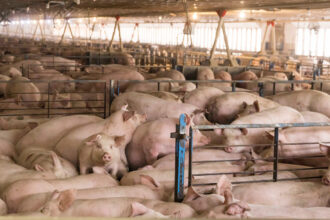
Swine CAFOs spray millions of gallons of reeking waste onto agricultural fields. From there, it seeps into the groundwater or can run off into streams and contaminate drinking water.
Poultry waste can also contaminate air and water. Companies haul the material off and pile it in fields, sometimes for up to 15 days, as state law allows. If it rains during that time, the piles become tides of waste. Even when it is spread as dry manure for fertilizer, it can seep into the drinking water supplies much like swine waste.
“We don’t know where the waste is going,” Strawderman said, “or whether there is enough land to apply it responsibly.”
It’s difficult to pinpoint all the poultry operations in North Carolina, but every five years the USDA conducts a census of CAFOs and birds sold per county and publishes the information online.
Strawderman analyzed county-level data from 2017 to 2022. Sampson County, already home to 2.1 million hogs, reported sales of 47 million poultry in 2017.
Five years later, the number had doubled to 95 million.
Over the same time period, poultry sales in Duplin County increased by a third, to 111 million birds; the county has 2.2 million hogs, state records show.
New data will be released next month. When the E-I-E-I-O-No project is complete, it will feature a comprehensive map of every active poultry CAFO and field where the waste is spread, Strawderman said, plus all swine lagoons that are equipped to generate biogas.
“This is a free and accessible project,” Brown said. “We can get what our state is trying to hide from us.”
About This Story
Perhaps you noticed: This story, like all the news we publish, is free to read. That’s because Inside Climate News is a 501c3 nonprofit organization. We do not charge a subscription fee, lock our news behind a paywall, or clutter our website with ads. We make our news on climate and the environment freely available to you and anyone who wants it.
That’s not all. We also share our news for free with scores of other media organizations around the country. Many of them can’t afford to do environmental journalism of their own. We’ve built bureaus from coast to coast to report local stories, collaborate with local newsrooms and co-publish articles so that this vital work is shared as widely as possible.
Two of us launched ICN in 2007. Six years later we earned a Pulitzer Prize for National Reporting, and now we run the oldest and largest dedicated climate newsroom in the nation. We tell the story in all its complexity. We hold polluters accountable. We expose environmental injustice. We debunk misinformation. We scrutinize solutions and inspire action.
Donations from readers like you fund every aspect of what we do. If you don’t already, will you support our ongoing work, our reporting on the biggest crisis facing our planet, and help us reach even more readers in more places?
Please take a moment to make a tax-deductible donation. Every one of them makes a difference.
Thank you,

Lisa Sorg
Reporter, North Carolina
Lisa Sorg is the North Carolina reporter for Inside Climate News. A journalist for 30 years, Sorg covers energy, climate environment and agriculture, as well as the social justice impacts of pollution and corporate malfeasance.
She has won dozens of awards for her news, public service and investigative reporting. In 2022, she received the Stokes Award from the National Press Foundation for her two-part story about the environmental damage from a former missile plant on a Black and Latinx neighborhood in Burlington. Sorg was previously an environmental investigative reporter at NC Newsline, a nonprofit media outlet based in Raleigh. She has also worked at alt-weeklies, dailies and magazines. Originally from rural Indiana, she lives in Durham, N.C.