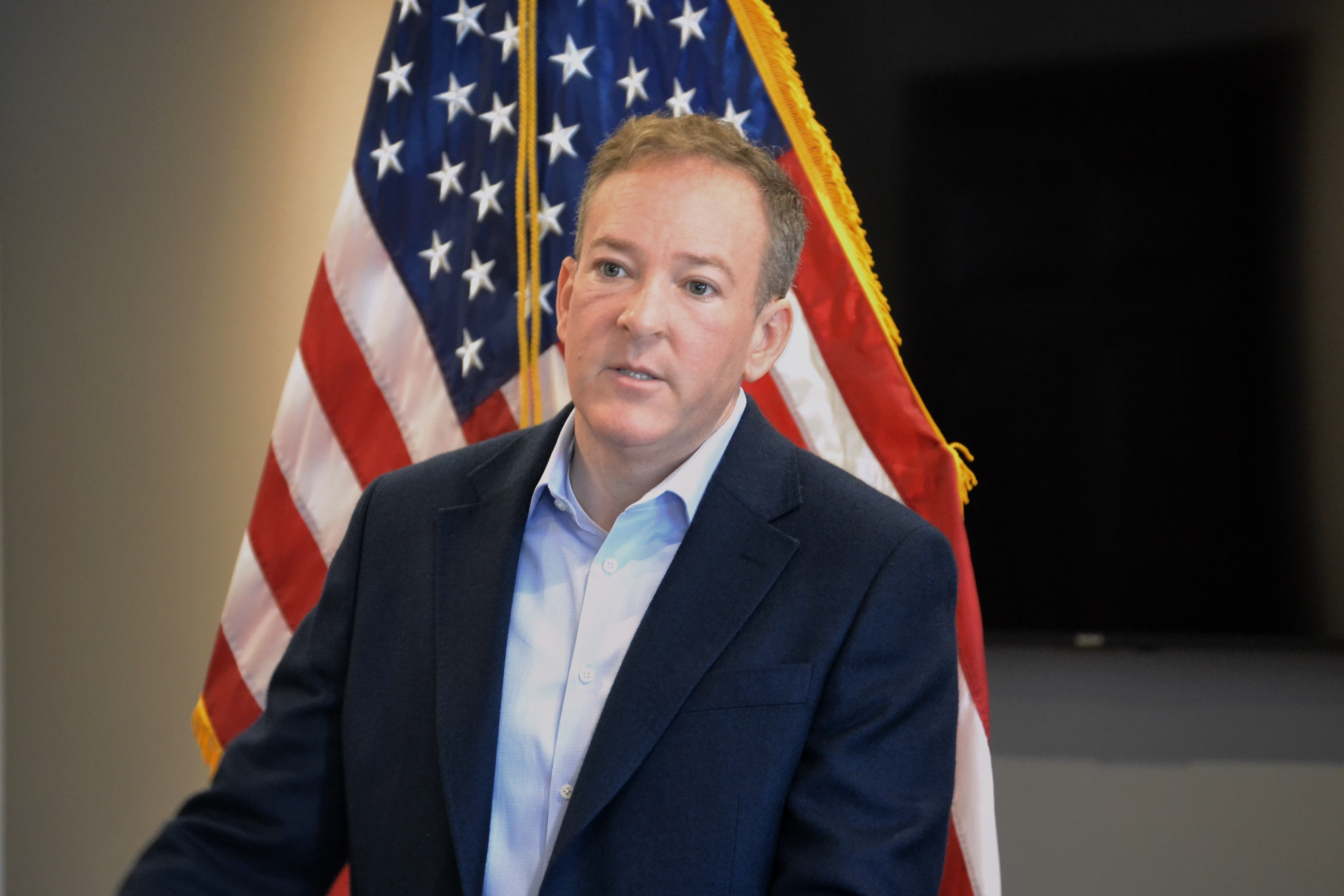


Intense rainfall delayed Iowa’s harvest by nearly three weeks this year, but the comines are finally out in full force. So are top Trump administration officials.
U.S. Secretary of Agriculture Brooke Rollins, Environmental Protection Agency Administrator Lee Zeldin and Vice President J.D. Vance have all traveled to Iowa in the last month, either in their official capacity or to campaign with GOP candidates. President Donald Trump visited Sioux City last Thursday and plans to return to Iowa before Election Day.
Though widespread frustration over affordability could fuel Democratic gains nationwide, Trump’s trade wars, the war in Iran and his support for the oil and gas industry have hit Iowa farmers particularly hard. The state is a leading producer of corn, soybeans and biofuels made from both crops.
With Iowa’s closely watched midterm elections roughly a week away, the Trump administration has rolled out a series of measures aimed at winning over farmers whose livelihoods depend heavily on federal fuel and agricultural policies.
Republicans could lose up to four GOP-held seats in Iowa’s congressional delegation. Democrats hope victories in the state will help them take control of Congress, while Republicans are fighting to preserve their narrow majorities in the House and Senate.
Republican political action committees have recently withdrawn financial support from incumbent Mariannette Miller-Meeks’ campaign in Iowa’s 1st congressional district, signaling little confidence in her ability to defeat Democratic challenger Christina Bohannan, who lost to Miller-Meeks during the 2022 and 2024 election cycles.
In the 3rd congressional district, which includes the more progressive Des Moines metropolitan area as well as reliably conservative Southwest Iowa, incumbent Republican Rep. Zach Nunn must fend off Democrat Sarah Trone Garriott. The Cook Political Report, a non-partisan election analyst, recently shifted predictions for both races from “toss-up” to “lean Democrat.”
The Report calls the U.S. Senate race between current Democratic state Rep. Josh Turek and Republican U.S. Rep. Ashley Hinson a toss-up. The race between Republican Joe Mitchell and Democrat Lindsay James in Iowa’s second district is also rated a toss-up, as they vie for the House seat Hinson vacated in her bid for Senate.
The war in Iran and the subsequent closure of the Strait of Hormuz have exposed how much Iowa farmers rely on fossil fuel imports. Spiking diesel prices have left growers paying almost twice as much per gallon this harvest as last year. That amounts to thousands of dollars of additional costs each day, even on smaller acreages.
Meanwhile, Trump’s tariffs have driven up the price of farm machinery and other essential materials, like fertilizer. Retaliatory tariffs from countries like China are devastating U.S. commodity crop exports and depressing market prices.
U.S. farm debt is projected to hit a record $605 billion this year, raising concerns about a repeat of the farm crisis of the 1980s. Back then, soaring debt, plunging land values and federal policies that encouraged consolidation contributed to widespread foreclosures of family farms.
Last week, Trump announced that the U.S. Department of Agriculture would offer American farmers $8 billion in one-time fuel relief payments.
The National Corn Growers Association welcomed the announcement with cautious optimism.
“We appreciate the administration recognizing how the high cost of inputs, especially diesel fuel prices during harvest time, is adding to the economic pain of America’s farmers,” the organization wrote in a statement. Still, they added, “We urge Washington to focus on durable, bipartisan, long-term solutions that will result in lasting improvements to the farm and national economy.”
“Hail Mary” on Fuel Policies
Throughout the summer, Democratic campaign ads in Iowa criticized Reps. Hinson, Miller-Meeks and Nunn for repeatedly voting against war powers resolutions directing the president to end U.S. military action in Iran.
In September, after voting “no” five times, Miller-Meeks and Nunn broke with most of their party and voted in favor of a resolution. Hinson voted against the Senate version for the sixth time, but days later posted on social media that she wanted to see a “successful and immediate end” to the war.
Votes on these resolutions can signal lawmakers’ views and their awareness of how a war affects their constituents, but the resolutions are still subject to a presidential veto, said James McCormick, a professor emeritus of political science at Iowa State University.
Even if the war ends today, Iowa farmers are unlikely to see an immediate drop in prices, McCormick said. Prices on refined oil products like diesel and gasoline could remain high for a year or more after the conflict ends.
Aaron Lehman, president of the Iowa Farmers Union, described last Monday’s fuel relief announcement as a “Hail Mary pass” by Trump to fix a problem his own policies created. “We need genuine efforts to help farmers now while fixing the real causes of our current situation. We need to conclude the war without sacrificing our farmers’ bottom lines,” Lehman said in a statement.
As farmers face mounting financial pressure, many are looking to biofuels for a potential economic lifeline. Ahead of November’s election, Republican candidates and cabinet members have sought to capitalize on that optimism by courting Iowa’s biofuel industry.
This story is funded by readers like you.
Our nonprofit newsroom provides award-winning climate coverage free of charge and advertising. We rely on donations from readers like you to keep going. Please donate now to support our work.
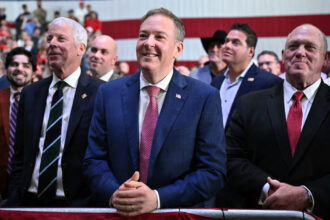
Donate NowAt a Farm Bureau office in Peosta, Iowa, earlier this month, EPA administrator Lee Zeldin announced the agency would preserve overall ethanol purchases by reallocating all the renewable fuel blending waivers it granted to small refineries this year.
The agency hailed the reallocation as a “Major American Farmer First Policy,” fulfilling a promise the EPA made in August after farm and biofuel groups raised concerns the waivers would hurt ethanol demand.
The announcement closed out Zeldin’s three-day trip across Iowa, during which he also toured an ethanol plant with Rep. Hinson and appeared alongside Rep. Nunn at a motor vehicle parts and accessories manufacturer.
Over 60 percent of Iowa-grown corn is used to produce ethanol, while about a quarter of Iowa soybeans go to biodiesel. Two decades of the Renewable Fuel Standard, which requires transportation fuel sold in the U.S. to contain a minimum volume of renewable fuel, have propped up both markets.
For years, Midwestern corn growers and biofuel groups have pushed to expand biofuel demand by approving nationwide, year-round sales of E15, a higher-ethanol fuel blend.
The Clean Air Act currently restricts summertime sales of E15 across much of the country, as higher ethanol blends release more smog-forming volatile organic compounds in hot weather. Iowa is one of several corn-belt states exempt from summer restrictions.
Amid a deepening farm crisis, nationwide, year-round E15 could provide a much-needed boost for American corn growers, according to industry groups such as the Iowa Farm Bureau and Iowa Corn Growers Association.
Though Iowa’s Republican incumbents have championed year-round E15, Congress has yet to pass legislation allowing its nationwide sale, either as a standalone measure or as part of a long-delayed Farm Bill. That lack of progress could hurt Republicans in Iowa’s congressional races, McCormick said.
While Trump has endorsed year-round E15, that position appears to conflict with his support for oil and gas industry interests.
Reducing transportation emissions was a key goal when Congress established the Renewable Fuel Standard in 2005. Although growing corn for ethanol and converting land for agricultural production generate greenhouse gas emissions, higher-ethanol blends generally produce fewer emissions from a vehicle’s tailpipe than conventional gasoline.
Yet in Trump’s second term, the EPA repealed the 2009 Endangerment Finding, which had provided the legal and scientific foundation for federal regulation of greenhouse gas emissions. The agency subsequently rescinded all federal emissions standards and requirements for on-road vehicles.
Asked whether the rollback of emissions regulations would influence the EPA’s next round of Renewable Fuel Standard rules, Zeldin said the agency would follow a process similar to the one used to develop the “Set 2” mandates, finalized in March. Those rules established record-high renewable fuel blending requirements, but removed renewable electricity as a qualifying fuel.
Ahead of the election, the Iowa Farmers Union has endorsed all five Democrats running for U.S. Senate and House of Representatives seats from Iowa. It marks the first time the union has endorsed a candidate for federal office in years.
The Iowa Farm Bureau Political Action Committee also released endorsements, naming Republican Senate hopeful Ashley Hinson and House candidates Mariannette Miller-Meeks, Joe Mitchell, Zach Nunn and Chris McGowan as “Friends of Agriculture.”
About This Story
Perhaps you noticed: This story, like all the news we publish, is free to read. That’s because Inside Climate News is a 501c3 nonprofit organization. We do not charge a subscription fee, lock our news behind a paywall, or clutter our website with ads. We make our news on climate and the environment freely available to you and anyone who wants it.
That’s not all. We also share our news for free with scores of other media organizations around the country. Many of them can’t afford to do environmental journalism of their own. We’ve built bureaus from coast to coast to report local stories, collaborate with local newsrooms and co-publish articles so that this vital work is shared as widely as possible.
Two of us launched ICN in 2007. Six years later we earned a Pulitzer Prize for National Reporting, and now we run the oldest and largest dedicated climate newsroom in the nation. We tell the story in all its complexity. We hold polluters accountable. We expose environmental injustice. We debunk misinformation. We scrutinize solutions and inspire action.
Donations from readers like you fund every aspect of what we do. If you don’t already, will you support our ongoing work, our reporting on the biggest crisis facing our planet, and help us reach even more readers in more places?
Please take a moment to make a tax-deductible donation. Every one of them makes a difference.
Thank you,

Anika Jane Beamer
Reporter, Iowa
Anika Jane Beamer covers the environment and climate change in Iowa, with a particular focus on water, soil and CAFOs. A lifelong Midwesterner, she writes about changing ecosystems from one of the most transformed landscapes on the continent. She holds a master’s degree in science writing from the Massachusetts Institute of Technology as well as a bachelor’s degree in biology and Spanish from Grinnell College. She is a former Outrider Fellow at Inside Climate News and was named a Taylor-Blakeslee Graduate Fellow by the Council for the Advancement of Science Writing.