

KWIGILLINGOK, Alaska—Lucy Martin’s family was among the last to be evacuated from Kwigillingok, a Yup’ik village a quarter mile from the Bering Sea that was devastated by Typhoon Halong in October 2025.
A year later, Martin, the village’s tribal resilience coordinator, is still in Bethel, a regional hub about 70 miles to the northeast, and is unsure when she and the other villagers can return home.
About 30 people are back in Kwigillingok, despite the village being largely unlivable due to the damage to housing stock and critical infrastructure, such as boardwalks, plumbing and the community water pipeline. But most of the 361 residents who lived there before the storm are sheltered in Bethel, Anchorage and several nearby communities. The post-disaster recovery has been slow, and the village remains under a ‘no-go-home’ order.
“I have no house,” Martin said. “All of our tribal leaders have no homes to go to.”
In the wee hours of October 12, 2025, the remnants of Typhoon Halong, which had reached Category 4 strength near Japan, slammed into southwestern Alaska, impacting over 40 communities in the Yukon-Kuskokwim Delta and destroying the Alaska Native Villages of Kwigillingok and Kipnuk. Southwestern winds and a high tide supercharged by the full moon drove a storm surge into Kwigillingok, reaching over 6.3 ft above the normal highest tide line—more than twice as high as the previous record.
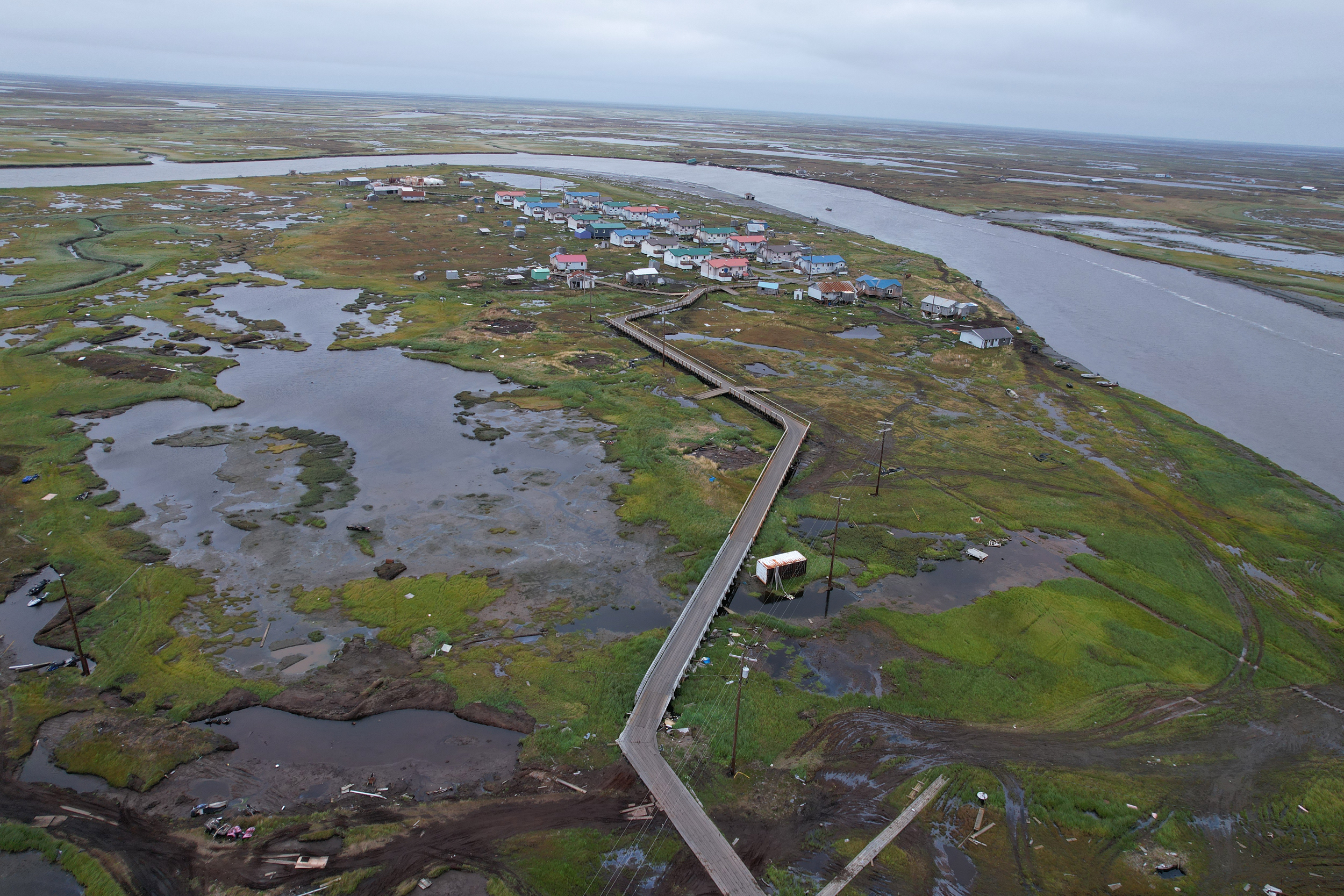
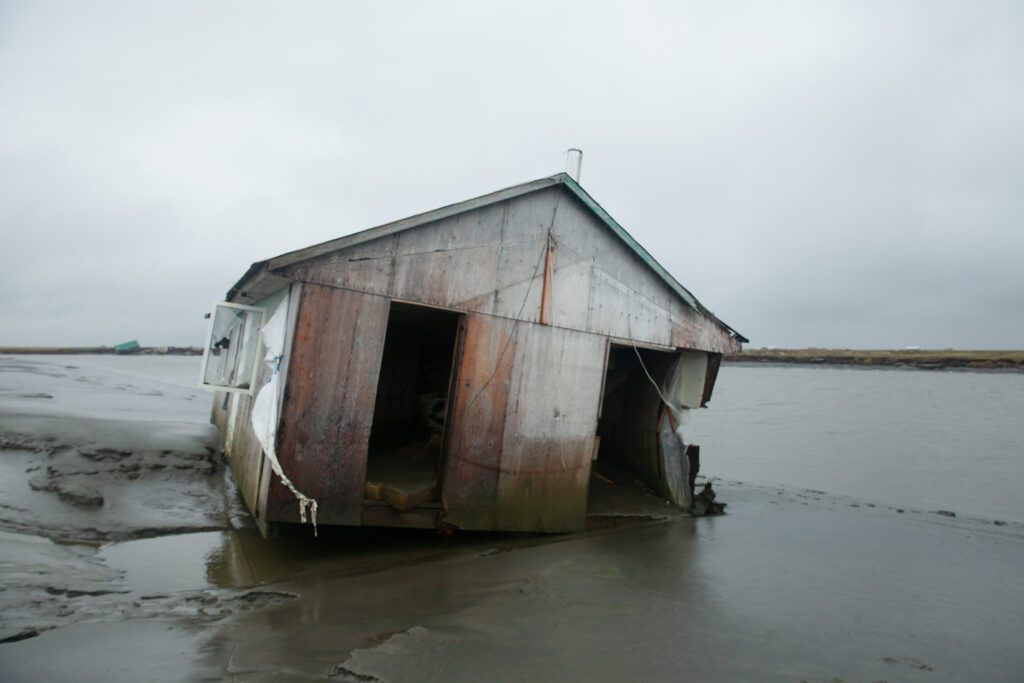
The village became the sea. The surge lifted 46 of 99 houses off their foundations and carried them for miles, most with their inhabitants trapped inside. The water ripped boardwalks from the ground, downed power lines and washed away snowmobiles, ATVs and boats, as well as freezers packed with months of food. Caskets from the cemetery rolled in the waves. Three people died.
The evacuation of about 1,500 people from the villages of Kwigillingok, Kipnuk and Nightmute was the largest domestic rescue operation in Alaska history. The scale of damage is still being assessed, and, although it was recognized as a federal disaster, the recovery from Halong, delayed by multiple shutdowns of the U.S. Department of Homeland Security, including the Federal Emergency Management Agency, will take years.
This year, Kwigillingok and Kipnuk voted to relocate to higher ground. But neither federal nor state disaster recovery funding is designed to help communities move out of harm’s way.
But the rebuilding of Kwigillingok has also stalled.
Alaska has short and expensive construction seasons, but despite the mild weather, Kwigillingok had no crews on the ground from early September to mid-October. The spokesperson for the Department of Transportation and Public Facilities, the state agency tasked with clearing the debris, restoring roadways and stabilizing structures, said that construction crews waited for FEMA funding to resume work.
Wreckage has been removed, but debris remains in the village. Some boardwalks elevated above the soggy tundra have been restored and reinforced, but many are still broken. About 13 houses have been partially repaired, Martin said. Others are in the tundra, sideways, or piled up against each other like dominoes. Homes are overrun with mold. The school, though largely undamaged, remains indefinitely closed. Two solemn rows of about 50 caskets are lined up on a boardwalk, waiting for a mass re-internment. Seven more are still in the tundra.
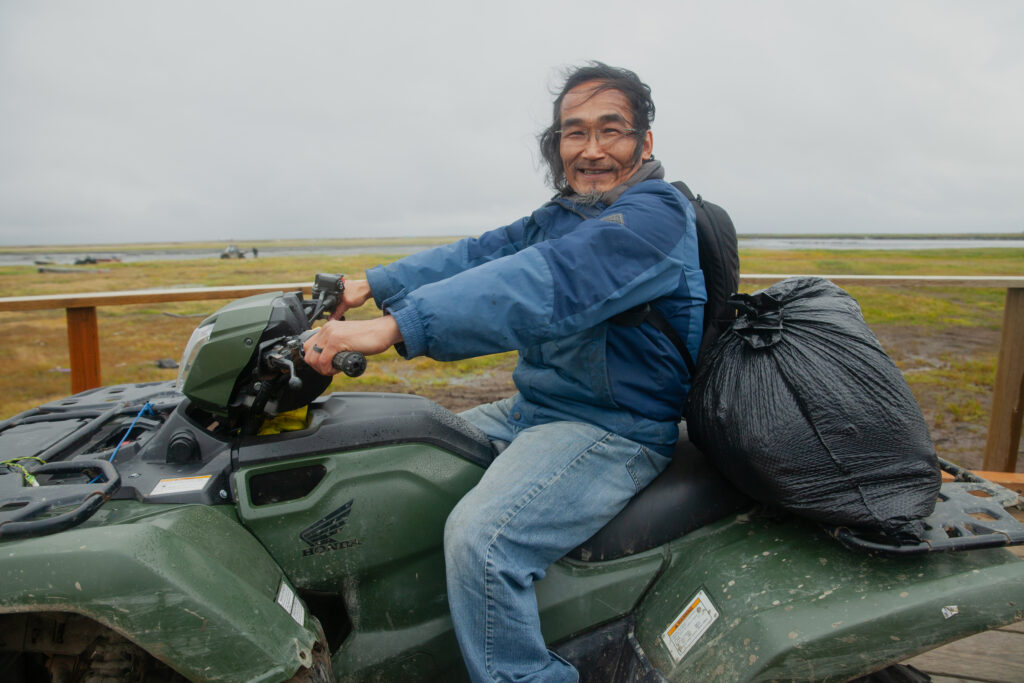
The villagers who have returned have little to survive on as Kwigillingok prepares for its second winter since the disaster.
The state of Alaska has already committed $75 million to recovery efforts, and that tally will keep growing as damages and needs increase. FEMA has approved and largely paid out $62.9 million in individual and housing assistance to more than 2,500 households, plus an additional $40.2 million in other assistance, including for subsistence equipment, such as fishing gear, fish racks and smokehouses. FEMA has also set aside almost $9 million for the State of Alaska to repair or replace critical infrastructure and facilities in all impacted communities. The U.S. Department of Housing and Urban Development, the Bureau of Indian Affairs, the Small Business Administration and several dozen other federal, state, and Alaska Native agencies are also involved in the recovery.
But these amounts fall far short of what the region needs to recover from the unprecedented storm.
The state of Alaska asked FEMA for additional Permanent Housing Construction funding and was denied after eight months of waiting. This funding program, authorized in the Stafford Act for Insular States and Territories, may provide home repair and construction services where regular streams of FEMA funding are not feasible or cost-effective.
Bryan Fisher, the Director of the Alaska Division of Homeland Security and Emergency Management, told Inside Climate News that the denial brought more delays on the ground. The state is preparing to appeal that decision, he said.
Fisher estimates the total cost of post-Halong recovery will surpass $400 million, requiring greater buy-in from the federal government.
Darell John, one of the few residents who stayed in the village after the evacuation, is frustrated with the speed and quality of the recovery, and the poor communication between the village and the agencies intended to help it.
According to John, the DOT’s crews didn’t consult the community or its leadership about which houses to repair and fixed several homes that were uninhabited before the storm. Some exterior sewage flush tanks—called “dog houses”—are improperly affixed to the houses and will not survive subarctic winters, he said.
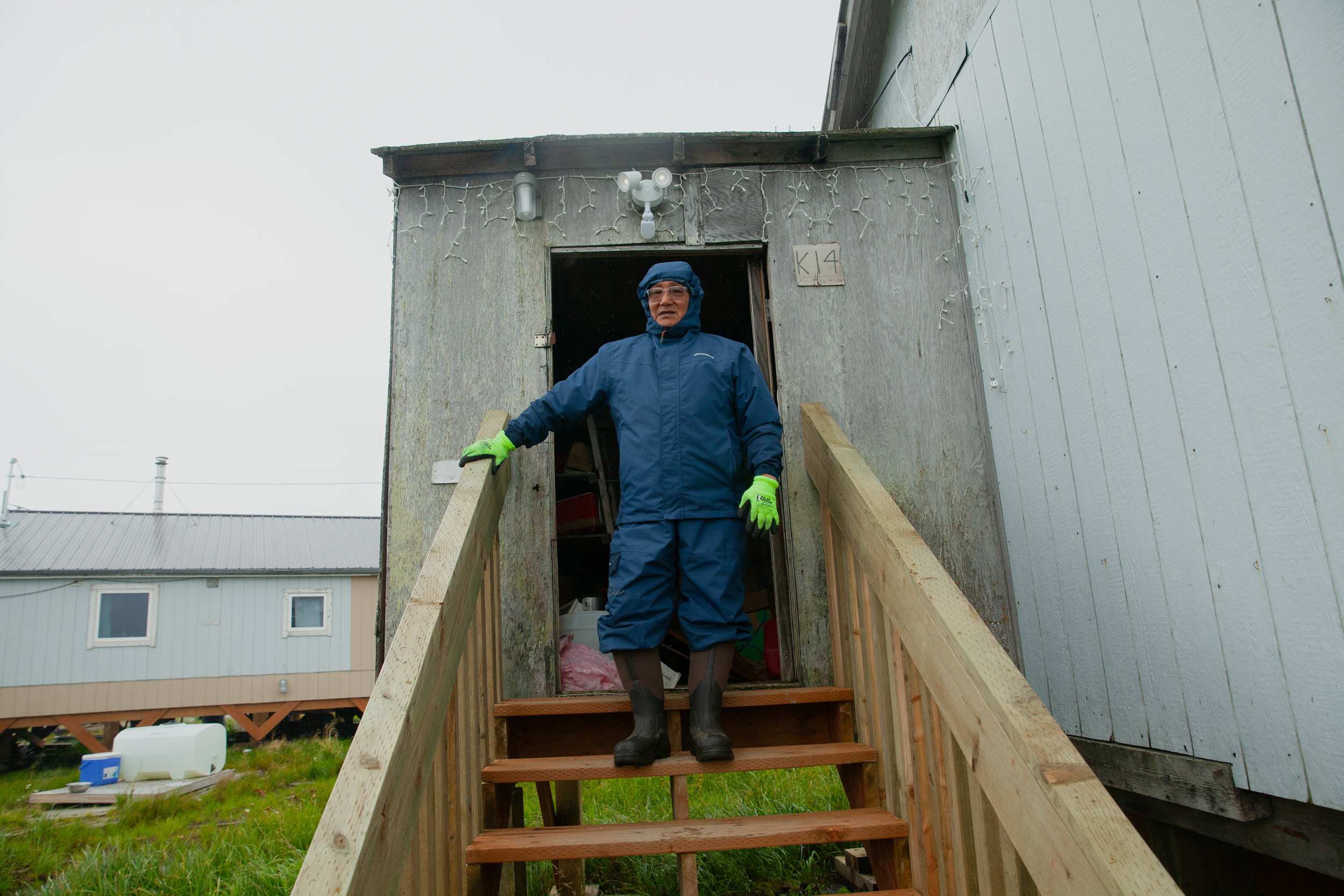
John described the work as a “bad investment.” “They could have invested in getting portable homes that community members can come back to and stay [in] until the new site is ready,” he said.
Martin, the tribal resilience coordinator, agreed, adding that repairing drenched, mold-infested houses was ill-advised and “a big waste of money.”
“We are not happy,” said the tribal administrator Gavin Phillip about the contractors. “They still got work to do.”
But the Department of Transportation and Public Facilities coordinated its work with the communities and their leaders, the department’s spokesperson said.
This story is funded by readers like you.
Our nonprofit newsroom provides award-winning climate coverage free of charge and advertising. We rely on donations from readers like you to keep going. Please donate now to support our work.
Donate Now“DOT&PF has worked directly with tribal leadership in both communities and with the Association of Village Council Presidents (AVCP) to identify and prioritize homes for emergency stabilization,” wrote the spokesperson in response to an Inside Climate News request for clarification. “To evaluate the reports that work occurred on the wrong homes, we would need the specific properties and circumstances involved.”
Kwigillingok residents say that with permafrost gone, the land sunken and prone to flooding and severe erosion, the village is not safe long term.
“The village of Kwigillingok needs to relocate to a safer, higher ground, further away from the ocean,” said John.
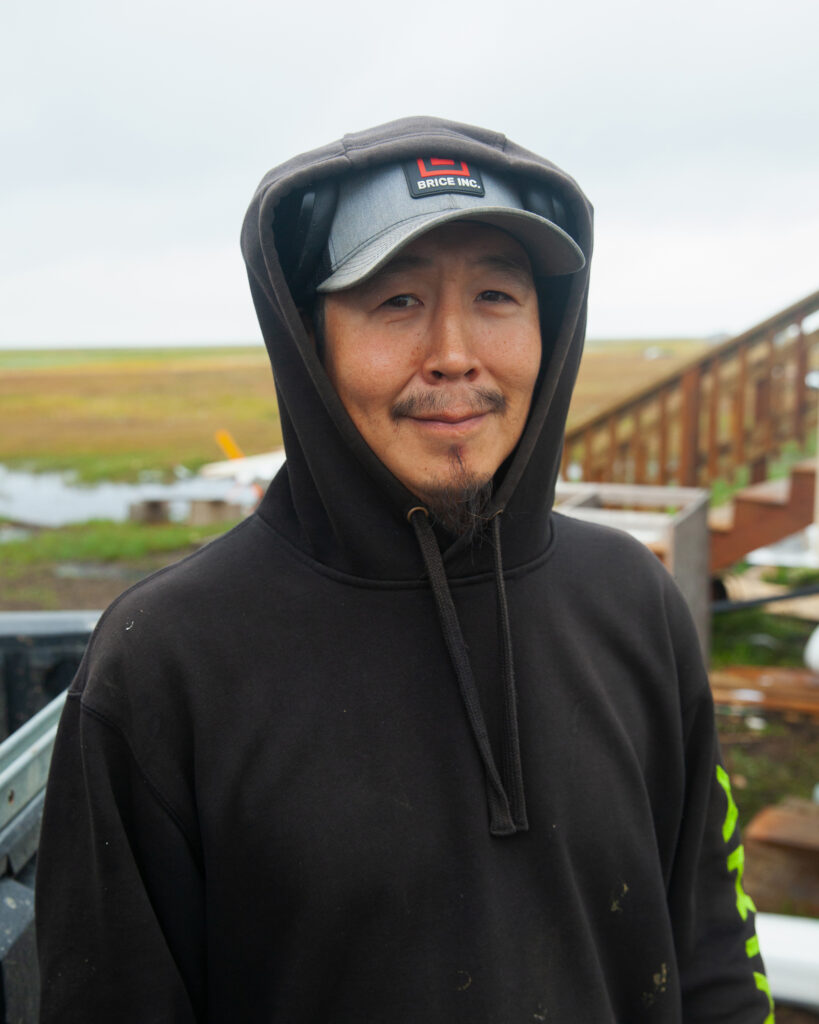
Kwigillingok and Kipnuk are in a particularly tough spot, and not just because of their proximity to the Bering Sea. Residents need federal and state help to relocate, yet are desperate to have their former sites rebuilt enough for residents to return temporarily until their new village is developed. Tribal leaders, state officials and researchers warn that long-term city life may harm the families and Native Alaskan culture of the evacuees still in Bethel and Anchorage.
Relocating the villages would be an uphill battle, Fisher said, because neither federal nor state disaster recovery programs are designed to move communities.
“There is not enough money […] from FEMA to relocate a community. It’s just not what their programs are meant for,” he said. “There is no federal program that really addresses relocation or managed retreat.”
The goal of his state agency is to repair the villages enough to buy communities time to complete relocation planning.
A source working for a federal agency involved in disaster recovery told Inside Climate News, that despite the rigidity of federal programs, there may be a path forward. For example, a community can apply for FEMA Public Assistance funding under an Alternate Project to rebuild damaged infrastructure and facilities in a new location.
Alternate Project funds can only provide limited relocation assistance, cautioned postdisaster recovery policy expert Andrew Rumbach, a senior fellow in the Housing and Communities Division at the Urban Institute.
“You can direct those funds to help support the rebuilding somewhere else,” Rumbach said, but “it’s only for moving very specific infrastructure pieces. Everything else around the relocation has to be done separately, and that raises all kinds of problems.”
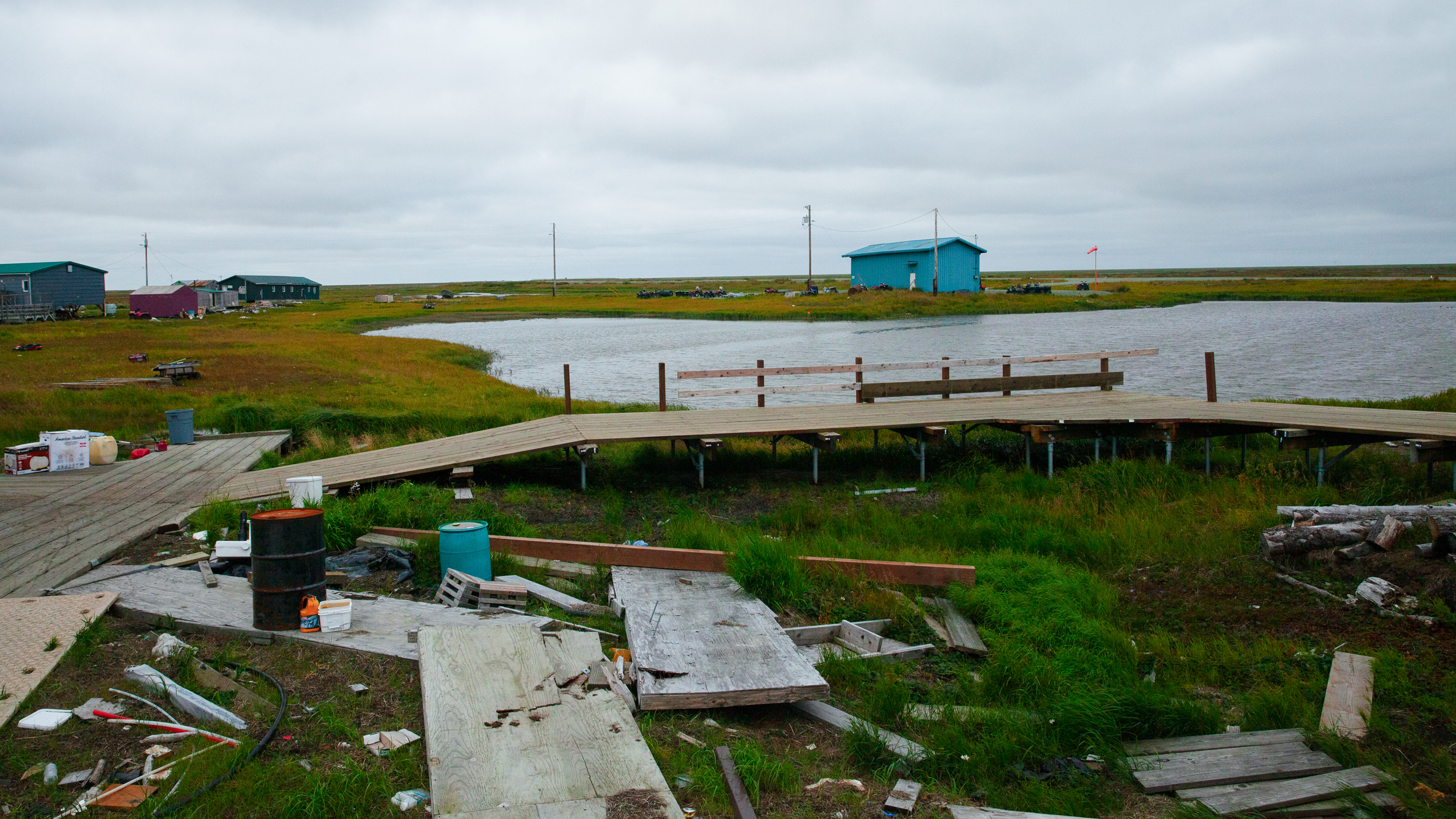
Although FEMA cannot fund entire village resettlements, its Public Assistance program can fund the relocation of specific damaged facilities. With the Alternate Project route, a community may use restoration funds for a damaged facility for a different project that better serves its needs.
“Disaster recovery is a collaborative effort that is locally led, state managed and federally supported,” a FEMA spokesperson wrote to Inside Climate News. “Every community’s path to recovery is unique, and local leaders are best positioned to determine the timeline and decisions for their residents, including the status of local evacuation or ‘No Return Home’ orders. FEMA will continue to stand alongside our state and local partners to provide the flexibility and resources available under federal law to build back stronger and safer.”
The challenges aren’t deterring Martin and others in Kwigillingok’s tribal leadership who hope to move the village.
A licensed drone pilot and GIS mapper, Martin meticulously gathers data from above and around the village as evidence for grant applications that may help with the resettlement. She also wants evacuees still far from Kwigillingok to know she is fully committed to getting her community out of harm’s way.
“We’re still working. We’re just a phone call away. We’re a Zoom meeting away,” Martin said.
Reporting for this story was supported by the Fund for Investigative Journalism.
About This Story
Perhaps you noticed: This story, like all the news we publish, is free to read. That’s because Inside Climate News is a 501c3 nonprofit organization. We do not charge a subscription fee, lock our news behind a paywall, or clutter our website with ads. We make our news on climate and the environment freely available to you and anyone who wants it.
That’s not all. We also share our news for free with scores of other media organizations around the country. Many of them can’t afford to do environmental journalism of their own. We’ve built bureaus from coast to coast to report local stories, collaborate with local newsrooms and co-publish articles so that this vital work is shared as widely as possible.
Two of us launched ICN in 2007. Six years later we earned a Pulitzer Prize for National Reporting, and now we run the oldest and largest dedicated climate newsroom in the nation. We tell the story in all its complexity. We hold polluters accountable. We expose environmental injustice. We debunk misinformation. We scrutinize solutions and inspire action.
Donations from readers like you fund every aspect of what we do. If you don’t already, will you support our ongoing work, our reporting on the biggest crisis facing our planet, and help us reach even more readers in more places?
Please take a moment to make a tax-deductible donation. Every one of them makes a difference.
Thank you,