
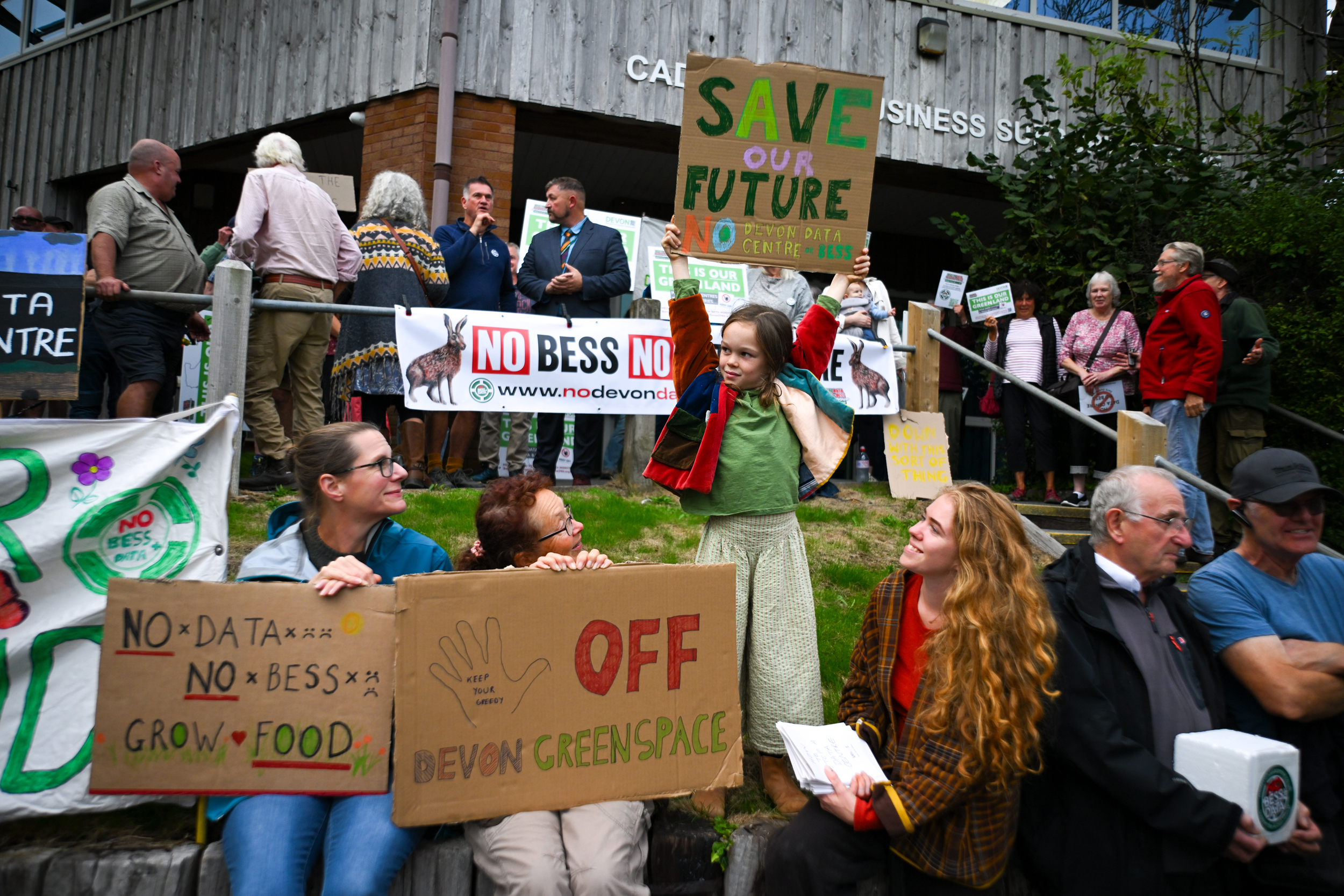


Ambily Banerjee moved to Langley, in the borough of Slough, 18 miles west of London, for its good schools and green spaces.
Now, Microsoft is planning to move in nearby. Its proposed 140-megawatt data center, the company promises, will be a good neighbor.
It is the latest operator drawn to Slough for its fast fiber-optic connections to London and to major transatlantic subsea cables farther west, as well as its proximity to, but geographic separation from, the capital, offering security should London’s data infrastructure be compromised.
The borough is home to 40-plus data centers, with more in the pipeline, earning it a reputation as Europe’s data-center capital and placing its cluster among the largest in the world.
Recently, residents like Banerjee have begun to push back, questioning not only what the data-center boom has brought to the borough, but what its longer-term costs might be.
“Where is this supposed investment? Slough has not become Silicon Valley,” said Banerjee, a scientist and mother. “Residents shoulder all the risk, while developers sit in their ivory towers.”
Those questions are being asked far beyond Slough, and have increasingly found their way into electoral politics. In the 2026 U.S. midterms, opposition to the facilities helped Democrats make massive gains. Some 56 percent of voters said data centers were a major or crucial factor in their congressional choices, according to polling by The Wall Street Journal, even as the industry poured mammoth sums into defending its interests.
The British government has played a more direct coordinating role in data center development than its U.S. federal counterpart, giving projects greater weight in the planning system, incentivizing development in designated areas and accelerating planning decisions and grid access for developers that demonstrate specific public benefits.
It remains to be seen what electoral consequences the incumbent Labour Party’s approach will carry. The party, characterized as center-left and sharing similarities with the Democrats, has set out to triple its data center capacity by the decade’s end, dismissing the Green Party’s proposed moratorium, warning it “would be a disaster for jobs and national security.”
Its efforts to manage the industry’s expansion have also been accompanied by significant gaps in oversight, particularly around energy demand and environmental issues.
An investigation by Spotlight on Corruption, a nonprofit that advocates for government transparency, found that ministers and officials had consulted 137 businesses on data center expansion, but just two community groups and no environmental organizations. Government estimates of the sector’s energy demands have also differed by as much as tenfold, according to The Guardian.
Public confidence in how that expansion will be managed appears fragile. With 84 percent of Britons believing the government will “prioritize its partnerships with large technology companies over the public interest” when regulating AI, and sizable campaigns opposing development emerging in Devon, Scotland, Essex and London’s Brick Lane, the prospect of opposition derailing the industry’s expansion is not merely theoretical.
A report by the Sovereign AI Leadership (SAIL) taskforce, drawing on input from the likes of Nvidia, Microsoft and Cisco, warned that organized local opposition in the U.S. has already halted fully permitted data center projects, prompting moratoriums even in states otherwise supportive of development.
“Britain has a window—we think of roughly 12 months—to build a compact that earns public consent before that pattern takes hold,” the report said.
Britain’s Plan to Power the AI Boom
The U.K. is the third-largest AI market in the world after the U.S. and China. There are around 500 data centers across the U.K. Up to the end of 2025, around 90 percent were sited in England, with London alone accounting for nearly two-thirds of the national total.
The question of who benefits and who bears the cost took on new significance in Chancellor John Healey’s Oct. 28 budget, which announced a new British Data Centre Covenant. For developers, it set out a clear offer: faster, more certain access to grid connection in exchange for a “credible” commitment that they will not over-reserve, but will use and pay for the grid capacity they request, invest in clean power and net zero, deliver benefits for local residents and businesses and adhere to the “highest” environmental standards.
This comes amid Britain’s growing grid-connectivity problems, which have left some developers waiting years for access, and others forced to abandon projects altogether.
The connections queue, historically operated on a first-come, first-served basis, has become choked with speculative or unviable projects. Microsoft recently withdrew from a flagship data center project in Essex, developed by British startup Nscale, after it became clear it would not be connected to the grid until the 2030s.
There are 315 hyperscale data center projects awaiting access to the national grid, accounting for 73 GW of Britain’s demand connection queue, according to Ofgem, the U.K.’s energy regulator. Peak national demand in 2025 was around 45 GW.
The government is also trying to steer where facilities are built through its AI Growth Zones program, designed to attract investment to locations where data centers can more readily access power. In the past year, five such zones have been announced.
At times, regions generate more power than the grid can transmit elsewhere. Scotland, for example, can produce more wind power than its transmission lines can carry south. The government argues that locating data centers in such areas would allow them to absorb this otherwise-wasted generation, reducing costs across the electricity system. To encourage developers, the government is proposing discounts on electricity costs, expected to take effect in April 2027. For a 500-megawatt facility, the savings could reach around $32 per megawatt-hour in Scotland, $21 in Cumbria and $18 in the North East.
For local authorities, there is also a financial incentive: those in England’s AI Growth Zones will be able to retain 100 percent of additional tax revenue generated by new data center development for the next 25 years, providing a long-term source of funding for community projects and public services.
The government also plans to help developers build their own power infrastructure and give ministers greater control, taking planning decisions on “nationally significant” data center projects away from local councils.
The push reflects the scale of the market Britain hopes to capture. BloombergNEF expects installed data center capacity across Europe, the Middle East and Africa to reach 53.1 gigawatts by 2035, up from an estimated 19.2 gigawatts in the first quarter of 2026. The U.K. is projected to account for around 14.5 percent of that.
“There’s a massive gulf between where communities are at, and the discussions they want about data centers, and where political leaders are currently at. Local councils are opposing data centers, and elected councilors are turning down proposals, only for them to be approved at the national level,” said Owen Espley, campaigns manager at the environmental charity Global Action Plan.
On the government’s new Data Centre Covenant, he said: “Local groups don’t think it’s worth very much. They want the normal rules to apply to data centers.”
The Environmental Costs of Britain’s AI Ambitions
A recent investigation by Spotlight on Corruption found that environmental groups had been largely excluded from the government’s policymaking on data centers and AI Growth Zones.
It found that, alongside the lack of environmental organizations involved in shaping policy, the government’s Sustainability Working Group, established in January 2025 to examine the environmental impacts of artificial intelligence and related technology policy, met just once in its first 17 months, with no environmental organizations represented.
This story is funded by readers like you.
Our nonprofit newsroom provides award-winning climate coverage free of charge and advertising. We rely on donations from readers like you to keep going. Please donate now to support our work.
Donate NowDonald Campbell, director of advocacy at Foxglove, a U.K. nonprofit that campaigns for greater accountability from technology companies and governments, argued that the government lacked the assessments and information needed to make decisions in the environment’s interest.
“There is a serious information gap around the impacts of hyperscale facilities, particularly how much energy they will consume, and the resulting emissions,” he said.
The government itself has struggled to establish the emissions data centers will produce. In April 2026, it revised its estimate to as much as 123 million tons of carbon dioxide over the next decade, or 12.3 million tons annually, up from a previous estimate of no more than 142,000 tons in a single year, according to The Guardian.
Research by Foxglove, using developers’ own estimates, found that the 10 largest data centers planned in the U.K. in 2025 could produce as much annual carbon emissions as the combined savings from Britain’s transition to electric vehicles.
Meanwhile, a new report commissioned by Global Action Plan and written by economist James Meadway estimates that data center expansion could add $3.48 billion to household electricity bills across the U.K. by 2035. The projection is based on the National Energy System Operator’s highest-growth scenario for the industry.
The increase could push 77,000 more households across England, Wales and Scotland into fuel poverty.
“With communities across the world questioning the value of these digital behemoths, the figures in this report raise urgent questions for government about their wholehearted support for U.S. Big Tech’s data center frenzy,” said Meadway.
A Growing, Diverse Backlash
Resistance to data center development is bringing people together across Britain. Concerns range from electricity costs and water shortages to noise, potential health impacts and anxieties about artificial intelligence. Campaign groups are increasingly sharing information, coordinating their efforts and looking to one another for examples of successful challenges. The campaigns vary in their demands, from tighter planning controls and greater transparency to outright moratoriums.
In the U.K., an additional concern is that the country could bear the environmental costs of an industry whose economic rewards flow disproportionately to the U.S.
“People are protesting because the U.K. is on course to build digital infrastructure that uses up our power and water while the economic benefits are extracted to Silicon Valley,” said Taylor Gese, U.K. lead at the Future of Tech Institute, a European think tank focused on technology policy and digital sovereignty, in a statement. “We cannot let U.S. hyperscalers monopolize this market—we must find ways to ensure the economic value from this infrastructure stays in the U.K.”
The race to build AI infrastructure is global; its consequences are local. Britain’s new Data Centre Covenant is an attempt to bridge that divide. Whether it will be enough to convince communities that they have a stake in the AI boom remains an open question.
About This Story
Perhaps you noticed: This story, like all the news we publish, is free to read. That’s because Inside Climate News is a 501c3 nonprofit organization. We do not charge a subscription fee, lock our news behind a paywall, or clutter our website with ads. We make our news on climate and the environment freely available to you and anyone who wants it.
That’s not all. We also share our news for free with scores of other media organizations around the country. Many of them can’t afford to do environmental journalism of their own. We’ve built bureaus from coast to coast to report local stories, collaborate with local newsrooms and co-publish articles so that this vital work is shared as widely as possible.
Two of us launched ICN in 2007. Six years later we earned a Pulitzer Prize for National Reporting, and now we run the oldest and largest dedicated climate newsroom in the nation. We tell the story in all its complexity. We hold polluters accountable. We expose environmental injustice. We debunk misinformation. We scrutinize solutions and inspire action.
Donations from readers like you fund every aspect of what we do. If you don’t already, will you support our ongoing work, our reporting on the biggest crisis facing our planet, and help us reach even more readers in more places?
Please take a moment to make a tax-deductible donation. Every one of them makes a difference.
Thank you,

Leana Carbonez
Fellow
Leana Carbonez is a fellow at Inside Climate News. Born in London, she studied History at the University of Cambridge, and recently graduated from Columbia’s Graduate School of Journalism. She is interested in exploring Americans’ manifold understandings of ‘nature’ and the ways these perceptions are shaped by, and serve, political ideologies. She hopes to continue pursuing investigative projects while working across a variety of journalistic mediums.