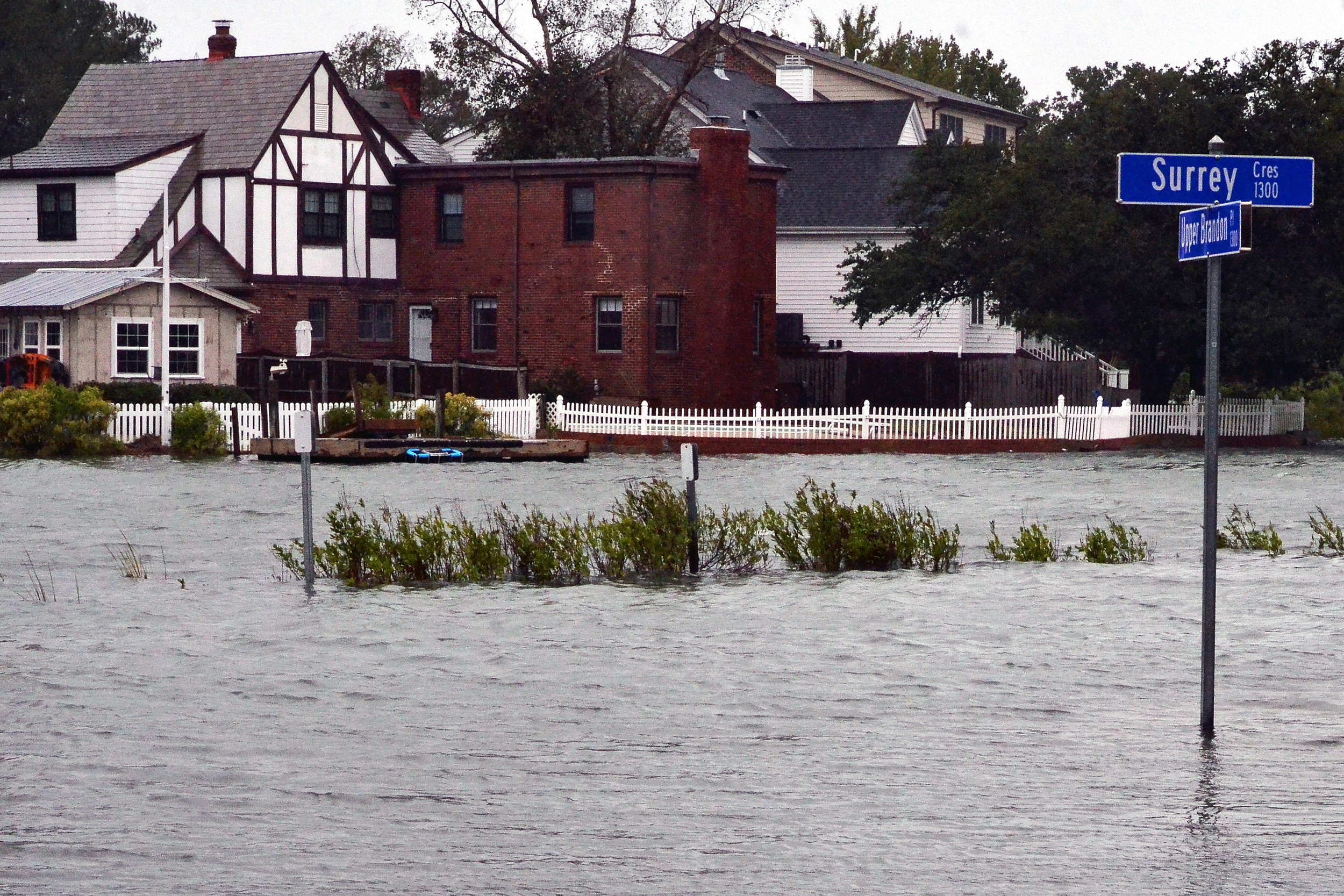


Norfolk, Virginia, has remained the poster child for cities facing land subsidence and flooding in the country, struggling through an onslaught of storm surges and blue-sky flooding that become more frequent every year. But while a major storm has not hit the city directly since Hurricane Matthew in 2016, it is one of the many places looking to congressional funding as a way to fund preemptive land management projects to protect their shorelines and their residents.
Although city leaders currently plan to rehabilitate their shorelines every seven years, the Norfolk Coastal Storm Risk Management program is now suggesting they change that schedule to every five years due to erosion trends.
Kyle Spencer, the City of Norfolk’s chief resiliency officer, said state and local officials are aiming to secure more funding each year because the restoration projects are increasing in price and taking longer to complete every cycle. This year, the City of Norfolk, part of the larger Hampton Roads region, filed an appropriations request with U.S. Sen. Tim Kaine for their scheduled beach renourishment project.
“Hampton Roads is home to roughly two million Virginians, over a dozen shipyards, the world’s largest naval base, and one of the largest ports on the East Coast—and it’s on the frontlines of rising sea level challenges caused by climate change,” Kaine said in a statement to Inside Climate News. “Virginians’ safety and prosperity and America’s national security depend on leaders and stakeholders on the local, state, and federal levels working together on large-scale resilience projects to protect this critical area.”
Hurricane Matthew, the last major storm to directly impact the Hampton Roads region, cost the state about $60.2 million and damaged at least 2,000 homes, according to a 2019 report.
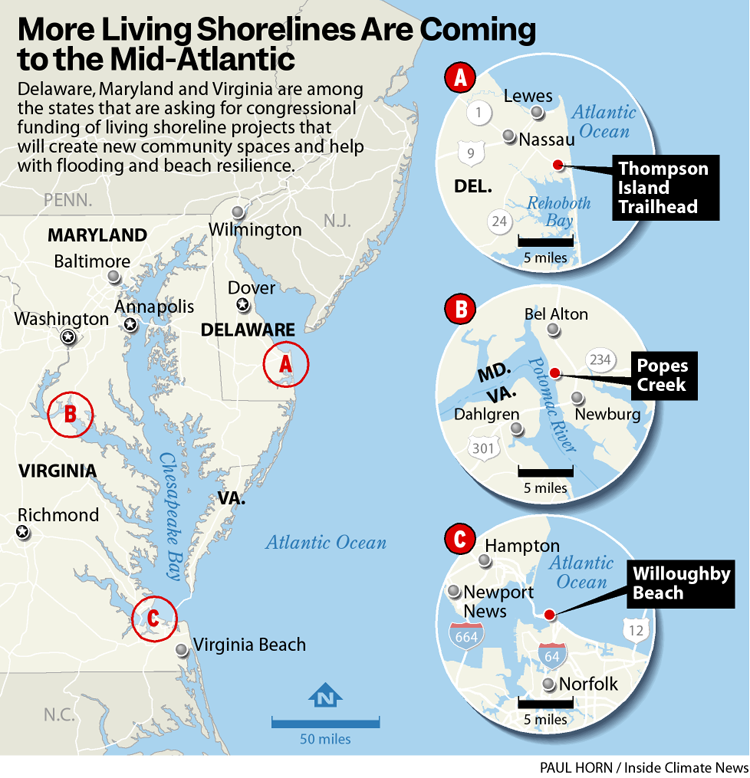
Right now, Virginia and several of its neighbors are looking to invest federal dollars in living shoreline development.
A living shoreline is a method of shoreline stabilization using natural materials like plants, sand and even oyster shells to protect against erosion. Outside of acting as a barrier against storm surges by storing floodwater, living shorelines can also attract wildlife to the area, filter runoff and act as carbon sinks, according to the National Oceanic and Atmospheric Administration (NOAA).
Living shorelines are not designed to replace stormwater management systems and will not be able to prevent flooding on their own, but they “can at least store some of that stormwater, coastal flooding water, coming in and slow some of the waves coming in,” said Donna Bilkovic, the assistant director of the Center for Coastal Resources Management at the College of William & Mary and the Virginia Institute of Marine Science. The institute has been designing living shoreline projects in Virginia for nearly four decades.
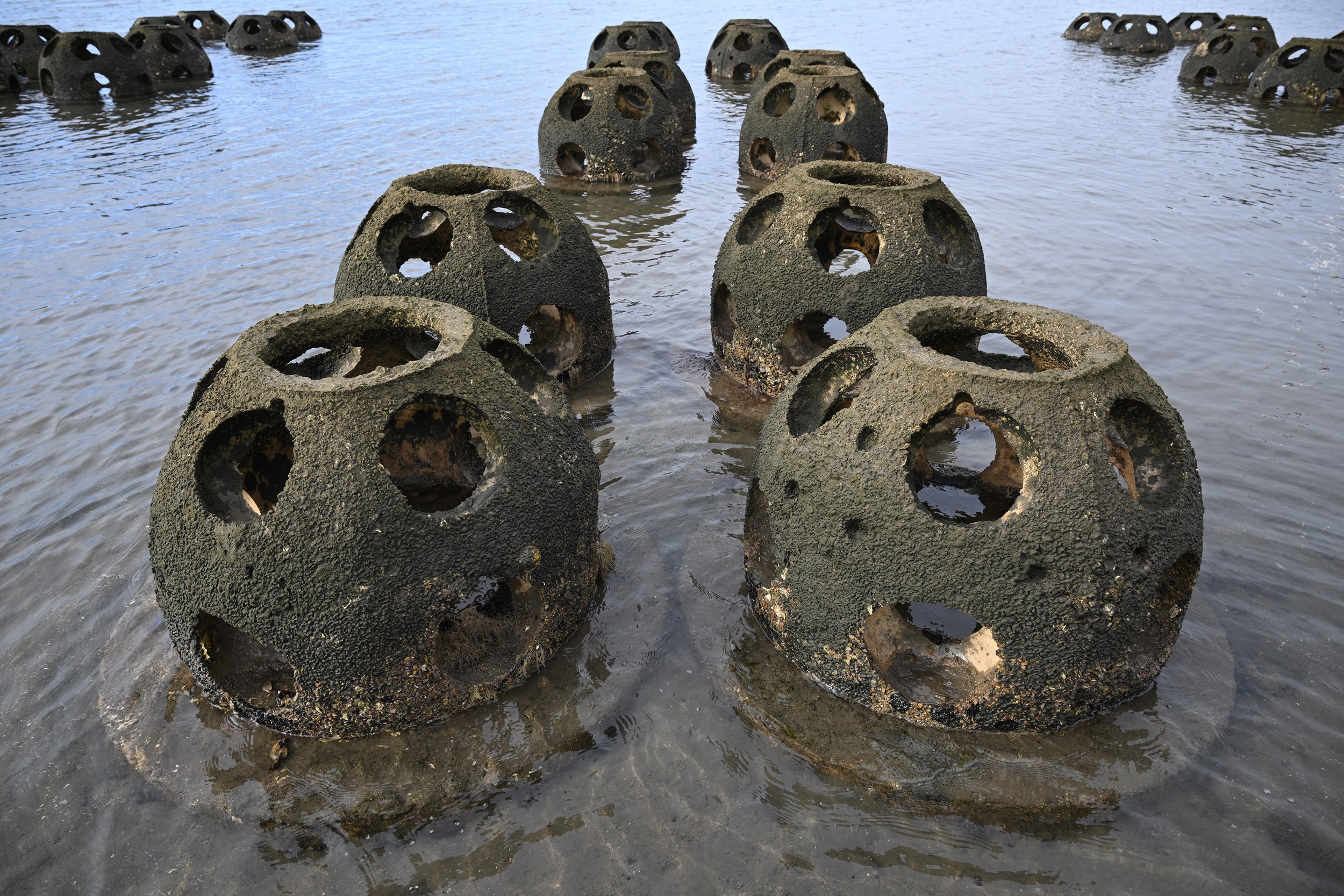
In an April report, Bilkovic explained that living shorelines’ resilience against storms comes from their ability to grow and recover over time, allowing them to produce ecological benefits for longer periods of time than a hard shoreline would. She told Inside Climate News that her surveys have reflected skepticism among coastal communities of the need for resilience projects if a major storm has not hit them in years, but her data suggests this method can protect shorelines similarly to hard structures like seawalls and bulkheads.
Delaware and Maryland also have appropriations requests out for living shoreline projects.
These shoreline projects are not just a partisan issue, Christophe Tulou, the executive director at the Delaware Center for the Inland Bays, said.
“This is a challenge that those of us in blue and red states are facing equally with the same amount of passion, especially in coastal areas,” Tulou said.
As well as protecting land important to the state’s Indigenous communities, Tulou said that he hopes the technology and collaboration the state’s shoreline project is utilizing can set an example for other states to follow suit.
The Thompson Island Nature Preserve, where the living shoreline will be built, is managed by Delaware’s Division of Parks and Recreation, and while Tulou said he appreciates the state’s support, his group needs federal dollars to get it done. The Delaware Center for Inland Bays asked for Sens. Christopher Coons and Lisa Blunt Rochester’s support to obtain appropriation funds. Both Coons and Blunt Rochester asked for $4,192,000 but are targeting different committees, with Coons’ request going to the Interior, Environment, and Related Agencies and Blunt-Rochester submitting hers to the Commerce, Justice, Science, and Related Agencies.
Tulou said that while the Delaware Center for the Inland Bays has been wanting to do this project for years, the need becomes more pressing as time passes. “Erosion didn’t stop while we were deliberating what’s best to do about [flooding],” he said. And like Virginia, living shorelines are a solution they’re excited about.
“There’s just a broad swath of interest and a lot of interest in living shorelines, which is more natural and, we would argue, a more sustainable way of providing those kinds of protections compared to these hard structures of the past,” Tulou said.
This story is funded by readers like you.
Our nonprofit newsroom provides award-winning climate coverage free of charge and advertising. We rely on donations from readers like you to keep going. Please donate now to support our work.
Donate NowWhile Maryland officials do note the cost of these solutions can be steep, they believe the ecological benefits and long-term results outweigh those concerns in one living shoreline project in Maryland.
Sen. Christopher Van Hollen told Inside Climate News that it is important to invest federal dollars in projects like the one at Popes Creek Waterfront Park in Charles County to protect their communities.
“These improvements can increase public access to waterfront spaces while keeping Maryland communities safe, supporting economic development, and ensuring generations to come can continue to enjoy our state treasures,” Van Hollen said in a statement.
The senator submitted an appropriations request for $3,244,000 to construct a living shoreline at Popes Creek. Sara Coleman, a conservation resilience planner with the Maryland Department of Natural Resources (DNR), said it would be the county’s first public access to the beach. The project received funding to design the shoreline in 2024 through the Bipartisan Infrastructure Law under the Biden administration. Now, after waiting on permits, they are ready to construct it with federal dollars behind them.
The plan was developed in tandem with a community task force and the DNR. Coleman hopes that they can squash any doubt around the shoreline’s development by using it as an educational tool.
“There can be a lot of misconceptions around living shorelines because people think that a hardened bulkhead is going to be stronger and protect better over time, but a lot of the data shows that living shorelines have the ability to kind of adapt as time goes on, plants will continue to grow, sediment will accrete, and these types of nature-based solutions can actually provide more protection,” said Coleman.
Maryland Gov. Wes Moore signed into law the Supporting Inclusive Community Adaptation Act in April to alleviate upfront costs, which the DNR says “will increase access to more property owners, and establish a framework for partial loan forgiveness.”
Coleman said that while this state support can be helpful, they still depend on grants from federal programs or appropriation requests to finally start constructing the shoreline. Even so, privately owned shorelines in Maryland and Virginia will continue to be an obstacle, she said.
Norfolk is treating its living shoreline projects as just one layer of protection against the threat of worsening storms. Spencer said they are developing them in tandem with hard shoreline initiatives and flood walls when they approach their beach renourishment projects.
What Spencer is really preparing Norfolk for is blue-sky flooding, he said. While storm surges are becoming more frequent, he said that minor flooding when they least expect has caused the most annoyance for community members and is slowly deteriorating infrastructure as water seeps in through floors and pipes. By getting ahead of even the most unlikely floods—through private shoreline protection programs and encouraging community members to use the city’s collaboration with Waze to track floods—Spencer said they can start to create a holistic system.
“It’s not always just about the big storms and the major events, it’s all these things that work together as a system,” Spencer said.
In addition to the Willoughby Beach Nourishment project that stretches more than seven miles along Chesapeake Bay, the City of Norfolk is using multiple state-funded grants to support their living shoreline development, like a federally funded coastal protection and stormwater project in low-income neighborhoods.
Spencer said most people living in Norfolk are supportive of shoreline stabilization projects, but some have expressed reservations because the results cannot always be immediately seen. Spencer said the city is aiming to prioritize shorter-term projects to engage community and federal support wherever they can.
Bilkovic attributes the rise in popularity in living shorelines to decades of research supporting this development in the right settings, and more states, like Maryland, adapting policies to mandate shoreline management projects. While she said living shorelines can incur more upfront costs associated with mobilizing the sand and rock necessary to undertake the project, she said they are typically designed to last longer than traditional bulkheads.
These projects are not one-size-fits-all, Bilkovic said. While a style of living shoreline might work in one area, she said it is important to manage expectations and work with the limitations each shoreline is going to present.
“It’s important to remember that these are not appropriate everywhere, but where we can put them, we do get this great additional co-benefit,” Bilkovic said. “We gain all these ecosystems.”
About This Story
Perhaps you noticed: This story, like all the news we publish, is free to read. That’s because Inside Climate News is a 501c3 nonprofit organization. We do not charge a subscription fee, lock our news behind a paywall, or clutter our website with ads. We make our news on climate and the environment freely available to you and anyone who wants it.
That’s not all. We also share our news for free with scores of other media organizations around the country. Many of them can’t afford to do environmental journalism of their own. We’ve built bureaus from coast to coast to report local stories, collaborate with local newsrooms and co-publish articles so that this vital work is shared as widely as possible.
Two of us launched ICN in 2007. Six years later we earned a Pulitzer Prize for National Reporting, and now we run the oldest and largest dedicated climate newsroom in the nation. We tell the story in all its complexity. We hold polluters accountable. We expose environmental injustice. We debunk misinformation. We scrutinize solutions and inspire action.
Donations from readers like you fund every aspect of what we do. If you don’t already, will you support our ongoing work, our reporting on the biggest crisis facing our planet, and help us reach even more readers in more places?
Please take a moment to make a tax-deductible donation. Every one of them makes a difference.
Thank you,

Avril Silva
Fellow
Avril Silva is an award-winning journalist and an Outrider fellow at Inside Climate News. She has experience covering environmental and public health policy and is interested in pursuing investigative political journalism. She is currently pursuing a master’s at NYU’s Science, Health, and Environmental Reporting program. You can find more of her work on the New York Times, CBS News, POLITICO’s E&E News, and more.