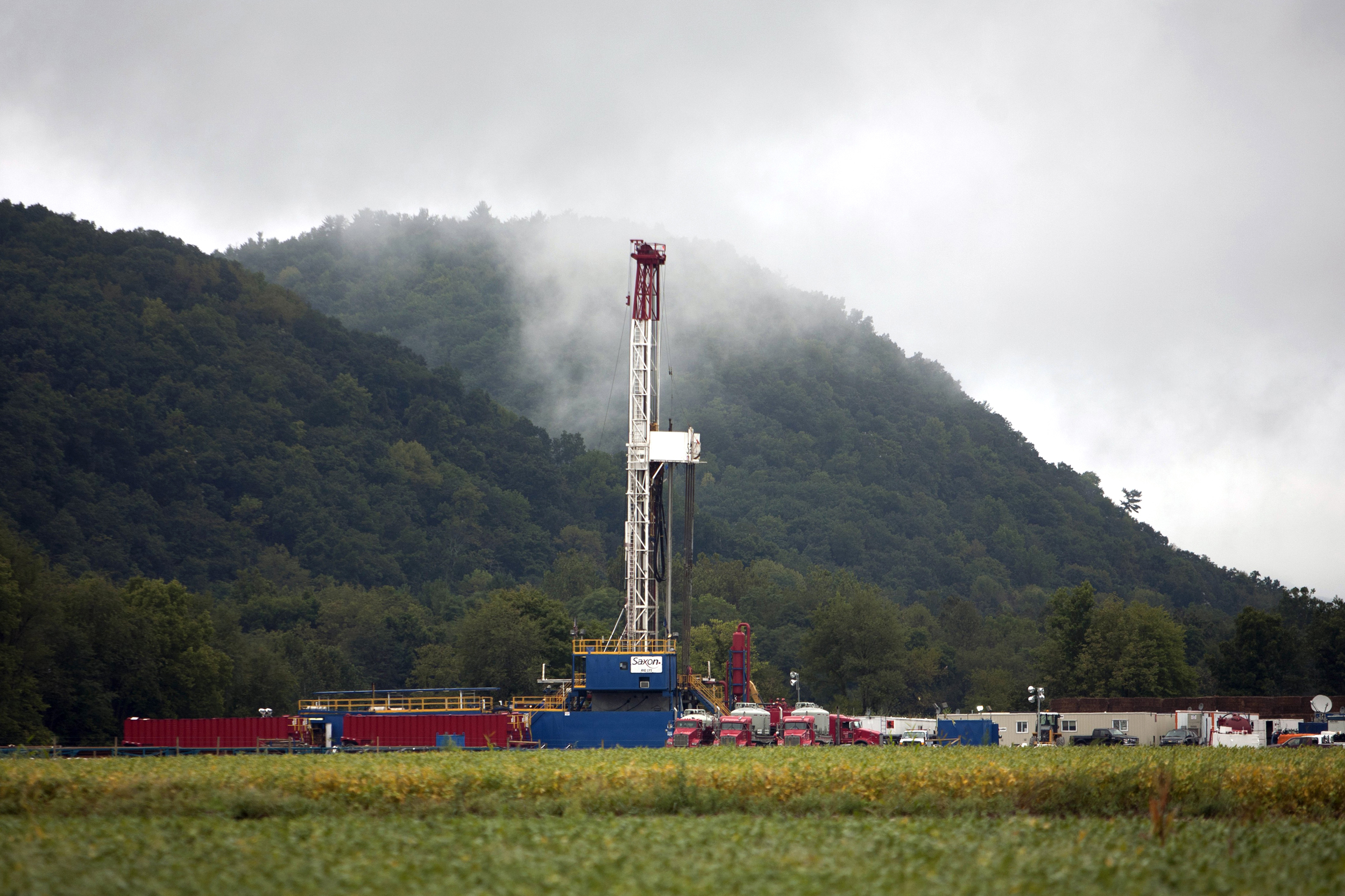


Advocates for an increase in mandated distances between Pennsylvania communities and natural gas infrastructure said their call has become more urgent with an expected surge in fracking to fuel the state’s data center buildout.
The Environmental Integrity Project, Clean Air Council and their allies urged Pennsylvania towns and lawmakers to support a plan to widen most setbacks by more than 2,500 feet to protect public health, which they say is endangered by a current rule allowing energy companies to build well pads, compressor stations and pipelines as close as 500 feet from homes, schools and hospitals.
The request was first made in a petition to the state’s Environmental Quality Board in 2024. In December the board passed it along to the Department of Environmental Protection, which is expected to conclude an analysis of the proposal by year’s end. Meanwhile, natural gas production is expected to increase to help supply electricity to energy-hungry data centers, dozens of which are now planned for Pennsylvania.
“The majority of the data-center buildout will be powered by fracked gas,” said Matt Kelso, manager of data and technology at FracTracker Alliance, a nonprofit that maps, analyzes and shares data on the oil, gas and petrochemical industries, during a webinar on Wednesday. “It will require not just the wells but pipelines, trucking, water usage, injection wells. This will allow the industry to pump the gas from where it is, safely locked in the ground, to the data centers or to the power plants that provide their electricity.”
According to Data Center Proposal Tracker, an independent website, 47 data centers are proposed or in either pre-construction or construction phases in Pennsylvania. Another 21 are on the drawing board and haven’t applied for government approvals yet.
The petition calls on the Department of Environmental Protection to increase the distance between gas infrastructure and homes to at least 1 kilometer (3,281 feet), and to at least 1 mile (5,280 feet) for buildings such as schools or hospitals with “vulnerable” populations. A new rule would also increase the buffer between gas plants and a body of surface water to at least 750 feet.
The American Petroleum Institute of Pennsylvania told the Environmental Quality Board that it “strongly” opposed the plan, saying it would impose onerous restrictions on the industry. The petition exceeds the authority of the panel because changes in well locations cannot be achieved through regulation, said the chapter’s executive director, Stephanie Catarino Wissman, in a December letter to the board.
“The petition’s proposed setbacks would function as a de facto ban on unconventional natural gas development in Pennsylvania by confining operations to extremely limited areas,” she wrote, contending that residents are already protected by “stringent” regulation of natural gas development.
The petition includes 42 peer-reviewed studies showing that people living near gas infrastructure are more likely to get sick, said Lisa Hallowell, an attorney for the Environmental Integrity Project (EIP). One study showed that children living within a mile of a gas well were five to seven times more likely to suffer from lymphoma, a type of blood cancer, than those who had no wells within five miles of their homes, she noted.
Hallowell denied that the proposed rule change would effectively ban fracking. She said it would not relocate existing gas plants and would only apply to new unconventional oil and gas wells.
“Don’t believe the false narrative that protective buffers would ban fracking,” she said.“Requiring increased buffers is well within their capabilities, and will not infringe their abilities to reach the gas they seek to extract.”
This story is funded by readers like you.
Our nonprofit newsroom provides award-winning climate coverage free of charge and advertising. We rely on donations from readers like you to keep going. Please donate now to support our work.
Donate NowThe American Petroleum Institute of Pennsylvania said that extending the current 500-foot setback to 3,281 feet would block production in an area 43 times larger than the current rule, while the area off-limits to gas production would be 112 times larger if the setback area is increased to 5,280 feet for buildings housing vulnerable populations.
“Such subjective and sweeping changes would also impede Pennsylvanians’ ability to responsibly develop their private mineral rights—effectively condemning property without just compensation,” the group’s letter said.
Lisa Graves-Marcucci, a community advocate at EIP, said the proposed setbacks were inspired by a Pennsylvania grand jury report in 2020 that found communities had been harmed by fracking. That report proposed setbacks of at least 2,500 feet.
The report was led by then Attorney General Josh Shapiro, who is now governor. Shapiro, a Democrat, has courted the data center industry by offering to speed permitting on the condition that data centers bring their own power rather than taking it from the grid.
Graves-Marcucci said towns have a legal right under the state’s municipal planning code to increase setback distances above the state minimum of 500 feet. But she wasn’t sure that all local officials were aware of that right and said EIP and other advocates are hoping to educate them.
She urged activists to join a rally at the state capitol in Harrisburg on Oct. 7 to call on lawmakers and the governor to support bigger setbacks.
Cecil Township, in heavily fracked Washington County, increased its minimum setback distance to 2,500 feet in 2024. That prompted a bill by its Republican state senator, Camera Bartolotta, that would reduce or eliminate revenue from the state’s impact fee on fracking allocated to any town that followed its lead.
Activists said Pennsylvania, which produces the second-largest amount of natural gas of any U.S. state after Texas, has attracted many data center proposals because one of the world’s biggest gas fields underlies about two-thirds of the state.
The state’s rich natural resources, starting with oil and coal, have attracted industries that pay little attention to the communities in which they operate, argued Lauren Posey, an advocate with Protect PT, an environmental group in Westmoreland County, east of Pittsburgh.
That southwest Pennsylvania region “has long functioned as an industrial hub for all sorts of industries, and a public health sacrifice zone,” Posey said during Wednesday’s webinar. “Now it’s easy to see this history repeating itself as our region is being targeted for large-scale data center development, in large part because we’re an energy-producing state, and we already have these industries and this infrastructure in place.”
About This Story
Perhaps you noticed: This story, like all the news we publish, is free to read. That’s because Inside Climate News is a 501c3 nonprofit organization. We do not charge a subscription fee, lock our news behind a paywall, or clutter our website with ads. We make our news on climate and the environment freely available to you and anyone who wants it.
That’s not all. We also share our news for free with scores of other media organizations around the country. Many of them can’t afford to do environmental journalism of their own. We’ve built bureaus from coast to coast to report local stories, collaborate with local newsrooms and co-publish articles so that this vital work is shared as widely as possible.
Two of us launched ICN in 2007. Six years later we earned a Pulitzer Prize for National Reporting, and now we run the oldest and largest dedicated climate newsroom in the nation. We tell the story in all its complexity. We hold polluters accountable. We expose environmental injustice. We debunk misinformation. We scrutinize solutions and inspire action.
Donations from readers like you fund every aspect of what we do. If you don’t already, will you support our ongoing work, our reporting on the biggest crisis facing our planet, and help us reach even more readers in more places?
Please take a moment to make a tax-deductible donation. Every one of them makes a difference.
Thank you,