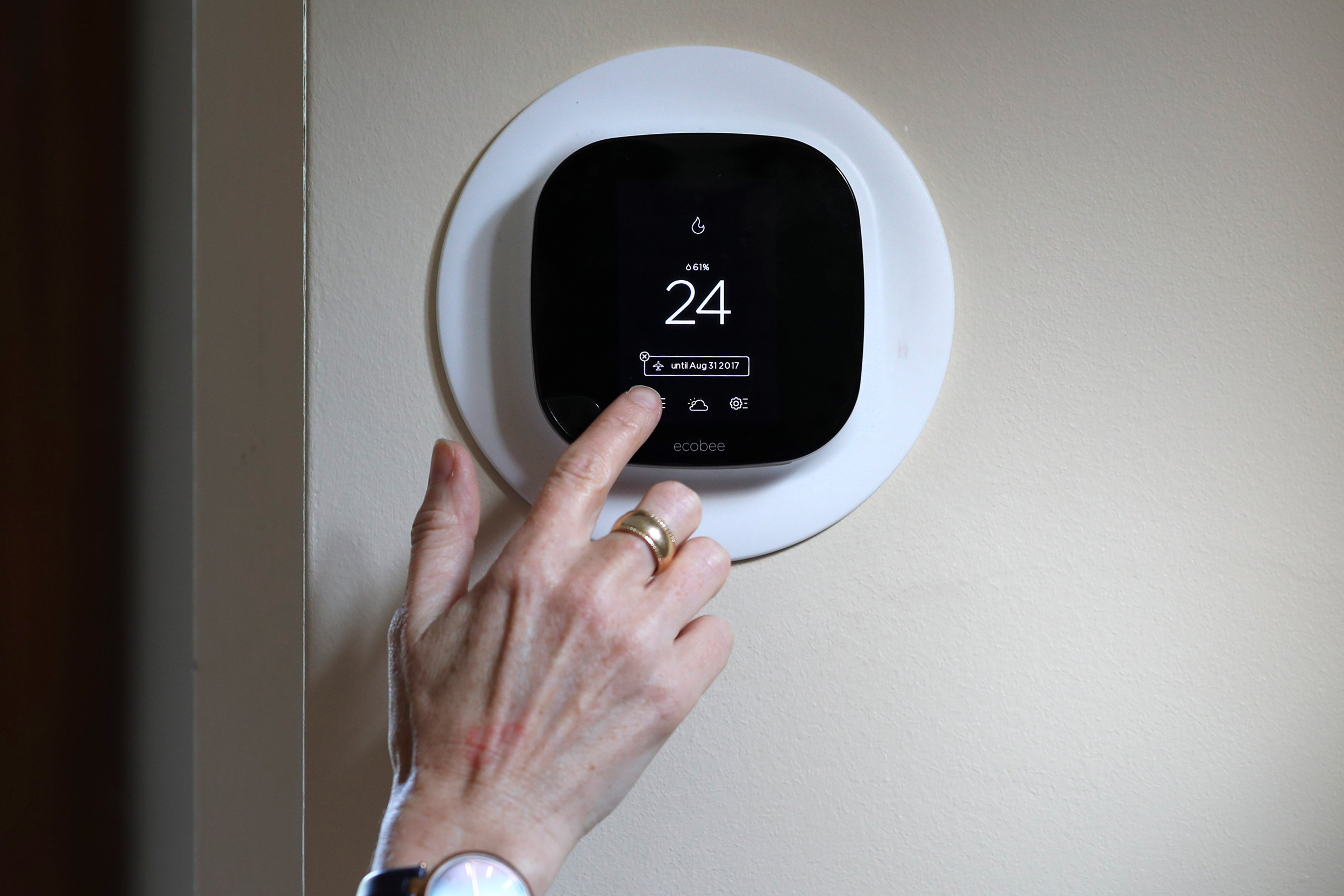


In the near future, the Chicago-area electricity grid will meet demand during a heatwave by remotely turning up thermostats by a degree or two in households that choose to participate.
This adjustment—barely noticeable at the household level—would reduce the region’s electricity demand by the equivalent of several power plants, giving the grid the help it needs.
Illinois regulators approved the program last week, with plans to start operations in May 2027. It could be one of the largest virtual power plants in the country that relies on advanced thermostats. It’s the kind of thing every metro area should be doing.
Some basics of how the program works:
- ComEd, the utility serving northern Illinois, is overseeing a smart thermostat program in which customers “bring their own device,” meaning companies that sell thermostats compete on price and technology to sell their products and customers get to choose what they want.
- The thermostats can operate in a network as part of a virtual power plant. Households can sign up to receive payment in exchange for allowing an outside controller to adjust the thermostat by 1 to 4 degrees when the grid needs additional power.
- The compensation for signing up would be $30 per household per year, plus additional payment based on the amount of energy savings. That would amount to about $60 per year for most households, according to organizations that helped to design the program.
- Customers receive notification before any adjustment and can choose to manually override it to maintain their desired temperature. So, if you’re hosting a dinner party and don’t want the system changing your house’s temperature, you make a few clicks on a mobile app.
I asked several people for their best estimate on the program’s potential impact in terms of energy savings and smart thermostat market share. The short answer is “it’s too early to say,” because it doesn’t launch until next spring and the enrollment numbers and other variables will change before then, making it difficult to provide an estimate.
But the Illinois Commerce Commission’s docket for the program includes testimony providing some educated guesses. A filing from clean energy organizations estimates that ComEd territory likely has more than 1 million smart thermostats, which, for perspective, is about one-third of the utility’s households. The energy savings from utilizing the thermostats could be about 250 megawatts.
Before we move on, let’s define some terms. A virtual power plant, or VPP, is when a bunch of distributed energy resources—such as rooftop solar, batteries and smart thermostats—work in tandem to send power to the grid or reduce demand on it.
Many of the country’s initial VPPs are battery networks based in homes and businesses. Utilities, grid services companies or others can run them.
If we can get to a point where most home batteries—including EV batteries—and home thermostats are part of a VPP, the opportunity for a cleaner grid is huge. It would reduce the need for some of the dirtiest and most expensive fossil fuel power plants.
A key part of the rollout is public education and acceptance. I scanned the Illinois Commerce Commission docket to see if anyone objected to the smart thermostat program. I can imagine pushback because some consumers don’t want their home’s temperature adjusted by an outside controller, but nobody raised these kinds of concerns.
I asked Tamara Dzubay, senior director for energy at ecobee, a Toronto-based maker of smart thermostats, about public response. Her company was one of many that helped design Illinois’ program.
“Generally, what we’ve seen is when customers can opt out and what’s happening is transparent and easy, there has not been backlash,” she said. ”So we don’t participate in any programs that prevent customers from being able to opt out.”
Other makers of smart thermostats include Google Nest, Honeywell Home and Sensi. The federal government’s Energy Star website has a page for comparing options. The systems cost about $100 to $200, but most customers qualify for utility rebate programs that cover most or all of the cost.
Another important part of the mix is the software companies that manage the thermostat networks. One of them is Renew Home of Oakland, California, which operates in most of the country and primarily works with Google Nest equipment. Will Baker, the company’s director of market development, told me what he sees as important and interesting about what’s happening in Illinois.
“What’s new is this approach to customization,” he said, referring to the many choices customers have about which thermostat to use and whether to participate in the program.
This story is funded by readers like you.
Our nonprofit newsroom provides award-winning climate coverage free of charge and advertising. We rely on donations from readers like you to keep going. Please donate now to support our work.
Donate NowBaker thinks this will attract more participants, which means greater ability to save on electricity. And, if enrollment numbers are high enough, the region will be able to achieve larger energy savings with minimal changes in temperature for each customer.
“We’re expanding the tent,” he said.
So, the shift may be a barely noticeable 1 degree instead of 4 degrees, which is a big difference in a week, like this one, when much of the country is suffering under a heatwave.
Let’s Say It Again: Clean Energy Is Cheapest
The think tank Energy Innovation issued a report this week projecting the costs of building out the U.S. electricity grid with fossil-fuel power plants compared with an approach that leans more on solar, batteries and lower-emission technologies.
The results aren’t surprising to anyone who reads this newsletter. We’ve known for a while that renewables have many cost advantages, in addition to environmental advantages, over coal and natural gas power plants. The report finds that a cleaner approach could reduce costs by about 17 percent by 2030.
“We’re facing affordability challenges across the grid,” said Brendan Pierpont, Energy Innovation’s director of electricity, and a co-author of the report. “The risk is that we react to these things by pouring ratepayer dollars and public dollars into a riskier, more expensive system.”
One of the key points is that solar, batteries and other non-fossil technologies also carry lower financial risks. Prices for fossil fuels are much more volatile, to the point that system planners don’t know what they’re signing up for if they plan to burn gas for decades.
I’m highlighting the report because it provides a straightforward explanation of the findings and also has plenty for energy wonks who want to know the assumptions and data that underlie the results.
Other stories about the energy transition to take note of this week:
Duke Energy Is Latest to Take Federal Money to Abandon Offshore Wind Lease: Duke Energy is surrendering a lease that would have allowed it to build up to 1.6 gigawatts of offshore wind in the Carolina Long Bay area, the latest energy company to accept the Trump administration’s offer to walk away from offshore wind projects, as Diana DiGangi reports for Utility Dive. Duke, the North Carolina-based utility, said it will receive a partial reimbursement of the $155 million it paid for the lease in 2022. Several state governments are suing the Trump administration, arguing that it’s illegal to offer these kinds of deals to get companies to surrender their leases.
Private Equity Firm Buys Major Renewables Developer: KKR, the global investment firm, is paying $4.2 billion to acquire the North American power assets of EDF Power Solutions, which includes solar, wind and battery energy storage projects, as Ryan Kennedy reports for PV Magazine. EDF’s North American operations are subsidiaries of EDF Group, a utility company based in France. This continues a trend of consolidation in the power sector amid rising electricity demand.
U.S. Government Bans Polestar Cars, Leaving Owners to Wonder What’s Next: The U.S. government has said the EV company Polestar cannot sell new models in this country starting with the 2027 model year because of a ban on Chinese-linked vehicle technologies. The ban has ripple effects for consumers, including questions about who will provide service for the vehicles already on the road, as Nora Eckert reports for Reuters. Polestar’s majority owner is Geely, a large automaker based in China that makes some of its models at a plant in South Carolina. The U.S. ban caught many in the industry by surprise, and so far it doesn’t apply to Volvo, another Geely-owned brand that makes and sells cars in the United States. Polestar has said it will continue to service vehicles through its 32 existing centers, which are at Volvo dealerships.
Inside Clean Energy is ICN’s weekly bulletin of news and analysis about the energy transition. Send news tips and questions to [email protected].
About This Story
Perhaps you noticed: This story, like all the news we publish, is free to read. That’s because Inside Climate News is a 501c3 nonprofit organization. We do not charge a subscription fee, lock our news behind a paywall, or clutter our website with ads. We make our news on climate and the environment freely available to you and anyone who wants it.
That’s not all. We also share our news for free with scores of other media organizations around the country. Many of them can’t afford to do environmental journalism of their own. We’ve built bureaus from coast to coast to report local stories, collaborate with local newsrooms and co-publish articles so that this vital work is shared as widely as possible.
Two of us launched ICN in 2007. Six years later we earned a Pulitzer Prize for National Reporting, and now we run the oldest and largest dedicated climate newsroom in the nation. We tell the story in all its complexity. We hold polluters accountable. We expose environmental injustice. We debunk misinformation. We scrutinize solutions and inspire action.
Donations from readers like you fund every aspect of what we do. If you don’t already, will you support our ongoing work, our reporting on the biggest crisis facing our planet, and help us reach even more readers in more places?
Please take a moment to make a tax-deductible donation. Every one of them makes a difference.
Thank you,

Dan Gearino
Reporter, Clean Energy
Dan Gearino covers the business and policy of renewable energy and utilities, often with an emphasis on the midwestern United States. He is the main author of ICN’s Inside Clean Energy newsletter. He came to ICN in 2018 after a nine-year tenure at The Columbus Dispatch, where he covered the business of energy. Before that, he covered politics and business in Iowa and in New Hampshire. He grew up in Warren County, Iowa, just south of Des Moines, and lives in Columbus, Ohio.