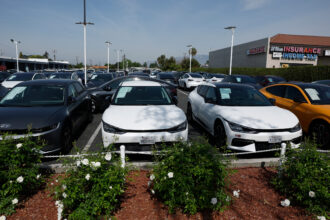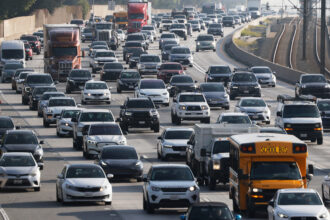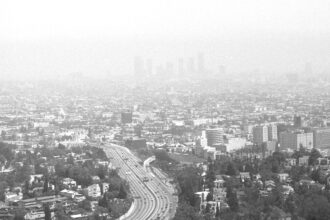


A federal judge has temporarily blocked the Environmental Protection Agency from challenging California’s longstanding authority to set vehicle pollution standards stricter than federal requirements.
The legal dispute stems from a decision announced in June by EPA administrator Lee Zeldin, who said the agency had determined that four of California’s Clean Air Act preemption waivers were actually “rules” subject to congressional approval under the Congressional Review Act. For decades, the waivers have allowed the state to adopt its own vehicle emissions standards and attack its smog problem—with ripple effects across the country.
The EPA has granted California more than 100 waivers since the Clean Air Act was enacted more than 60 years ago, none of which had previously been considered as rules. Zeldin has argued that previous administrations erred by failing to submit the waivers for congressional review.
California Attorney General Rob Bonta, Gov. Gavin Newsom and the California Air Resources Board filed a lawsuit in the U.S. District Court for the District of Columbia in late June challenging the reclassification of the waivers.
Shortly after the lawsuit was filed, the EPA reclassified two more preemption waivers, which set emissions standards for boats.
On Wednesday, Judge Beryl A. Howell granted the state’s request for a preliminary injunction, blocking further EPA action until the lawsuit can be decided. Howell ordered the agency to “restore the status quo” as it existed before its June announcement reclassifying the waivers.
“EPA’s action in reclassifying prior waiver orders, one of which was issued over fifteen years ago, to now treat those waivers as ‘rules’ is a slippery slope in the use of the [Congressional Review Act],” Howell wrote in her decision. “Such gamesmanship may seem like a clever policy move, but undermines honest compliance with the law, which is what Americans should expect from executive branch agencies.”
As the only state to have adopted new motor vehicle emissions standards before the Clean Air Act of 1963, California is permitted to seek a waiver of federal preemption that otherwise prohibits states from imposing their own standards.
The state has used this special authority to apply for and receive preemption waivers from the EPA since the law’s enactment. Other states may adopt emissions standards identical to those for which California receives a waiver but cannot enforce unique standards.
Bonta, California’s attorney general, celebrated the injunction decision in a press release late Wednesday. “Today’s decision is a key victory that rebuffs President Trump’s prior efforts. Federal emission standards should be a baseline to protect our future, not a ceiling to limit it,” he said.
“Such gamesmanship may seem like a clever policy move, but undermines honest compliance with the law, which is what Americans should expect from executive branch agencies.”
— Judge Beryl A. Howell
Both Democratic and Republican administrations have previously upheld California’s authority to set state emission standards, “but this administration thinks it can roll back the clock and sow chaos even while our lawsuit plays out in court,” Bonta said.
The EPA said that it is “considering immediate appeal options.”
The ruling has brought relief to climate and public health advocates, many of whom saw the EPA waiver reclassification as a thinly veiled attack on clean air protections.
“Everyone can breathe easier knowing that California’s strong clean car and truck standards are winning against the other side’s dirty dealings,” said David Pettit, a senior attorney at the Center for Biological Diversity’s Climate Law Institute, in a press release.
This is the second lawsuit that California has filed against the EPA since President Donald Trump returned to office over the reclassification of Clean Air Act waivers as rules that require congressional approval.
During Trump’s second term, his administration has aggressively targeted California’s authority to set state standards. On his first day back in office, Trump signed an executive order to eliminate “state emissions waivers that function to limit sales of gasoline-powered automobiles.”
In February 2025, the EPA sent Congress three California waivers, reclassified as rules needing approval, including one requiring all passenger vehicles sold in the state be zero-emission by 2035 and one mandating a growing percentage of zero-emission trucks. The Republican-held Congress passed resolutions of disapproval for all three.
California responded by filing a lawsuit that argued that the resolutions are unlawful. That case is being heard in the U.S. District Court for the Northern District of California and has not been decided.
This story was updated September 3, 2026 to include comment from the EPA.
About This Story
Perhaps you noticed: This story, like all the news we publish, is free to read. That’s because Inside Climate News is a 501c3 nonprofit organization. We do not charge a subscription fee, lock our news behind a paywall, or clutter our website with ads. We make our news on climate and the environment freely available to you and anyone who wants it.
That’s not all. We also share our news for free with scores of other media organizations around the country. Many of them can’t afford to do environmental journalism of their own. We’ve built bureaus from coast to coast to report local stories, collaborate with local newsrooms and co-publish articles so that this vital work is shared as widely as possible.
Two of us launched ICN in 2007. Six years later we earned a Pulitzer Prize for National Reporting, and now we run the oldest and largest dedicated climate newsroom in the nation. We tell the story in all its complexity. We hold polluters accountable. We expose environmental injustice. We debunk misinformation. We scrutinize solutions and inspire action.
Donations from readers like you fund every aspect of what we do. If you don’t already, will you support our ongoing work, our reporting on the biggest crisis facing our planet, and help us reach even more readers in more places?
Please take a moment to make a tax-deductible donation. Every one of them makes a difference.
Thank you,

Anika Jane Beamer
Reporter, Iowa
Anika Jane Beamer covers the environment and climate change in Iowa, with a particular focus on water, soil and CAFOs. A lifelong Midwesterner, she writes about changing ecosystems from one of the most transformed landscapes on the continent. She holds a master’s degree in science writing from the Massachusetts Institute of Technology as well as a bachelor’s degree in biology and Spanish from Grinnell College. She is a former Outrider Fellow at Inside Climate News and was named a Taylor-Blakeslee Graduate Fellow by the Council for the Advancement of Science Writing.