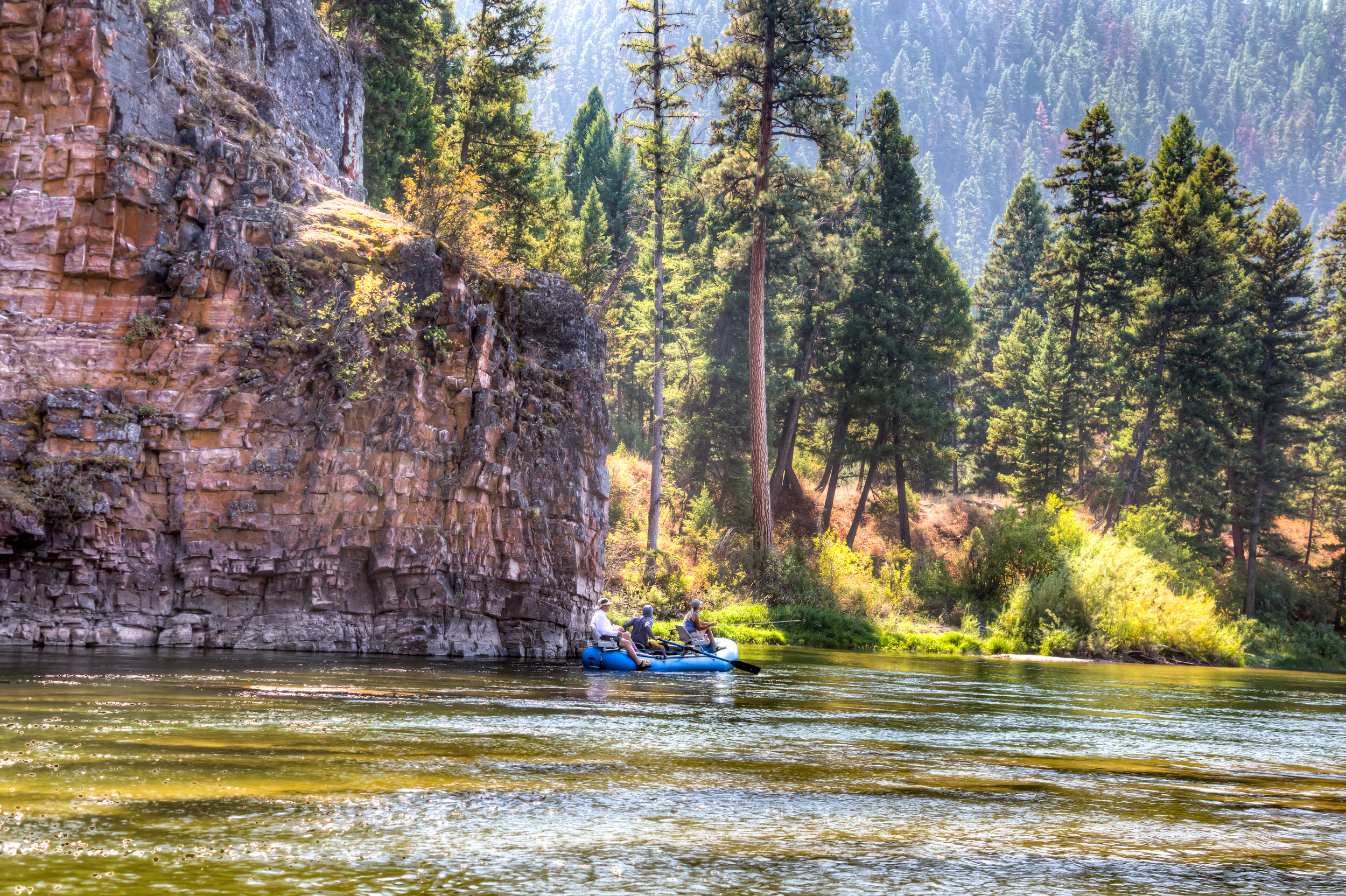


More than half a century after one of Montana’s most destructive mining disasters poisoned the upper Blackfoot River, a new gold exploration project near the river’s headwaters is sparking concerns about whether its decades of environmental recovery could be at risk.
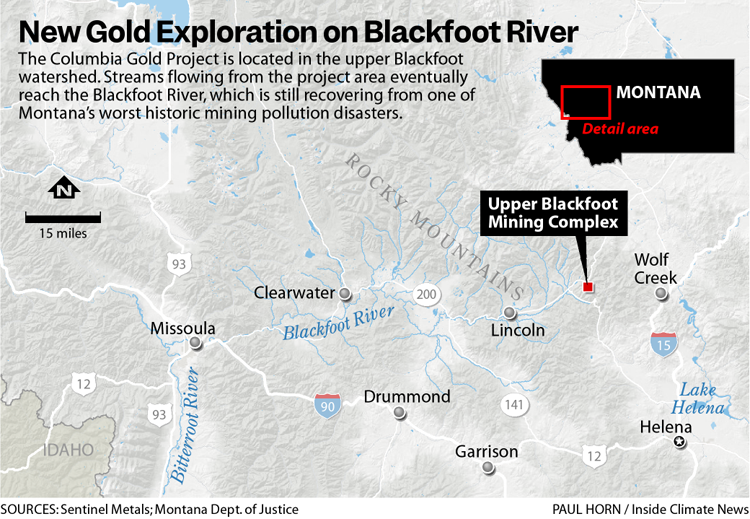
Last month, the Montana Department of Environmental Quality (DEQ) approved an amended exploration license for Australia-based Sentinel Metals to conduct additional drilling at its Columbia Gold Project, located near Lincoln in western Montana. The approval allows the company, which does business in Montana as Great Plains Mining LLC, to drill up to 21 exploratory holes, some reaching depths of 2,300 feet, in a mountainous area with streams that eventually flow into the Blackfoot River.
The decision comes after more than 8,700 public comments were submitted during the state’s environmental review process, which ended in April, reflecting widespread public interest in a watershed that has become both a symbol of ecological recovery and a cornerstone of Montana’s outdoor recreation economy.
Conservation groups and local residents cite widespread opposition to the project.
“We can’t let this happen!” wrote Laurie Lane, a Missoula resident, on the Montana Trout Unlimited Facebook page. “This river is sacred to many and home to the threatened bull trout.”
On June 26, the Montana Environmental Information Center and the Clark Fork Coalition sued the Montana Department of Environmental Quality, alleging the agency failed to provide requested public records in time for meaningful public participation before approving additional exploration at the Columbia Gold Project. The groups argue that the delay prevented them from fully evaluating the proposal during the public comment period and are asking the court to invalidate both the environmental assessment and the exploration permit. Gold mining is one of the most destructive mining activities in the world, the plaintiffs said, causing long-term environmental degradation, significant water contamination from toxics and severe health issues for workers and nearby communities.
DEQ has not publicly responded to the lawsuit.
For many conservation groups, the approval isn’t just a routine exploration permit, but the latest chapter in a long-running conflict between mineral development and the protection of one of the American West’s most celebrated rivers.
“The Blackfoot is an internationally recognized restoration success story,” Montana Trout Unlimited said in a public statement following the state’s decision, noting that the river inspired a famed novella by Norman Maclean that was turned into a Robert Redford-directed movie starring Brad Pitt. “The River of ‘A River Runs Through It’ is too precious to risk with a gold mine in its headwaters.”
The advocacy group wrote on Facebook that “in spite of thousands of comments in opposition to a potential mine in the upper Blackfoot River, an exploratory permit has been issued. Our position is clear: millions of dollars and countless hours were spent bringing this river back from the devastating effects of earlier mining.”
“These are companies that have a singular interest in using the Blackfoot and its resources for profits that will primarily flow outside of Montana and outside of the U.S.,” David Brooks, executive director of Montana Trout Unlimited, told Field & Stream. “And they’ll leave behind damages to the Blackfoot, its traditional land uses, and a blue-ribbon fishery that the community has spent decades and millions of dollars restoring.”
For Blackfoot advocates, the proposal raises deeper concerns about whether renewed mining activity could threaten decades of restoration in a watershed still carrying the scars of past mining. To many residents and conservation groups, the central question is not simply whether exploratory drilling can be done safely, but whether mineral development should return to the headwaters of one of Montana’s most treasured rivers at all.
A Famed River Rebounds From Calamity
In 1975, the tailings dam at the Mike Horse Mine failed, releasing vast quantities of sediment and heavy metals into tributaries feeding the upper Blackfoot River, according to the Montana Department of Justice. Zinc, cadmium and other contaminants spread downstream, devastating aquatic insect populations that form the foundation of the river’s food web.
The cleanup has lasted decades. Federal and state agencies, nonprofit organizations and local communities have spent more than $100 million restoring damaged stream channels, floodplains and aquatic habitat. A water treatment facility must continue cleaning contaminated mine drainage in perpetuity, showing just how long mining damage can last.
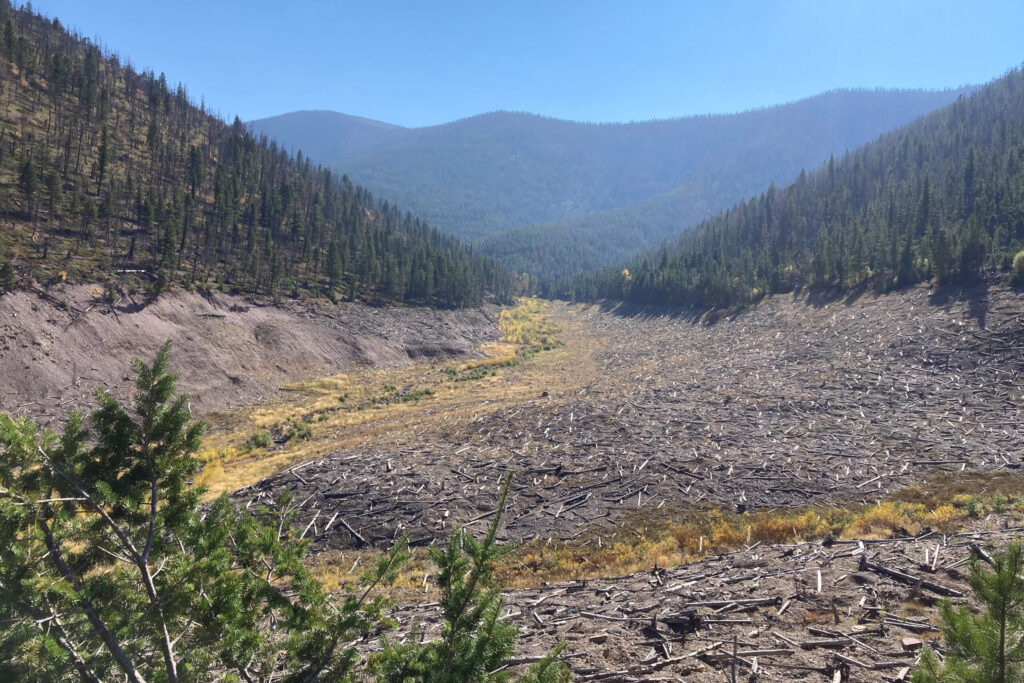
But despite those investments, some fisheries experts and local residents say portions of the watershed have never fully returned to pre-disaster conditions.
That history looms large over the Columbia Gold Project. The project area lies roughly three miles south of Highway 200 on a patchwork of private land surrounded by the Lewis and Clark National Forest. Several historic mining sites including the Columbia, Rover and Seven Up Pete mines are located within the project area, and two nearby streams, Seven Up Pete Creek and Hogum Creek, eventually flow into the Blackfoot River.
Conservation organizations argue that the location alone warrants a more comprehensive review.
The Clark Fork Coalition, Montana Environmental Information Center, Montana Wildlife Federation, American Rivers and the Montana chapter of Backcountry Hunters & Anglers submitted extensive comments during the review process, arguing that DEQ should prepare a full environmental impact statement rather than relying on the less stringent and detailed environmental assessment of 24 pages that it relied on for its approval of the license.
Their concerns extend beyond the immediate drilling program.
The organizations point to the cumulative effects of decades of exploration activity in the area, including hundreds of previous drill holes. They also argue that regulators failed to adequately analyze potential impacts on groundwater, water quality, fisheries and wildlife habitat.
Particular concern has focused on bull trout, a federally threatened species that depends on cold, clean headwater streams. The upper Blackfoot watershed remains one of the species’ most important strongholds in Montana.
Conservation groups also raised concerns about grizzly bears, Canada lynx and other sensitive wildlife that occupy the largely undeveloped landscape surrounding the project area.
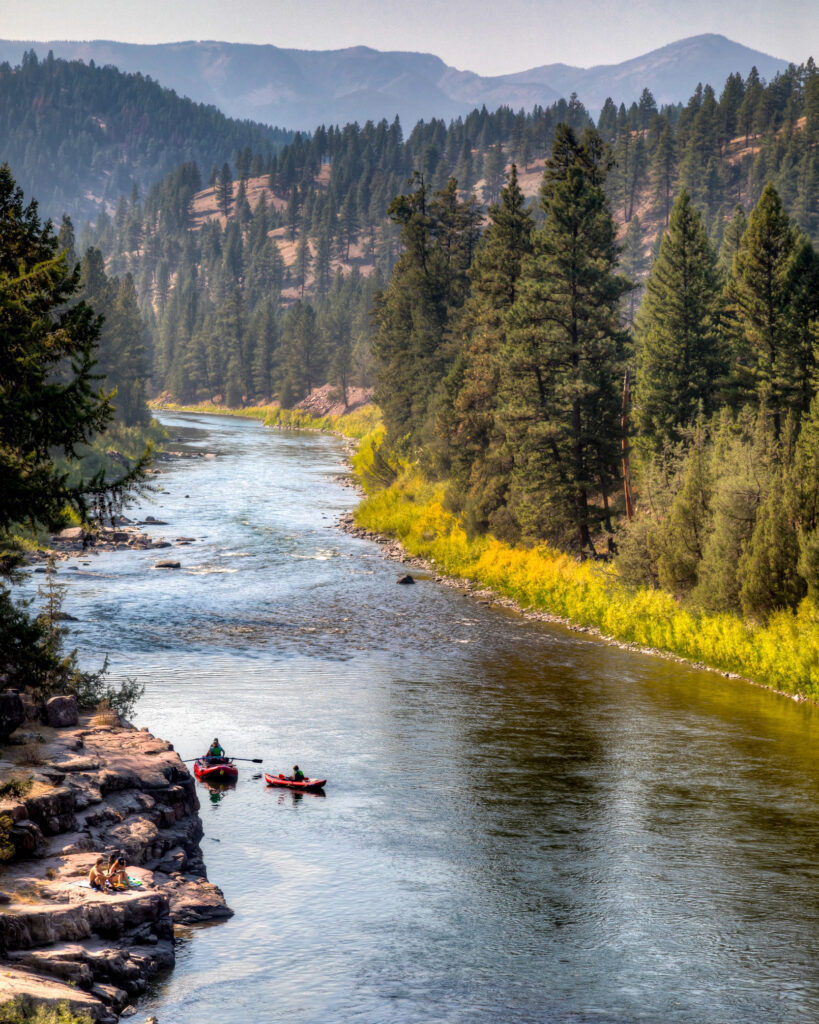
“Like many of our rivers in the Clark Fork watershed, the Blackfoot River bears the scars of legacy mining activity, but after decades of effort, the river and its renowned fishery are on the mend,” Andrew Gorder, policy and legal director of the Clark Fork Coalition, told Inside Climate News. “Sufficient water supplies and high water quality are crucial to supporting the agricultural and recreational economies that support the Blackfoot Valley. The Montana Department of Environmental Quality must weigh the anticipated economic benefits of the Columbia Gold Project against the potential losses to the Blackfoot River.”
In its final Environmental Assessment, however, DEQ concluded that the exploration activities would result in only minor and temporary impacts.
The agency emphasized that the permit authorizes exploration, not mining, and that no new roads would be constructed for the authorized work.
“Approval of the proposed action does not set any precedent that commits DEQ to future actions,” the agency stated in its final assessment. Areas disturbed by the exploration would be reclaimed after drilling, and any future proposal to develop a mine would require an entirely separate permitting process and environmental review.
Increasing Interest
Opponents argue that exploration builds momentum toward development of the mine.
Sentinel Metals itself has described Columbia as its “flagship” project.
The company, which debuted on the Australian Securities Exchange in October 2025, says previous exploration has found the area holds approximately 23.6 million tons of ore containing an estimated 920,000 ounces of gold.
In presentations to investors, company officials described Columbia as a project with significant growth potential. Sentinel CEO Matt Herbert, a former executive with mining giant Rio Tinto, has repeatedly highlighted the project’s potential.
“Located in the heart of one of the world’s most exciting emerging gold districts, the Columbia Project offers a compelling combination of a large existing resource, simple geology and exceptional exploration upside,” Herbert said in a company statement.
Such statements reinforce mine opponents’ concerns that the new exploration will make eventual production difficult to stop.
Conservation groups argue that previous decades of exploration and more than 400 existing drill holes already provide substantial information about the deposit, raising questions about the need for additional drilling and its cumulative environmental impacts. Sentinel Metals, however, says the new drilling program should expand and refine knowledge of the resource, verify previous findings and gather data needed for updated resource estimates and future project evaluations.
The dispute reflects broader questions about mining in the American West.
With mineral prices high and the federal government looking to grow domestic supplies of critical resources, pressure is increasing to develop new extraction projects. Although the federal government does not list gold as a critical mineral in the same category as lithium or copper, rising prices for the metal have renewed industry interest in deposits that may previously have been considered marginal.
At the same time, communities across the region continue grappling with the legacy of abandoned mines, contaminated waterways and costly cleanup efforts.
Those competing realities are particularly evident in the Blackfoot watershed, where restoration efforts have become a source of local pride.
Over the last three decades, conservation groups, landowners, government agencies and local communities have collaborated on projects aimed at improving water quality, restoring habitat and supporting sustainable recreation. The Blackfoot Challenge, a local watershed organization, has often been cited nationally as a model for collaborative conservation.
But some residents worry the future mining could jeopardize those gains.
In DEQ documents, supporters of exploration counter that modern mining regulations are far more stringent than those that existed during the era of the Mike Horse disaster. They argue that current environmental safeguards, monitoring requirements and bonding obligations provide significantly greater protections than in previous decades.
The state required Sentinel Metals to post a reclamation bond of nearly $339,000 before beginning exploration. The company posted the bond in late May, and DEQ accepted it in early June before issuing final approval.
This story is funded by readers like you.
Our nonprofit newsroom provides award-winning climate coverage free of charge and advertising. We rely on donations from readers like you to keep going. Please donate now to support our work.
Donate NowOpponents of the project, however, point to past projects across Montana where environmental impacts were greater than predicted or where reclamation costs exceeded financial assurances.
According to the Montana DEQ environmental assessment, Great Plains Mining requested an amendment to its existing exploration license allowing up to 21 additional drill holes “to conduct additional exploration activities during spring or summer 2026.” If the application is approved, the company hopes to start drilling in about a month, said Krista Lee Evans, Sentinal Metal’s vice president of government and community relations.
“We estimate about four to six weeks, recognizing that at the same time, we have baseline analysis being conducted on wildlife, vegetation, fisheries, all those other pieces,” Evans said.
Evans and Sentinel Metals did not respond to more detailed questions about the project timeline, groundwater protections and the environmental concerns raised by conservation groups.
“More Precious than Gold”
Author John Maclean, son of acclaimed writer Norman Maclean, who helped make the Blackfoot River famous worldwide, said the Blackfoot’s significance exceeds its reputation as a trout stream.
“The Blackfoot has achieved a meaning far beyond what it is as a fishery,” said Maclean, whose book “Home Waters” also chronicles his family’s relationship with the river. “It has come to define what Montana is.”
While he’s waiting for more facts to judge the current exploration proposal, he noted that he and others among the river’s advocates stopped previous proposals to mine gold near its headwaters.
“The Blackfoot is more precious than gold,” he said.
“Like many of our rivers in the Clark Fork watershed, the Blackfoot bears the scars of legacy mining activity, but after decades of effort, the river and its fishery are on the mend,” stated Andrew Gorder, Legal Director of the Clark Fork Coalition, in a press release from the MEIC and the coalition. “Sufficient water supplies and high water quality are crucial to supporting the agricultural and recreational economies that support the Blackfoot Valley. Any new threat to the Blackfoot should be carefully scrutinized by our regulatory agencies, and the public must be fully informed in order to participate in the review process.”
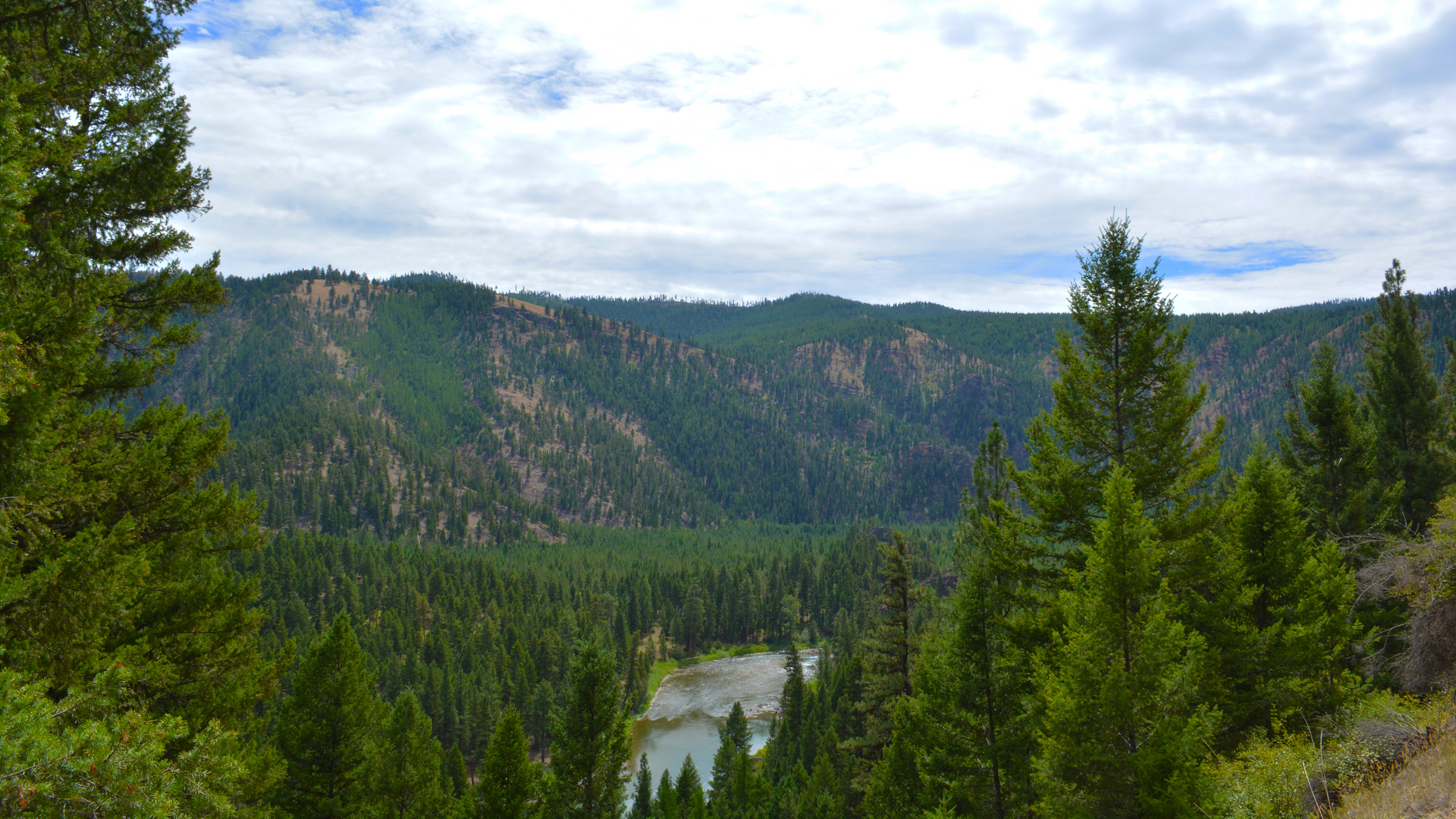
DEQ did not say whether the majority of the 8,736 public comments it received from 1,713 individuals supported or opposed the project. The agency instead reviewed whether comments were substantive, identifying 26 broad themes that were addressed in the final environmental assessment, said Madison McGeffers, a DEQ public information officer. Sentinel’s operating plan and required best management practices would reduce risks to surface water, erosion and spills, according to DEQ, and the project’s small footprint of up to 1.53 acres of surface disturbance on ground previously disturbed in 2016 helped support that agency’s finding that the new exploration would have no significant environmental impact.
DEQ has not received an application from Sentinel Metals for a hard rock mining operating permit, McGeffers said. If the company later proposes a mine, she said, that would require a separate environmental review and could involve additional air, water and state or federal permits.
The project remains in an early exploration stage, according to Sentinel Metals. The company is entering a new phase of mineral exploration focused on transparency, community engagement and environmental stewardship, and is committed to carrying out its work in a manner consistent with Montana values, Evans said.
About This Story
Perhaps you noticed: This story, like all the news we publish, is free to read. That’s because Inside Climate News is a 501c3 nonprofit organization. We do not charge a subscription fee, lock our news behind a paywall, or clutter our website with ads. We make our news on climate and the environment freely available to you and anyone who wants it.
That’s not all. We also share our news for free with scores of other media organizations around the country. Many of them can’t afford to do environmental journalism of their own. We’ve built bureaus from coast to coast to report local stories, collaborate with local newsrooms and co-publish articles so that this vital work is shared as widely as possible.
Two of us launched ICN in 2007. Six years later we earned a Pulitzer Prize for National Reporting, and now we run the oldest and largest dedicated climate newsroom in the nation. We tell the story in all its complexity. We hold polluters accountable. We expose environmental injustice. We debunk misinformation. We scrutinize solutions and inspire action.
Donations from readers like you fund every aspect of what we do. If you don’t already, will you support our ongoing work, our reporting on the biggest crisis facing our planet, and help us reach even more readers in more places?
Please take a moment to make a tax-deductible donation. Every one of them makes a difference.
Thank you,

Mosabber Hossain
Fellow
Mosabber Hossain is an Inside Climate News Fellow and an award-winning climate and environmental investigative journalist from Bangladesh. His reporting focuses on climate change, biodiversity, environmental justice, adaptation and corruption. His work with Reuters and other international outlets has been republished globally, and some of his reporting contributed to discussions featured on the agenda of the World Economic Forum. Mosabber is a graduate student at the University of Montana studying environmental science and natural resource journalism. Previously, he was a fellow with the Institute for Journalism and Natural Resources and Investigative Reporters and Editors. He is a recipient of the South Asian Investigative Journalism Award from the Thomson Foundation and was featured among eight journalists during the organization’s 60th anniversary for the impact of his investigative reporting. Mosabber is also a wildlife and nature photographer whose work has been published internationally.