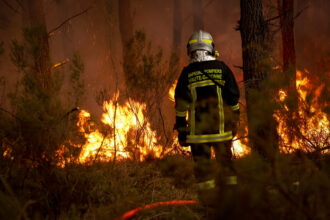


Climate-fueled wildfires could scorch many of the sites that shape America’s cultural identity.
A study published in May found wildfire risk threatens the majority of sites designated by the federal government as historically significant, from centuries-old homes to cherished churches and cemeteries. A separate forward-looking study published last week found worsening climate change could substantially ramp up average potential fire frequency in four of California’s national parks by the end of the century, under a worst-case emissions scenario.
The researchers say this data could help park and site managers better protect these places from flames. However, as experts sound the fire alarms for iconic American sites, the Trump administration is on a mission to remove mentions of climate change from many of these places.
History in the Line of Fire
Managed by the National Park Service, the National Register of Historic Places is the country’s official list of local, state and national landmarks “worthy of preservation,” according to the agency’s website. The inventory includes a sprawling hodgepodge of special sites, from the candy-cane-striped Sapelo Island Lighthouse in Georgia that served as a beacon for mariners about a century ago to the unusual row of eucalyptus trees along a side street road in Carmel Valley, California, planted more than 140 years ago.
However, more than half of the 100,117 places listed in the registry at the time the research was compiled are exposed to measurable wildfire risk, according to the May study. The researchers built a map of this burn risk using a high-resolution fire simulator developed by the U.S. Forest Service, which combines data on factors such as weather, terrain and vegetation that influence wildfire behavior. Here’s the map if you’re curious about the wildfire risk for sites near you.
Much of the highest-risk area is in the Western United States, where anthropogenic climate change doubled burned forest area above natural levels from 1984 to 2015. However, the researchers also identified hotspots in Oklahoma, Arkansas and several states along the southeastern coast.
“One of the things that I think we underappreciate is the threat that wildfire poses to these places that help tie us to the landscape, that help build our sense of place, our identity, our cultural heritage,” Cat Fong, a researcher at the National Center for Ecological Analysis and Synthesis, told me. “We were surprised by the extent of exposure that these places had to wildfire hazard.”
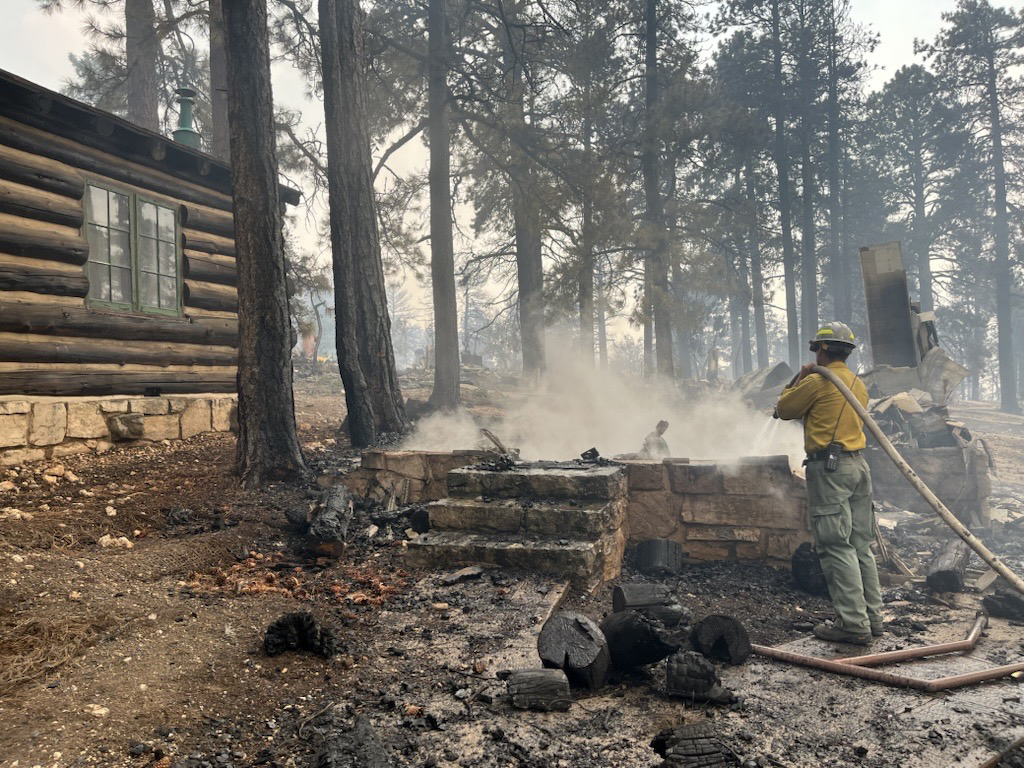
She pointed to the Dragon Bravo Fire that tore through the North Rim of Grand Canyon National Park last year. Not only did the blaze burn nearly 150,000 acres, it also destroyed the historic Grand Canyon Lodge, a refuge first built in 1927 for visitors in the quieter side of the park. It had to be rebuilt in the 1930s following a fire before the recent blaze claimed the building once again.
Sometimes the age and design of the buildings themselves makes them more likely to burn, Fong explained. Many older buildings do not follow modern fire codes, and retrofitting historical buildings to include things like sprinklers or ember grates can be highly expensive and detract from the historical value, Fong said.
At some sites, vegetation that could ignite may be part of that historical value. Or in the eucalyptus-lined road’s case, the plants themselves are the history (and unfortunately, highly flammable).
Fong noted the study focuses only on wildfire risk in these places based on historical conditions. A wide body of research shows that climate change could further stoke the fire threat.
A separate study published last week suggests that a more severe fiery climate future threatens some of the country’s most beloved natural places: California’s national parks.
National Parks at Risk
Fire is crucial for forest health in many ecosystems across the Sierra Nevada mountain range in central California, clearing out dense undergrowth and spurring the release of seeds for certain trees, including those that grow into giant sequoias nearly the size of Big Ben.
But experts say high heat, dry conditions and poor fire management practices are changing California’s fire regime and forest biomes. Anthropogenic climate change has increased wildfire in California forests more than other regions in the U.S., tripling burned area above natural levels since 1996.
According to the new study, climate change increased average temperatures up to almost 4 degrees Fahrenheit above pre-industrial levels from 1895 to 2023 in four of California’s national parks: Yosemite, Sequoia, Kings Canyon and Lassen Volcanic.
Under a scenario of the highest greenhouse gas emissions, a worst-case situation scientists now believe the world can avoid, the researchers found accelerated warming and below average precipitation could increase the average potential fire frequency of the national parks 150 percent to 350 percent by 2100.
On top of this, fire-dependent biomes such as temperate conifer forest and mixed shrubland could shift upslope and replace red fir forest and alpine grassland, where wildfire is infrequent or absent. Even in areas where these red fir forests and alpine grasslands do not shift, the heat of climate change could severely increase wildfire, according to study co-author Patrick Gonzalez, a climate change scientist and forest ecologist at the University of California, Berkeley.
“The intensification or introduction of fire could damage these more sensitive vegetation types and eventually cause their local disappearance and the loss of their unique biodiversity,” Gonzalez told me over email. He previously served as the principal climate change scientist of the National Park Service and assistant director for climate and biodiversity of the White House Office of Science and Technology Policy.
Fire managers in the U.S. use pre-European American settlement as a reference condition to select areas for letting naturally ignited fires burn or for setting controlled prescribed fires that help clear dry undergrowth that could otherwise fuel worse blazes. But the new research “shows that conventional method misses vast areas at high risk under climate change,” Gonzalez said.
The study identifies high-risk areas at a resolution fine enough for the national parks managers to target specific places for proactive fire management. A key way to reduce climate-fueled fire risk, though, is by cutting carbon emissions, the researchers found.
However, as researchers increasingly emphasize the rising climate and wildfire risks across sites managed by the National Park Service, the Trump administration has removed content that includes climate change-related information at parks and on the agency’s webpages.
While the initiative faced legal pushback, a federal appeals court in July ruled the administration could continue removing park signs and exhibits related to topics such as slavery and climate change.
“The pessimist in me worries deeply that we’re removing the climate narrative from all of our public-facing documentation around these things, around our national parks, and around our historic places,” said Fong.
But she added that signs or not, warming impacts such as historic wildfire seasons and flooding have forced people to confront the reality of climate change.
“The optimist in me believes that simply stripping some words out of some public-facing material will not change the shift that we’ve seen over the last 20 years,” Fong said. “I personally don’t think as a nation we’re burying our head in the sand. I think that that’s just a handful of people who are putting lipstick on a pig.”
More Top Climate News
As U.S. officials continue to investigate and contain the outbreak of cyclospora, experts point to possible climate connections with the parasite often found in produce that has caused severe gastrointestinal distress in hundreds of people, Frida Garza reports for Grist. The cyclospora parasite is transferred in food and water contaminated with human feces, so you may be wondering: How does it end up in food? A common pathway is when irrigation water comes in contact with wastewater that is not treated to a high enough standard, which may be in greater use during drought conditions as producers struggle to hydrate their crops. Global warming may also be accelerating cyclospora’s maturation, increasing the risk of outbreaks for longer periods of time.
The South Korean city of Yangsan reached 108.5 degrees Fahrenheit on Monday, the country’s hottest day since modern record-keeping started, Mark Saunokonoko reports for the Guardian. Many other cities saw similarly high temperatures amid a severe heat wave, prompting authorities to warn residents to halt all outdoor activities. Parts of Europe are also in the midst of a heat wave, which has disrupted energy supplies and fueled severe wildfires, Robbie Griffiths reports for NPR.
A three-decade conservation initiative in Zimbabwe is helping bring back black rhinos in the country, Marcus Westberg reports for National Geographic. The country’s parks and wildlife management authority partnered with conservation groups and local leaders in the region after rhinos were nearly wiped out, largely due to poaching. These groups helped create systems to push back against poachers and rebuild populations to return to the Zambezi Valley. Their longer-term goal is to create genetically robust populations across all of Zimbabwe.
About This Story
Perhaps you noticed: This story, like all the news we publish, is free to read. That’s because Inside Climate News is a 501c3 nonprofit organization. We do not charge a subscription fee, lock our news behind a paywall, or clutter our website with ads. We make our news on climate and the environment freely available to you and anyone who wants it.
That’s not all. We also share our news for free with scores of other media organizations around the country. Many of them can’t afford to do environmental journalism of their own. We’ve built bureaus from coast to coast to report local stories, collaborate with local newsrooms and co-publish articles so that this vital work is shared as widely as possible.
Two of us launched ICN in 2007. Six years later we earned a Pulitzer Prize for National Reporting, and now we run the oldest and largest dedicated climate newsroom in the nation. We tell the story in all its complexity. We hold polluters accountable. We expose environmental injustice. We debunk misinformation. We scrutinize solutions and inspire action.
Donations from readers like you fund every aspect of what we do. If you don’t already, will you support our ongoing work, our reporting on the biggest crisis facing our planet, and help us reach even more readers in more places?
Please take a moment to make a tax-deductible donation. Every one of them makes a difference.
Thank you,

Kiley Price
Reporter
Kiley Price is a reporter at Inside Climate News, with a particular interest in wildlife, ocean health, food systems and climate change. She writes ICN’s “Today’s Climate” newsletter, which covers the most pressing environmental news each week.
She earned her master’s degree in science journalism at New York University, and her bachelor’s degree in biology at Wake Forest University. Her work has appeared in National Geographic, Time, Scientific American and more. She is a former Pulitzer Reporting Fellow, during which she spent a month in Thailand covering the intersection between Buddhism and the country’s environmental movement.