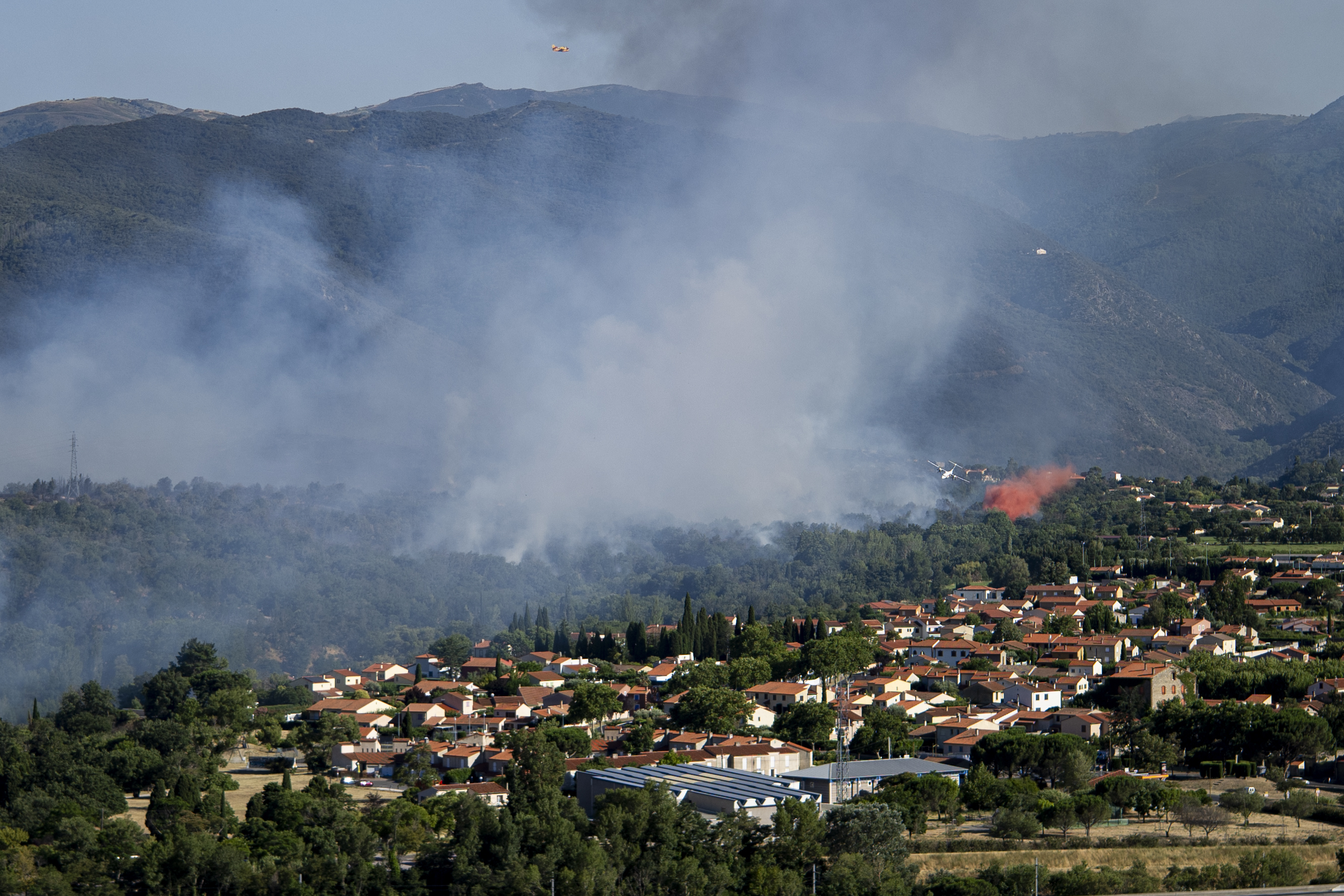


Wildfires are tearing through southern France and parts of Spain, Portugal and Greece, forcing thousands of people to evacuate from their homes.
The wildfires follow a record-breaking June heat wave across the continent that caused thousands of deaths, strained healthcare facilities, dried out acres of land and is slated to continue with triple-digit temperatures in southern Europe this week.
Heat is one of the leading global causes of weather-related deaths, and it wreaks harm throughout the body, including to the heart, kidneys and brain. Wildfires—growing in size and intensity as climate change swings the pendulum between storms and drought—create air pollution that can travel many miles beyond their burn zones and cause respiratory and cardiovascular damage, among other health consequences.
Exposure to high heat and wildfire smoke at the same time is even more dangerous, as both hazards strain the heart and lungs. Young children, older adults and people with preexisting health conditions are most at risk.
Climate-driven extremes are hitting around the world this summer, from deadly floods in parts of Asia and Africa to wildfires and dangerous heat in North America.
“Based on the climate science, we know that this is just the beginning of worsening heat waves that are going to become more frequent, more intense, and last longer into the future if we don’t get fossil fuel burning under control and transition towards clean energy,” said Vijay Limaye, a climate and health scientist at the Natural Resources Defense Council.
France’s Minister of the Interior, Laurent Nuñez, wrote on X on Monday that the wildfires there were not under control and had already burned through more than 12,000 acres. The government evacuated nearly 12,000 people, he wrote.
The blaze is also near the third stage of the Tour de France bicycle race, which passes through the Pyrénées mountains near France’s southern border. Officials closed the portion of the race to spectators in order to ensure firefighters have easy access to the area.
Hundreds of residents were also evacuated in parts of Spain and Greece.
In a statement on Tuesday, the European Commission noted that climate change is increasing the risk of forest fires, and said that a total of 777 firefighters from 14 countries have been or will be deployed to areas of high risk across Cyprus, Greece, Italy, France, Spain and Portugal.
“In the face of these devastating wildfires, Europe is united,” said Hadja Lahbib, the commissioner for equality, preparedness and crisis management, in the statement, written in French. “We are determined to protect human lives, communities, the means of subsistence and our natural environment.”
Europe just underwent a scorching heat wave in June that smashed historic records, with temperatures above 104 degrees Fahrenheit. Hungary, Austria, the United Kingdom, the Netherlands and Switzerland all set June temperature records, while France, Germany and Denmark recorded all-time temperature highs, according to the World Meteorological Organization. On June 24, France experienced its hottest day in recorded history, beating a record set just one day prior.
French authorities announced an estimate of 2,025 excess deaths in one week of the heat wave, which officials said is likely an undercount. Spanish authorities recorded 1,029 excess deaths attributable to heat in the month of June, Reuters reported.
As the fastest-warming continent in the world, Europe is heavily impacted by climate change, which is primarily driven by the continued burning of fossil fuels.
Scientists with World Weather Attribution, which quantifies how climate change affects the intensity and likelihood of extreme weather, said that the high temperatures of Europe’s June heat wave would have been “virtually impossible” just 50 years ago. They found that heat waves cause more deaths in Europe than all other natural hazards combined, and wrote that extreme heat is already reaching the limits of what societies can cope with.
“Our analysis here shows that intense heat is increasing rapidly even in living memory,” the scientists wrote. “A rapid phase-out of fossil fuels is critical if we are to avoid even higher temperatures and their consequences in the future.”
A Deadly Summer Across the World
This summer is bringing climate-driven extremes across the globe. The eastern U.S. baked under its own heat dome last week, through its 250th birthday on Saturday, and drought-fueled wildfires scorched several states in the West, blazing through Arizona, Colorado, New Mexico, Wyoming, Nevada and Utah. Experts had already flagged concerning conditions for this year’s wildfire season in the U.S., including a light snowpack and widespread drought.
In China, where scientists say climate change is increasing the likelihood of super typhoons and intense rainfall, storms and flooding from Typhoon Maysak killed at least 15 people and forced another 62,000 to evacuate as of Monday, The New York Times reported.
On Tuesday, heavy rain triggered flash floods across India and Indian-administered Jammu and Kashmir, Reuters reported, and landslides in southeastern Bangladesh killed at least eight Rohingya refugees, including five children, according to ABC News.
The floods follow extreme heat waves across South Asia. Temperatures have already soared even higher than usual this year in India, Pakistan and Bangladesh, with some areas experiencing heat above 114 degrees Fahrenheit.
This story is funded by readers like you.
Our nonprofit newsroom provides award-winning climate coverage free of charge and advertising. We rely on donations from readers like you to keep going. Please donate now to support our work.
Donate NowFloods from torrential rain last week in Ghana impacted more than 38,000 people and displaced 7,761 households, according to Ghanaian Interior Minister Mohammed Mubarak Muntaka via Reuters. At least 13 people died from the floods in Accra, the country’s capital, the BBC reported. In neighboring Ivory Coast, officials reported last week that the floods killed 59 people.
In a May update, the World Meteorological Organization (WMO) noted that warm ocean waters are fueling El Niño conditions, which drive higher temperatures and increases in extreme weather and rainfall. The organization also predicted above average temperatures around the world this summer.
Just over a decade after the landmark Paris Agreement was signed by countries committing to cutting their greenhouse gas pollution, emissions continue to rise. The result is more heat, floods and wildfires, making extreme weather and compounding disasters increasingly unavoidable.
Inside Climate News reporter Lauren Dalban contributed translation.
About This Story
Perhaps you noticed: This story, like all the news we publish, is free to read. That’s because Inside Climate News is a 501c3 nonprofit organization. We do not charge a subscription fee, lock our news behind a paywall, or clutter our website with ads. We make our news on climate and the environment freely available to you and anyone who wants it.
That’s not all. We also share our news for free with scores of other media organizations around the country. Many of them can’t afford to do environmental journalism of their own. We’ve built bureaus from coast to coast to report local stories, collaborate with local newsrooms and co-publish articles so that this vital work is shared as widely as possible.
Two of us launched ICN in 2007. Six years later we earned a Pulitzer Prize for National Reporting, and now we run the oldest and largest dedicated climate newsroom in the nation. We tell the story in all its complexity. We hold polluters accountable. We expose environmental injustice. We debunk misinformation. We scrutinize solutions and inspire action.
Donations from readers like you fund every aspect of what we do. If you don’t already, will you support our ongoing work, our reporting on the biggest crisis facing our planet, and help us reach even more readers in more places?
Please take a moment to make a tax-deductible donation. Every one of them makes a difference.
Thank you,

Keerti Gopal
Reporter, Health and Justice
Keerti Gopal covers intersections between climate change, public health and environmental justice at Inside Climate News. Previously, she covered climate activism and movement repression. She is a National Geographic Explorer and has received fellowships from Fulbright, the Solutions Journalism Network, The Lever, and the National Press Foundation.