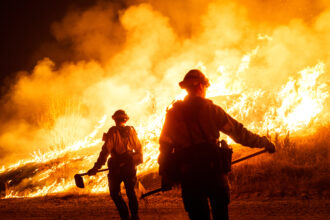
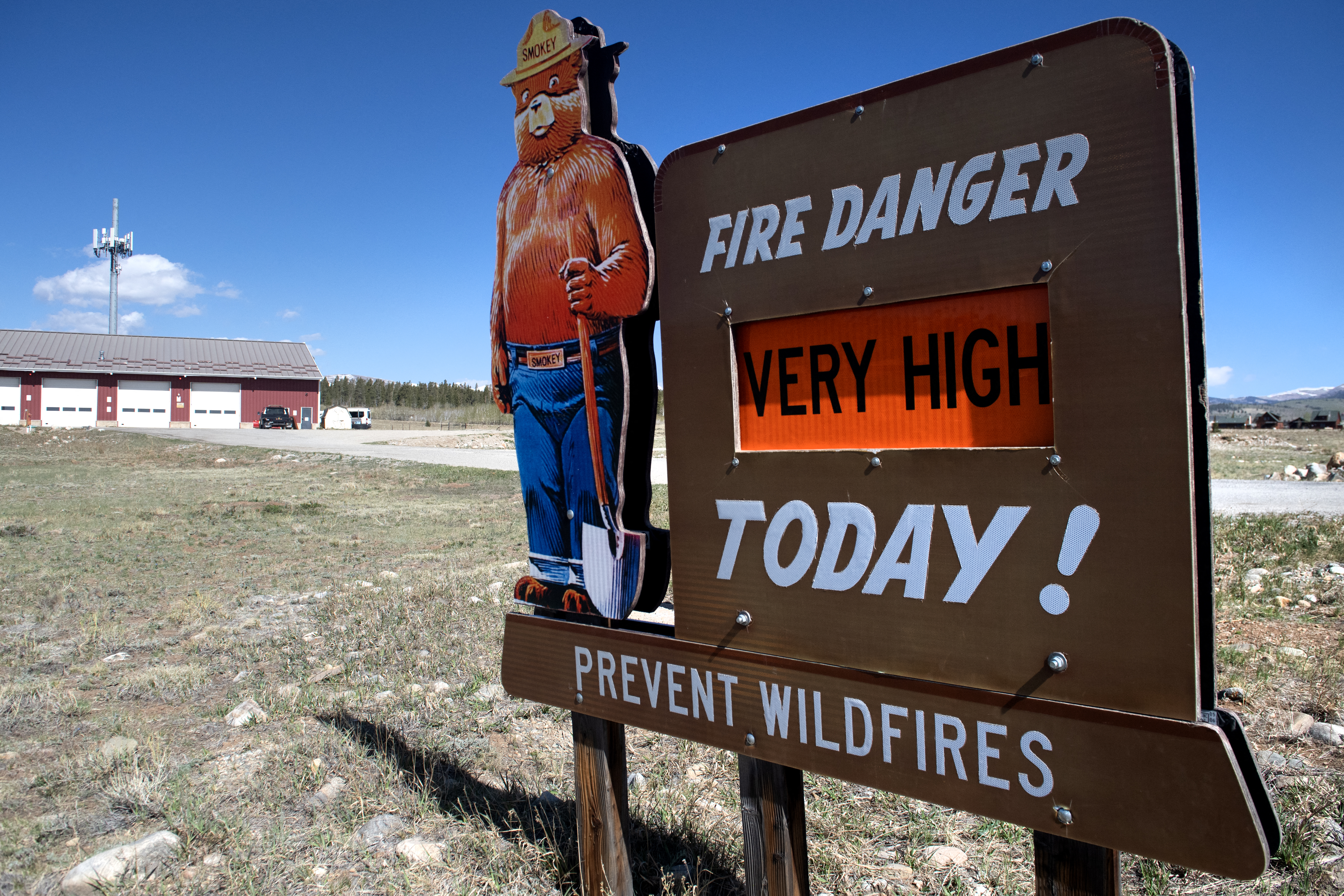


After an exceptionally warm and dry winter, vast swaths of the Western United States are up in flames—and conditions could get worse.
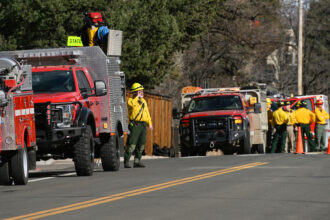
Several large fires are burning in Arizona, Colorado, New Mexico, Wyoming, Nevada and Utah. In Colorado, three federal wildland firefighters died while battling a blaze over the weekend.
“Significant wildland fire activity is occurring across multiple geographic areas, resulting in a substantial commitment of incident management teams,” the National Interagency Fire Center (NIFC), which coordinates federal and state fire operations across the U.S., said on Monday. The organization on Monday escalated the country’s preparedness level to the second-highest designation, which essentially means that all hands are on deck.
Fueled by parched vegetation, the fires are spreading rapidly as unusually strong winds extend their reach, particularly across the southern Intermountain West region. The conditions are “extraordinarily rare for late June, and impacts will likely be severe,” NIFC warned on Monday.
Winter weather set the stage for this early and aggressive start to fire season. As I reported in March, many Western states saw record or near-record lows in snowpack coinciding with consistently high winter temperatures, capped off by a heat wave in March that melted much of the meager reserves. An analysis by my colleague Peter Aldhous shows that trend has continued.
With an even hotter, dry forecast on the horizon, experts are concerned that the fires tearing through much of the Southwest could be a sign of what’s to come over the next few months.
A Fiery Start to Summer
With a dense blanket of smoke overhead, thousands of households in south central Colorado were told to evacuate on Monday as the Aspen Acres Fire exploded to more than 20,000 acres in a matter of hours. On the other side of the Colorado Rockies, close to the Utah border, the Snyder Fire has scorched more than 30,000 acres and claimed the lives of three firefighters, as my colleague Nicholas Kusnetz reported.
Meanwhile, several more blazes burn across much of the interior West, where “there’s really not much of a hint of moisture right now,” said Daniel Swain, climate scientist at the California Institute for Water Resources at the University of California, Los Angeles, in a Monday video. “The air is bone dry. The soil is bone dry. The vegetation is bone dry as well. So, it’s a pretty serious situation.”
As of Tuesday morning, the Cottonwood Fire burning up and down southwest Utah’s Tushar Mountains was the largest active blaze in the U.S. at around 94,000 acres—and could become the most destructive to property in the state’s history, according to Utah Gov. Spencer J. Cox. Even so, “Colorado has really become the epicenter,” Swain said.
That’s largely due to the high winds and drought plaguing the area, which experts call “extreme fire weather.” Colorado Gov. Jared Polis declared a disaster emergency on Saturday in response to the Snyder Fire, authorizing use of the National Guard. On Monday, 83 new fires were reported nationwide.
Some of the most dangerous conditions are expected on Tuesday, when wind in parts of Utah and Colorado could reach up to 35 miles per hour, The New York Times reports. The simultaneous blazes have put enormous strain on the country’s firefighting resources, according to the National Interagency Fire Center.
As of Tuesday, more than 8,200 personnel are assigned to active incidents nationwide.
But the concurrent fires come at a moment of flux for the U.S. federal firefighting system. Over the past year, agencies lost many fire-qualified staff. At the same time, the Trump administration in recent months launched a reorganization of fire forces under the Department of the Interior to combine them and create an entirely new “U.S. Wildland Fire Service.” As my colleague Peter reported in May, experts say this could be problematic as weather and environmental conditions are ripe for catastrophic blazes.
And more fire threats loom, including from the Fourth of July.
Risky Celebrations
It’s perhaps unsurprising to hear that fireworks are a major ignition source, considering fire is literally in their name. However, what may shock you is the scale of this risk.
When researchers analyzed wildfire data from 2000 to 2019, they discovered nearly twice as many wildfires were recorded on July 4 as almost any other day in the U.S. West. And this threat is likely to worsen as climate change continues to dry out the region, experts say.
“When our founding fathers [adopted] the Declaration of Independence on July 4, they didn’t foresee that people would be setting off fireworks in an arid drought-stricken western USA on that date in the future but that’s where we are,” Dmitri Kalashnikov, a climate scientist at the University of California, Merced, told me.
To mitigate this risk, Utah’s governor took the unprecedented step of restricting fireworks statewide on the holiday, though fire officials will work with towns to designate limited safe areas for the pyrotechnics.
The federal government already prohibits the possession or use of fireworks on public lands managed by the U.S. Forest Service, Bureau of Land Management and National Park Service. However, the Trump administration lifted an NPS fireworks ban for Mount Rushmore National Memorial in South Dakota, where Trump is expected to visit this week, prompting some wildfire fears in the surrounding national forest, Politico reports. Several national parks in Utah are already contending with fires in the region heading into the holiday weekend, SFGate reports.
As we head deeper into the summer, extreme heat could also ramp up fire risk, according to Kalashnikov. Earlier this month, he and colleagues published a study that found nearly half the area burned by fires in the West from 2001 to 2024 occurred during or right after a heat wave. On top of that, the area scorched each day during the fires was more than 50 percent larger during heat waves than during the cooler days before.
“That persistence of multiple straight days of hot weather just sort of compounds things,” Kalashnikov said. “Things stay hot, they stay dry and critically, things stay warmer overnight too, with lower humidity.”
Typically, fires die down a bit during cooler evenings, but research shows nights are getting hotter with climate change, which means the blazes can continue to grow and become harder to contain. With all this in mind, Kalashnikov said people should be extra vigilant this fire season and avoid activities that could accidentally ignite an inferno, such as leaving behind a smoldering campfire.
After all, humans cause nearly 85 percent of wildland fires in the nation.
More Top Climate News
Around half of all Americans could be impacted by a heat dome blanketing the Midwestern and eastern U.S. this week, Briana Waxman and Chris Dolce report for CNN. It could bring temperatures in some cities to their highest levels in more than a decade, potentially reaching 105 degrees Fahrenheit in New York. The combined heat and humidity could drive health problems such as heat stress, dehydration and even heat stroke, so medical experts are urging people under the dome to seek air-conditioned spaces and drink plenty of water this week. Europe is also still in the midst of a major heat wave, which is linked to around 1,000 deaths in France.
The Lincoln Memorial Reflecting Pool has an algae problem, with the organisms turning water in the famous historical site green less than two weeks after President Donald Trump’s multi-million-dollar renovation. This nuisance is just one example of a much larger algae explosion across U.S. bodies of water in recent years as climate change and pollution compound the blooms, Sarah Kaplan reports for The Washington Post. Warming waters have triggered rampant algal growth, which is fed even more by runoff of fertilizer and sewage produced by farms and cities. While quick fixes like chemicals may help mitigate blooms in the short term, these efforts will likely struggle in the long run because they don’t address the root of the problem, experts say.
Devastating earthquakes hit Venezuela last week, killing more than 1,700, The New York Times reports. Thousands more are injured and more than 15,000 were displaced by the disaster, though total damages are still being assessed as rescue and recovery efforts continue. Experts say the country lacks the specialized equipment necessary for rapid assistance after such a destructive quake.
About This Story
Perhaps you noticed: This story, like all the news we publish, is free to read. That’s because Inside Climate News is a 501c3 nonprofit organization. We do not charge a subscription fee, lock our news behind a paywall, or clutter our website with ads. We make our news on climate and the environment freely available to you and anyone who wants it.
That’s not all. We also share our news for free with scores of other media organizations around the country. Many of them can’t afford to do environmental journalism of their own. We’ve built bureaus from coast to coast to report local stories, collaborate with local newsrooms and co-publish articles so that this vital work is shared as widely as possible.
Two of us launched ICN in 2007. Six years later we earned a Pulitzer Prize for National Reporting, and now we run the oldest and largest dedicated climate newsroom in the nation. We tell the story in all its complexity. We hold polluters accountable. We expose environmental injustice. We debunk misinformation. We scrutinize solutions and inspire action.
Donations from readers like you fund every aspect of what we do. If you don’t already, will you support our ongoing work, our reporting on the biggest crisis facing our planet, and help us reach even more readers in more places?
Please take a moment to make a tax-deductible donation. Every one of them makes a difference.
Thank you,

Kiley Price
Reporter
Kiley Price is a reporter at Inside Climate News, with a particular interest in wildlife, ocean health, food systems and climate change. She writes ICN’s “Today’s Climate” newsletter, which covers the most pressing environmental news each week.
She earned her master’s degree in science journalism at New York University, and her bachelor’s degree in biology at Wake Forest University. Her work has appeared in National Geographic, Time, Scientific American and more. She is a former Pulitzer Reporting Fellow, during which she spent a month in Thailand covering the intersection between Buddhism and the country’s environmental movement.