

Leia este artigo em Português.
Along the river the Xavante people of Brazil call Owawê are many of the Indigenous tribe’s sacred sites, ancient villages and cemeteries. It is also where their ear piercing rituals are held, marking the transition of boyhood to adulthood.
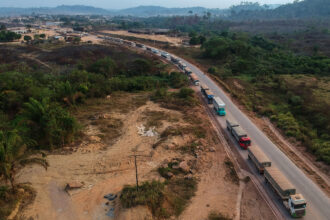
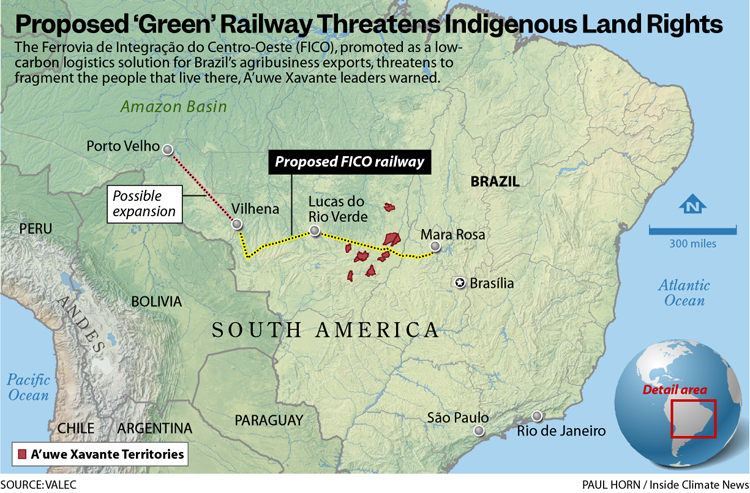
Now, a railway project—Ferrovia de Integração do Centro-Oeste (Center-West Integration Railway, or FICO)—threatens to separate an already fragmented population even more. While the first phase of the project nears completion, Xavante leaders say the government did not give them the prior and informed consent assured in legal documents. The leaders say problems like food insecurity, invasions by loggers and weakening of community organization tend to worsen when big projects encroach on their territory.
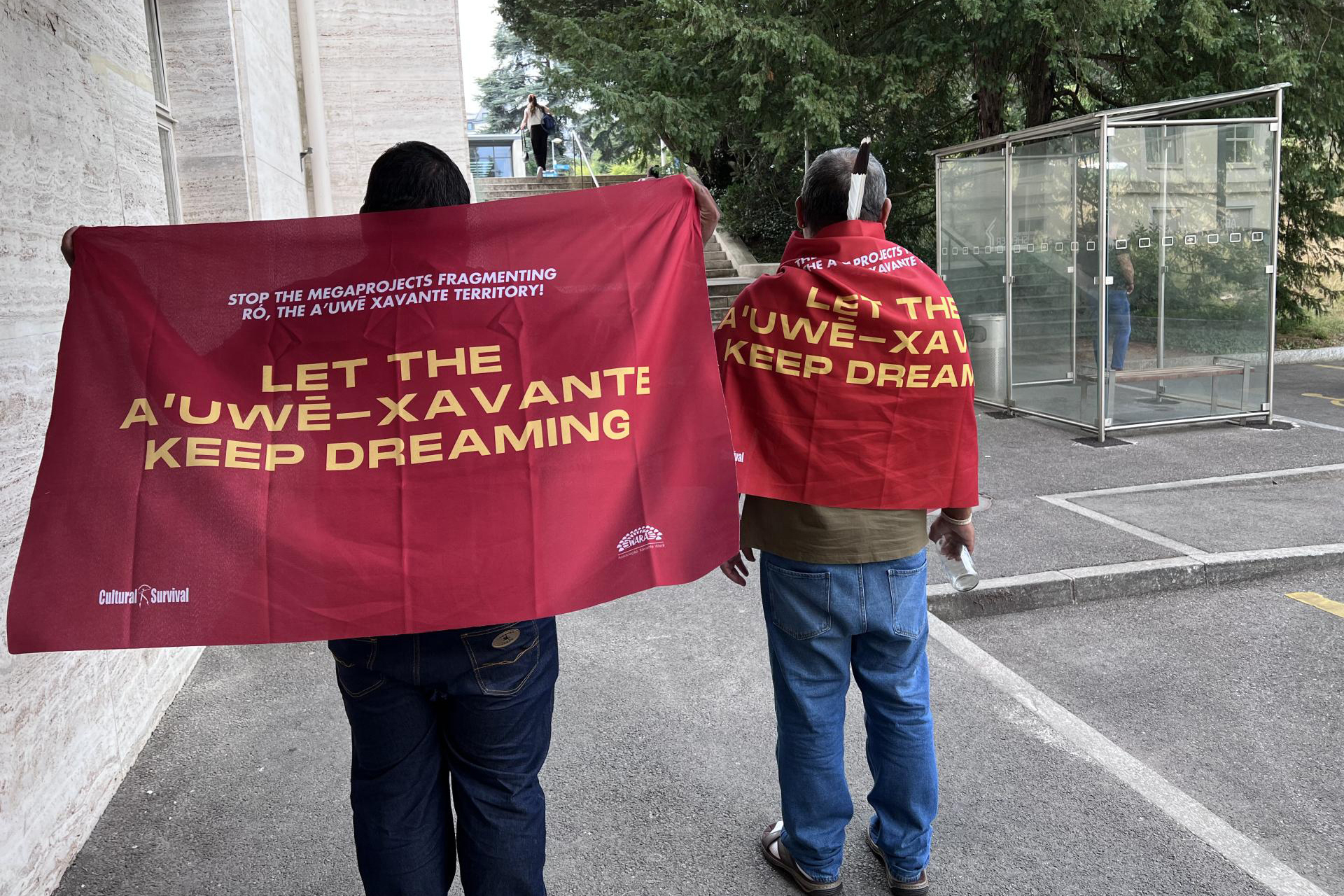
A delegation that included Hiparidi Top’Tiro, Xavante chief of the Abelhinha village in the Sangradouro territory; Missia Ihiwe Urace, another Xavante leader; and allies from the Xikrin people and the Indigenous rights advocacy group Cultural Survival traveled to Geneva in July to bring this issue to the United Nations’ 19th session of the Expert Mechanism on the Rights of Indigenous Peoples (EMRIP).
EMRIP is a mechanism within the U.N.’s Human Rights Council that provides expertise and advice on the rights of Indigenous peoples and assists member states in achieving the goals of the United Nations Declaration on the Rights of Indigenous Peoples.
“We know that the U.N. will not force the country to do what the U.N. says,” Top’Tiro said. “But at least the world will know what is happening. It’s important that many of our colleagues hear what we are saying and denouncing.”
The A’uwe Xavante gather natural resources essential for life in their villages and for rituals at some of the areas close to the river, known in Portuguese as Rio das Mortes or River of the Deaths. Top’Tiro said it got its name after Brazilian expeditionary forces repeatedly threw dead Xavante bodies into the river during the battles they fought between 1949 and 1950. He said the railway will run over those gathering places, cemeteries and other sacred sites “without respect for them.”
The FICO project initially aimed at integrating the country’s major agricultural region to its north-south railway network, allowing for grains and other crops to be directly transported to the bigger shipping hubs along the coast while decreasing emissions by taking trucks off the roads.
But since 2015 the project has developed a geopolitical aspect, after Brazil, China and Peru signed a treaty to start researching the possibility of connecting the nation’s agriculture- and mining-rich regions to Peruvian ports—and especially after Peru, in 2024, inaugurated a deep water port majority owned by the Chinese shipping giant Cosco.
The country set a goal to increase rail’s freight modal share by volume—the percentage of trips with this type of transportation—to 35 percent from its current share of 25 percent by 2035. The World Bank, in an analysis of the project, said achieving this goal would reduce the number of heavy vehicles on the road and decrease emissions.
China committed $50 billion last year toward infrastructure, logistics and what it described as sustainable developments in the Brazilian Center-West region. The investment would ultimately create a path for commodities to flow more directly from Brazil to China, its biggest trading partner, bypassing the Panama Canal.
A Warning Becomes Reality
The A’uwe Xavante have nine territories registered within the country’s National Foundation for Indigenous People (FUNAI), three of which are north of the proposed FICO railway. All of the territories are located on the easternmost parts of the state of Mato Grosso and occupy an area of about 5,683 square miles.
Top’Tiro said the A’uwe Xavante are all fragmented now, a stark contrast to the time when his ancestors, before the 1930s, lived in one long continuous territory along the Rio das Mortes. He believes this fragmentation was deliberate.
“Because the land is not contiguous, businessmen are taking advantage of this and creating more divisions among us,” he said. “In this sense, it is really bad … to not have continuous communication with our people. It cuts out our dreams and our connections to our parents.”
Djalma Aranã Caboclo, part of the Cultural Survival staff that accompanied the delegation to Geneva, said his own people, the Aranã Caboclo, have been fighting the Brazilian government for 22 years for the demarcation of their territory in the Jequitinhonha Valley that runs through the states of Bahia, Minas Gerais and São Paulo. He said that while the process of demarcating their lands is slow, licenses for natural resources exploration, such as lithium mining, get issued very quickly.
“We demand that our rights be respected, that our territories be protected, that our life be safeguarded and that our cultural integrity be fulfilled, recognized and upheld,” Caboclo said in an Instagram post. “Development cannot come at the cost of Indigenous Peoples. The energy transition cannot become a new form of colonial violence.”
The FICO Project
The railway integration project is divided into three phases.
The first phase, consisting of a 383-kilometer route designed for heavy loads, links the town of Mara Rosa, in the state of Goiás, to Água Boa, in Mato Grosso. It was initiated in 2021 and is estimated to be completed in 2028. Mara Rosa is also on the route for a different rail project that, if approved, will link the Center-West region with the port of Ilhéus, in the state of Bahia.
The second and third phases of the project will connect the Mato Grosso city with other northern municipalities, reaching the state of Rondônia.
FICO is a project of Infra S.A., a federal public company with closed capital, linked to Brazil’s Ministry of Transport. The Brazilian mining giant Vale allowed some funds from two of their railway renovation projects to be sent instead to the project through cross investment practices, a financing model generally used in rail projects that allows resources from a grant to be used to fund public interest projects in other areas.
This story is funded by readers like you.
Our nonprofit newsroom provides award-winning climate coverage free of charge and advertising. We rely on donations from readers like you to keep going. Please donate now to support our work.
Donate NowFor part of the agricultural sector of Mato Grosso, the project was received with high expectations for a boost of logistical infrastructure in the region. Luiz Pedro Bier, vice president of Aprosoja, the Brazilian association of the soybean producers, told Gazeta do Povo last year that bottlenecks on some of the state’s highways that lack paving or roadwork compromised the competitiveness of their products in the market.
While Amazon rainforest deforestation in Mato Grosso recently saw sharp reductions, many of the environmental protection areas, which often overlap with Indigenous territories, were not fully safeguarded from deforestation. The Triunfo do Xingu environmental protection area in the neighboring state of Pará lost 35 square kilometers (14 square miles) between August 2025 and March 2026.
In 2018, 176 square kilometers (68 square miles) of rainforest were cut down at the Areões, one of the A’uwe Xavante’s demarcated territories, according to the Brazilian space agency. This follows a deforestation of more than 55 square kilometers (21 square miles) in 2017 in the same territory.
Repeating the Same Mistake
When more than 50 nations, including Brazil, gathered in Santa Marta, Colombia, in April to map out specific plans to phase out fossil fuels, Indigenous organizations, like the Coordination of Indigenous Organizations of the Brazilian Amazon (COIAB), were hopeful for a decisive advancement.
For the Indigenous communities that traveled to Geneva, this hope lasted less than three months.
Bekroiti Xikrin, a youth leader from the Xikrin people who also joined the Geneva delegation, said the pattern of not consulting with Indigenous people prior to advancing with infrastructure and energy projects shows that economic development is still prioritized over their rights.
With demarcated territory in the state of Pará, the Xikrin people suffer with the consequences brought by Vale’s operations, including one of the largest open-air iron mines in the world, formerly owned by U.S. Steel. Vale allegedly was responsible for polluting the Cateté River with lead, mercury, manganese, aluminum and iron from its Onça Puma nickel mining project near Xikrin communities. The company denied responsibility for the contamination.
Bekroiti Xikrin said coming to Geneva was a way to show the world their reality and livelihoods, as well as the difficulties in their territories.
“The [energy] transition is important for climate change,” he said. “But it can’t repeat the same mistake from the past. There truly is not ‘green’ energy when they are built through the destruction of Indigenous territories … For generations, we’ve protected the forests, and you cannot fight the climate crisis by creating new injustices.”
About This Story
Perhaps you noticed: This story, like all the news we publish, is free to read. That’s because Inside Climate News is a 501c3 nonprofit organization. We do not charge a subscription fee, lock our news behind a paywall, or clutter our website with ads. We make our news on climate and the environment freely available to you and anyone who wants it.
That’s not all. We also share our news for free with scores of other media organizations around the country. Many of them can’t afford to do environmental journalism of their own. We’ve built bureaus from coast to coast to report local stories, collaborate with local newsrooms and co-publish articles so that this vital work is shared as widely as possible.
Two of us launched ICN in 2007. Six years later we earned a Pulitzer Prize for National Reporting, and now we run the oldest and largest dedicated climate newsroom in the nation. We tell the story in all its complexity. We hold polluters accountable. We expose environmental injustice. We debunk misinformation. We scrutinize solutions and inspire action.
Donations from readers like you fund every aspect of what we do. If you don’t already, will you support our ongoing work, our reporting on the biggest crisis facing our planet, and help us reach even more readers in more places?
Please take a moment to make a tax-deductible donation. Every one of them makes a difference.
Thank you,

Gabriel Matias Castilho
Fellow
Gabriel Matias Castilho is an Inside Climate News fellow reporting on the Washington, D.C. area. Previously, he worked for Capitol News Illinois, covering environmental policy, energy and utilities across the state. He is currently a master’s student at Northwestern University.