

In Montgomery County, Indiana, utility-scale solar projects appear on an official list of undesirable land uses that also includes “adult-oriented businesses.”
So it wasn’t surprising that the county Board of Commissioners unanimously rejected a 200-megawatt solar project on Sept. 28.
But it still stings for renewable energy advocates. It shows a huge challenge lurking right behind the debate over a U.S. Senate energy permitting bill. Even if the federal government eases the permitting process, much of the country is off-limits for wind and solar development because local residents and their elected officials oppose it.
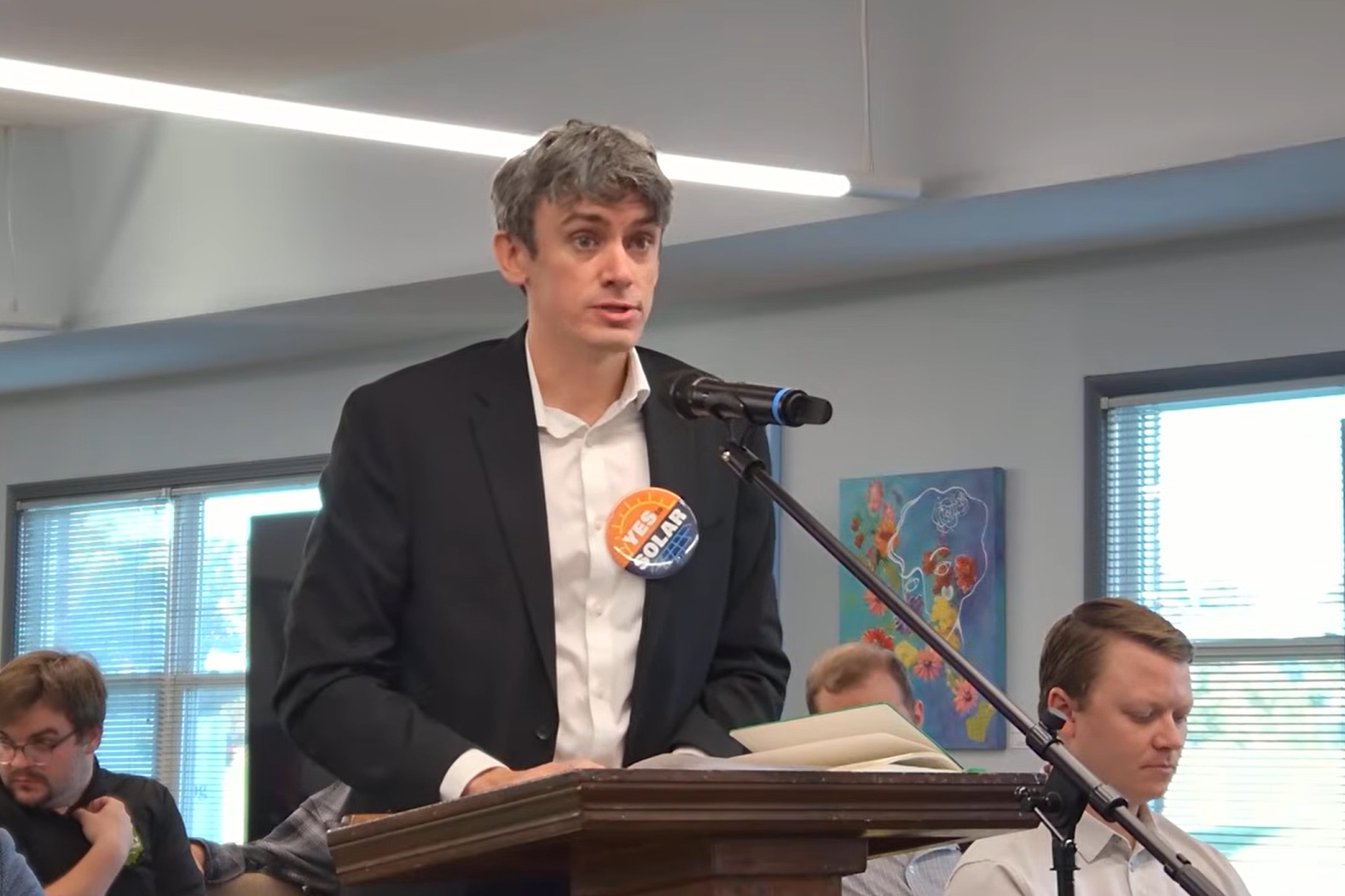
One person who repeatedly defended the Indiana project at public meetings was John Smillie, a solar power supporter who lives in Crawfordsville, the county seat. He works as a finance manager for an industrial lighting company and does charitable work, written about by Canary Media, to help nonprofits install solar.
I spoke with Smillie this week to explore how Montgomery County and the country are supposed to move into the energy future when a seemingly beneficial project gets smacked down in such a fashion.
“Hearing the disinformation is very difficult,” he said.
For example, people opposing the project said China doesn’t use solar panels, it just sells the panels to the United States.
“That’s radically untrue,” Smillie said. Indeed, China has installed more solar power than any other country.
Video of the meeting shows more than an hour of testimony, including repeated claims that solar is a danger to human and animal health. Such concerns are widely debunked, but they are repeated at government meetings as if they were true.
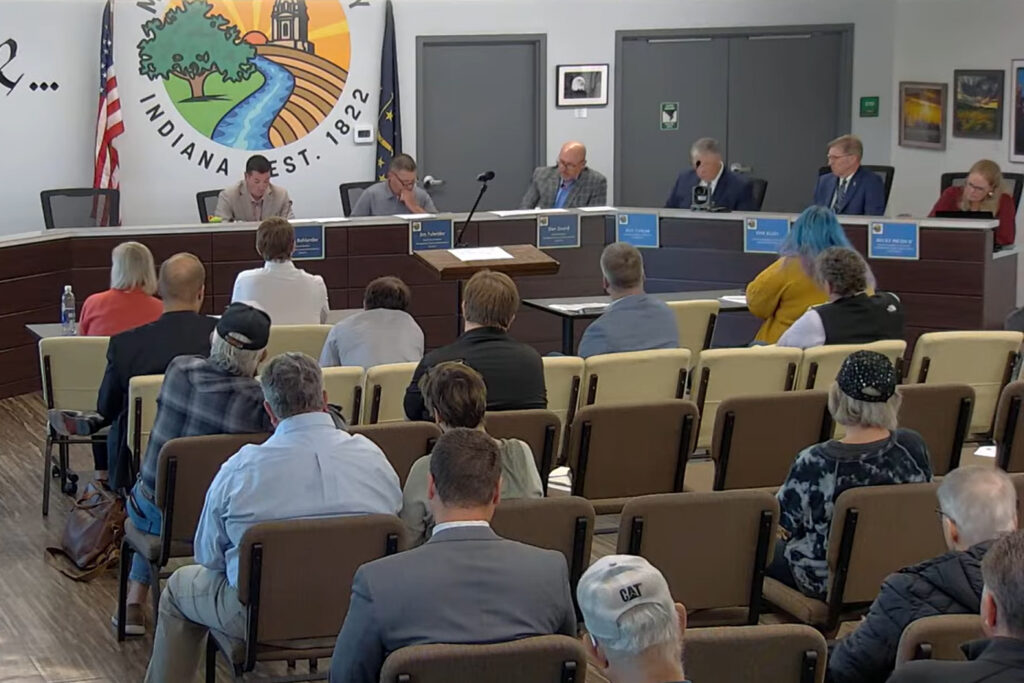
Commissioners said they were swayed by testimony that the project may reduce nearby property values and change the character of the area.
“This is a large agricultural area,” said Commissioner Jim Fulwider.
Solar will “change the looks and the surroundings of that community for years to come with the size of that project,” he said.
Researchers have looked at how solar and wind projects may affect property values. A 2023 study from Lawrence Berkeley National Laboratory—which did not include data from Indiana—showed small effects in some states, but nothing close to the drastic changes that opponents have claimed.
Much of the world of environmental and clean energy advocacy is now focusing on the permitting bill in the U.S. Senate, announced on Sept. 30.
Supporters of the bill, including clean energy industry groups, say it would unleash a building boom for interstate power lines, wind, solar and battery projects. Opponents, including many environmental advocacy groups, say the measure would accelerate construction of fossil fuel infrastructure and lock in decades of emissions that contribute to climate change.
I think what happened in Montgomery County and similar communities across the country must be part of the discussion. Even if federal permitting gets easier, developers will struggle to build if local residents and elected officials are not on board.
By the end of 2025, there were 888 state and local laws restricting renewable energy across 48 states, according to Columbia Law School’s Sabin Center for Climate Change Law. The center’s database shows restrictions in more than 30 of Indiana’s 92 counties.
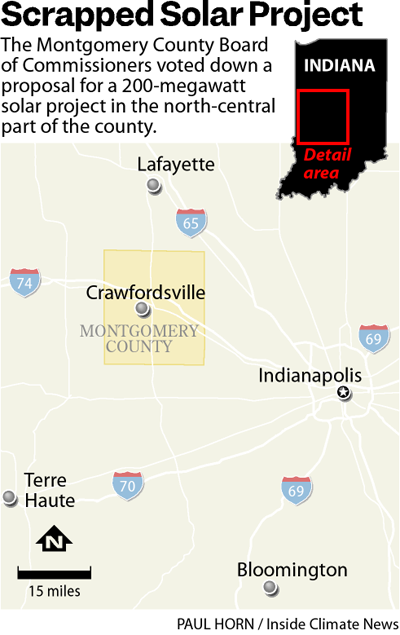
Notably, Montgomery County is not one of them. Its limits are indirect, stemming from a comprehensive planning process in 2024 that includes wind and solar as undesirable land uses, based on focus groups with residents. The county’s list of undesirable uses also has junkyards, landfills and adult-oriented businesses, among others.
Researchers at Ball State University in Muncie, Indiana, released a policy brief in April showing that county-level restrictions on wind and solar are associated with a decrease in economic activity, while Indiana counties without restrictions saw a net gain. The limits on development also contributed to a net loss of jobs, mainly in manufacturing and transportation, that were partly offset by small gains in agricultural jobs.
I reached out to Engie North America, developer of the solar project, and the Montgomery County Board of Commissioners, and didn’t hear back from either.
The project would have paid more than $40 million in local taxes during its lifespan and generated enough electricity each year to meet the needs of about 32,000 households, according to Engie North America. The company planned to spend more than $300 million to build the solar farm.
It’s not every day that Montgomery County has a company wanting to invest $300 million.
And the project was to be in a location with few houses within view, with greenery planted to partially block the view, Smillie said.
“Most people going through Montgomery County would never have noticed it was there,” he said.
I don’t have a solution to the problem playing out in Indiana and so many other places.
Ideally, developers would get better at connecting with local residents and elected officials, while local officials would find ways to use revenue from renewable energy projects to reduce taxes and fund community priorities.
States could also step in to limit the ability of local governments to block projects, as Illinois, Michigan and others have done. That approach may lead to more projects being built, but it can also deepen resentment from rural communities and probably isn’t a long-term solution.
I asked Smillie how he felt walking out of that meeting.
“Pretty doomy,” he said.
Same.
Other stories about the energy transition to take note of this week:
Supreme Court Hears Landmark Climate Deception Case: The U.S. Supreme Court heard arguments this week in Suncor v. Boulder, a case that affects dozens of lawsuits accusing fossil fuel industries of deceiving the public about climate change, as my colleague Nicholas Kusnetz reports. The sides focused on procedural issues regarding whether the case should be allowed to proceed. Oil companies are seeking protection from courts and lawmakers from liability related to climate change, and the outcome of those efforts has major implications for the trajectory of the shift away from fossil fuels.
Tandem Solar Cells Could Be a Leap Forward for U.S. Manufacturers: Tandem solar cells, which use several layers of solar material to produce additional energy, offer U.S.-based solar manufacturers a chance to catch up with competitors in China, as Ivan Penn reports for The New York Times. Tandem PV, First Solar and Hanwha Qcells are among the companies working to develop the products.
Solar Program Grantees Seek Damages: Organizations that stood to benefit from the federal government’s Solar for All program have already won a judgment that will restore funding from the Trump administration, and now they are asking a court for damages related to the disruption of the funding, as Diana DiGangi reports for Utility Dive. Meanwhile, the Trump administration is still weighing whether to appeal the Sept. 18 ruling that restored the program. Solar for All was a Biden administration initiative aimed at expanding access to customer-owned solar, but it became caught up in the Trump administration’s push to claw back funding from clean energy programs.
New Chevrolet Bolt Has Extremely Limited Run: General Motors had touted the return of the Chevrolet Bolt as an affordable electric vehicle. But the subsequent cancellation of federal EV incentives may now be prompting the company to scale back production to just 35,000 units in the model’s one-year run, according to a union official cited by Kalea Hall of Reuters. The Bolt went on sale this year with a starting price of $27,600. The model may be a casualty of a shifting market in which entry-level EVs are getting hurt by last year’s removal of consumer tax credits.
Inside Clean Energy is ICN’s weekly bulletin of news and analysis about the energy transition. Send news tips and questions to [email protected].
About This Story
Perhaps you noticed: This story, like all the news we publish, is free to read. That’s because Inside Climate News is a 501c3 nonprofit organization. We do not charge a subscription fee, lock our news behind a paywall, or clutter our website with ads. We make our news on climate and the environment freely available to you and anyone who wants it.
That’s not all. We also share our news for free with scores of other media organizations around the country. Many of them can’t afford to do environmental journalism of their own. We’ve built bureaus from coast to coast to report local stories, collaborate with local newsrooms and co-publish articles so that this vital work is shared as widely as possible.
Two of us launched ICN in 2007. Six years later we earned a Pulitzer Prize for National Reporting, and now we run the oldest and largest dedicated climate newsroom in the nation. We tell the story in all its complexity. We hold polluters accountable. We expose environmental injustice. We debunk misinformation. We scrutinize solutions and inspire action.
Donations from readers like you fund every aspect of what we do. If you don’t already, will you support our ongoing work, our reporting on the biggest crisis facing our planet, and help us reach even more readers in more places?
Please take a moment to make a tax-deductible donation. Every one of them makes a difference.
Thank you,

Dan Gearino
Reporter, Clean Energy
Dan Gearino covers the business and policy of renewable energy and utilities, often with an emphasis on the midwestern United States. He is the main author of ICN’s Inside Clean Energy newsletter. He came to ICN in 2018 after a nine-year tenure at The Columbus Dispatch, where he covered the business of energy. Before that, he covered politics and business in Iowa and in New Hampshire. He grew up in Warren County, Iowa, just south of Des Moines, and lives in Columbus, Ohio.