

The Birmingham darter, though only recently discovered by science, is a survivor.
The roughly two-inch long fish, adorned with red spots and stripes along translucent fins, has survived 100 years of coal mining, steel-making, quarrying and suburban development along the rolling Appalachian foothills running southwest from Birmingham to Tuscaloosa.
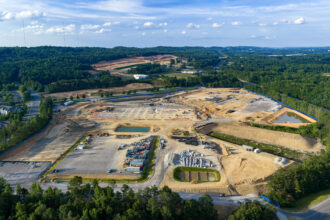
But the fish might not survive the new 4.5-million square foot hyperscale data center planned just upstream from one of the six known locations where it still survives.
“Clearly they’re endangered in fact, if not by law, because their populations are so small,” Charles Miller, policy director for the Alabama Rivers Alliance, said in an interview. “They’re only found in Jefferson County, and so the loss of even one of those populations can be devastating for the species as a whole.”
The Rivers Alliance, along with the Center for Biological Diversity and Black Warrior Riverkeeper, petitioned the U.S. Fish and Wildlife Service nearly a year ago to consider whether the species should be listed under the Endangered Species Act, a move that would likely force developers of the Project Marvel data center to make accommodations to save the fish.
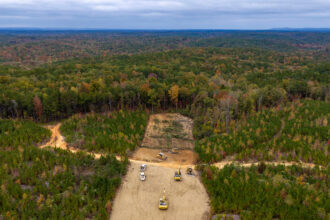
Now, after nearly a year with no action and crews already clearing land for the data center, they are threatening to take the matter into court.
On Thursday, the groups sent a notice of intent to sue the Fish and Wildlife Service and the Department of the Interior, saying they will file suit if the FWS does not respond within 60 days. The groups are required to give 60 days notice before filing a lawsuit under the Endangered Species Act.
Laurel Jobe, an attorney at the Center for Biological Diversity, said the FWS missed a legally required 90-day deadline to issue an interim decision on the darter’s status, and that time is of the essence.
“Birmingham darters don’t have time for the Fish and Wildlife Service to slow-walk this decision,” Jobe said in a news release. “Every day these darters spend waiting for protections brings them that much closer to extinction.”
The U.S. Fish and Wildlife Service and data center developer QTS did not immediately respond to requests for comment for this story.
The data center, called Project Marvel, was announced in 2025 as having 18 warehouse-style data center buildings spanning 4.5 million square feet on 700 undeveloped acres in the city of Bessemer, just west of Birmingham.
Since then, developers purchased an additional 900 acres of property surrounding the original site plan. Virginia-based data center developer QTS purchased the project for $432 million in June, according to local media reports.
Clearing Continues for Project Marvel
Recent municipal elections in Bessemer installed a new mayor and city councilors, after strong public backlash against the data center. The previous mayor and other officials signed non-disclosure agreements with the original developer that even required them to destroy records that the developers deemed confidential.
In October, new Bessemer Mayor Louise Alexander asked QTS to pause development operations until a scheduled meeting with city officials. According to AL.com, the company responded saying it would continue clearing the site, which had already been permitted by the city.
QTS has offered to buy homes surrounding the site from residents, and subcontractors have sent letters to residents informing them they are within a half mile of a potential blasting site, seeking to conduct “pre-blast inspections” on structures in that radius.
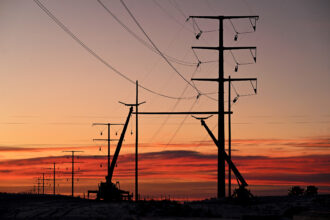
When completed, Project Marvel will be one of the largest users of electricity in the state, needing an estimated 1,200 megawatts of power. That’s almost half the total capacity of Alabama Power’s James H. Miller Jr. Electric Generating Plant, a coal-fired power plant located about 20 miles away.
Birmingham Darter’s Habitat Dwindles
The darter is surviving, but definitely not thriving. The species has already been extirpated from parts of its range, in a number of streams feeding into Valley Creek, a Black Warrior River tributary. The clear, spring-fed streams that it needs to survive have been impacted by urban runoff and industrial pollution.
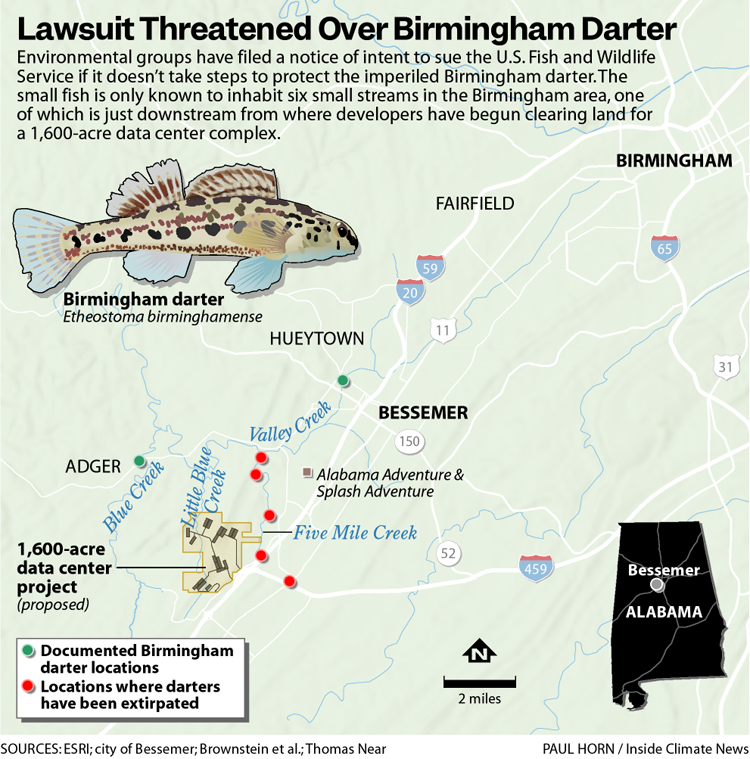
According to the groups’ notice, there were populations of the Birmingham darter in Fivemile Creek, just east of the data center site, that have seemingly been wiped out due to quarrying operations in the area. The groups say darters haven’t been seen there since 2006.
“Birmingham was the center of a coal and an iron and steel industry that really messed with these streams,” Miller said. “The darters that we have left are so precious because they represent individuals and species that were really put through the wringer.”
Now, the darter is facing threats from the development of the new data center, as well as the controversial Birmingham Northern Beltline highway project, which is planned to run directly through the area. The highway is being built not to alleviate traffic problems, but in an attempt to spur economic development through sparsely populated areas north and west of Birmingham.
The route will take it directly through many forested and undeveloped areas, clearing hundreds of acres of wetlands, critics say, imperiling the Birmingham darter and numerous threatened and endangered species in the area. The project’s estimated total cost is more than $6 billion in 2026 dollars, though the road is not expected to be completed for several decades.
These two massive new developments on top of the existing pressures on the darter threaten its survival as a species.
“We’re seeing this new form of industry come in that is posing threats to our natural environment in similar ways as mining did back in the day,” Miller said. “And we’ve got to make sure that these species can survive this next revolution in terms of AI and data centers.”
Darters Are Key Part of Alabama’s Celebrated Biodiversity
Alabama is a well-recognized hotbed of biodiversity, boasting more freshwater aquatic species than any other state, thanks to its wide range of habitats from the Appalachian foothills to coastal plains, Piedmont, and the Mobile-Tensaw Delta, one of the richest wildlife areas in North America.
These diverse ecosystems in Alabama are home to at least 300 species of freshwater fish, 186 species of mussels, 31 species of turtles, 97 species of crayfish and 200 species of freshwater snails, according to The Nature Conservancy in Alabama.
This story is funded by readers like you.
Our nonprofit newsroom provides award-winning climate coverage free of charge and advertising. We rely on donations from readers like you to keep going. Please donate now to support our work.
Donate NowThere are numerous species of darters in the Birmingham area that are found nowhere else in the world, including the vermilion and watercress darters. The Birmingham darter was initially thought to be part of another species until biologists documented it as a distinct species about two years ago.
“It’s incredible, and I think a lot of people living in Jefferson County, like I do, don’t even know this,” Miller said. “But we have all of these cool little endemic darter species that only live here, and that are found nowhere else on Earth.”
But Alabama is also among the national leaders in extinctions, with more than 100 documented species lost since European settlers arrived.
Miller said action is needed to prevent the Birmingham darter from becoming another lost species, and that protecting any of the six remaining populations would have a big impact.
“Any one of those fish in any one of those populations that we can save contributes a great deal to the genetic biodiversity of the species as a whole, and increases its chances of survival,” Miller said.
About This Story
Perhaps you noticed: This story, like all the news we publish, is free to read. That’s because Inside Climate News is a 501c3 nonprofit organization. We do not charge a subscription fee, lock our news behind a paywall, or clutter our website with ads. We make our news on climate and the environment freely available to you and anyone who wants it.
That’s not all. We also share our news for free with scores of other media organizations around the country. Many of them can’t afford to do environmental journalism of their own. We’ve built bureaus from coast to coast to report local stories, collaborate with local newsrooms and co-publish articles so that this vital work is shared as widely as possible.
Two of us launched ICN in 2007. Six years later we earned a Pulitzer Prize for National Reporting, and now we run the oldest and largest dedicated climate newsroom in the nation. We tell the story in all its complexity. We hold polluters accountable. We expose environmental injustice. We debunk misinformation. We scrutinize solutions and inspire action.
Donations from readers like you fund every aspect of what we do. If you don’t already, will you support our ongoing work, our reporting on the biggest crisis facing our planet, and help us reach even more readers in more places?
Please take a moment to make a tax-deductible donation. Every one of them makes a difference.
Thank you,

Dennis Pillion
Reporter, Alabama
Dennis Pillion is a reporter for Inside Climate News based in Alabama. He joined ICN in 2024 after 17 years working for Alabama Media Group, including nine as the statewide natural resources reporter. His work for AL.com and The Birmingham News, won numerous Green Eyeshade and Alabama Press Association awards for his coverage of environmental issues in Alabama. He was born and lives in Birmingham, Ala.