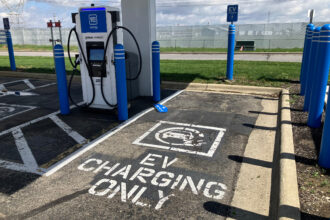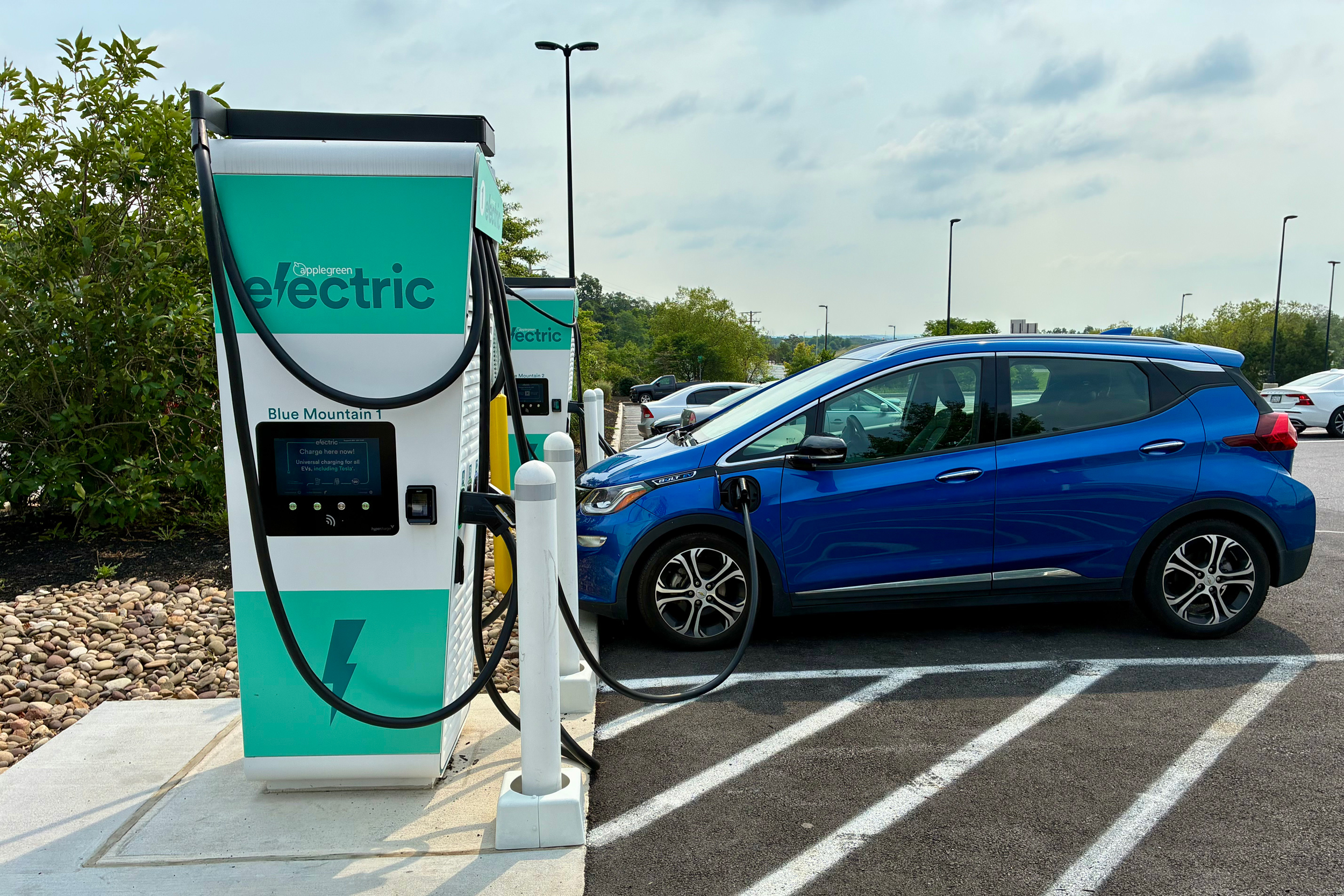


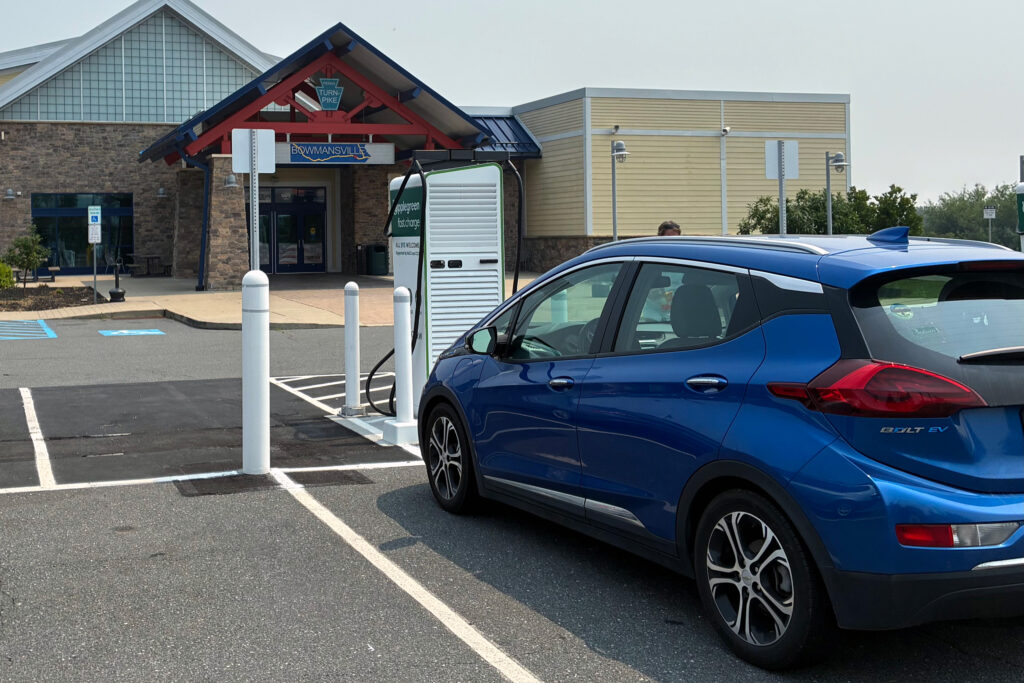
As I drove 500 miles across Pennsylvania and back in a little blue Chevrolet Bolt EV, a charging station near a dumpster at the back of a Pizza Hut parking lot proved to be a convenient stop. But after spending two hours charging there on back-to-back days and encountering more feral cats (four) than other drivers (one), I started to wonder about its overall utility.
It’s an important question, because the charging station was subsidized with $705,000 in federal taxpayer money, part of $4.5 billion being spent across the country through the National Electric Vehicle Infrastructure (NEVI) program, a Biden-era pot of money to install thousands of EV fast chargers nationwide.
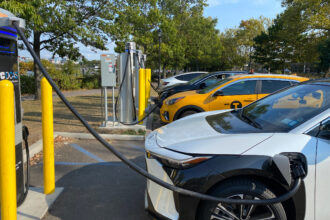
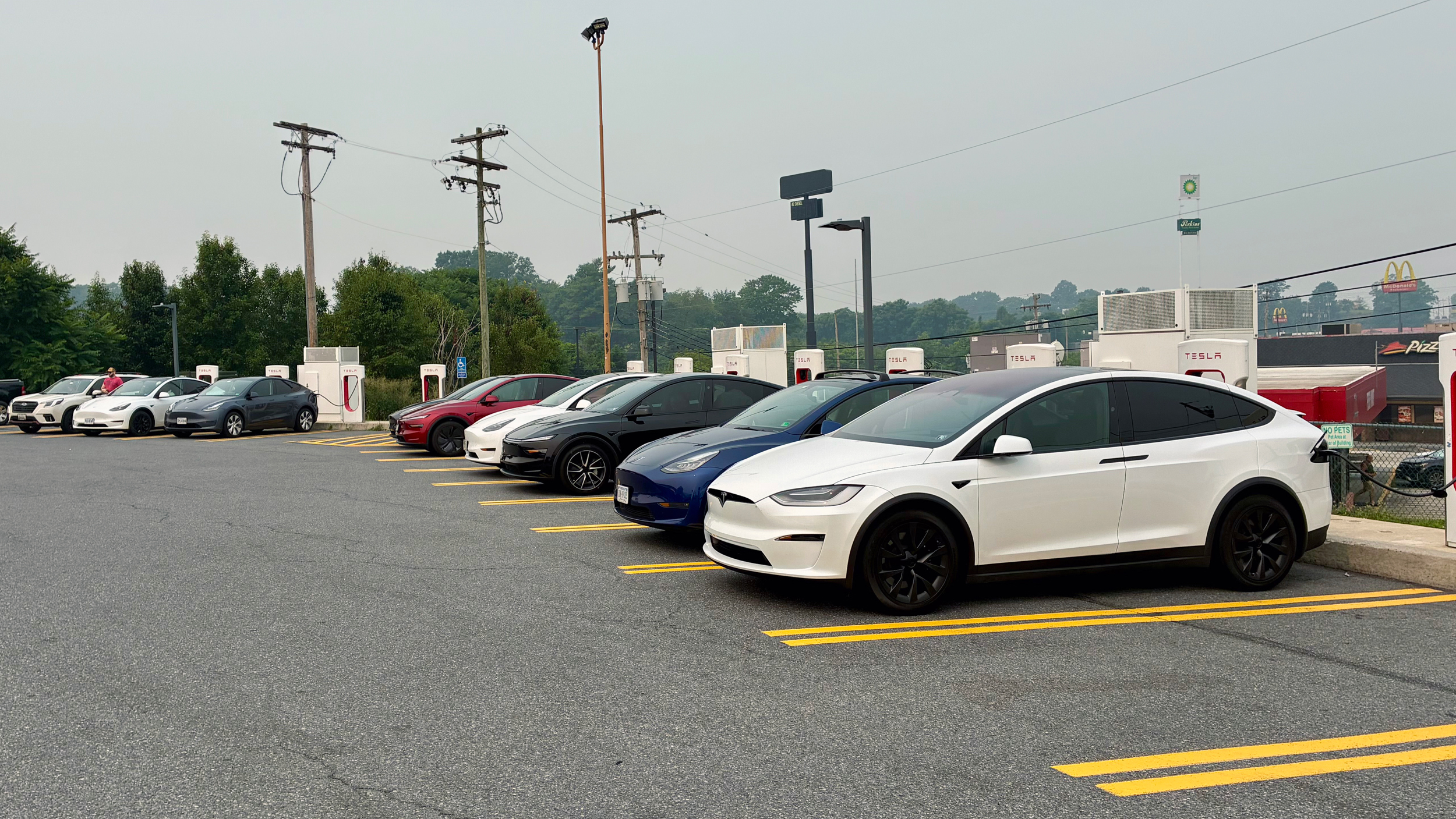
Just up the hill from the quiet Pizza Hut station was a Tesla supercharger station constructed with no such subsidy. It was crowded with drivers like Levi Morgan, a western Pennsylvania resident who stopped there amid a six-hour drive to Virginia with his family of five. For him, the company’s robust network was a major selling point, and he actually welcomed having to stop and charge every now and then.
“I know some people want to drive eight hours straight or whatever. We would never do that with kids,” Morgan said, adding that Tesla chargers seemed to be everywhere. “For us, they’re there anytime we need it.”
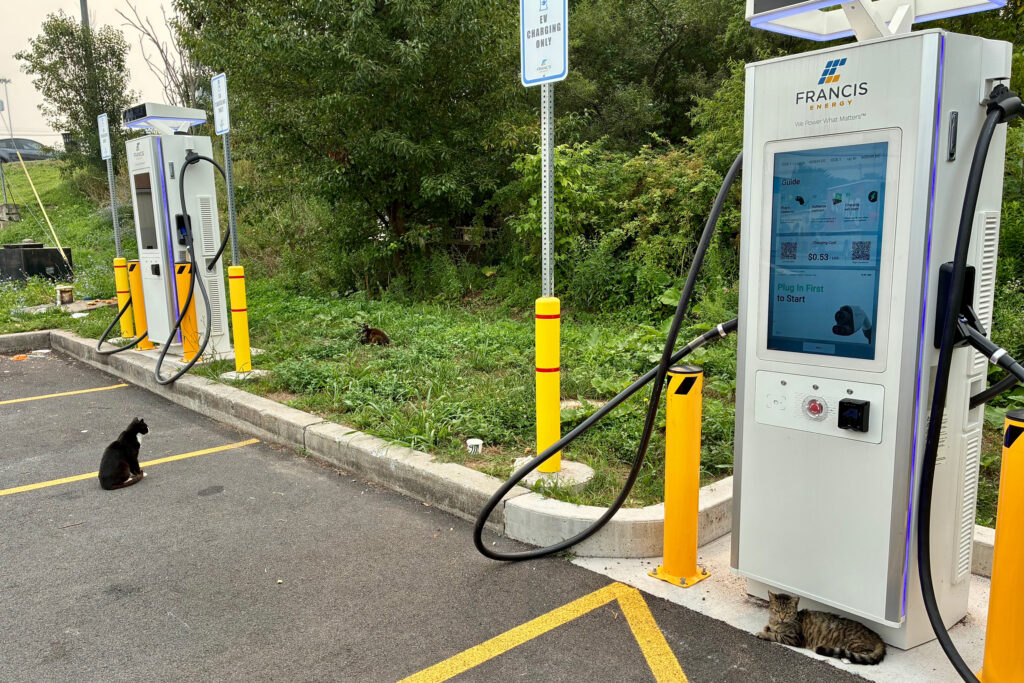
At first glance, the contrast between the two charging stations would seem to lend credence to criticisms of the NEVI program. The Competitive Enterprise Institute, a libertarian think tank, opined in a report this year that “the private market is already responding to consumer demand for EV chargers far more efficiently than NEVI has,” and called for the program’s abolition.
The U.S. Government Accountability Office has also faulted the program for a lack of clearly-defined performance goals, at a time when the country’s EV market is floundering and the usefulness of federal investment is up for debate.
But transportation experts like Nick Nigro, founder of the research firm Atlas Public Policy, recommend staying the course. For one, he said, the economics of charging stations are different from gas stations and don’t rely as much on the regular coming and going of vehicles. More importantly, he added, NEVI wasn’t designed to meet or spur current EV demand, but instead help the United States build infrastructure for a future of electric transportation.
Despite shifting policy priorities among federal lawmakers, who have already rescinded $500 million from NEVI and don’t plan to add any new money during the next five-year transportation funding cycle, Nigro believes that an electrified future is still to come. Even in Pennsylvania, where EV adoption is lagging, as the state ranks just 29th in electric vehicle ownership per capita.
“Just like when we built the national highway system, just like when we built the electrical grid, the federal government was seeing the future and trying to make it possible for Americans to get there more quickly,” Nigro said. “A lot of these stations along highway rest stops, in today’s EV market, are not going to be frequently visited because we don’t have thousands and thousands of electric vehicle drivers crisscrossing the country… but we will.”
Pennsylvania is perhaps the best test case for what federal dollars can buy. The $16.2 million in NEVI funding it spent by the end of 2025 puts it ahead of every other state, according to the Sierra Club. That made it one of few bright spots in a rollout often criticized for being too slow, as just 25 chargers were installed nationwide between the program’s creation in 2021 and the time Biden left office in early 2025.
Colton Brown, alternative fuels infrastructure coordinator for the Pennsylvania Department of Transportation, said that Pennsylvania alone has since eclipsed that mark, using its NEVI dollars to underwrite 40 charging stations in operation along highway corridors in the commonwealth, with construction of another 39 underway.
Pennsylvania has also received a total of $77 million in NEVI funding thus far, most of any state. That means much more charging infrastructure will soon follow, including the installation of chargers at every turnpike rest stop from Philadelphia to Pittsburgh. The state is already considered “fully built out” along its highways under NEVI guidelines, Brown said, allowing it to be among the first to move onto a second, community-charging phase in which funds will subsidize chargers within cities and towns.
As in the U.S. as a whole, there are important climate stakes in Pennsylvania, which has the fourth-highest greenhouse gas emissions nationally. Its transportation sector accounts for about a quarter of those emissions, as Pennsylvania tailpipes spew out more greenhouse gases than the individual economies of 20 other U.S. states.
All of this makes the Keystone State, currently ranked just 32nd in public chargers per capita, a proving ground for what NEVI funding looks like in action. As more charging infrastructure is built, will the EVs come?
Road Worrier
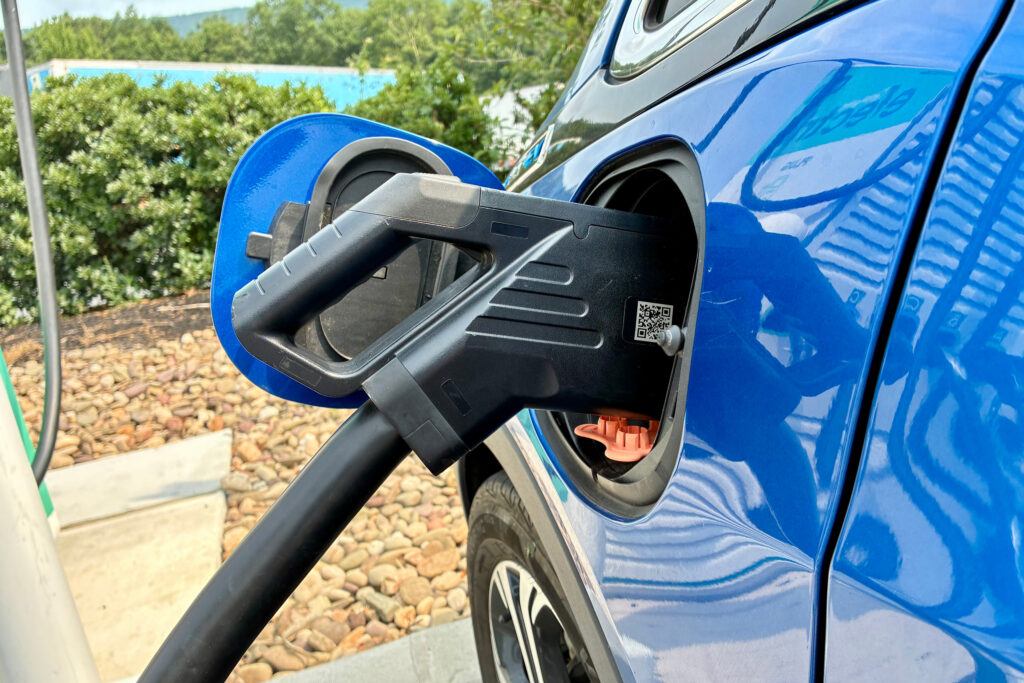
To test out the current NEVI network in Pennsylvania, Inside Climate News spent five hours at four NEVI-funded charger stations spread out along the Pennsylvania Turnpike this July. A 2017 Chevy Bolt made an ideal test subject, as the vehicle’s maximum charging speed (55 kilowatts) is about three times slower than the now-industry standard of 150 kilowatts, and much slower than the more than 350 kilowatts newer top models can reach. The Bolt also only reaches its top charging speed when its battery is 10 to 50 percent charged, after which it drops precipitously.
That means the vehicle has little room for error on a road trip, and thus presents a worst case scenario for traversing Pennsylvania’s highways in an EV. To avoid being stuck charging for hours on end, a roadtripping Bolt driver needs to pull into a charging station near empty and leave when the battery is about three-quarters full. Hitting that window just right requires a robust number of chargers along the route. Too few, and the driver will be forced to stop at inopportune times and sit through longer charging sessions.
Or even worse: anxiously watching the car’s predicted range, switching off AC and slowing down, all to squeeze out the miles needed to make the next charging station. Such range anxiety is now at the top of the list of reasons consumers are wary of buying electric vehicles, Brown said.
“In the 2010s, purchase price was the number one thing cited holding people back,” Brown said. “Now in the past five years, reliable charging access has kind of become that number one.”
So how did the decidedly non-roadtrip friendly Bolt do on a 240-mile route from Philadelphia to Johnstown, Pennsylvania and back again?
Surprisingly well.
Heading west on the Pennsylvania Turnpike, the first planned stop was the conveniently located charger station behind the Pizza Hut near the town of Bedford. At exactly 200 miles away (near the end of the Bolt’s 240-mile range) and just off the exit for Johnstown, it was an ideal location to recharge a low battery.
But driving at highway speeds on a hot day, the Bolt’s battery started draining more quickly than anticipated, and reaching Bedford became a dicey proposition. Not a problem: more NEVI-funded chargers could be found at Turnpike rest stops 25 miles and 60 miles closer. A 20-minute charging stop at one boosted the battery from 20 to 50 percent, adding 65 miles of range, while allowing for a bathroom break and the consumption of an Auntie Anne’s soft pretzel. No other drivers were present.
Next up were two stops at the Pizza Hut station, one on the way to Johnstown, and one on the way back the next morning. On the second visit, another driver was there: Mary Peters and her husband, EV enthusiasts from Detroit who were driving 530 miles to Baltimore to trade in their electric Ford F-150 Lightning for a Volkswagen ID. Buzz, an electric minivan.
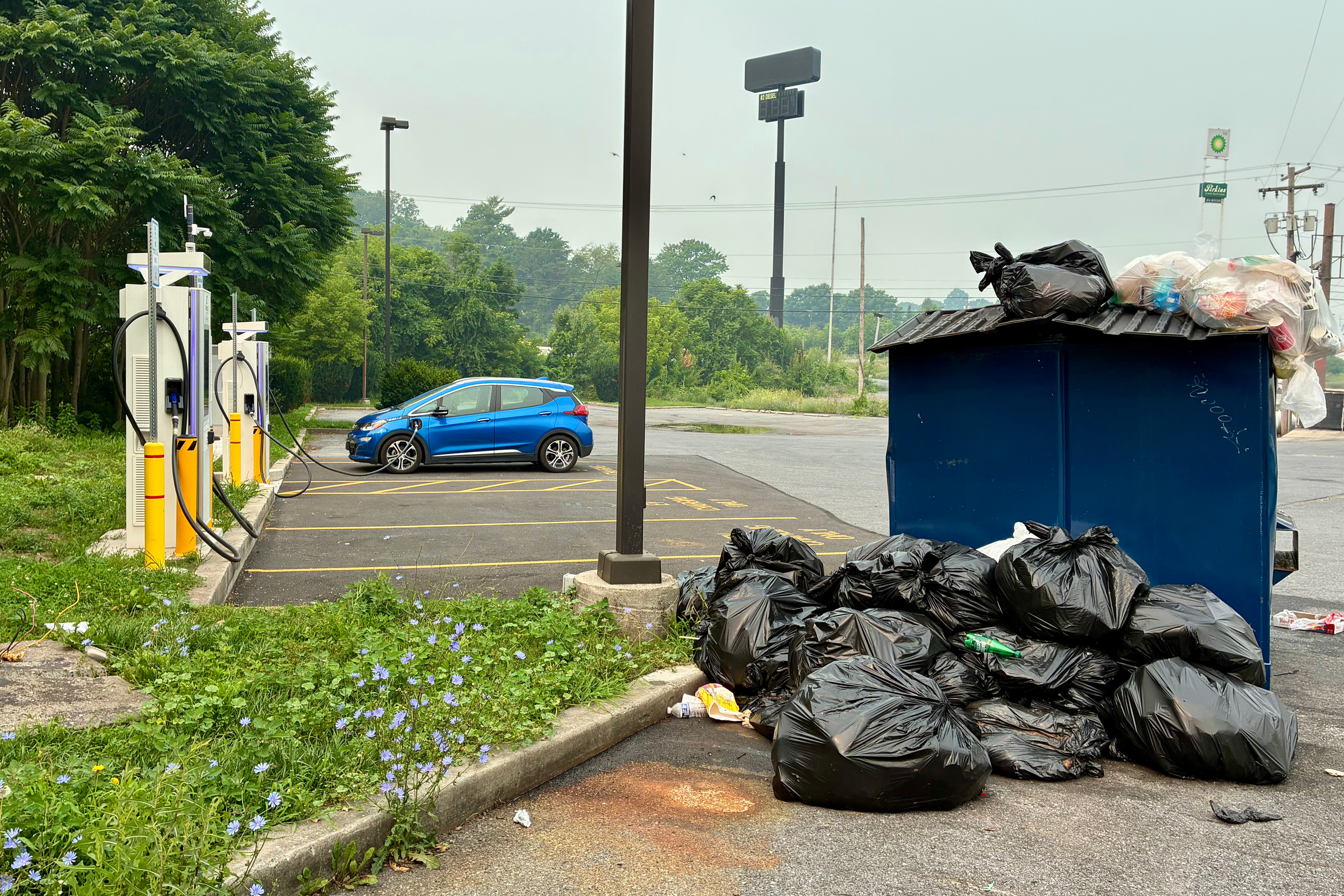
The couple has been “all EV” since 2022, she said, and used to experience range anxiety. But Peters works for an electric utility in Michigan and has firsthand knowledge of how many businesses are requesting connection to the grid to build chargers. The charger behind the Pizza Hut was a prime example—a station right where she needed it as she disembarked from the Pennsylvania Turnpike to head south into Maryland.
“I can tell you the infrastructure is growing,” Peters said. “It’s gotten a lot better… you can stop and charge at a fast charger for 30 minutes, and you’re out. We always time them around eating.”
The final scheduled stop was another NEVI-funded EV charger along the turnpike in Lancaster County, 150 miles east. But halfway there a detour to the state capital of Harrisburg was required, and the Bolt didn’t have enough power to make both.
This time there were no nearby NEVI stations to divert to. However, there were plenty of private options, and a quick stop at a charging station tucked aside a convenience store provided the needed boost. Later, a stop at the Lancaster charger finished the job. Once again, there were no other drivers present.
Looking in the Mirror
The trip may sound a bit chaotic, but the five-stop itinerary was due mostly to its fact-finding nature. Using a popular route-planning smartphone app for EV drivers, a straightforward trip could be done in two stops of about 50 minutes each, or three stops of 35 minutes.
That’s a long time to spend waiting for fuel. But the 2017 Chevy Bolt is not indicative of the EVs on the market today. A middle-of-the-road, newer electric SUV could do the trip in two stops of 30 minutes. Something really fancy could make do with two 10-minute stops, basically a gas-up-and-go experience, which the next generation of EVs are expected to finally match.
All three of these scenarios would involve a stop at a NEVI-funded charging station just off the Turnpike’s Blue Mountain exit, where Pennsylvania’s farmland meets the southern run of its Appalachian Mountains. Located outside a restaurant and ice cream parlor, the 10 chargers available there are drawing good reviews since opening in January 2026, the beneficiary of $811,000 in federal funding.
Brown, with Pennsylvania’s transportation agency, PennDOT, said the stop exemplifies exactly what the NEVI program required states to build with their federal dollars: high-quality, fast-charging, dependable stations located conveniently along highways.
“It essentially meant you have to have charging to a level that people can confidently travel the interstate highway system and have a place to charge when they need it,” Brown said, adding that a federal guidance that Pennsylvania followed— since scuttled by the Trump administration— required chargers to be placed no more than 50 miles apart.
He also said contrary to criticisms that NEVI is redundant, perhaps even wasteful compared to private industry, the program has proved essential to building out high-quality charging stops in Pennsylvania. There are over 2,000 EV charging stations in the state, and only 40 of them so far were built with the help of NEVI, he admitted. But only about 300 are fast chargers, and half of those are Tesla, which are not compatible with many other makes and models. That leaves just 150 fast chargers for cars like the Bolt.
Whittle it down further to reliable stations where there are at least four charging cords, Brown said, and the NEVI program represents “a decent proportion of the stations that any vehicle can drive up to use.” And while some stations may appear underused, he added, they’re balanced by others. In total, the NEVI-funded network in Pennsylvania saw 30,000 charging sessions in Q2 2026 for the first time, an average of about eight sessions per station per day.
That’s closing in on the 10-per-day mark that Brown says is a typical break-even point for a charging station. NEVI subsidies already make that math better for developers, providing up to 80 percent of capital costs, which is typically the most expensive proposition for a would-be developer.
“We’re still at 1 percent to 2 percent of cars on the road [being EV],” Brown said, meaning developers have to be cautious. “It really helps to have that capital incentive.”
But it isn’t clear that Pennsylvania’s NEVI buildout has so far insulated it from a nationwide downturn in EV demand. Sales of plug-in electric cars in the state fell 3.1 percent between Q1 2025 and 2026, according to the Alliance for Automotive Innovation, slightly better than the national average of 3.4 percent.
This story is funded by readers like you.
Our nonprofit newsroom provides award-winning climate coverage free of charge and advertising. We rely on donations from readers like you to keep going. Please donate now to support our work.
Donate NowStill, experts say some of that has to do with a rush to buy EVs prior to the expiration of federal tax credits last year, and Pennsylvania remains committed to its plans. Now that the state is nearing completion on its highway buildout—the turnpike plans to have EV chargers at all 17 of its rest stops by next spring—it is moving on to providing funding for community charging. Brown said that will begin in the state’s heavily populated southeast, where EV adoption is highest, and owners often have to endure long queues at public charging stations. The state took community applications this summer and is actively scoring them based on factors like location and cost, with construction likely to start next year.
“For Pennsylvanians, you’re good [to drive an EV] within the state, and probably within most of our surrounding states as well,” Brown said. “Great progress has been made, and we’re going to continue.”
A Bumpy Road in Washington
In the nation’s capital, however, continued support for EV charging remains precarious.
In an interesting twist, the slow, prescribed rollout of NEVI has actually helped protect it from Trump-era rollbacks, E&E News reported last fall. The program’s clearly delineated rules, approved by Congress, have made it difficult for the administration to exercise prerogative.
But the program hasn’t proven bulletproof. In 2025 it endured a funding freeze and a lawsuit, only to see Congress approve a $504 million rescission in NEVI funding in January 2026, dropping total funding from $5 billion to less than $4.5 billion. The rescission impacted 28 states, Washington, D.C., and Puerto Rico, all of which had not yet received their full 2022 allotments, which became subject to rescission.
On a percentage basis, Atlas Public Policy found, hit hardest were states like Nevada, which Atlas calculated could lose a third of its total NEVI allotment, enough to threaten its ability to build out a highway network. In total dollars, Texas, Florida and Missouri lost the most, and the nation now stands to have 3,700 fewer fast charging ports after the rescission, Atlas estimated.
Linda Bailey, a transportation consultant and former technical assistance team leader in the federal office that administered NEVI, said it’s hard to say just how far the remaining funds will go. Quick-acting states like Pennsylvania are in good shape, she said. But lagging states now face a fear of further reductions, making it difficult to confidently invest.
She predicts rural states in particular may end up falling behind. And they’ll also have less help after Bailey’s former office, the Joint Office of Energy and Transportation, was hollowed out in the first months of the second Trump administration.
“It’s really tough to complete a federal grant program if the federal agency you’re working with doesn’t want to help,” Bailey said.
The storm clouds hanging over the program extend to next year, when Congress is set to determine the latest round of federal highway funding, which moves in five-year cycles. As presently written, the House’s BUILD America 250 Act adds no further funding for the NEVI program, while cutting a sister program, the Charging and Fueling Infrastructure (CFI) program, from $2.5 billion to $1 billion.
Some Pennsylvania political leaders are already rallying to the cause, with a collection of State Representatives and county and city executives in April penning a letter to Pennsylvania’s Democratic U.S. Senator, John Fetterman, urging him to prioritize NEVI.
State Rep. Madsen, a signee of the letter whose Harrisburg office became an impromptu stop on the Bolt trip, said his district is making progress on the clean energy transition, with the local Steelton-Highspire School District becoming a state leader in solar installation and school bus electrification.
Madsen’s House district has just one public charger, and he’s fielding calls from constituents asking for more. More federal funding will become even more critical in districts like his, he predicts, as adoption increases.
“Once EVs become cost effective and people can save money and they’re as efficient,” Madsen predicts, “You’ll see people make that transition.”
About This Story
Perhaps you noticed: This story, like all the news we publish, is free to read. That’s because Inside Climate News is a 501c3 nonprofit organization. We do not charge a subscription fee, lock our news behind a paywall, or clutter our website with ads. We make our news on climate and the environment freely available to you and anyone who wants it.
That’s not all. We also share our news for free with scores of other media organizations around the country. Many of them can’t afford to do environmental journalism of their own. We’ve built bureaus from coast to coast to report local stories, collaborate with local newsrooms and co-publish articles so that this vital work is shared as widely as possible.
Two of us launched ICN in 2007. Six years later we earned a Pulitzer Prize for National Reporting, and now we run the oldest and largest dedicated climate newsroom in the nation. We tell the story in all its complexity. We hold polluters accountable. We expose environmental injustice. We debunk misinformation. We scrutinize solutions and inspire action.
Donations from readers like you fund every aspect of what we do. If you don’t already, will you support our ongoing work, our reporting on the biggest crisis facing our planet, and help us reach even more readers in more places?
Please take a moment to make a tax-deductible donation. Every one of them makes a difference.
Thank you,