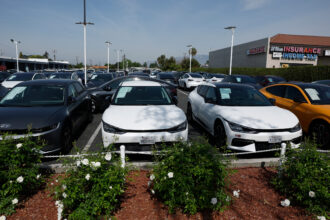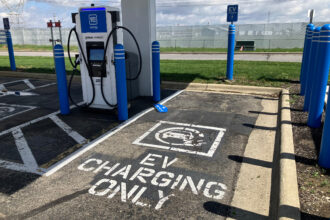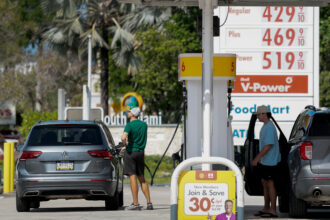


The U.S. electric vehicle market continues to suffer through a long hangover following the cancellation of federal tax credits.
One of the keys to recovery is a model, or hopefully several models, that grab the public’s attention and exceed sales forecasts. Among the candidates is the Rivian R2, an SUV that began deliveries last month.
But it’s difficult to declare any model as the savior in a market that continues to struggle.
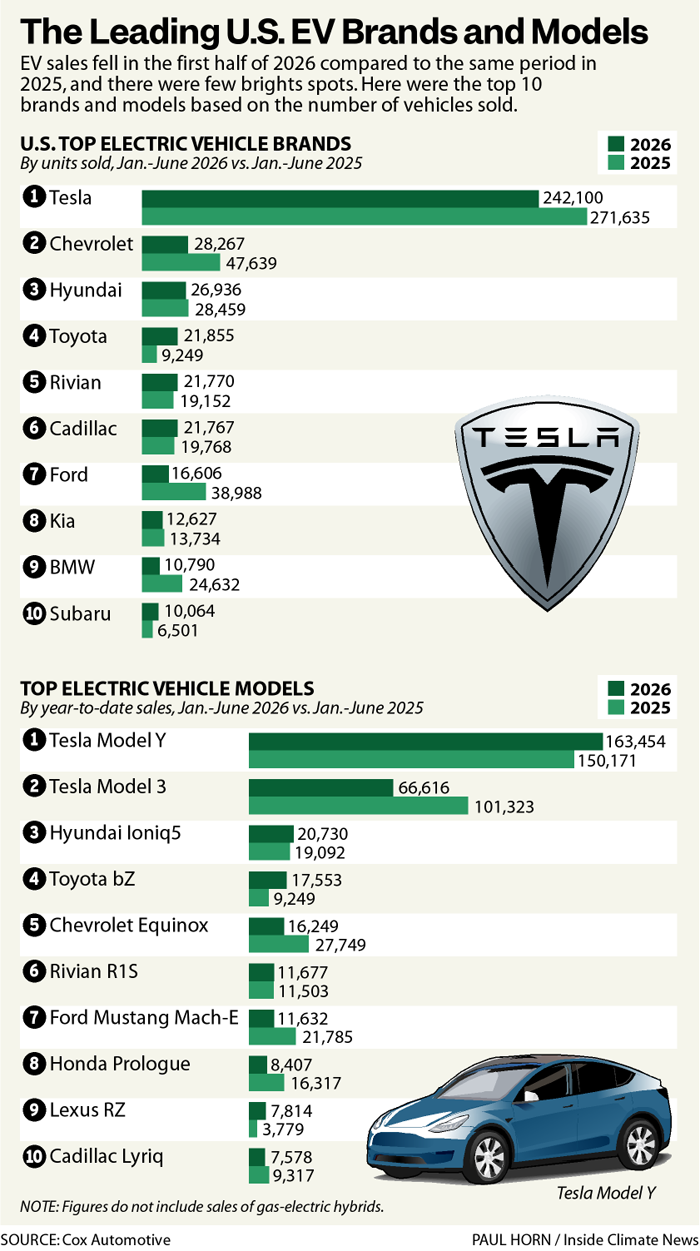
Automakers sold 462,892 all-electric vehicles in the first half of 2026, down 23.8 percent from the first half of last year, according to Cox Automotive. EV market share was 6 percent in the most recent quarter, down from a high of 11 percent last year in the rush to buy right before the tax credits ended.
Toyota, Rivian, Cadillac and Subaru stand out as brands posting sales increases. Tesla remained the market leader but continued to lose ground, although the size of its decrease, 10.9 percent, was smaller than some analysts had expected.
“We knew this was going to be a year of the market really finding what natural EV demand is,” said Stephanie Valdez Streaty, Cox Automotive’s director of industry insights. “That’s kind of where we’re at right now.”
Valdez Streaty senses that the market has not bottomed out following the cancellation of federal tax credits on Sept. 30 of last year, but she thinks the bottom is close, after which a recovery will begin.
She can see this in the numbers: First-quarter EV sales were down 27.3 percent compared to the first quarter of the prior year, and second-quarter sales were down 20.5 percent compared to the second quarter of the prior year, which indicates a narrowing of losses.
A year ago, President Donald Trump signed the One Big Beautiful Bill Act, which reduced or eliminated tax credits designed to encourage a shift to clean energy sources. The EV tax credits provided up to $7,500 for a new car or light truck and $4,000 for a used vehicle and would have been in effect until 2032. Now, the credits are gone, although some states are seeking to fill the void. California is offering a $3,500 credit for first-time EV buyers, signed this week by Gov. Gavin Newsom.
Meanwhile, gas-electric hybrids are having a moment. Hybrids, which already have higher market share than all-electric vehicles, are on track to increase their sales by 9 percent in 2026, outpacing the overall market for cars and light trucks, including gasoline models, which are expected to grow about 2 percent, according to Cox.
The most successful hybrids are models such as the Toyota RAV4 Hybrid, which has no plug and uses a battery to provide additional fuel economy to a vehicle that is already a top seller, with minimal increase in the sticker price.
The formula for the EV market to return to growth lies in winning over customers who have never owned an EV, said Stephanie Brinley, an analyst at Mobility Global, the company that recently spun off from S&P Global Mobility.
“EVs need to compete with ICE vehicles in one way, shape or form,” she said, referring to the abbreviation for vehicles with internal combustion engines. “If it’s not on price, it’s got to be on what you’re delivering.”
In other words, EVs need to be the best option for someone to make that leap of faith.
Once someone has an EV, it’s like preaching to the converted. The vehicles offer smooth acceleration and handling and provide a sense of freedom from the costs and hassles of gasoline.
Brinley doesn’t see any blockbuster models in today’s EV market or the near future. There’s nothing on the horizon like the Tesla Model 3, which helped transform the industry in 2017.
“It’s not that there aren’t compelling and interesting products coming up,” she said. But there isn’t anything that “is going to fundamentally change the conversation.”
This story is funded by readers like you.
Our nonprofit newsroom provides award-winning climate coverage free of charge and advertising. We rely on donations from readers like you to keep going. Please donate now to support our work.
Donate NowAs I spoke with analysts this week, I was also shopping for a car for my household. My family’s 2007 Pontiac Vibe is no longer drivable and we need a replacement right away.
I’d like to buy an EV, preferably a used one. One thing that gives me pause is that many of the most affordable models get rotten reliability scores from organizations such as Consumer Reports.
This is a less-discussed obstacle to expanding EV market share. Too many models in recent years have a history of battery problems and other mechanical or electronic concerns.
“It’s worth knowing for the average consumer and anyone, really, that the reliability that we see with electric vehicles, overall, and plug-in hybrids as well, is less than that of traditional gas cars and hybrid vehicles,” said Alex Knizek, director of auto test development for Consumer Reports.
But there are reliable EVs out there, he said.
Knizek cited the Tesla Model Y as a standout for reliability, and said several automakers are releasing models with excellent road-test scores. Examples include the Nissan Leaf, Subaru Solterra and Toyota bZ, along with the BMW and Mercedes-Benz EV lineups as a whole.
While his overall message—EVs are less reliable than gasoline models—is discouraging for prospective buyers like me, he did strike an optimistic tone about the near future.
“Things are going to get better,” he said.
Other stories about the energy transition to take note of this week:
The U.S. Auto Industry Flirts With Obsolescence: It’s good to take a step back to examine all that’s gone wrong with the U.S. auto industry’s missteps on EVs and over-reliance on large trucks and SUVs. Matthew Shaer takes the long view in a story for The New York Times Magazine. Many of the episodes he recounts are familiar, but when viewed as part of a narrative it underscores the scale of mistakes that brought us to this moment.
Toyota Wants a Team-Up to Confront Competition: Toyota Vice Chairman Koji Sato wants to standardize certain parts among Japanese automakers to cut costs and better enable the companies to compete, as Suvrat Kothari reports for InsideEVs.com, citing comments made at an event covered by Automotive News. While Sato didn’t say the idea would help against Chinese automakers, the context is clear for anyone paying attention as Japanese automakers lose market share to Chinese competitors. Toyota could work with Honda, Nissan and others.
Offshore Wind Already Producing Results in New England: The New England grid got a boost from newly operational offshore wind farms during recent heatwaves, helping to reduce the need for highly polluting peaker plants, as Maria Gallucci reports for Canary Media. The Trump administration has used just about every tool at its disposal to slow development of offshore wind. But several projects are now running, and it’s becoming clear how they fit into the mix of resources available to the regional grid.
Heat Pumps May Be Approaching a Tipping Point: Heat pumps, which are electric systems for household heating and cooling, continue to gain market share and move into the mainstream, as Matt Simon reports for Grist. A new report from the Building Decarbonization Coalition shows that heat pump sales have doubled over the last 15 years and have outpaced gas furnaces sales in the first quarter. This is encouraging because heat pumps are much more efficient and better for the climate than options that burn fossil fuels.
ESS Tech Has New Product, Part of Sodium-Ion Battery Boom: Oregon-based ESS Tech has said it is developing a 1.2-megawatt-hour sodium-ion battery that can easily be stacked to increase capacity, as Brian Martucci reports for Utility Dive. This is the latest of several U.S. companies that see a bright future for sodium-ion batteries, which have the potential to be less expensive than the dominant technology, lithium-ion batteries. I wrote recently about Peak Energy’s partnership with General Motors on sodium-ion batteries.
Inside Clean Energy is ICN’s weekly bulletin of news and analysis about the energy transition. Send news tips and questions to [email protected].
About This Story
Perhaps you noticed: This story, like all the news we publish, is free to read. That’s because Inside Climate News is a 501c3 nonprofit organization. We do not charge a subscription fee, lock our news behind a paywall, or clutter our website with ads. We make our news on climate and the environment freely available to you and anyone who wants it.
That’s not all. We also share our news for free with scores of other media organizations around the country. Many of them can’t afford to do environmental journalism of their own. We’ve built bureaus from coast to coast to report local stories, collaborate with local newsrooms and co-publish articles so that this vital work is shared as widely as possible.
Two of us launched ICN in 2007. Six years later we earned a Pulitzer Prize for National Reporting, and now we run the oldest and largest dedicated climate newsroom in the nation. We tell the story in all its complexity. We hold polluters accountable. We expose environmental injustice. We debunk misinformation. We scrutinize solutions and inspire action.
Donations from readers like you fund every aspect of what we do. If you don’t already, will you support our ongoing work, our reporting on the biggest crisis facing our planet, and help us reach even more readers in more places?
Please take a moment to make a tax-deductible donation. Every one of them makes a difference.
Thank you,

Dan Gearino
Reporter, Clean Energy
Dan Gearino covers the business and policy of renewable energy and utilities, often with an emphasis on the midwestern United States. He is the main author of ICN’s Inside Clean Energy newsletter. He came to ICN in 2018 after a nine-year tenure at The Columbus Dispatch, where he covered the business of energy. Before that, he covered politics and business in Iowa and in New Hampshire. He grew up in Warren County, Iowa, just south of Des Moines, and lives in Columbus, Ohio.