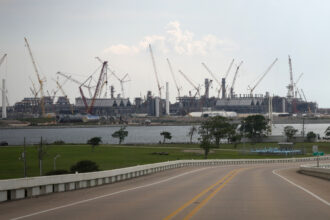
A gas export terminal on the Gulf Coast of Texas has routinely violated air pollution permits for years with little consequences from state regulators, according to a report released this week by Oilfield Witness, an environmental watchdog.
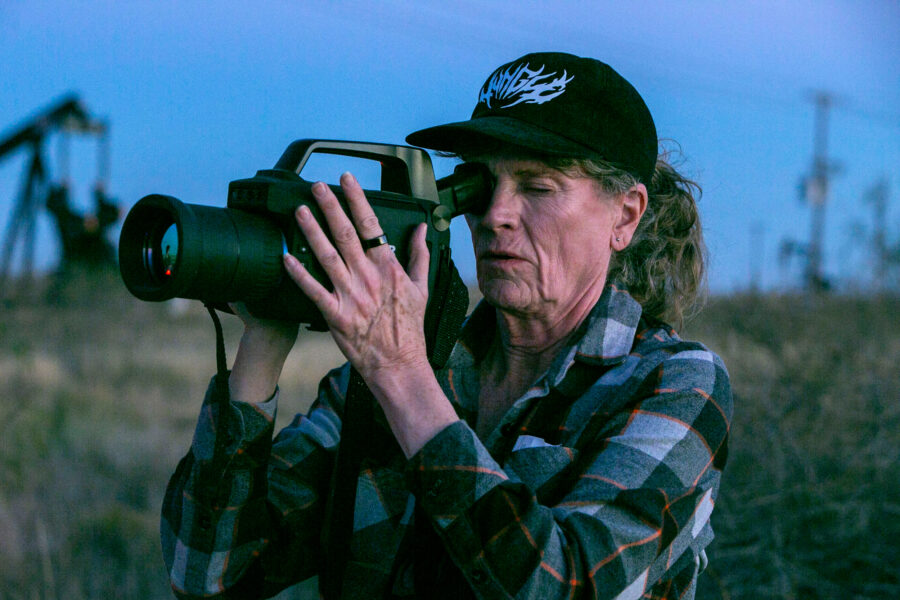
The Texas-based activist group cited thousands of pages of documents and a month of optical gas monitoring in its 27-page report on Freeport LNG, the nation’s third-largest exporter of liquified natural gas, where an explosion in 2022 caused an eight-month shutdown.
Oilfield Witness identified 532 unpermitted emission events reported by the company since 2019, along with more than 200 other permit deviations, but just seven penalty fines levied by the Texas Commission on Environmental Quality.
“The findings in this report paint a stark picture of an out of control operator,” said the report. “This incompetence is enabled by regulators failing to act.”
The report tallied annual emissions more than 100 times greater than established limits. It also found that part of the $14 billion Freeport LNG complex reported emitting a staggering 1,500 pounds of the carcinogen benzene, known to cause leukemia, in 2024—five times more than its larger counterpart down the coast, Corpus Christi LNG.
A spokesperson for Freeport LNG, Heather Browne, said in a statement: “Freeport LNG’s unwavering commitment to safety, reliability and environmental stewardship and preservation are at the forefront of our operations. Our electric-drive LNG facility reduces plant emissions by over 90% relative to a typical LNG liquefaction facility, and our facility’s carbon footprint is the lowest of any LNG liquefaction facility in the world.”
Freeport LNG is currently expanding with a fourth liquefaction unit in development.
Earlier in September, Japan’s state-owned lender announced an investigation into its $2.6 billion financing for the project following complaints from community leaders and environmental groups, Global Trade Review magazine reported on Wednesday.
“Japanese financial institutions and companies are deeply involved in the Freeport LNG project,” said Ayumi Fukakusa, executive director of climate, energy, and development at Friends of the Earth Japan, in a press release Thursday. “They should re-examine the environmental and social risks.”
Fifty miles south of Houston, Freeport LNG is one of several gas liquefaction and export terminals that have cropped up along the coast of Texas and Louisiana in recent years. Through energy-intensive processes, the enormous installations super-cool methane gas into liquid at -260 degrees Fahrenheit, then load it onto tanker ships for consumption overseas.
“Texas remains the nation’s leading producer of natural gas and our state’s LNG export capacity plays a vital strategic role in strengthening America’s energy security,” Ed Longanecker, president of the Texas Independent Producers and Royalty Owners Association, said in a May newsletter.
A 2023 investigation by Inside Climate News showed how Freeport LNG, a project of New York billionaire Michael Smith, used a series of permit amendments to avoid a stricter review by the Texas Commission on Environmental Quality, known as the TCEQ. The facility was ultimately authorized to release almost 900 tons of regulated pollutants per year.

Chronic Emission Violations
Actual emissions from the facility appear much higher than the permitted limits, according to Oilfield Witness. For example, one flare at the complex was authorized to release 3.3 tons of carbon monoxide per year but reported emissions of 381 tons in the year after July 2019.
Another part of the Freeport LNG complex burnt off waste gas at more than six times its permitted rate for the most recent yearlong reporting period.
“Oilfield Witness makes a strong case that the facility has trouble following the law,” said Luke Metzger, director of Environment Texas. “With such a tepid response to their violations from TCEQ, it’s not hard to see why.”
This story is funded by readers like you.
Our nonprofit newsroom provides award-winning climate coverage free of charge and advertising. We rely on donations from readers like you to keep going. Please donate now to support our work.
Donate NowAccording to Oilfield Witness, TCEQ has issued 76 violation notices to Freeport LNG since it opened in 2019, leading to seven fines totaling $610,000—about 2 percent of the facility’s estimated 2025 revenue.
Bobby Janecka, a former TCEQ commissioner, said the agency is doing the best it can with limited resources. It oversees thousands of industrial facilities across the state and lacks capacity to monitor them all. So the regulator depends on companies’ own emission reporting. Levying punitive fines on companies might only encourage them not to report violations, Janecka said.
“As much as this state relies on self-reporting and data collection from the industry itself, it’s imperative that TCEQ keeps in mind that long-term relationship,” he said.
Fines also make the agency vulnerable to long and expensive legal challenges from the companies, he said. Even when the TCEQ doesn’t impose fines, it puts companies through processes meant to correct the problems that led to unpermitted emissions.
“The agency is always quick to focus on achieving compliance even if it means doing so in lieu of a penalty,” said Janecka, who spent 12 years at the TCEQ.
At Freeport LNG, all of the largest emission events in the last two years resulted from units tripping, according to TCEQ data compiled by Texas-based oil and gas watchdog group Future Heist.
In the largest, on Nov. 1, 2024, three units at Freeport LNG “tripped due to an incoming power feed interruption. The trips resulted in unavoidable venting,” according to company reports. Gas was burned off for 62 hours at one part of the complex and for 55 hours at another.
On May 7, 2025, the same three units again “tripped due to an incoming power feed interruption,” leading the company to burn off gas for 19 hours.
On July 9, 2026, the facility “tripped due to a mechanical issue,” according to company reports, leading it to burn off gas for 14 hours. One week later the facility “tripped due to an incoming power feed interruption” and burnt off gas for 17 hours.
“Freeport frequently claims to have resolved deviations by adjusting operating parameters, only to report the same problem the following year,” said the Oilfield Witness report. “Each time, regulators accept the same parameter adjustments that failed to thoroughly resolve the problem previously.”
A TCEQ spokesperson, Richard Richter, said the agency has responded to over 19,000 complaints and conducted 200,000 investigations in the last two years.
“TCEQ’s Environmental Crimes Unit conduct investigations related to intentional falsification or knowing disregard of emissions reporting requirements,” he said. “The Agency investigates all emission events that exceed reportable quantities and allocates resources to meet the needs of the state in order to protect human health and natural resources.”
About This Story
Perhaps you noticed: This story, like all the news we publish, is free to read. That’s because Inside Climate News is a 501c3 nonprofit organization. We do not charge a subscription fee, lock our news behind a paywall, or clutter our website with ads. We make our news on climate and the environment freely available to you and anyone who wants it.
That’s not all. We also share our news for free with scores of other media organizations around the country. Many of them can’t afford to do environmental journalism of their own. We’ve built bureaus from coast to coast to report local stories, collaborate with local newsrooms and co-publish articles so that this vital work is shared as widely as possible.
Two of us launched ICN in 2007. Six years later we earned a Pulitzer Prize for National Reporting, and now we run the oldest and largest dedicated climate newsroom in the nation. We tell the story in all its complexity. We hold polluters accountable. We expose environmental injustice. We debunk misinformation. We scrutinize solutions and inspire action.
Donations from readers like you fund every aspect of what we do. If you don’t already, will you support our ongoing work, our reporting on the biggest crisis facing our planet, and help us reach even more readers in more places?
Please take a moment to make a tax-deductible donation. Every one of them makes a difference.
Thank you,

Dylan Baddour
Reporter, Austin
Dylan Baddour covers the energy sector and environmental justice in Texas. Born in Houston, he’s worked the business desk at the Houston Chronicle, covered the U.S.-Mexico border for international outlets and reported for several years from Colombia for media like The Washington Post, BBC News and The Atlantic. He also spent two years investigating armed groups in Latin America for the global security department at Facebook before returning to Texas journalism. Baddour holds bachelor’s degrees in journalism and Latin American studies from the University of Texas at Austin. He has lived in Argentina, Kazakhstan and Colombia and speaks fluent Spanish.