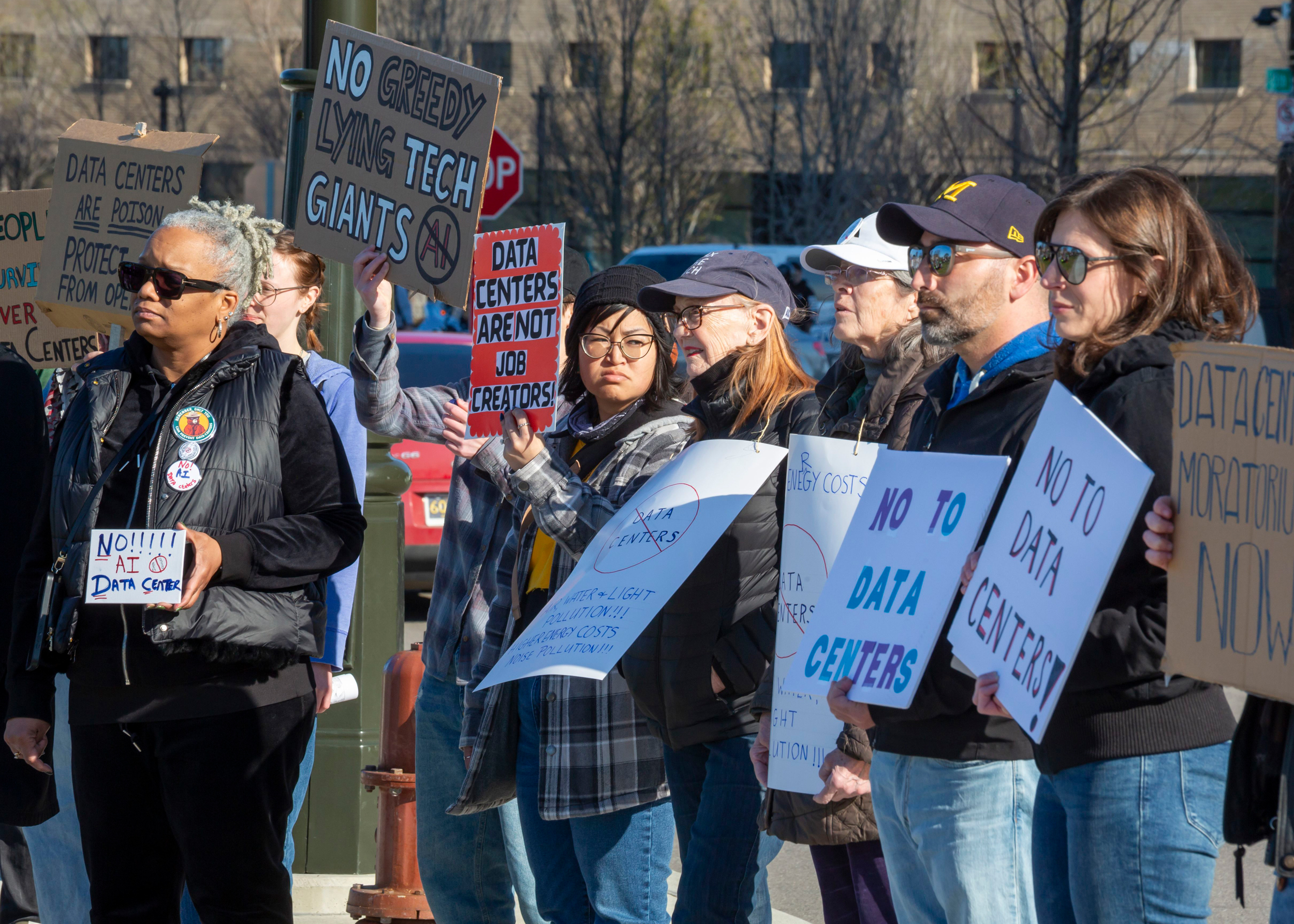


Plans for a 26-megawatt data center that surfaced in Allen Park, Michigan, last year quickly ignited a groundswell of opposition from residents in the small, working-class Detroit suburb. As in dozens of other communities across Michigan where similar facilities were proposed, they feared pollution, increased energy rates, overuse of water and a host of other problems.
Among those who organized the opposition: Joanna Whaley, who was running for a state House seat against a data center-supporting member of a political family that has for decades represented the region.
Whaley, a pastor, said she got involved because it sounded like the community was suffering an “existential crisis” similar to those she encounters in church. She helped organize hundreds of people who protested and showed up to city meetings, and they successfully pressured city leaders to vote down the Solstice Data center.
“We believe that public pressure was why this data center was stopped,” Whaley told Inside Climate News. This victory, along with Whaley’s calls to rein in the unpopular DTE Energy utility, helped propel Whaley in her Aug. 4 primary win.
The controversial facilities turned into a major issue in races across Michigan, from city councils to the U.S. Senate, and candidates with strong anti-data center positions cleaned up. Whaley was part of a wave of at least 14 anti-data center candidates who defeated pro-data center opponents in both parties’ primaries.
Many come from environmental justice backgrounds and back moratoria on new data centers, strong clean energy requirements, water-use limits and requiring big tech pay for soaring electricity costs.
The centers are widely loathed by residents across the political spectrum here, but many pro-business Democrats have staunchly supported them. Legislation for data center tax breaks with little meaningful protections for the environment or ratepayers bitterly divided Democrats in late 2024. A few months ago, Gov. Gretchen Whitmer was caught laughing as she apparently told Oracle CEO Clay Magouyrk, “We’re used to people saying no and doing it anyway.”
The primary results show how political support for unpopular data centers can come with a real cost, and the results are instructive for those who want to win in this critical swing state in 2028.
“Voters are saying that they do not want data centers and that is very clear from the election results,” said Yousef Rabhi, a clean energy advocate and vocal data center opponent who helped organize against centers proposed near Ann Arbor, where he won the Democratic nomination for mayor. “It is one of the issues that is the most unifying as a state and country, and across political divides.”

At the top of the ballot, in the Democratic U.S. Senate primary, Abdul El-Sayed supported state and local moratoria, and U.S. Rep. Haley Stevens did not, while federal election records show she was backed by big tech and the utilities. Voters also chose Donavan McKinney in the state’s 13th Congressional District—he has vocally supported a federal moratorium and reining in DTE Energy, and he did not take corporate donations.
On the state’s west side, GOP state Rep. Steve Carra, a fierce data center critic, fended off an onslaught of spending by groups tied to Consumers Energy that sought to oust him. The nearly $300,000 in spending is extremely high for a small House district. In rural Augusta Township, where the electorate is split among Democrats and Republicans, residents voted down a rezoning proposal to allow a data center to be built.
The issue also seemed to cut across socio-economic lines, said Chris Gilmer-Hill, part of leadership at the Michigan Environmental Justice Council, a grassroots nonprofit that lobbies and mobilizes the public against data centers. He won a four-way race in a Democratic state House primary and beat an incumbent who voted for the data center tax breaks in 2024.
The diverse district spans low-income neighborhoods in Detroit that are often also lower-information, to wealthier suburbs north of the city, where residents are more tuned in to issues like data center controversies. Gilmer-Hill told Inside Climate News he heard opposition to the centers and fears over how they would impact pocketbooks while knocking on doors across the district.
“People see this thing coming into their community that poses a very real risk in terms of higher rates, environmental damages, etcetera, but they also see that there’s no benefit to them,” Gilmer-Hill said. “People aren’t dumb—they see what’s happening.”
In a tight three-way U.S. House race near Lansing, Sunrise Movement co-founder William Lawrence took the strongest position on data centers, calling for a national moratorium. He beat two establishment Democrats as the issue took center stage.
His primary opponents, as well as his general election opponent, Republican U.S. Rep. Tom Barrett, have each taken a position that local communities should have control to decide whether they want centers. Barrett, meanwhile, supported President Donald Trump’s tax bill that provided tax incentives for data centers.
This story is funded by readers like you.
Our nonprofit newsroom provides award-winning climate coverage free of charge and advertising. We rely on donations from readers like you to keep going. Please donate now to support our work.
Donate NowLawrence said that is effectively a pro data-center position, and pointed to what happened in Saline Township, a small municipality where residents overwhelmingly opposed plans for a center supported by Oracle, Open AI, Whitmer and Trump. The companies threatened to sue, and Saline Township leaders, fearful of being vastly outgunned, quickly buckled. The center is under construction.
“Open AI and Oracle said ‘We have $1 trillion and you don’t so we dare you to take us on in court,’” Lawrence said. “The township feared they would be bankrupted and didn’t think they could stand up to these behemoths because of the imbalance in resources, and that shows you what local control amounts to.”
Four data centers are planned around Ann Arbor, where voters chose Rabhi, who was the utility’s biggest foe during his 2016-2022 legislative tenure. He won along with a council candidate opposed to centers. Rabhi’s opponent in the primary, establishment Mayor Chris Taylor, was not a vocal supporter of the centers, but also did not take a strong stand against them.
“My campaign did an effective job of taking a strong position on data centers, there was no hand wringing on my end, and my point all along was that it’s not just Ann Arbor,” Rabhi said, noting that a new gas plant proposed for just outside of Ann Arbor would have impacted its residents. He was among a coalition of local leaders who pressured Consumers Energy to rescind the plans. Incumbent Ann Arbor leadership was not part of that coalition.
Meanwhile, progressive attorney general candidate Eli Savit, who bucked corporate PAC money and promised to rein in the utilities, beat a utility-backed opponent. Current Michigan Attorney General Dana Nessel, who is term-limited, has been a nation-leading consumer advocate in the fight against exploitation by data centers, and that will likely continue under Savit.
The results also bode well for a campaign spearheaded by Voters Not Politicians that aims to ban utilities from making political contributions to state lawmakers. DTE and Consumers Energy, the two largest utilities, are widely loathed because of the state’s poor reliability and cost increases. Their support for data centers has only fueled the anger, but state politicians have failed to take steps to protect residential customers.
Both companies widely donate to state politicians, and residents see the connection, data center opponents say.
“Two years ago we sounded the alarm on what the data center boom meant for Michigan; higher utility bills, more air and water pollution, and regular Michiganders being forced to foot the bill for Silicon Valley billionaire’s infrastructure in their job-killing AI race with each other,” said Christy McGillivray, executive director of Voters Not Politicians. “We knew it wasn’t just bad policy—it’s also terrible politics. Elections since then have proved we were right, and proved that politicians should listen to nonpartisan advocates instead of big tech and utility lobbyists.”
About This Story
Perhaps you noticed: This story, like all the news we publish, is free to read. That’s because Inside Climate News is a 501c3 nonprofit organization. We do not charge a subscription fee, lock our news behind a paywall, or clutter our website with ads. We make our news on climate and the environment freely available to you and anyone who wants it.
That’s not all. We also share our news for free with scores of other media organizations around the country. Many of them can’t afford to do environmental journalism of their own. We’ve built bureaus from coast to coast to report local stories, collaborate with local newsrooms and co-publish articles so that this vital work is shared as widely as possible.
Two of us launched ICN in 2007. Six years later we earned a Pulitzer Prize for National Reporting, and now we run the oldest and largest dedicated climate newsroom in the nation. We tell the story in all its complexity. We hold polluters accountable. We expose environmental injustice. We debunk misinformation. We scrutinize solutions and inspire action.
Donations from readers like you fund every aspect of what we do. If you don’t already, will you support our ongoing work, our reporting on the biggest crisis facing our planet, and help us reach even more readers in more places?
Please take a moment to make a tax-deductible donation. Every one of them makes a difference.
Thank you,

Tom Perkins
Contributor
Tom Perkins is a freelancer living in Detroit who focuses on toxic chemicals and corporate wrongdoing.