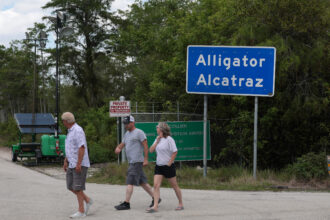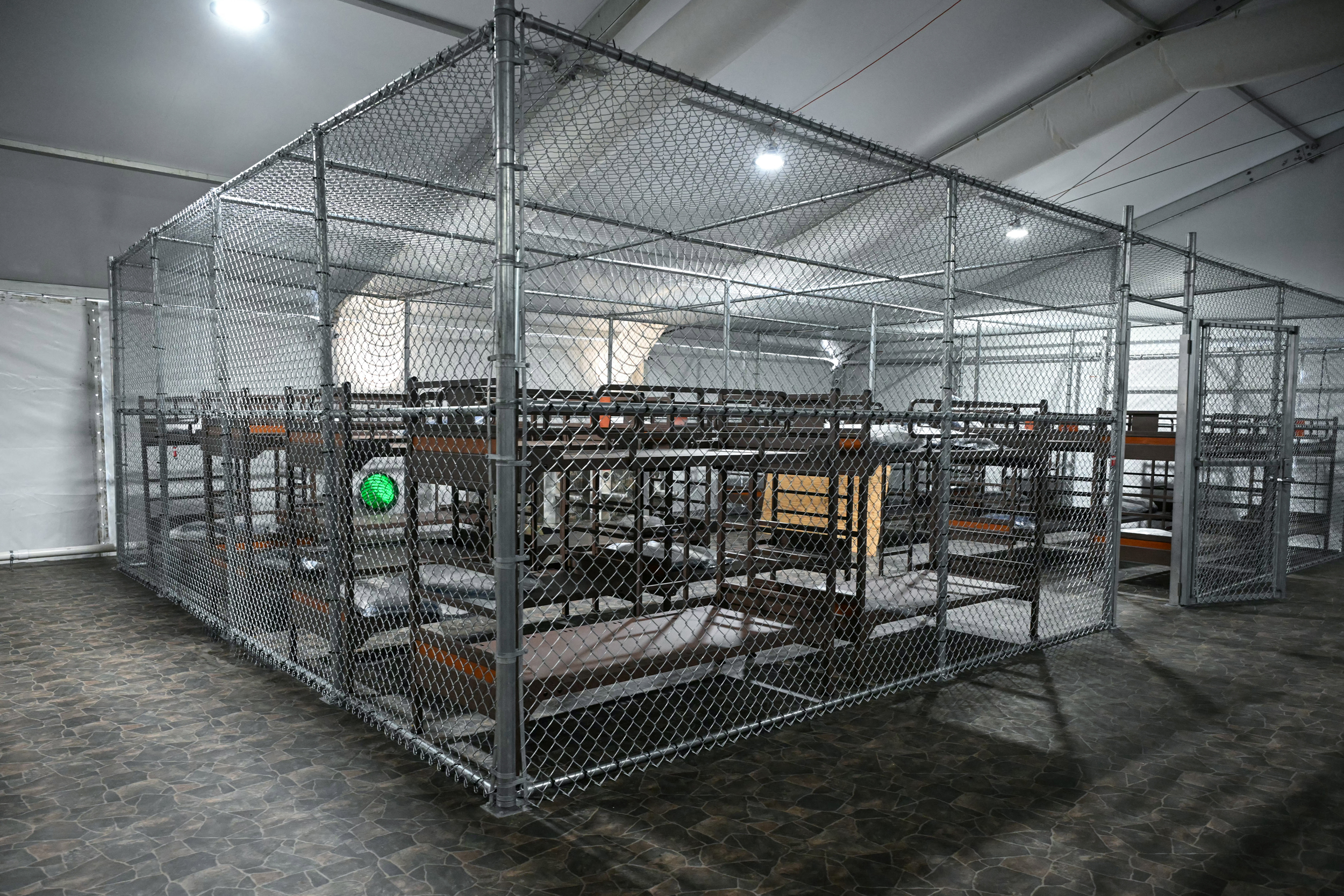


Florida plans to shut down the Everglades migrant detention site known as Alligator Alcatraz as soon as early June, according to a news report.
Officials at the site told vendors this week the facility, which is located in a sensitive region of the river of grass, will close and detainees will be moved elsewhere, The New York Times reported. State Rep. Anna Eskamani (D-Orlando) confirmed the reporting to Inside Climate News, citing conversations with two congressional members she declined to identify publicly. But Gov. Ron DeSantis, a Republican, was vague about the facility’s future when asked about it Wednesday during a news briefing.
“I don’t think you get the job done without that close cooperation where we are assisting in this important mission, but if they have beds other places where they’re able to do it, that’s fine. That was never meant to be permanent,” he said. “We didn’t build any permanent facilities down there because we knew it was going to be temporary. Now, I have not gotten official word that they’re going to not be sending illegal aliens there.”
The Florida Division of Emergency Management was similarly vague in a statement provided to Inside Climate News: “If federal operational needs evolve and the Department of Homeland Security implements alternative plans for the South Florida detention facility, the state will pivot accordingly.”
The Department of Homeland Security added in a statement: “Any reports that DHS is pressuring the state to cease operations at Alligator Alcatraz are false. Florida continues to be a valuable partner in advancing President Trump’s immigration agenda, and DHS appreciates their support. DHS continuously evaluates detention needs and requirements to ensure they meet the latest operational requirements.”
The development comes after the 11th U.S. Circuit Court of Appeals in April invalidated a preliminary injunction issued by U.S. District Court Judge Kathleen Williams, who in August 2025 had ordered the facility to wind down. The case now will go back to Williams, who will decide next steps.
The ruling enabled the detention facility to continue operating while environmental groups and the Miccosukee Tribe pursue litigation over environmental concerns at the site. The plaintiffs say the federal and state governments unlawfully rushed the facility to completion without a required environmental review under the National Environmental Policy Act.
The government agencies contend the site is a state and not a federal one, and that therefore such a review is not necessary. The agencies also say the facility’s impact on the environment is minimal.
The Everglades are responsible for the drinking water of millions of people in the state. A $27 billion restoration effort is among the most ambitious of its kind in human history.
Alligator Alcatraz opened in early July 2025 as part of the Trump administration’s immigration crackdown. The environmental groups said they plan to continue their litigation despite the detention facility’s expected closure. They said that based on published reports, the site would be shuttered just days before they are scheduled to resume their litigation in the U.S. District Court in the Southern District of Florida.
“We are not letting up in court,” said Eve Samples, executive director of Friends of the Everglades, one of the groups involved in the litigation. “Even when it does close it will be really important to press forward to full remediation of the harm that was caused, and our legal team is in very active talks about how to ensure that outcome.”
About This Story
Perhaps you noticed: This story, like all the news we publish, is free to read. That’s because Inside Climate News is a 501c3 nonprofit organization. We do not charge a subscription fee, lock our news behind a paywall, or clutter our website with ads. We make our news on climate and the environment freely available to you and anyone who wants it.
That’s not all. We also share our news for free with scores of other media organizations around the country. Many of them can’t afford to do environmental journalism of their own. We’ve built bureaus from coast to coast to report local stories, collaborate with local newsrooms and co-publish articles so that this vital work is shared as widely as possible.
Two of us launched ICN in 2007. Six years later we earned a Pulitzer Prize for National Reporting, and now we run the oldest and largest dedicated climate newsroom in the nation. We tell the story in all its complexity. We hold polluters accountable. We expose environmental injustice. We debunk misinformation. We scrutinize solutions and inspire action.
Donations from readers like you fund every aspect of what we do. If you don’t already, will you support our ongoing work, our reporting on the biggest crisis facing our planet, and help us reach even more readers in more places?
Please take a moment to make a tax-deductible donation. Every one of them makes a difference.
Thank you,

Amy Green
Reporter, Florida
Amy Green covers the environment and climate change from Orlando, Florida. She is a mid-career journalist and author whose extensive reporting on the Everglades is featured in the book MOVING WATER, published by Johns Hopkins University Press, and podcast DRAINED, available wherever you get your podcasts. Amy’s work has been recognized with many awards, including a prestigious Edward R. Murrow Award and Public Media Journalists Association award.