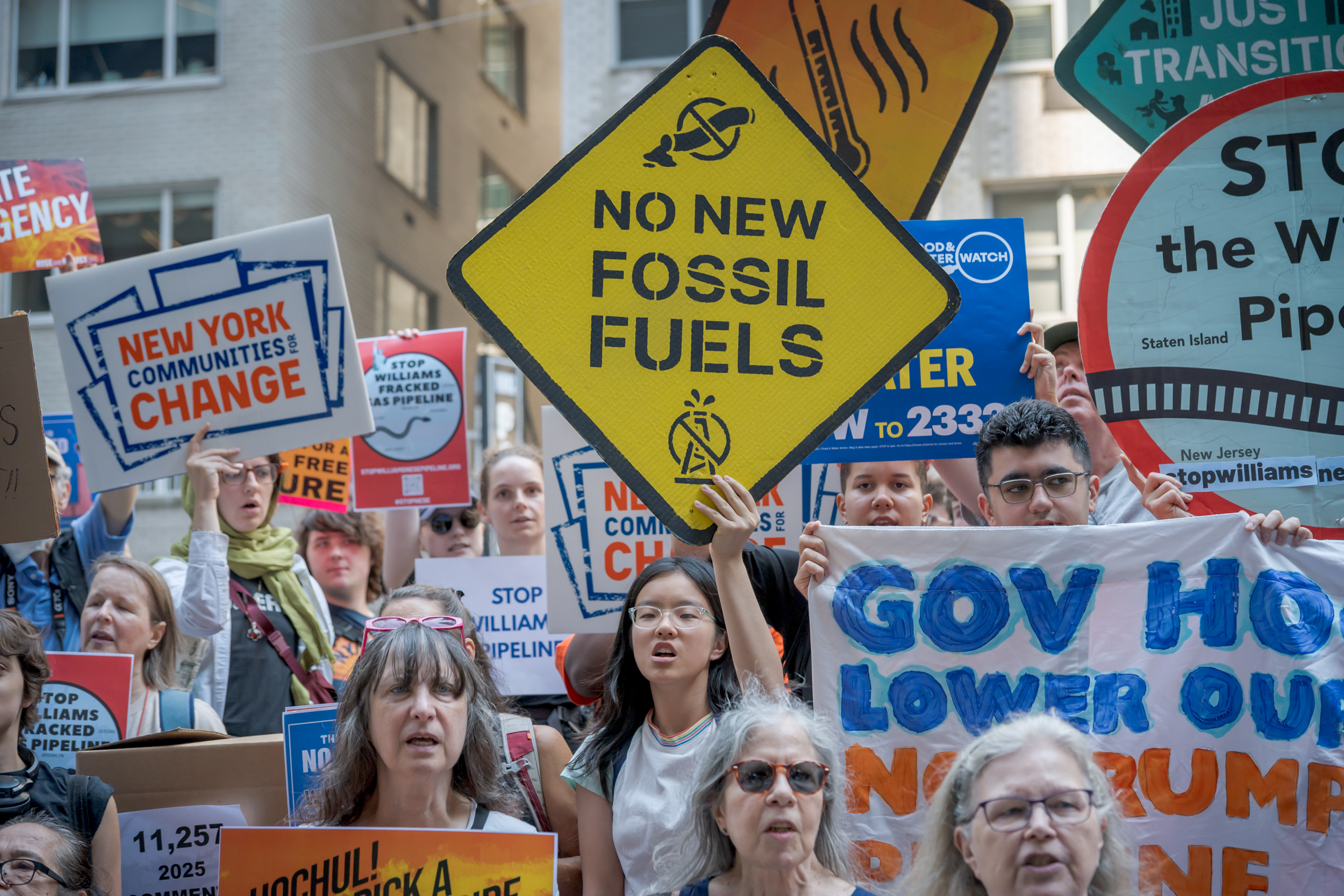


Tanja Konwinski thought the Constitution pipeline was dead.
When her husband bought 82 acres in Schoharie County, New York, in 2023, she knew Williams Cos. held an easement on the property for the proposed natural gas pipeline. But the state had rejected the project’s water quality permit application in 2016 and courts upheld that decision. She assumed it would never be built.
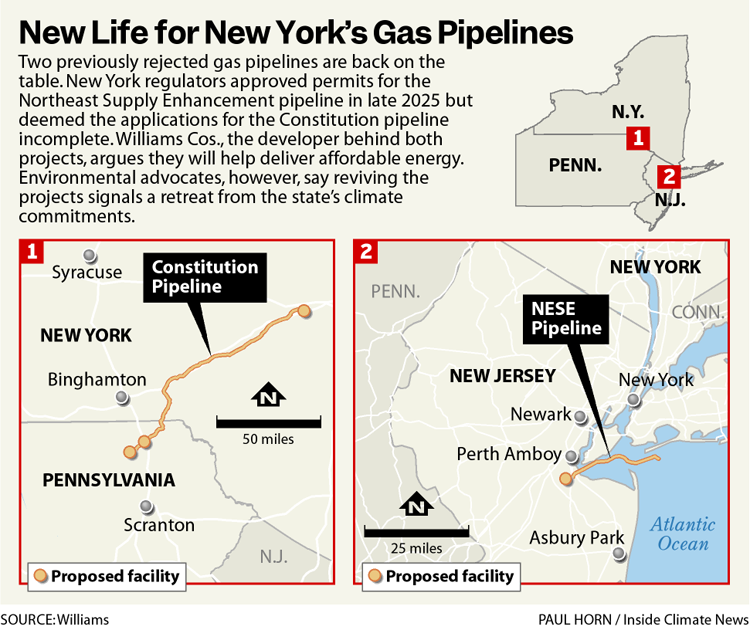
Now, the 125-mile pipeline, which would stretch from Pennsylvania to upstate New York, is back in the federal regulatory process, backed by the Trump administration’s push to expand domestic energy production. The U.S. Department of Energy has announced plans to direct up to $42 million to the project under the Defense Production Act, a 1950 law that allows the federal government to support private-sector production in the interest of national security.
For New Yorkers, the pipeline’s revival has implications beyond the fate of a single project. It’s the latest flashpoint in the state’s debate over how to balance energy costs and supply with its climate commitments—and the debate is taking center stage in the state’s governor’s race.
Incumbent Democratic Gov. Kathy Hochul is trying to weigh the state’s climate commitments against concerns about rising electricity and heating costs.
Hochul’s Republican challenger, Nassau County Executive Bruce Blakeman, argues that expanding natural gas infrastructure would increase energy supplies and lower utility bills. Blakeman has floated the idea of repealing New York’s 2014 fracking ban, which was enacted due to concerns over public health and environmental risks.
While Hochul has said she will not allow fracking, her administration has approved a previously rejected pipeline and delayed a major climate target. Even if Hochul wins this November, environmental advocates question whether the state will maintain protections they fought for years to secure.
A recent poll conducted by Quinnipiac University, shows Hochul leading Blakeman by 14 percentage points.
Pipeline Problems
There is currently no proposal for the Constitution pipeline before New York, said Ken Lovett, a spokesperson for Hochul.
Late last year, Williams, the energy infrastructure company, withdrew its state permit applications after the Department of Environmental Conservation determined that three of them were incomplete.
The company says it is still pursuing state permits. Public records also show it has asked the Federal Energy Regulatory Commission, which regulates interstate gas pipelines, to reinstate the project’s 2014 construction approval and waive the requirement for a New York permit.
While the Department of Energy has pledged to help Williams pay permitting development costs under the Defense Production Act, environmental groups and state regulators have questioned whether the project can lawfully proceed without New York’s approval.
Joshua Sewell, director of policy and research at the budget watchdog group Taxpayers for Common Sense, said using the law to support energy development is not unprecedented. Former President Joe Biden invoked it to strengthen domestic renewable energy supply chains.
But Sewell sees the Trump administration’s approach as part of a broader effort to bypass established safeguards.
The Constitution pipeline is one of two major gas projects Williams is pursuing in the region. The other, the Northeast Supply Enhancement (NESE) pipeline, would wind through New Jersey into New York Harbor.
Williams says the projects would help address regional gas supply constraints and deliver reliable, affordable energy “while supporting economic growth and emissions reductions,” company spokeswoman Cherice Corley said in an email.
New York rejected NESE’s permit applications twice over water-quality concerns. The project resurfaced last year after the Trump administration briefly halted construction on Empire Wind, an offshore wind farm near New York City. A few months later, NESE received permits from New York and New Jersey—though an appeals court subsequently cancelled New Jersey’s approval.
President Donald Trump has claimed Hochul agreed to allow pipelines to proceed in exchange for federal support for offshore wind projects. At a June press conference, he said Hochul agreed to allow construction, but was now “holding up” the Constitution pipeline. Hochul’s spokesperson denied that she made such a deal, saying the governor is open to gas projects when they meet state regulations.
The dispute reflects the tension in Hochul’s “all of the above” energy policy, which aims to combine natural gas and nuclear power with investments in renewable energy. She has directed the state power authority to develop at least one gigawatt of nuclear power and pledged state funding for clean energy development.
“The Governor’s all-of-the-above approach to energy is designed to increase New York’s energy supply in a variety of ways to keep the lights on and costs down for New Yorkers,” Ken Lovett, a spokesperson for Hochul, said in an email.
But Hochul has also pushed back the state’s original deadline to cut greenhouse gas emissions to 40 percent below 1990 levels by a decade, while increasing the eventual reduction target to 60 percent. She said the original timetable would have driven up energy costs.
Environmental groups say the pipeline approvals and delayed climate goals risk are undermining the state’s progress on environmental issues.
This story is funded by readers like you.
Our nonprofit newsroom provides award-winning climate coverage free of charge and advertising. We rely on donations from readers like you to keep going. Please donate now to support our work.
Donate NowGas pipeline construction can damage wetlands and streams, while leaks from operating pipelines release methane, a potent greenhouse gas.
“We have to be in a new kind of social contract that includes nature … we don’t want this land to be collateral damage,” said Karenna Gore, executive director of the Center for Earth Ethics.
Gore joined environmentalists and Indigenous women in walking part of the Constitution pipeline’s route last month to draw attention to its potential impacts.
The Fracking Divide
The Republican push to expand gas infrastructure extends beyond pipelines. Blakeman has campaigned on repealing New York’s fracking ban to lower utility bills. Lee Zeldin, the former Long Island congressman who now leads the Environmental Protection Agency, has also called for lifting the ban.
New York prohibited fracking in 2014 after years of organizing by environmental groups, health advocates and residents concerned about contaminated water and the effects of drilling on nearby communities.
Sandra Steingraber, a senior scientist at the Science and Environmental Health Network, has spent years compiling research concerning fracking’s potential health effects.
Studies have linked pollution from fracking to respiratory illnesses and birth defects, among other health risks. Hydraulic fracking, the most common process, can expose workers and nearby residents to carcinogens such as benzene and formaldehyde.
“Any Republican candidate claiming we’re going to reopen New York to fracking… is underestimating the depth and breadth of the public opposition,” Steingraber said. “It’s a laughable idea.”
The ban is also facing a legal challenge. In an April lawsuit, Thomas and Madison Woodward, who say they bought land in upstate New York in 2011 intending to frack it, challenged the state’s prohibition.
Their attorney, Tyler Fry of the Pacific Legal Foundation, a law firm focused on individual freedom and property rights, argues that the Woodwards “made a reasonable investment in a valuable and much relied on natural resource,” and now bear the cost of the state’s ban.
The lawsuit seeks a ruling that declares the ban is unconstitutional and an order barring the state from enforcing it against the couple.
While Hochul has said she will not permit fracking, environmental groups worry that her willingness to accommodate some gas development could weaken protections they fought to establish.
“New York state has been a leader up until now on using common sense measures to protect our land and water and human health,” said Julia Walsh, the executive director of FrackAction, a nonprofit that pushed for the ban. “We’re really hoping that the governor is going to stay the course.”
Back in Schoharie County, Konwinski is worried Williams will win approval from regulators, allowing it to build the Constitution pipeline that could cut across her family’s land. She and her husband hoped to develop community agriculture programs on their land, but those plans have stalled, she said.
“Over the last year or more, I’ve shifted completely and focused on opposition to the pipeline,” she said.
About This Story
Perhaps you noticed: This story, like all the news we publish, is free to read. That’s because Inside Climate News is a 501c3 nonprofit organization. We do not charge a subscription fee, lock our news behind a paywall, or clutter our website with ads. We make our news on climate and the environment freely available to you and anyone who wants it.
That’s not all. We also share our news for free with scores of other media organizations around the country. Many of them can’t afford to do environmental journalism of their own. We’ve built bureaus from coast to coast to report local stories, collaborate with local newsrooms and co-publish articles so that this vital work is shared as widely as possible.
Two of us launched ICN in 2007. Six years later we earned a Pulitzer Prize for National Reporting, and now we run the oldest and largest dedicated climate newsroom in the nation. We tell the story in all its complexity. We hold polluters accountable. We expose environmental injustice. We debunk misinformation. We scrutinize solutions and inspire action.
Donations from readers like you fund every aspect of what we do. If you don’t already, will you support our ongoing work, our reporting on the biggest crisis facing our planet, and help us reach even more readers in more places?
Please take a moment to make a tax-deductible donation. Every one of them makes a difference.
Thank you,

Lauren Dalban
Reporter, New York City
Lauren Dalban is a New York City-based reporter with a background in local journalism. A former ICN fellow, she now covers environmental issues in all five boroughs. Originally from London, she earned a B.A. in History and English from the University of Virginia, and an M.S. from Columbia Graduate School of Journalism.