
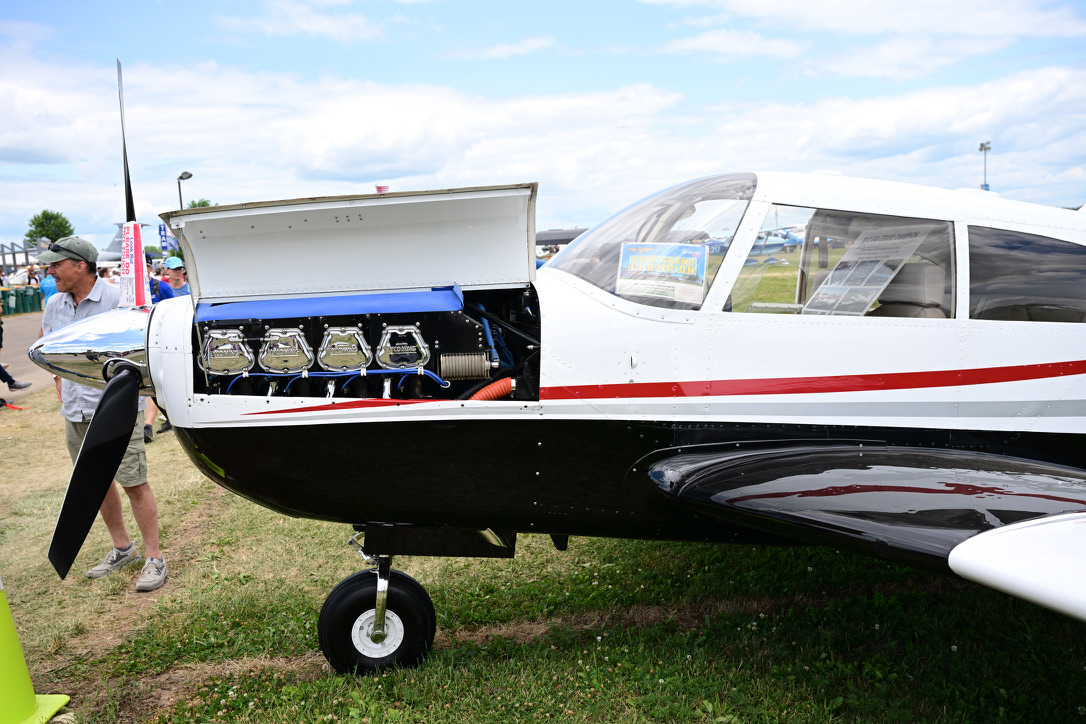


OSHKOSH, Wisc.—Every July, more than 10,000 general aviation aircraft from around the world fly here for the Experimental Aircraft Association’s AirVenture, widely recognized as the largest annual aviation gathering and fly-in convention.
Many aircraft owners arrived this year with a common concern: The fuel that brought them there and has powered their airplanes for decades will likely be phased out.
General aviation is now the largest remaining user of leaded transportation fuel in the United States. Although lead was phased out of automotive gasoline in the 1970s because it poses serious threats to public health, aviation gasoline remained leaded because many aircraft engines required higher-octane fuel that was difficult to produce without lead.
The industry’s answer at that time was 100LL, or 100-octane low-lead aviation gasoline. It became the standard fuel for piston-engine aircraft right as automobiles transitioned away from leaded gasoline.
According to the Federal Aviation Administration, more than 220,000 aircraft still use aviation gasoline. Most commercial airliners are not included in that figure because turbine-powered airplanes generally burn kerosene-based jet fuel rather than 100LL.
Lead’s toll on both children and adults include brain, nervous system and reproductive problems.
“Every molecule of lead that enters your body, there is an increased risk of having some type of adverse effect,” said Jay Turner, an air-quality researcher and professor of energy, environmental and chemical engineering at Washington University in St. Louis.
Turner also served on a National Academies committee studying lead emissions from piston-engine aircraft.
Airplanes operating on leaded gasoline emit lead particles into the air, which can settle into soil and water and create additional routes of exposure. Turner and his colleagues noted in the National Academies report that people may also be exposed by eating food in lead-contaminated soils near airports or by accidentally swallowing contaminated dirt or dust.
“Children eat a lot of soil,” Turner said. “It’s shocking how much they eat.”

In 2022, the FAA and aviation industry groups launched the Eliminate Aviation Gasoline Lead Emissions (EAGLE) initiative, aiming to eliminate leaded aviation gasoline by the end of 2030. Congress reinforced the effort in the FAA Reauthorization Act of 2024, which formally directed the FAA to continue supporting EAGLE and pursuing its 2030 goal.
Four years into the initiative, the clock is ticking.
A 2030 Target, but a Long Road Ahead
At AirVenture 2026, FAA officials outlined the agency’s four-phase transition plan: authorize and compare replacement fuels; gain market experience; kick off a national transition; and finally begin a separate Alaska transition.
The FAA said the effort remains in phase 1, which is expected to conclude by the end of 2027.
Three high-octane unleaded fuels are in various stages of approval or authorization, but none of them have been widely adopted as a nationwide replacement for 100LL.
Uncertainty about costs, safety and aging aircraft components highlights the complexity of the transition.
“If you look at the time it has taken to get here, 2030 is going to be a real stretch,“ Jack Pelton, chairman and chief executive of the Experimental Aircraft Association, said in one of the AirVenture forums last month.
In response to questions from Inside Climate News, the FAA referred to 2030 as a “national deadline for transitioning fully to unleaded aviation,” established by the FAA Reauthorization Act.
The statute itself uses more conditional language. It directs the FAA to facilitate “the safe elimination of the use of leaded aviation gasoline by piston-engine aircraft by the end of 2030 without adversely affecting the safe and efficient operation of the piston-engine aircraft fleet.” It also calls for a transition plan to move the fleet to unleaded aviation gasoline by 2030 “to the extent practicable.”

At AirVenture, Caitlin Locke, the FAA’s associate administrator for aviation safety and a co-chair of EAGLE, took an even more cautious tone.
“We need a target that we’re aiming at,” Locke said. “But we’re also recognizing that if we don’t meet our milestones in our phases of the process, we have to reevaluate the direction that we have to go.”
One-Fuel Solution
Swift Fuels, a fuel developer, said its UL94 unleaded fuel is approved for roughly 70 percent of the U.S. piston-engine aircraft fleet. Because UL94 has a lower-octane rating than 100LL, it is not approved for many high-performance or turbocharged aircraft. Several flight schools are using UL94, but most of the general aviation fleet, even many that could fly on UL94, still relies on 100LL.
Swift Fuels said it has sold over 5.8 million gallons of unleaded aviation gasoline since 2015, mostly UL94. By comparison, the annual 100LL consumption in the U.S. alone is about 180 million gallons.
Around 100 airports offer unleaded gasoline in the U.S., according to FlyUnleaded.com, an independent website that tracks U.S. airports offering unleaded aviation fuel. There are nearly 20,000 airports in the country.
“The economics aren’t right for airports to put in a second fuel distribution system,” Turner said. “We estimated costs for putting in a second fueling system. And for a lot of airports, that’s cost-prohibitive.”
With plans to meet the 2030 deadline, Swift Fuels is now developing and testing the 100R, its proposed replacement for 100LL.
“We believe the government, Congress, spoke and said, ‘You shall do this by the end of 2030,’ and we’re responding to that,” said Chris D’Acosta, the company’s CEO.
This story is funded by readers like you.
Our nonprofit newsroom provides award-winning climate coverage free of charge and advertising. We rely on donations from readers like you to keep going. Please donate now to support our work.
Donate NowThe other two unleaded fuel candidates are G100UL, made by General Aviation Modifications, Inc.(GAMI), and UL100E, developed by VP Racing Fuels and LyondellBasell. G100UL is already approved for use in nearly all certified piston-engine aircraft. However, owners must provide GAMI with the engine and airframe serial numbers, and purchase the documents certifying that their airplanes are approved to use the fuel.
UL100E has not yet received FAA fleet authorization. The testing is expected to conclude around September.
Certification is only the beginning. The fuels must be produced at scale, transported around the country and stored and dispensed at thousands of airports. Under the EAGLE initiative, the market will ultimately decide which and how many types of fuel will emerge as the top choice among pilots.
“We believe that we’re going to have to settle on one fuel,” said Katie Pribyl, the acting co-president of Aircraft Owners and Pilots Association. “The transition plan assumes that the market is going to decide—that’s probably not realistic. Realistically, the industry can’t support three different fuels.”
Concerns From California
One California county did not wait for the nationwide transition.
In January 2022, Santa Clara County stopped selling 100LL at its two county-owned airports, citing a county-commissioned study that found elevated blood-lead levels among children living near Reid-Hillview Airport in San Jose.
The FAA found that the restriction violated federal airport-grant obligations and directed the county to permit access to 100LL in March 2025. The county appealed and maintained its policy. As of August 2026, neither Reid-Hillview nor San Martin Airport was selling 100LL.
Both airports instead sell UL94. Reid-Hillview also began selling G100UL in late 2024, two years after the FAA approved the fuel for use in nearly the entire piston-engine fleet.
At AirVenture, Michael Luvara, a pilot based in Reid-Hillview Airport, gave a presentation on the potential risks of transitioning to unleaded fuel. He shared photos from other pilots that he said showed fuel leaks and paint damage after using G100UL.
George Braly, GAMI’s head of engineering, told Inside Climate News that the company investigated the reported leaks.
“I traveled to California, where about 150 airplanes were using our fuel,” Braly said. “Eleven of them reported leaks, and we found that all but one had blue stains, indicating that the airplanes had previously leaked while using 100LL.”
100LL is dyed blue, while G100UL is green. Braly said neither GAMI nor the FAA has identified any material-compatibility issue unique to G100UL that could affect flight safety.
GAMI used testing and engineering analysis to secure broad FAA approval for G100UL, while Swift Fuels has taken a staged approach, expanding 100R’s approval to additional groups of aircraft and engine models as more test data become available.
In July, Swift Fuels announced that the FAA had approved its product for use in approximately 1,200 engine models and 1,600 airframe models.
The average age of the general aviation fleet in the U.S. is roughly 40 years, while active single-engine piston aircraft average about 50 years old. Some models are no longer in production, some manufacturers no longer exist and some homebuilt aircraft have outlived their builders. Replacement parts can be difficult to find, and maintenance and modifications can be costly and complicated.
Testing a new fuel across such an old and varied fleet can be a lengthy process, and earning pilots’ confidence presents a challenge of its own. However, many understand that leaded fuel will not be available forever.
At AirVenture, Swift Fuels presented an ambitious plan for its 100R fuel, projecting that it would phase out 95 percent of 100LL by 2030.
“Take a picture of that and call me a liar next year if you want to,” D’Acosta said. “But I’m telling you, we’re moving forward as fast as we can.”
GAMI produced over 1 million gallons of G100UL in 2024, an effort Braly said demonstrated the company’s ability to produce the fuel at scale.
Paul Wrzesinski, the FAA’s senior technical specialist for aviation fuels, estimated that establishing a distribution network would take 18 to 24 months. A fuel authorized in 2027 could therefore require much of the remaining time before 2030 to become widely available.
Pelton, the Experimental Aircraft Association leader, said questions remain about how approved fuels would be distributed and placed into service nationwide.
“This is probably one of the most difficult programs I’ve ever been associated with,” Pelton said. “It’s more than just the science of the fuel and the operation of the airplane. The biggest issue is the supply chain.“
About This Story
Perhaps you noticed: This story, like all the news we publish, is free to read. That’s because Inside Climate News is a 501c3 nonprofit organization. We do not charge a subscription fee, lock our news behind a paywall, or clutter our website with ads. We make our news on climate and the environment freely available to you and anyone who wants it.
That’s not all. We also share our news for free with scores of other media organizations around the country. Many of them can’t afford to do environmental journalism of their own. We’ve built bureaus from coast to coast to report local stories, collaborate with local newsrooms and co-publish articles so that this vital work is shared as widely as possible.
Two of us launched ICN in 2007. Six years later we earned a Pulitzer Prize for National Reporting, and now we run the oldest and largest dedicated climate newsroom in the nation. We tell the story in all its complexity. We hold polluters accountable. We expose environmental injustice. We debunk misinformation. We scrutinize solutions and inspire action.
Donations from readers like you fund every aspect of what we do. If you don’t already, will you support our ongoing work, our reporting on the biggest crisis facing our planet, and help us reach even more readers in more places?
Please take a moment to make a tax-deductible donation. Every one of them makes a difference.
Thank you,

Andrew Liu
Fellow
Andrew Liu is an Outrider fellow at Inside Climate News and a journalist covering climate, business and technology. Born and raised in China, he spent more than 20 years living and working in Singapore before moving to the United States. He holds degrees from Columbia Journalism School and Singapore Management University. Before focusing on climate and business reporting, Liu spent more than a decade as a sports reporter for Singapore’s Lianhe Zaobao, a leading Chinese-language daily newspaper. His reporting took him across Southeast Asia, China and Brazil.