

This reporting was supported by a Transatlantic Media Fellowship from the Heinrich Boll Foundation.
Picture a buoyant triangular steel or concrete platform roughly the dimensions of a baseball field. Now place a wind turbine taller than the London Eye on top, connect mooring lines to the seabed and power cables to the grid, and you’ve got a floating wind turbine.
This fantastical-sounding technology is real. At demonstration and small-scale projects in Europe, Asia and a single U.S. site in Maine, floating turbines are producing power. Multiple different platform designs have been field tested, from the aforementioned triangle to a single massive cylinder. But plans to build larger projects of 10 or more turbines, each capable of powering a neighborhood, have lagged behind early projections.
The business case for floating turbines, as opposed to their fixed-bottom counterparts, boils down to two points: they can do their thing making power farther from shore, where the high winds are and the people generally aren’t. In some places like California, the coastal shelf slopes so steeply that floating wind has been seen as the only option. But the engineering challenges of keeping buoyant, vibrating skyscrapers stable—and the high costs of solving them—serve as a potent counterweight.
An army of researchers, engineers and policymakers across the globe have thrown themselves at the problem. In the U.S., the Biden Administration declared a national goal of installing 15 GW—up from zero—of floating wind turbines by 2035, comparing it to efforts to put a man on the moon.
While such announcements often have a nationalistic, competitive edge, a robust network of collaboration has driven the development of this technology. From study trips to open-source designs, researchers, financiers, and developers across the globe have worked together to get the technology to the cusp of commercial viability.
Now, with project delays and policy reversals, the industry is facing a bit of a crisis. A wind trade association recently warned that “the commercialisation window cannot be assumed to remain open indefinitely.” Reports blame causes both independent of and connected to the sustained attacks on the U.S. offshore wind industry by the Trump administration.
To get through the rough patch, the industry is leaning into what got it here: collaboration.
Maine’s Floating “Goldilocks”
Habib Dagher traces the efforts to develop a floating offshore wind industry in Maine to the global energy crisis of 2008, when heating fuel prices spiked above $4 a gallon (The state is once again facing the same crisis, with fuel over $6 a gallon today).
“Maine was in a really tough spot,” Dagher, who heads the Advanced Structures and Composites Center at the University of Maine, said. “That’s when the governor came to our lab, and said, ‘What do we do?’”
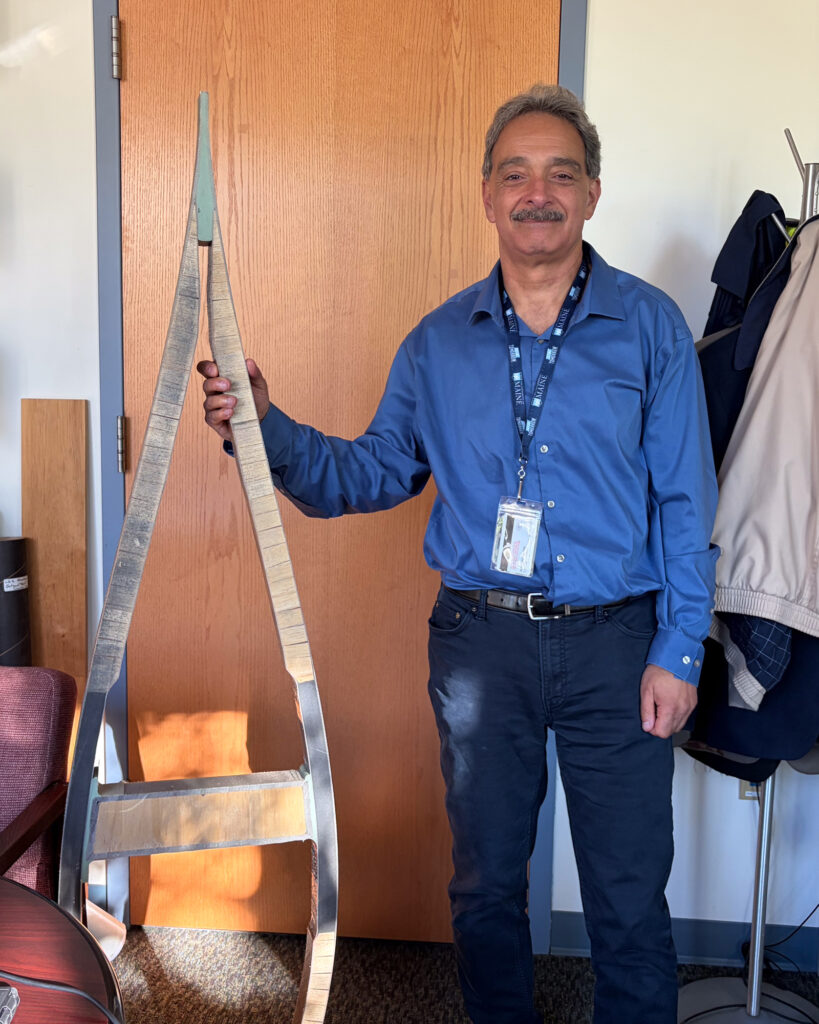
Dagher had heard of floating turbines, which he thought well suited to the deep waters of the Gulf of Maine. He traveled to Norway to visit one of the earliest demonstration turbines, and created a program within the center to develop platforms suitable to Maine’s environment and supply chains.
When nearly 60 percent of Maine voters passed a 2010 bond measure to fund this research, Dagher said he felt that the center “had a mandate from voters in the state of Maine.”
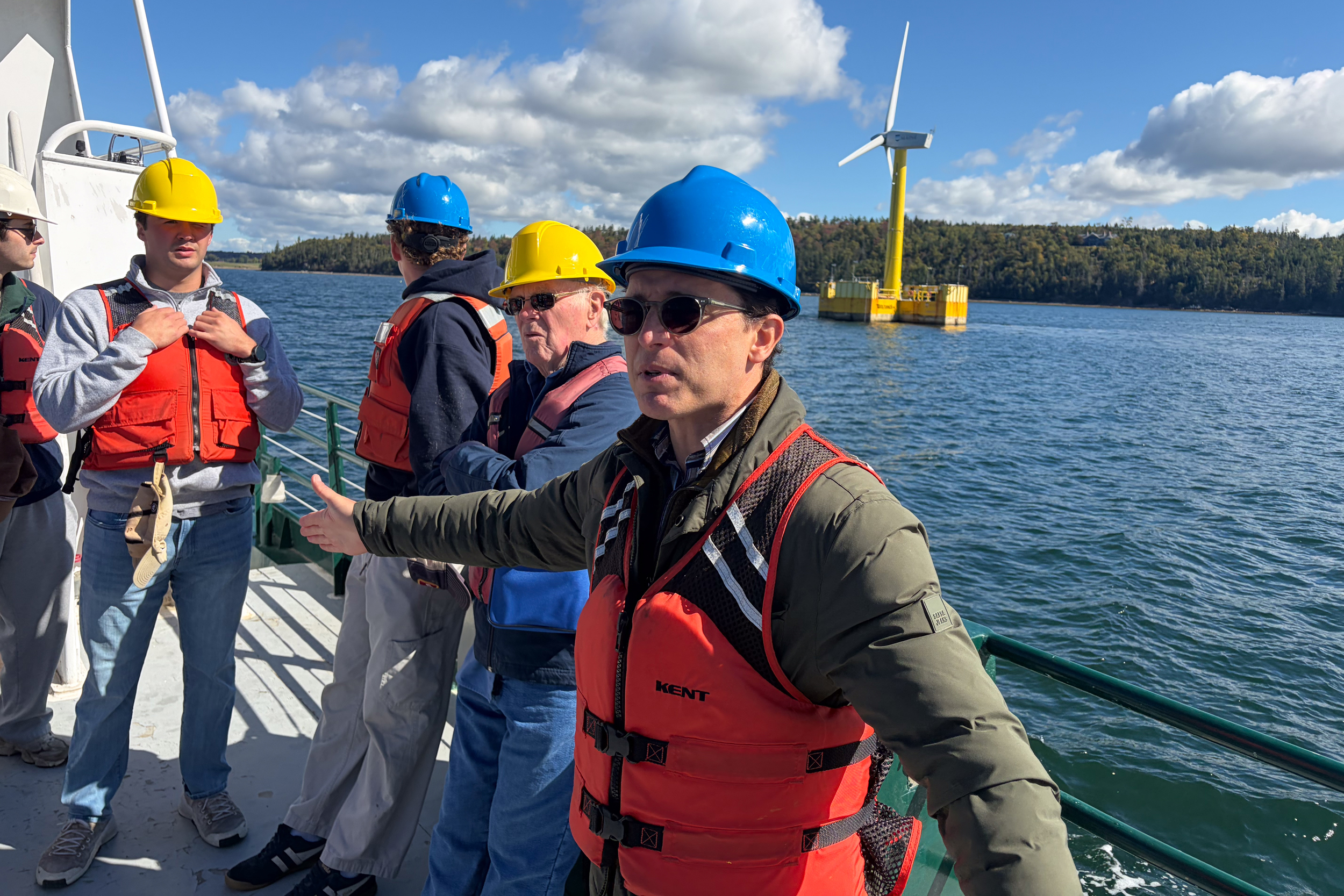
The fruits of that investment are visible today in a concrete, plus-sign-shaped platform bobbing in the waters off Castine. The structure is a quarter-scale model of the center’s latest platform design and supports a 108-foot tall turbine. It was towed there by the cadets of the Maine Maritime Academy in May 2025.
During a recent tour on a calm day, the platform seemed not to move at all, though the turbine blades kept up a steady motion.
“We jokingly call [Maine] a Goldilocks of floating wind because the water depths aren’t that deep, the wind resource is really good…[and] the waves aren’t that bad,” said Anthony Viselli, chief engineer at the center.
Students from a class on the social and political dimensions of offshore energy at nearby Colby College, among the tour participants, peppered Viselli with questions about everything from the effect of soil structure on mooring (significant) to the maximum wave height a full-scale model could withstand (60 feet, give or take).
The turbine is also answering questions another way: Dublin Offshore, an Irish maker of mooring line technologies, is currently testing a shock-absorbing device on the model. The company won a competition for U.K. firms, co-sponsored by the center.
“For us, transatlantic collaboration has a very practical value,” Darren Hayes, technical director at Dublin Offshore, said in a statement. “This demonstration is the critical final step to deliver the evidence developers and investors need to move towards commercial deployment.”
In the same spirit, the center has made the technical specifications and software parameters for its alternative steel platform widely available, which Emma Edwards, a researcher at Oxford University who specializes in floating wind, called “incredibly instrumental” to further research on the technology.
The quarter-scale platform and turbine was only meant to be one more step in a long collaborative effort between the center, state government and private sector partners. The next included building 10-12 full-sized platforms and turbines at a proposed “research array,” for which the state signed a lease with the Bureau of Ocean Energy Management in 2024.
Last March, however, the developer suspended contract negotiations for a power offtake agreement, citing “recent shifts in the energy landscape.” The project is in limbo.
Reaching a Shared Understanding
In 2021, Maine launched the Offshore Wind Research Consortium, with representatives from state and tribal governments, fisheries, environmental groups and energy developers.
The group decides together on the most pressing questions they have about how offshore wind projects would affect both coastal communities and fisheries in Maine and funds research to answer them.
Alison Bates, a co-chair of the consortium and professor at Colby College whose students were the ones peppering Viselli with questions, said this approach had benefits over and above the answers generated. “The way that we prioritize research projects has also been really helpful in creating a shared understanding” among members of the consortium from very different backgrounds, she said.
It’s an approach she says other jurisdictions have reached out to her to learn about.
The consortium funded Maine fisheries representatives to travel to Scotland to visit an operational five-turbine project east of Aberdeen and learn about interactions with the fishing industry there.
In a presentation of key takeaways, the group gave kudos to Maine for its comparatively proactive outreach to “deconflict lease areas,” yet noted Scottish fisherfolk shared many of their questions about long-term impacts on fisheries from the floating structures and cables.
Terry Alexander, Bates’s co-chair and a commercial ground fisherman, said that despite his ongoing skepticism of offshore wind, he appreciated the consortium’s work. “The most important question that we have is getting baseline data because we need to know what the changes are” after turbines are installed, he says—data the consortium is actively gathering.
WindShot in the Arm
Floating wind in the U.S. got a jolt in 2022, when the Biden Administration announced a goal of bringing down the cost of electricity from the technology by 70 percent.
The effort, labeled the “Floating WindShot” was one of eight “energy earthshots,” patterned in their ambition after the “sun shot,” which helped slash the costs of solar power by an even greater margin, and the moon shot before it. The Floating WindShot funded research, stakeholder convenings and critical infrastructure, like ports.
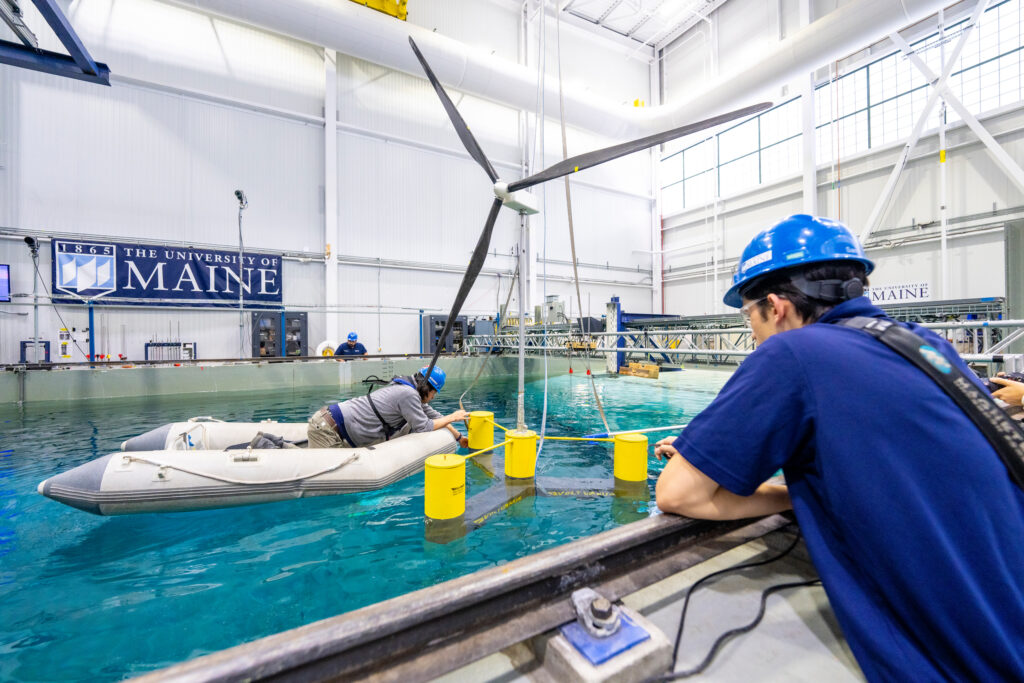
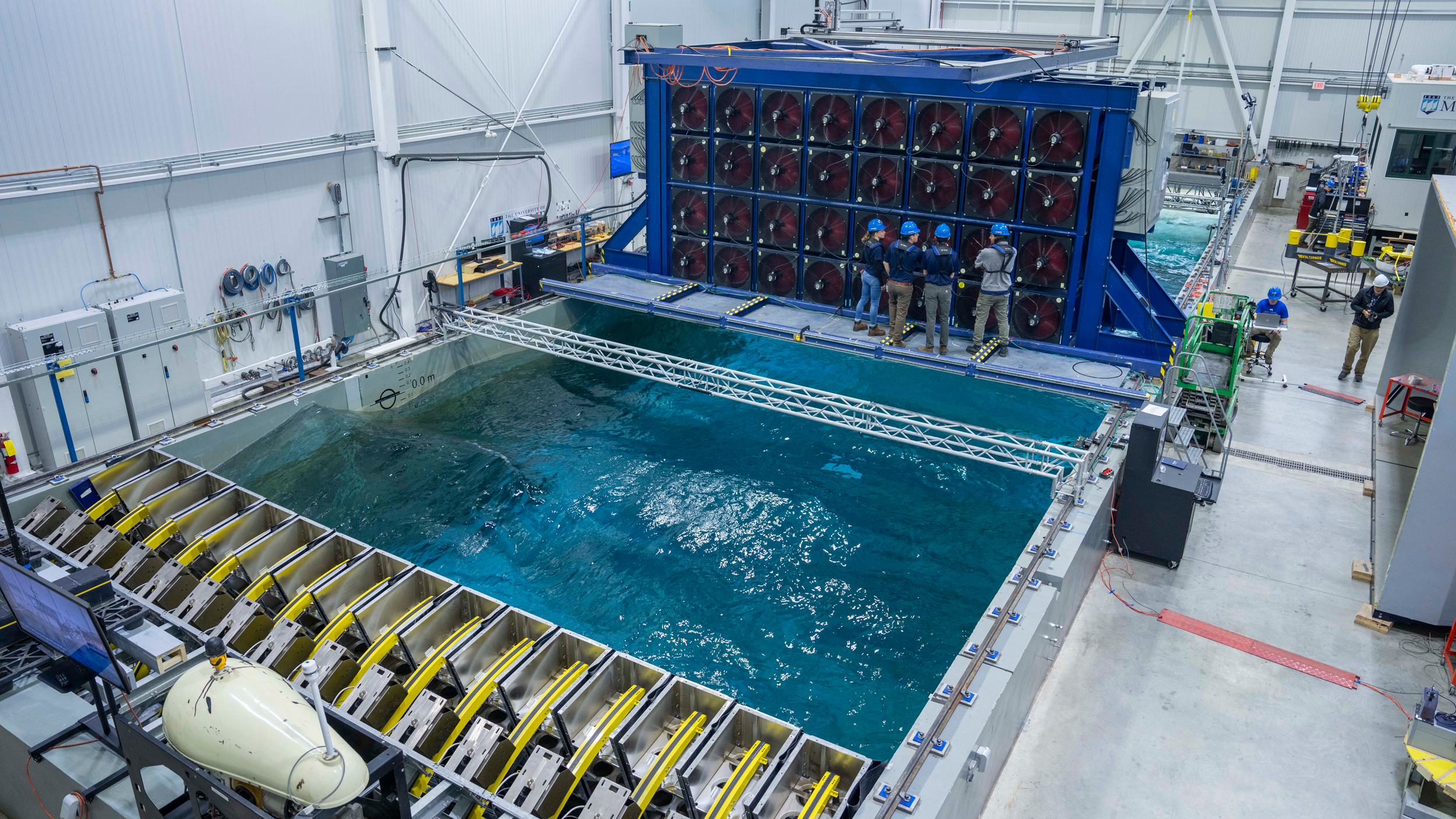
The U-Maine Center won one of the research prizes, as did several subsidiaries of European floating platform companies.
“The learning that happens all over the world is something that the United States was taking and learning from, and those were really important partnerships,” said Liz Klein, who was the director of BOEM for the final two years of the Biden Administration.
By the end of Biden’s presidency, BOEM had auctioned off several commercial-scale floating offshore wind lease sites in areas of the Gulf of Maine and California coast.
Strong Headwinds
Substantial challenges remained, however, starting with cost. The levelized cost of electricity from a new floating wind project (a metric which attempts to make apples-to-apples comparisons between different types of energy possible) was about double that of fixed-bottom wind when the WindShot was announced, as much as three times that of a combined cycle gas plant and roughly equivalent to a new nuclear plant, based on data from Lazard and the Department of Energy.
All of those other technologies, however, were mature. And if floating therefore had significant potential to catch up to the other technologies on price, it was (and is) also facing some growing pains.
“The deployment of commercial scale [floating] projects is still held back by some technical challenges in our view that have yet to be solved,” says Harrison Sholler, a wind energy analyst at Bloomberg NEF, citing in particular the dynamic power cables and offshore substations needed to transmit power from the structures to land.
Then there is the supporting cast: the ports, supply chains and transmission lines, without which a major floating project often can’t be built—all quite costly to develop.
Take just the ports, which, due to floating platforms’ size, must have large staging areas immediately adjacent to deep water. Studies conducted under the Floating WindShot priced the new and upgraded ports that would be required at upwards of $1 billion each.
This story is funded by readers like you.
Our nonprofit newsroom provides award-winning climate coverage free of charge and advertising. We rely on donations from readers like you to keep going. Please donate now to support our work.
Donate NowThese challenges, combined with macroeconomic factors like inflation and policy shifts (attributed by some to overambitious initial targets), have delayed auctions and permits for the next generation of projects in Europe and Asia.
And that was without President Trump’s actions against the U.S. offshore wind sector.
Last December, Trump tried to halt five under-construction fixed offshore wind projects, citing unspecified national security concerns; courts uniformly rejected the moves, but developers still lost millions of dollars per day of delay.
The administration has also, for now, effectively ended further offshore leasing. It has bought back many existing leases, including some suitable for floating wind. The deals have often included the lessees reinvesting the money into gas power plants and export terminals that do not serve the same regions as the proposed projects.
“Under President Trump, companies are shifting investment back toward dependable, secure energy infrastructure that can power our economy and lower utility costs,” Interior Secretary Doug Burgum said after announcing one such deal with Invenergy, a developer that held leases off both California and Maine.
Those states and at least seven others have sued, seeking to invalidate the agreements.
And the administration has cancelled grants made by the Biden administration to support wind port construction, including in California and Salem, Massachusetts. “[W]e are prioritizing real infrastructure improvements over fantasy wind projects that cost much and offer little,” Transportation Secretary Sean Duffy said at the time.
These actions have, to say the least, tarnished the image of the U.S. as a potential hub for investment in the sector, according to knowledgeable observers.
“Financiers and developers now see the U.S. as a politically risky market for offshore wind development,” said Sholler.
It’s unclear if they’ll ever come back.
Keeping the Fire Burning
Edwards leads a network of early career professionals at the Supergen Offshore Renewable Energy Hub, which connects academia, industry and policymakers in the U.K. She acknowledged the difficulties that some of her American colleagues face in continuing to partner on offshore wind research today: “It’s been hard for the U.S.-based people to continue some collaborations, not because of lack of desire, but because of not having the funding or not being able to be publicly seen doing this research.”
Yet beneath the surface, where research happens and projects are launched, technology, expertise and funding for floating wind do continue to circulate between Europe and North America.
Canada has taken over pole position to develop floating wind in North America, with Nova Scotia launching a solicitation for 5 GW of offshore wind, including sites suitable for floating, last year.
Although the Advanced Structures and Composites Center has had to let go of some staff working on wind energy and reassign others, it is still signing contracts to test component technologies at its facilities. And the center’s private sector spinoff, DeepCWind, is in the running for several contracts to supply planned floating wind projects in Europe, according to Viselli and Dagher.
Principle Power, another American firm, licensed its WindFloat platform technology to demonstration projects in Portugal, Scotland and France, where it has ongoing contracts for operations and maintenance. A company spokesperson declined to answer questions.
In Europe and Asia, several ongoing collaborative efforts bring industry together, at times with academics and policymakers, to solve the technological and policy barriers to commercialization.
“If you all collaborate, there’s certain bits and pieces of the puzzle that become cheaper and less risky for yourself,” Arturo Anderson, who leads one such collaboration for Carbon Trust UK, said of developers’ motivation to share information.
Dagher said that through all the challenges, his team has kept “the fire” that drove them to develop this technology burning.
“What you learn in life is that you really need to believe in what you do,” he said. “If you believe in what you do, and it’s a good thing for society, it’s a good thing for the people involved—you don’t really stop.”
About This Story
Perhaps you noticed: This story, like all the news we publish, is free to read. That’s because Inside Climate News is a 501c3 nonprofit organization. We do not charge a subscription fee, lock our news behind a paywall, or clutter our website with ads. We make our news on climate and the environment freely available to you and anyone who wants it.
That’s not all. We also share our news for free with scores of other media organizations around the country. Many of them can’t afford to do environmental journalism of their own. We’ve built bureaus from coast to coast to report local stories, collaborate with local newsrooms and co-publish articles so that this vital work is shared as widely as possible.
Two of us launched ICN in 2007. Six years later we earned a Pulitzer Prize for National Reporting, and now we run the oldest and largest dedicated climate newsroom in the nation. We tell the story in all its complexity. We hold polluters accountable. We expose environmental injustice. We debunk misinformation. We scrutinize solutions and inspire action.
Donations from readers like you fund every aspect of what we do. If you don’t already, will you support our ongoing work, our reporting on the biggest crisis facing our planet, and help us reach even more readers in more places?
Please take a moment to make a tax-deductible donation. Every one of them makes a difference.
Thank you,