

Illinois is the latest example of how a state can embrace virtual power plants and see results almost immediately.
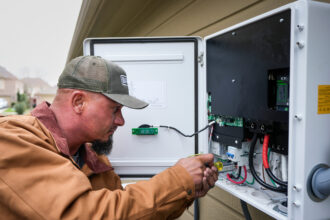
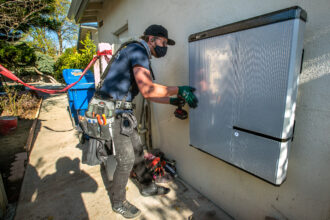
Today, Solrite Energy is announcing its entry into the Illinois market with a program that provides households with battery energy storage for $20 per month and makes the batteries available to support the local power grid.
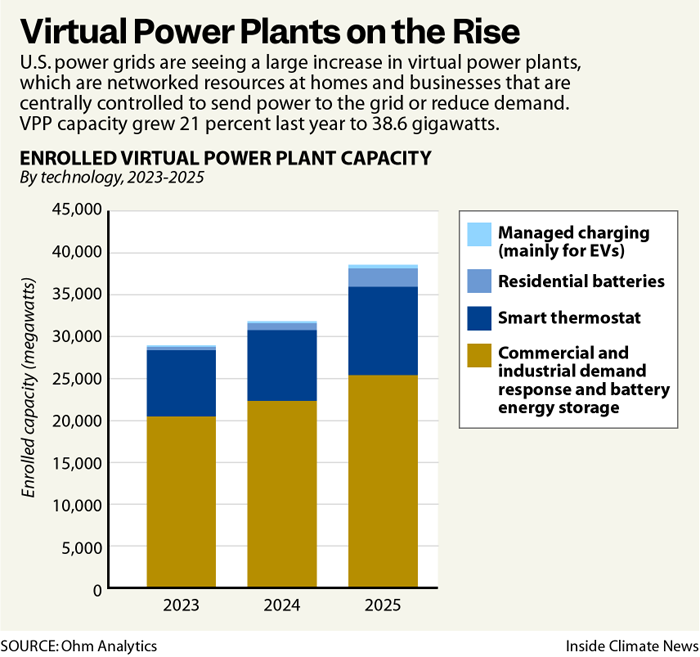
A virtual power plant, or VPP, is a network of resources at homes and businesses that can support the larger community by sending electricity to the grid or by reducing demand.
Solrite, based in Fort Worth, Texas, joins companies such as Base Power and Energywell that market solar and batteries to Illinois customers served by the state’s two largest electricity utilities, ComEd and Ameren.
This comes after Gov. JB Pritzker signed the Clean and Reliable Grid Affordability Act in January, requiring utilities to develop virtual power plant programs, among other provisions.
Often, VPPs are batteries connected to solar, but there are many other types, including grid-connected thermostats and water heaters.
I spoke with Regan George, Solrite’s founder and CEO. Illinois is the fifth state where his company owns virtual power plants, joining California, Connecticut, Massachusetts and Texas.
George has become adept at describing his business model, which relies on knowledge of the grid, utility regulation and battery technology.

“We put in batteries at residential locations in areas where we have deals with the utilities or the grid operator,” he said. “They can access our batteries [to help] support the grid and then they pay us.”
The company started as Solnova in 2017, specializing in rooftop solar, and then changed its name to Solrite in 2023 as it shifted its focus to virtual power plants.
Solrite owns the batteries and solar panels and sets up a system in which customers pay monthly bills for long-term leases for the equipment. It now has about 50 employees and operates systems in about 7,500 homes.
An Illinois customer pays $20 per month under Solrite’s program to have a battery installed, with no installation fee. The customer can also choose to have solar panels installed and pay 12 cents per kilowatt-hour for the electricity generated by the panels, which is a discount compared to the utility’s standard rate.
If the same customer wanted to buy a battery of this size and solar panels, the costs would be substantial, easily exceeding $30,000.
Part of the deal is that Solrite gets to use the battery whenever the grid needs a boost, drawing electricity from many batteries to function like a power plant.
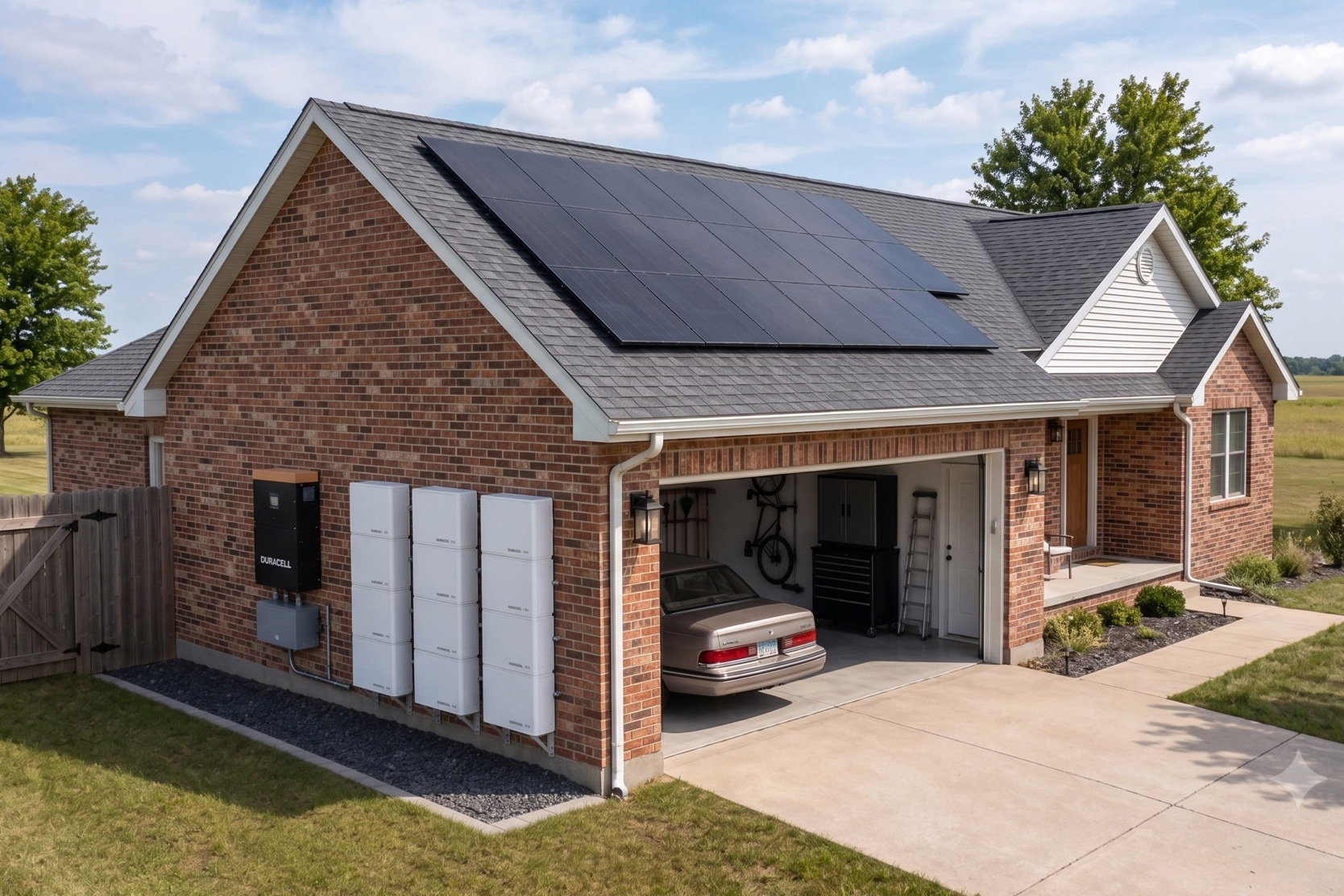
Solrite uses a 60-kilowatt-hour battery, which is much larger than a house usually needs, so there is plenty of power to serve that address and send power to the grid.
In a power outage, the household can use the battery to keep the lights on, with enough storage to last for days if needed. (For context, households in ComEd territory consume an average of about 20 kilowatt-hours per day.)
The large battery is a distinguishing feature of Solrite’s business model. It’s about four times the size of a Tesla Powerwall unit, which is another battery often used in VPPs. With large batteries in each home, the aggregate size of the power plant could be much larger as the programs gain popularity.
This story is funded by readers like you.
Our nonprofit newsroom provides award-winning climate coverage free of charge and advertising. We rely on donations from readers like you to keep going. Please donate now to support our work.
Donate NowAnother distinguishing feature is that Solrite uses batteries designed for use in VPPs, rather than those for which utility networking is a secondary function. The battery manufacturers include Duracell and Sonnen.
“When we’re talking with a retail electric provider or a utility, [it often begins with] them saying, ‘Don’t worry, we won’t use your batteries too much. We’re only going to use them five to 10 times a year,’” George said. “And I have to stop them and say, ‘No, no, no, not our batteries. I want you to use our batteries as much as you possibly can.’”
Meanwhile, the homeowner probably won’t notice when electricity is being exported, he said.
Solrite makes its money by selling electricity from its virtual power plant under contracts with utilities and other buyers, and from the monthly fees paid by people leasing solar and batteries.
There’s money to be made because VPPs help utilities reduce the amount of electricity they need when demand and prices are highest.
Mass deployment of virtual power plants has the potential to reduce electricity costs for all Illinois customers, including people not participating, by shifting supply and demand. One example is how VPPs can help to reduce the “capacity charge” from grid operator PJM Interconnection. PJM sets this charge as part of its process to ensure its territory has enough power plants to meet peak demand.
The charge is going to be lower, or at least grow less, as gigawatts of VPPs come online, said Will Kenworthy, Midwest regulatory director for Vote Solar, an advocacy group.
“If a battery discharges during the handful of summer peak hours that set that charge, the retail electric supplier avoids that cost—and passes the savings on to customers,” he said.
When scaled, VPPs can reduce reliance on centralized power plants, with broad financial and environmental benefits.
There is a virtuous cycle here. Illinois passed a law and companies showed up almost immediately. From the companies’ perspective, the state was opening its doors and streamlining the regulatory process for VPPs to operate.
Entering Illinois is “big for us,” George said. “We’re only going to see more and more markets come on.”
Other stories about the energy transition to take note of this week:
Canada Moves Ahead With Big Hydro and Wind Investment: Canadian Prime Minister Mark Carney announced an agreement to expand hydropower, onshore wind and transmission lines in Newfoundland and Labrador and Quebec, a plan he said is the largest clean energy investment in the history of North America, at $70 billion Canadian (U.S. $50 billion). I wrote about the plan and how it fits into a mixed record for Carney, who also is increasing Canada’s spending to expand oil production. Also, I’m cautious whenever something is touted as the largest ever, but there is no doubt that this package of projects is gigantic.
Argentina’s EV Market Surges, Underscoring China’s Growth as an Auto Market Power: By the end of this year or early next year, Argentina is on track for EV market share that exceeds the United States, rising from near zero at the beginning of last year. The pace of growth is almost completely due to one company, BYD, and my colleague Katie Surma and I took a close look at the rapid transformation of Argentina’s market. This is part of the ongoing Planet China series.
Qcells Perseveres at Georgia Solar Panel Plant: Qcells, a South Korean solar panel manufacturer, made a big investment in the U.S. market, promising tax credits under President Joe Biden that would help to support demand. Now, President Donald Trump is phasing out some of those credits but also adding tariffs that will make Qcells’ products more competitive with imports. Emily Jones reports for Grist about how this looks from the perspective of the company’s Cartersville, Georgia, plant.
Trump’s Attacks Have Set Back Offshore Wind for a Generation: President Donald Trump has used the levers of government to slow and sometimes stop development of offshore wind. We often look at this in terms of individual projects, but my colleague Ajani Stella takes a few steps back to ask what Trump’s actions mean for the long-term future of offshore wind. The answer is grim, with experts saying that developers will likely take years, financial inducements and ironclad commitments before they would ever put their money into a market that has so thoroughly burned them.
Inside Clean Energy is ICN’s weekly bulletin of news and analysis about the energy transition. Send news tips and questions to [email protected].
About This Story
Perhaps you noticed: This story, like all the news we publish, is free to read. That’s because Inside Climate News is a 501c3 nonprofit organization. We do not charge a subscription fee, lock our news behind a paywall, or clutter our website with ads. We make our news on climate and the environment freely available to you and anyone who wants it.
That’s not all. We also share our news for free with scores of other media organizations around the country. Many of them can’t afford to do environmental journalism of their own. We’ve built bureaus from coast to coast to report local stories, collaborate with local newsrooms and co-publish articles so that this vital work is shared as widely as possible.
Two of us launched ICN in 2007. Six years later we earned a Pulitzer Prize for National Reporting, and now we run the oldest and largest dedicated climate newsroom in the nation. We tell the story in all its complexity. We hold polluters accountable. We expose environmental injustice. We debunk misinformation. We scrutinize solutions and inspire action.
Donations from readers like you fund every aspect of what we do. If you don’t already, will you support our ongoing work, our reporting on the biggest crisis facing our planet, and help us reach even more readers in more places?
Please take a moment to make a tax-deductible donation. Every one of them makes a difference.
Thank you,

Dan Gearino
Reporter, Clean Energy
Dan Gearino covers the business and policy of renewable energy and utilities, often with an emphasis on the midwestern United States. He is the main author of ICN’s Inside Clean Energy newsletter. He came to ICN in 2018 after a nine-year tenure at The Columbus Dispatch, where he covered the business of energy. Before that, he covered politics and business in Iowa and in New Hampshire. He grew up in Warren County, Iowa, just south of Des Moines, and lives in Columbus, Ohio.