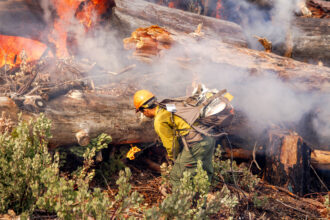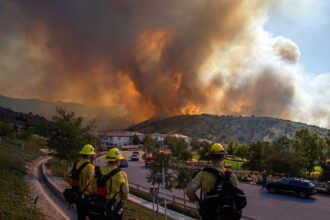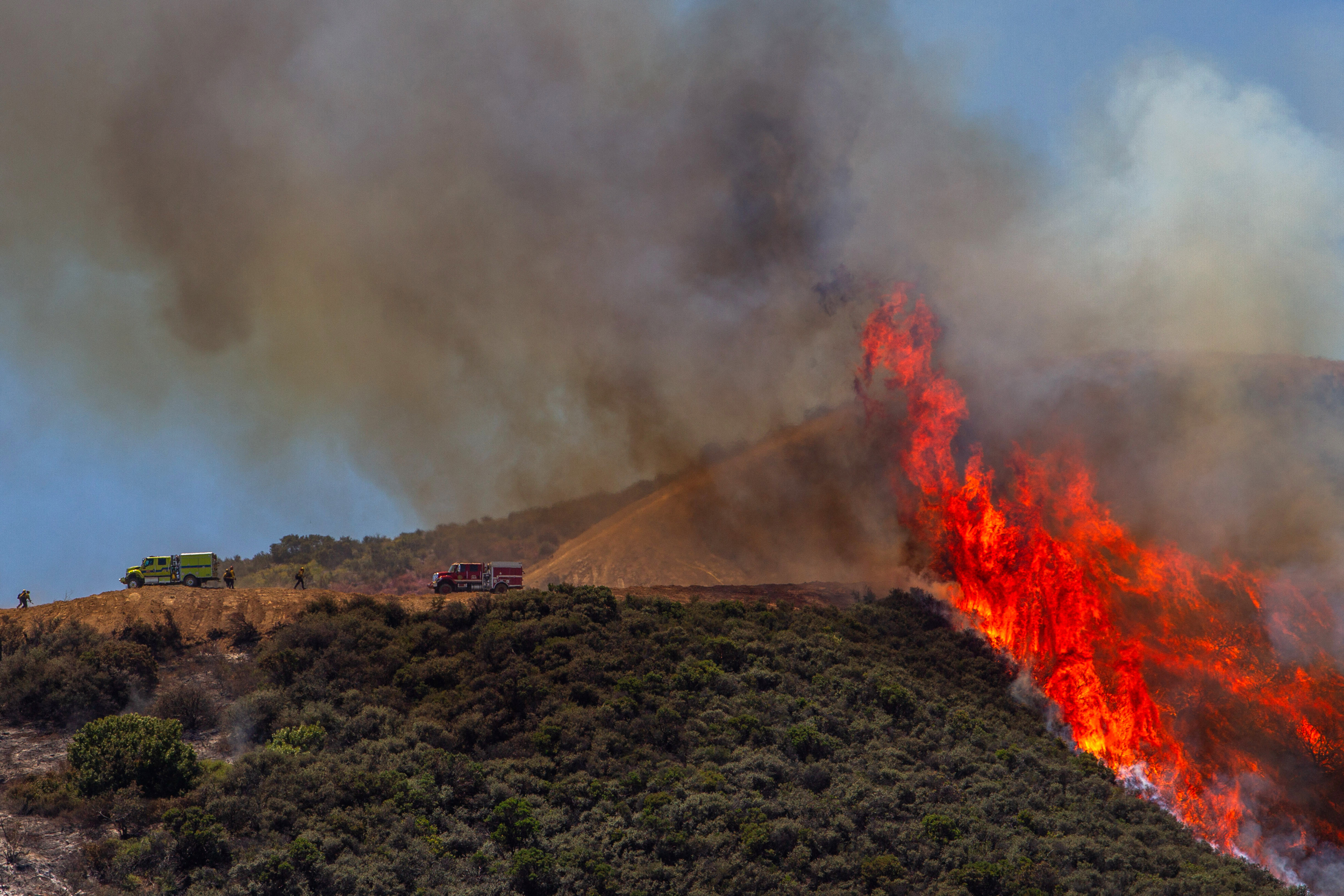


With a Southern California wildfire only growing in size, firefighters in Ventura County have increased response efforts near a former nuclear reactor and rocket testing site.
The Sandy Fire’s roughly quarter-of-a-mile proximity to the Santa Susana Field Laboratory, or SSFL, prompted at least one family to evacuate when the blaze began Monday.
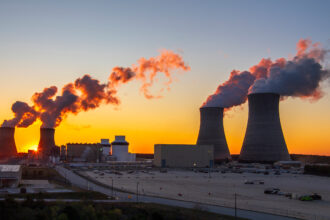
Nuclear research ended at the site in 1988 and rocket testing stopped in 2006. The defunct, 2,800-acre federal research complex—once jointly occupied by NASA, the Department of Energy and Boeing—still has radioactive and chemical contamination. Boeing has owned the site since 1996.
Amid the fire, which swelled to over 2,100 acres, and was 40 percent contained as of Friday afternoon, the Ventura County Fire Department said that “hazardous materials and radiological monitoring teams” continue to track air quality.
Air sampling locations have been established in seven areas near the fire northwest of downtown Los Angeles, the county said Thursday evening. The Department of Energy is also assisting with air monitoring around the SSFL site “out of an abundance of caution,” county officials said.
Between Monday and Friday, residents have observed the Sandy Fire encroaching closer to the site.
There is “no indication that any radiological material” has been released from the former nuclear site, Andrew Dowd, an engineer and spokesman for the Ventura County Fire Department, told Inside Climate News Friday afternoon.
“The fire has not reached the Santa Susana Field Laboratory,” added Dowd, noting residents can track updates online.
SSFL is known locally due to radiation concerns of local residents as years pass without a finished cleanup. A number of studies have sent families mixed signals over how worried they should be regarding exposure from the site, where possibly one of the worst nuclear meltdowns in U.S. history was recorded.
The Ventura County Air Pollution Control District noted on Friday in an e-mail that it is “not aware of any confirmed off-site air quality impacts” specifically attributable to SSFL amid the Sandy Fire.
A spokesman for Boeing said Friday the company is “continuing to coordinate with authorities responsible for fire control.”
The California Department of Toxic Substances Control also continues to work with emergency response units, a spokesperson with the agency said in a statement.
The recent wildfire at one point placed more than 33,000 people under evacuation orders. Some families left voluntarily.
Like past blazes, the growing wildfire makes Amy Marshall, a former resident, nervous, specifically because of SSFL.
“(I’m) very concerned every time there’s a fire,” the 27-year-old said Friday.
She remembers growing up in Simi Valley and hearing of the toxins at the lab site.
“I definitely keep all the windows closed,” said Marshall, who now lives in nearby Thousand Oaks and works in advertising. “We use tons of air filters in every room, and I don’t go outside. If I have to go outside, I’ll wear a mask or I’ll go out to visit a family member up north to avoid the smoke.”
Radiation measurements collected as recently as last year—as well as modeling conducted after the 2018 Woolsey Fire—”continue to indicate that the extremely low levels of residual radioactive material at the site pose no risk to public health, even in the event wildfire activity reaches the area,” the Ventura County Fire Department said Thursday.
This story is funded by readers like you.
Our nonprofit newsroom provides award-winning climate coverage free of charge and advertising. We rely on donations from readers like you to keep going. Please donate now to support our work.
Donate NowHowever, this time residents are concerned that shifting winds have put more people in the path of potentially contaminated smoke.
The Woolsey Fire burned through 80 percent of the SSFL site. Most of the affected area in that blaze was in the southern buffer zone and in the rocket testing area, not the nuclear testing area.
“During the Woolsey fire, the wind was blowing straight out to sea the whole time,” said one former heavy equipment operator who asked that his name not be used. He said he worked side by side with Ventura County Fire cutting fire lines for decades. “But this time with all the shifting winds … I don’t know,” he said. “So yeah, I’m really concerned.”
The state Department of Toxic Substances Control told the community during the Woolsey Fire that there was no risk of radioactive contamination, an assertion it confirmed in its 2020 final report on the fire.
An independent study—looking at 360 samples from the area around the burn zone—later found that 3 percent of them contained radioactive particles that could be traced to the SSFL. And still another study, funded by Boeing, found no such contamination.
All these years later, the SSFL cleanup plan still has not been finalized. Interim measures have meant about 6,000 cubic yards of the most contaminated soil was removed in 2024. However, that cleanup was limited to a single area.
The scope of the full remediation is still being decided by the state, federal authorities and Boeing.
As the Sandy Fire continues, community members remain vigilant.
Responding agencies “are saying, ‘Yes, we’re concerned about the air quality coming off that site with this fire,’ so that I think that’s a huge step,” Stephen Andrews, who also lives in Thousand Oaks near the lab site, said Friday.
The 71-year-old retired construction supervisor was still concerned, but considered the Sandy Fire response progress compared to how things were handled during the Woolsey Fire. During that fire, he doesn’t recall a publicly accessible air monitoring dashboard.
Though Andrews hopes more will be done before fire season, he said he is glad that the responding agencies “are taking it seriously this time.”
About This Story
Perhaps you noticed: This story, like all the news we publish, is free to read. That’s because Inside Climate News is a 501c3 nonprofit organization. We do not charge a subscription fee, lock our news behind a paywall, or clutter our website with ads. We make our news on climate and the environment freely available to you and anyone who wants it.
That’s not all. We also share our news for free with scores of other media organizations around the country. Many of them can’t afford to do environmental journalism of their own. We’ve built bureaus from coast to coast to report local stories, collaborate with local newsrooms and co-publish articles so that this vital work is shared as widely as possible.
Two of us launched ICN in 2007. Six years later we earned a Pulitzer Prize for National Reporting, and now we run the oldest and largest dedicated climate newsroom in the nation. We tell the story in all its complexity. We hold polluters accountable. We expose environmental injustice. We debunk misinformation. We scrutinize solutions and inspire action.
Donations from readers like you fund every aspect of what we do. If you don’t already, will you support our ongoing work, our reporting on the biggest crisis facing our planet, and help us reach even more readers in more places?
Please take a moment to make a tax-deductible donation. Every one of them makes a difference.
Thank you,

Steven Rodas
Reporter, California
Steven Rodas covers water, wildfires and agriculture throughout California for Inside Climate News. Based in Los Angeles, he previously reported on the environment in New Jersey, covering energy, pollution, wildlife and development. Steven’s work has appeared in the San Francisco Chronicle, NJ.com/The Star Ledger and Grist. He worked as a copywriter at Google. Steven has a master’s degree from Syracuse University’s S.I. Newhouse School Of Public Communications. He is fluent in English and Spanish (and welcomes your tips).