

A climate justice seed planted by young Pacific Island students in 2019, as mass participation in climate demonstrations peaked in the millions, is starting to reshape international law around the realities of a rapidly warming planet.
At the United Nations General Assembly this week, 141 countries passed a resolution welcoming an advisory opinion on climate change from the world’s top court, voting to “translate the Court’s findings into enhanced multilateral cooperation and accelerated climate action at all levels, consistent with international law.”
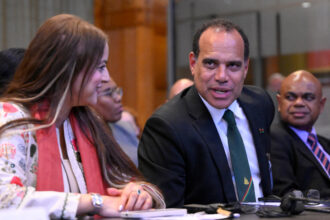
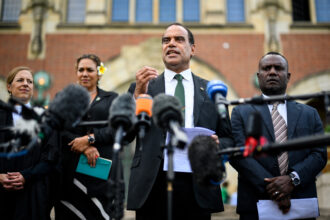
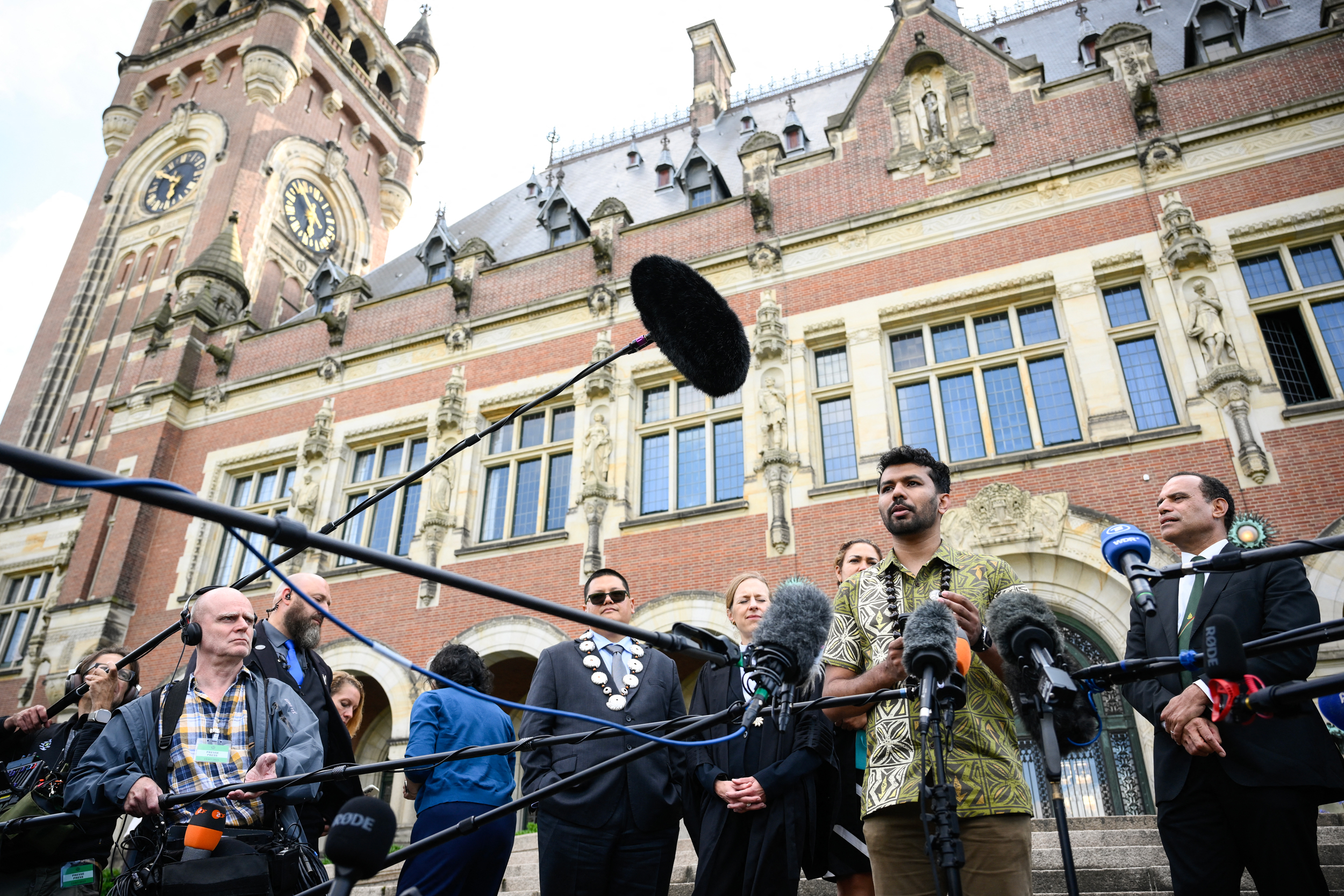
The nonbinding advisory opinion was issued last year by the International Court of Justice after the General Assembly requested it in 2022 with a unanimous vote, marking a rare recent moment of global solidarity on climate policy questions. The vote by the General Assembly on Wednesday to embrace the findings was a huge step forward for the climate justice campaign launched in the Pacific, said Vishal Prasad, director of Pacific Islands Students Fighting Climate Change.
Prashad joined the student-led effort just a few months after it started, feeling energized by the waves of grassroots climate activism, including repeated Fridays For Future marches with turnouts so large that governments could no longer ignore them. But he wanted to go beyond demonstrating, Prasad said in an interview with Inside Climate News. He wanted to get the ICJ to weigh in on the matter.
The student group involved island nation governments, which then built a coalition of nations from all continents to drive the process forward at the U.N. Prasad said the push to get the ICJ’s attention showed that young climate activists can do more than just campaign in the streets and post on social media. Taking climate change to the world’s highest court shows “that young people are competent enough to deal with serious issues and competent to deal with the technical, legal issues,” he said.
The ICJ opinion weaves climate change together with human rights, and Prasad said that helps show that the “fight for climate justice is just a manifestation of decades, even centuries, of injustice that people faced. It’s a direct product of colonialism and exploitative capitalism.”
A legal opinion, politically legitimized by the U.N., gives younger generations a transformative new tool to shape a better future with less conflict and suffering, he said.
“I think it’s a way for us to build a better society altogether, and not just to address climate change,” he said, “to build a society that’s just, equitable and fair for everyone by addressing the issue of climate in a way that leads to reorganizing our economic models and systems.”
Recalling the earliest days of the grassroots efforts to get a court hearing, he said the group decided it was the best path forward “because everyone was tired of hearing how COPs had failed.” The annual international climate talks, or Conference of the Parties, have made too little progress largely because the official U.N. climate framework “was not dealing with the human rights issues relating to climate that people are facing day to day,” he said.
Speaking via Zoom from Fiji, Prasad said the severity of global warming’s impacts began to crystallize there in 2016, when the island took a direct hit from Tropical Cyclone Winston’s 175-mph winds, the strongest storm on record in the Southern Hemisphere.
“Some of our family’s friends who lived in the outer islands had their homes blown away and villages were blown away in some parts of the country,” he said. “We didn’t have water or electricity for four days after the cyclone. A year later, we had another category 5 cyclone. That’s not normal.”
During a webinar ahead of the U.N. vote, Jule Schnakenberg, executive director of the World’s Youth for Climate Justice, noted that a third of the world’s population is younger than 19. Young people around the world pressed their national governments to co-sponsor the resolution, she said.
“These young people have marched on the streets of your capitals,” Schnakenberg said. “They’ve painted banners, learned to run climate clubs at their schools. They’ve lobbied politicians to call out climate emergencies and some have taken national climate cases to court.”
All of them are looking to institutions like the ICJ and the United Nations with hope, she said.
“Multilateralism Is Not Broken”
The global climate justice framework grows somewhat like a coral reef: slowly, with tiny accretions, case by case and norm by norm, until the structure is strong enough to change the currents flowing around it.
The new U.N. resolution is part of that process. It amplifies the ICJ’s nonbinding opinion that international climate agreements are not optional political promises, but obligations linked to existing principles of international law and human rights law. It emphasizes protections for vulnerable countries, Indigenous peoples, youth and people displaced by climate change. And it includes language that could open the door for a discussion of climate reparations or compensation, an idea bitterly disputed by many industrialized countries that emit large amounts of the greenhouse gases at the heart of the problem.
“The law has not caught up with the speed of climate change,” said Joie Chowdhury, a senior attorney with the Center for International Environmental Law.
This story is funded by readers like you.
Our nonprofit newsroom provides award-winning climate coverage free of charge and advertising. We rely on donations from readers like you to keep going. Please donate now to support our work.
Donate NowChowdhury noted that the ICJ opinion and the U.N. vote address existential issues for low-lying countries that are losing ground to sea level rise by ensuring “stability of legal entitlements for countries facing sea level rise, and also the duty to provide reparation and redress for climate-related harm.”
“This was not a settled area of the law before this,” she said. “It was very contested, and the court made it clear that, when there is climate harm that is attributable to a state, it triggers the duty to provide full reparation.”
The resolution also triggers formal steps within the U.N., including a report from the secretary general. But most crucially, it signals that there is widespread global political will, “a crucial bridge between legal norms and practical actions,” Chowdhury said.
“You have 141 states now affirming the legal conclusions of the court,” she said. “That means something.”
Even before the U.N. resolution, the ICJ’s opinion has been used as a legal anchor in numerous countries for climate lawsuits against states and polluters, and has been referenced in court rulings from Brazil to Canada, she said.
The opinion, now enshrined in U.N. climate governance, has also bolstered the negotiating position of some countries as they try to unravel climate-impact costs across various trade and policy talks, she said. And it may help reinvigorate grassroots activism, as climate advocates push to hold their governments accountable to the standards of the opinion.
Eight countries, including the United States, voted against the resolution and 39 others abstained.
“I think yesterday’s vote really sends such a clear message that multilateralism is not broken and climate justice will not be blocked by a handful of polluter states,” Chowdhury said on Thursday. That a small bloc of “historical and current major polluters” used last-minute procedural tactics to try and delay or block the vote shows that the fossil fuel industry fears the global legitimacy of the ICJ, she added.
“If they didn’t, they would not bother to fight this hard,” Chowdhury said. “If the ICJ, if international processes did not matter, why would they care?”
At a time when some states are trying to erode international institutions and the rule of law, the proceedings at the ICJ and U.N. act to counter isolationism and strengthen multilateral cooperation, “showing how these types of mechanisms and processes can be reimagined to address some of the big challenges of our time,” she said. “Hegemonic power cannot be the way forward.”
About This Story
Perhaps you noticed: This story, like all the news we publish, is free to read. That’s because Inside Climate News is a 501c3 nonprofit organization. We do not charge a subscription fee, lock our news behind a paywall, or clutter our website with ads. We make our news on climate and the environment freely available to you and anyone who wants it.
That’s not all. We also share our news for free with scores of other media organizations around the country. Many of them can’t afford to do environmental journalism of their own. We’ve built bureaus from coast to coast to report local stories, collaborate with local newsrooms and co-publish articles so that this vital work is shared as widely as possible.
Two of us launched ICN in 2007. Six years later we earned a Pulitzer Prize for National Reporting, and now we run the oldest and largest dedicated climate newsroom in the nation. We tell the story in all its complexity. We hold polluters accountable. We expose environmental injustice. We debunk misinformation. We scrutinize solutions and inspire action.
Donations from readers like you fund every aspect of what we do. If you don’t already, will you support our ongoing work, our reporting on the biggest crisis facing our planet, and help us reach even more readers in more places?
Please take a moment to make a tax-deductible donation. Every one of them makes a difference.
Thank you,

Bob Berwyn
Reporter, Austria
Bob Berwyn is an Austria-based reporter who has covered climate science and international climate policy for more than a decade. Previously, he reported on the environment, endangered species and public lands for several Colorado newspapers, and also worked as editor and assistant editor at community newspapers in the Colorado Rockies.