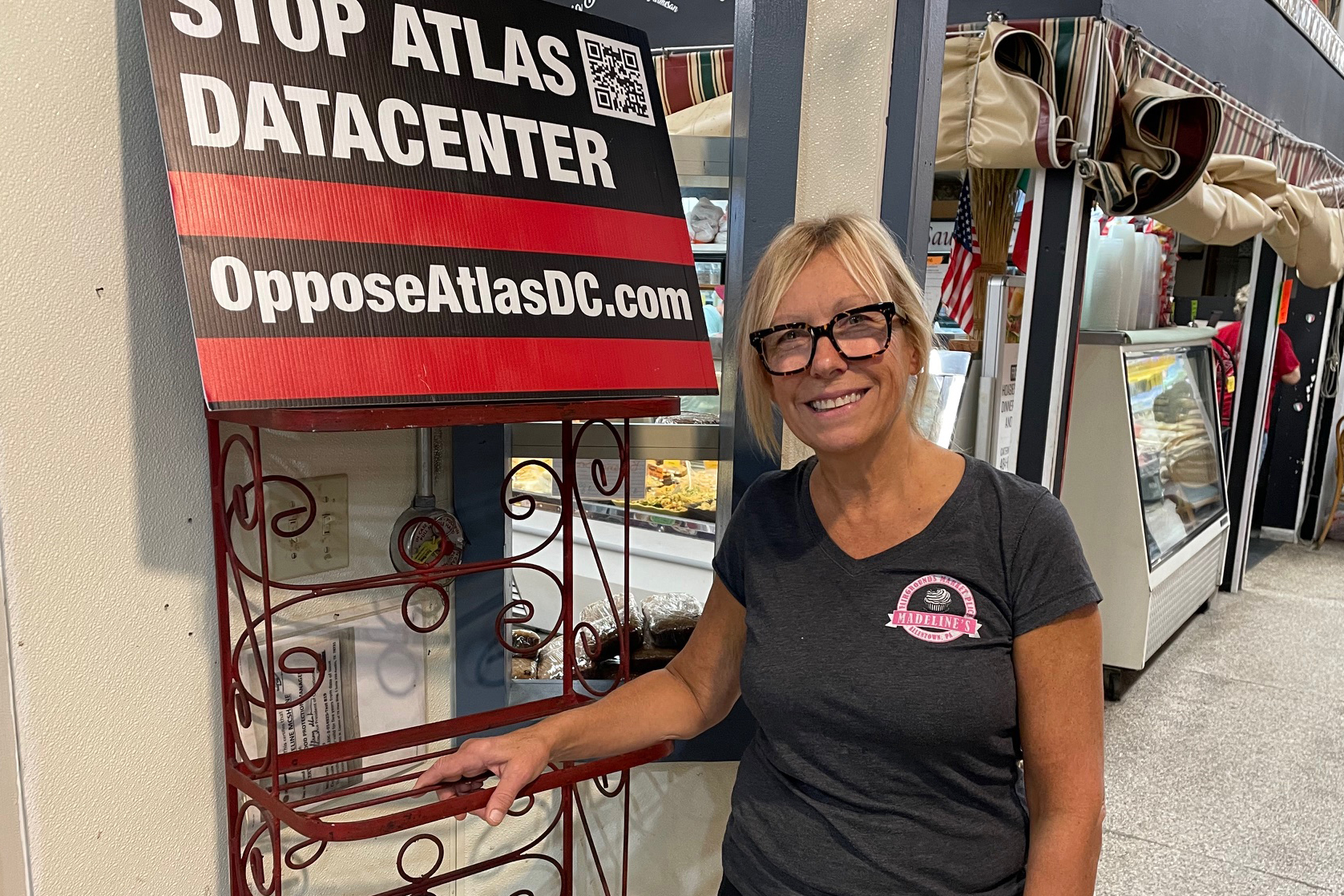


ALLENTOWN, Pa.—In all her 38 years living in South Whitehall Township in the Lehigh Valley, Laurie Gilley had never attended a municipal meeting, much less gotten involved in the politics of her community. But then she learned that a data center was being planned for 400 acres of land across from her home and the local high school.
Now, Gilley, who helped form the South Whitehall Township Civic Alliance to fight the center, is at the vanguard of an informal political movement experts say could impact the midterm congressional elections, especially in tight races like the one in her district, where incumbent U.S. Rep. Ryan Mackenzie, a Republican narrowly elected in 2024, is now facing Democrat Bob Brooks, a retired firefighter.
Gilley said she has been energized by the unified resistance to data centers. “Both sides of the aisle seem to come together on this,” said Gilley, 61, who runs Madeline’s Fairgrounds Marketplace at the popular farmers market here, where the chatter these days in her baked goods and sandwich shop often turns to data centers and politics. “Everywhere I go, we’re talking about it.”
Opposition to data centers—especially in places where they are proposed near residential neighborhoods or close to environmentally sensitive land or water—has been intense in Pennsylvania. Residents worry about property values, rising utility bills, the impact on the water and power supply, the loss of the state’s rural character and environment and even whether artificial intelligence is a good idea at all. And the voices are coming from both parties.
With the looming midterm elections, the question is whether all that talk will translate into votes—and which candidates might benefit.
“It doesn’t take much to tip elections” in Pennsylvania, said Christopher Borick, a political science professor and director of the Lehigh University Opinion Observatory. He said it’s still hard to predict the impact of the opposition that has spread “almost like a wildfire” across Pennsylvania.
But “it is front and center,” he said, in the Mackenzie-Brooks race and three other congressional races that are expected to be decided by thin margins.
Borick said President Donald Trump’s declining approval rating could hurt Republican incumbents in all four of those districts. “That’s a big weight and anchor on Republicans” in tight races, he said, adding that the “straw that breaks the camel’s back” may well be how the data center issue resonates with voters. And there may be far-reaching implications up and down the ballot, he said. “It’s in all the races,” said Borick.
Trump won the state in 2016 and in 2024, and helped two Republicans eke out narrow wins in Pennsylvania in 2024 for their first terms in the U.S. House of Representatives: Mackenzie, who is now facing Brooks in the 7th Congressional District in the Lehigh Valley; and Rep. Rob Bresnahan, who is facing Democrat Paige Cognetti, the mayor of Scranton, in the 8th Congressional District in northeastern Pennsylvania.
Two longtime incumbents also won new terms in 2024—U.S. Rep. Scott Perry, a Republican who is now facing Democrat Janelle Stelson, a former TV anchor, in the 10th Congressional District in the Harrisburg area, and U.S. Rep. Brian Fitzpatrick, a Republican who is facing Democrat Bob Harvie, a county commissioner, in the 1st Congressional District in Bucks County.
All eight candidates essentially agree that developers should pay for infrastructure and power needs and not leave residents with higher utility costs. Harvie is the only candidate so far to say he supports a moratorium. Perry, meanwhile, has adopted Trump’s strong overall support for data centers, saying they are essential to helping the United States stay ahead globally on artificial intelligence.
“The last thing we need are data centers raising our energy costs while big corporations get rich,” Brooks said in a statement to Inside Climate News. “My job is to make sure the people of the Lehigh Valley have the final say over what gets built in their backyard.”
Bresnahan, a Republican, struck a similar note in the 8th District race: “I am not going to allow data centers to be forced on northeastern Pennsylvania without the approval of the people,” he said in a campaign ad, adding that “families know what is best for our communities. We should decide if data centers get built here.”
Ginny Marcille-Kerslake, a senior organizer for the environmental advocacy group Food & Water Watch who is involved in the fight against data centers in Pennsylvania, said she doesn’t know how the issue will play out in the elections, but candidates clearly recognize “that support for these projects makes them vulnerable” in this election.
“I have never seen anything like this in terms of public engagement,” said Kerslake, with opposition coming from “across the political spectrum. We don’t see that these days.”

A Quinnipiac University poll of registered voters in Pennsylvania, published in July, found that 74 percent would oppose a new data center being built in their community. That’s up from 68 percent when the same question was asked of voters in February.
With lots of open space, water and energy resources, Pennsylvania is attractive to data center developers, who are looking for large chunks of land that are near adequate power sources or in places that will allow them to build their own power source, as well as near water, which is needed to cool the massive computer systems housed in these centers.
So far, about 70 data centers have been proposed, are under construction or have some kind of preliminary activity in Pennsylvania, according to the Data Center Proposal Tracker, a citizen-run database that tracks projects across multiple states. They are scattered in and around each of the four competitive districts, with a heavy concentration in the northeastern Pennsylvania region that includes the 8th District.
Christopher Nicholas, a GOP political consultant who grew up in Bucks County’s 1st Congressional District and now lives in the 10th Congressional District, said the issue is clearly a concern for voters across the political spectrum. “It’s both parties,” he said. “That’s why it’s hard for politicians to figure out how to talk about it publicly.”
But with so many issues affecting the various campaigns, he said he just doesn’t see data centers as the key issue. “I can’t look at any of those congressional [races] and say, ‘wow, it’s the defining issue,’” he said. The Quinnipiac poll reflects this assessment: When asked about the top issues in the governor’s race, a majority of Pennsylvania voters picked the economy and the cost of living as priorities when choosing a candidate. Only 42 percent picked data centers.
In the Lehigh Valley’s South Whitehall Township, a 1.5 million square foot data center complex called Project Atlas is planned for 410 acres of land zoned for industrial use and directly across from the Parkland High School, which is attended by more than 3,000 students, and Gilley’s home.
The developer, Edged US, said the project will bring 250 permanent jobs and generate $2.5 million annually for the township, $11.5 million annually for the Parkland School District and $2.4 million to Lehigh County. The project’s website said it will be “built to be a good neighbor.”
This story is funded by readers like you.
Our nonprofit newsroom provides award-winning climate coverage free of charge and advertising. We rely on donations from readers like you to keep going. Please donate now to support our work.
Donate NowAt Gilley’s shop at the Allentown Fairgrounds Farmers Market, a “STOP ATLAS DATACENTER” poster often gets customers talking about the issue. On one recent day, one customer pointed out a positive result of data centers—that they could bring in lots of revenue for the region— while another said simply that he distrusts what politicians say, no matter the party.
Amid the bake shops and deli counters, the vegetable stands and the novelty shops, other customers and workers expressed concern about the impact on the power and water supply but also how important it is nonetheless for the United States to help advance artificial intelligence.
George Snyder, 71, who works at one of the meat shops, said Pennsylvania is a large state and that there should be room for data centers to help the United States win out over China. “People don’t know how vast Pennsylvania is,” said Snyder., who identified himself as a conservative. “There’s a lot of open space.”
But he said the issue will not sway his vote. “I have at least 10 other issues ahead of that,” he said.
Jim Bartholomew, 71, who manages a vacuum cleaner shop, also said the issue will not affect how he votes. “We have too much other big fish to fry than worry about data centers,” he said, such as the price of food and gas.
Gilley said she and her husband were surprised when they learned of the plan to build a data complex so close to their home and the local high school, which is just 1,700 feet from the project site. “If that data center was there first, would we have put the high school there? Never,” she said.
Greg Sussman, president of the South Whitehall Township Civic Alliance, said their group is composed of mostly nearby residents who may have differing political viewpoints but are united in their opposition to the center. “Everybody wants to protect their home, and that’s something that people can rally around.”
Sussman, who declined to discuss his own personal politics, said it’s hard to say what impact the issue will have on the congressional race in his district. “I don’t think that Bob Brooks or Ryan Mackenzie have come out very strongly against data centers,” he said. “They all seem to be shying away from it.”
Gilley said she’s also uncertain how she will vote. “I’m not wowed with either,” she said of the candidates.
Looking back on how much she has learned about the intricacies of data storage and local ordinances by attending so many municipal meetings, Gilley said she never thought she would ever learn so much.
“I know more about data centers now than I ever needed to know,” she said.
About This Story
Perhaps you noticed: This story, like all the news we publish, is free to read. That’s because Inside Climate News is a 501c3 nonprofit organization. We do not charge a subscription fee, lock our news behind a paywall, or clutter our website with ads. We make our news on climate and the environment freely available to you and anyone who wants it.
That’s not all. We also share our news for free with scores of other media organizations around the country. Many of them can’t afford to do environmental journalism of their own. We’ve built bureaus from coast to coast to report local stories, collaborate with local newsrooms and co-publish articles so that this vital work is shared as widely as possible.
Two of us launched ICN in 2007. Six years later we earned a Pulitzer Prize for National Reporting, and now we run the oldest and largest dedicated climate newsroom in the nation. We tell the story in all its complexity. We hold polluters accountable. We expose environmental injustice. We debunk misinformation. We scrutinize solutions and inspire action.
Donations from readers like you fund every aspect of what we do. If you don’t already, will you support our ongoing work, our reporting on the biggest crisis facing our planet, and help us reach even more readers in more places?
Please take a moment to make a tax-deductible donation. Every one of them makes a difference.
Thank you,