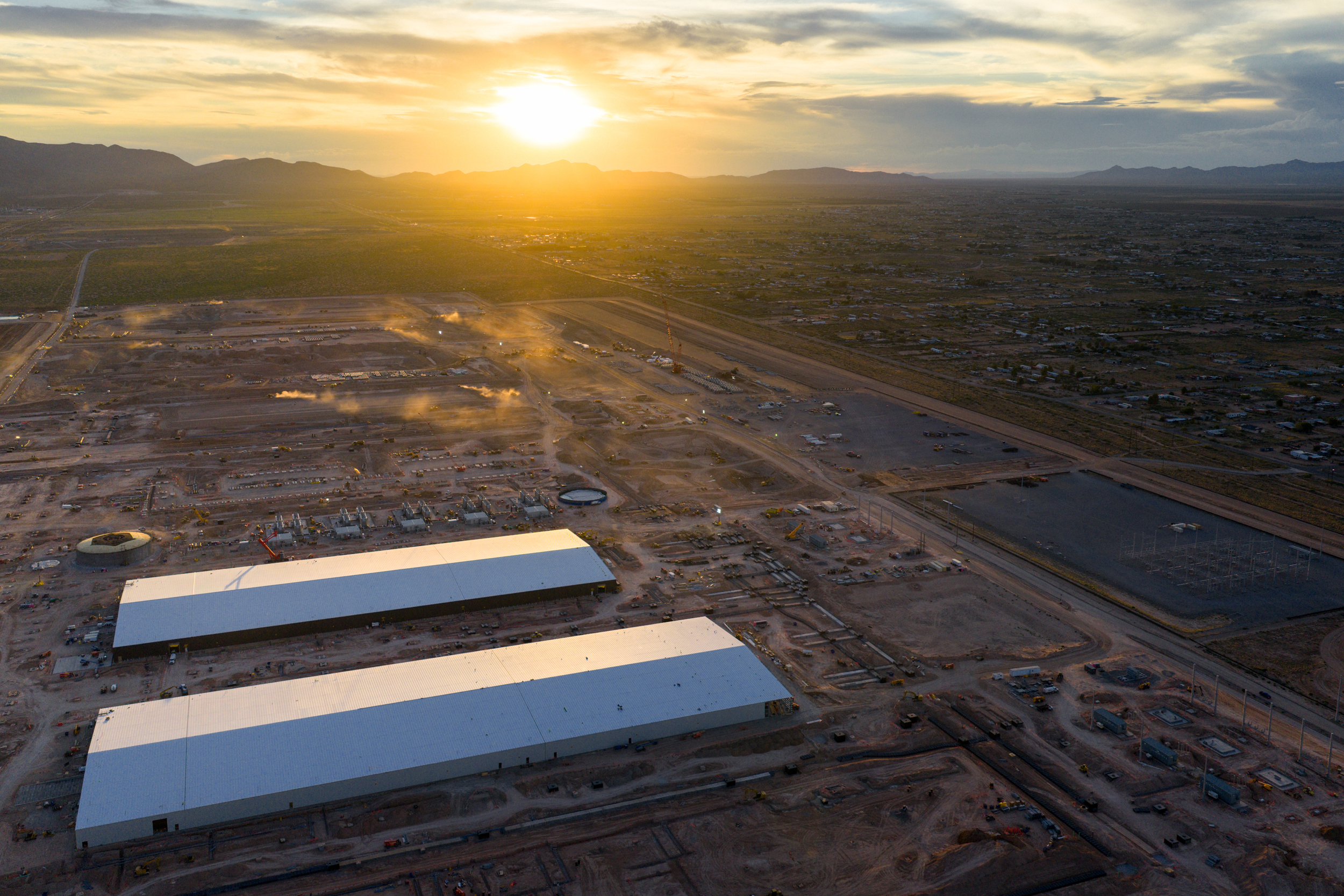


The first group of large data centers in line to get connected to Texas’ grid won’t move forward until mid-December, grid officials say.
Electric Reliability Council of Texas (ERCOT) staff needs to vet the first 300 projects, 90 percent of which are data centers, in “Batch Zero,” and put together a community impact review as directed by Gov. Greg Abbott last month.
Any data centers that don’t respond or don’t pass the verification process will be disqualified from Batch Zero, which was created earlier this year to refine how ERCOT studies the 1,800 projects now waiting for grid connection.
The same day that Abbott announced his plans to have regulators audit prospective data centers, ERCOT put out a market notice saying it would pause the Batch Zero study process and work with the Public Utility Commission of Texas (PUC) to carry out the governor’s request. Until ERCOT’s timing announcement on Thursday, it wasn’t clear how long this effective pause on data centers would last. No large data centers will be approved to come online in Texas until after the November midterm elections, the grid operator said.
The request to verify and audit data center projects comes as the energy- and land-intensive developments have become a flash point in midterm elections across the country. Abbott is running for reelection.
State leaders, including Abbott have switched from courting data centers to imposing new guidelines on the industry months later as the expansive rollout of data centers has heavily impacted the grid and rural communities. Constituents and politicians alike have said the issue will influence voter turnout.
A June poll from the University of Texas at Austin and the Texas Politics Project found 56 percent of respondents were opposed to building data centers in their communities, with 42 percent strongly opposed. When it came to rural responders, 62 percent were opposed, with half strongly opposing.
Texas Attorney General Ken Paxton, who is running to represent the state in the U.S. Senate, said on Monday he would author federal legislation prohibiting the use of Chinese technology to power data centers in the U.S., or to build corresponding infrastructure.
Paxton said he would also propose laws to hold data center operators criminally liable if they create artificial intelligence chatbots that undermine children’s safety.
Paxton’s four-part plan includes advocating for Abbott’s data center directives at the state level by banning A.I. data center developments in rural areas and repealing state tax incentives.
Constituents across the state have been outspoken about their disdain for the industrial facilities and the 765-kilovolt transmission infrastructure the PUC approved to deal with the state’s growing energy demands from large loads and the electrification of the oil and gas industry.
Aaron Games, a cattle rancher from Burnet County, spoke at a House committee hearing about data centers and high-voltage power lines on Wednesday. Calling himself a blighted voter, Games said he doesn’t want proposed transmission infrastructure to cross his family’s land to power the growing number of data center facilities. He’s called the governor’s office a dozen times with no response or reply, Games said.
“I have been a straight ticket Republican voter all my life,” Games said. “I have never voted for a Democrat. I’m about to.”
State Rep. Gina Hinojosa, a Democrat representing Central Austin and a candidate for governor, said in an interview last week with Bloomberg that Abbott’s audit is a late response to his constituents’ concerns and doesn’t use the full scope of his power. Abbott could call a special session of legislators to make laws to protect Texans, Hinojosa said.
“He invited data centers into Texas, has taken millions of dollars in donations from their CEOs, and is now desperately seeking their help to save his own political career,” Hinojosa said in a statement.

As groups of different data center developers commit to complying with Abbott’s audit, the governor’s office has released press statements stating that his directive is working.
“I established clear guardrails to ensure data centers protect our electric grid, conserve our water, respect our neighborhoods, and pay their own way,” Abbott said in each statement. “They must not pass costs on to Texas families or interfere with their quality of life.”
Carrying Out Abbott’s Audit
ERCOT was planning to do a similar audit and verification process in Batch Zero’s planning studies over the next several months, Chad Seely, ERCOT’s senior vice president for regulatory policy, said at a PUC meeting on Thursday. But at the request of the governor, he said ERCOT is now doing it earlier in the study process.
Soon data center operators will have to tell the state how much water their proposed facilities plan to use and what efforts they are making to reduce community impacts.
Most of the data center operators in Texas have ignored requests by state agencies to report water use at their facilities. A water survey released in April, developed by the PUC in collaboration with the Texas Water Development Board, asked operators to provide information about water consumption, cooling processes, electricity demands and whether facilities have their own on-site power source or are connected to the grid. The agency has received responses from only 28 companies.
This story is funded by readers like you.
Our nonprofit newsroom provides award-winning climate coverage free of charge and advertising. We rely on donations from readers like you to keep going. Please donate now to support our work.
Donate NowThe lack of responsiveness has angered some lawmakers as they try to make policies around the state’s natural resources with limited data.
But as early as the end of August or early September, ERCOT will request information from more than 300 prospective applicants, most of them data center operators, to verify that their projects are legitimate, and survey some 500 developers in the queue to measure quality of life mitigation approaches.
To ensure that a data center is eligible to be in Batch Zero, the developer needs to prove it has site control of where the facility will go. This could be a lease, a purchase agreement or site designs. A developer also needs to show purchase orders or provide delivery schedules for specialized machinery that can take months or years to acquire.
The verification process will also include ERCOT staff making site visits to projects with upcoming dates when they are scheduled to go live on the grid. The data center developers also need to have posted their financial commitment of $50,000 in project financing per megawatt.
As the large load interconnection queue exceeds 470 gigawatts, regulators and industry members alike suspect that much of this demand is speculative. PUC Senior Counsel Jessie Horn said the $50,000 per megawatt financial commitment is an incentive to rightsize a project.
Texas regulators have worked to reshape the state’s planning for data centers after drawing so many industry investors because of the state’s reputation as business friendly, with quick permitting timelines. In 2025, state lawmakers passed sweeping rules so the PUC and ERCOT could remove unfit projects from the queue using these criteria.
Seely said that while ERCOT is still working to finalize questions to pose to data center operators for the community impact report, the staff is working with a consultant on ways to verify some of the answers.
In October and November, ERCOT plans to complete information gathering and issue any additional requests for information to the developers. Texas grid officials said they hope to file their reports related to Abbott’s audit by Dec. 10.
About This Story
Perhaps you noticed: This story, like all the news we publish, is free to read. That’s because Inside Climate News is a 501c3 nonprofit organization. We do not charge a subscription fee, lock our news behind a paywall, or clutter our website with ads. We make our news on climate and the environment freely available to you and anyone who wants it.
That’s not all. We also share our news for free with scores of other media organizations around the country. Many of them can’t afford to do environmental journalism of their own. We’ve built bureaus from coast to coast to report local stories, collaborate with local newsrooms and co-publish articles so that this vital work is shared as widely as possible.
Two of us launched ICN in 2007. Six years later we earned a Pulitzer Prize for National Reporting, and now we run the oldest and largest dedicated climate newsroom in the nation. We tell the story in all its complexity. We hold polluters accountable. We expose environmental injustice. We debunk misinformation. We scrutinize solutions and inspire action.
Donations from readers like you fund every aspect of what we do. If you don’t already, will you support our ongoing work, our reporting on the biggest crisis facing our planet, and help us reach even more readers in more places?
Please take a moment to make a tax-deductible donation. Every one of them makes a difference.
Thank you,

Arcelia Martin
Reporter, Texas Renewables
Arcelia Martin is an award-winning journalist at Inside Climate News. She covers renewable energy in Texas from her base in Dallas. Before joining ICN in 2025, Arcelia was a staff writer at The Dallas Morning News and at The Tennessean. Originally from San Diego, California, she’s a graduate of Gonzaga University and Columbia University Graduate School of Journalism.