

By the time it was dumped on deck, the heaved contents no longer resembled ocean life.
Smashed, and now spilled, a soup of dead crabs and conger eels slid across the salt-covered ship floor. Bruised, banged and beaten by boulders, half a ton of mud sprinkled with squashed starfish and assorted shells had been bounced violently across the sea floor for the last four hours. From the dark depths of the ocean, these creatures only came to light after their deaths.
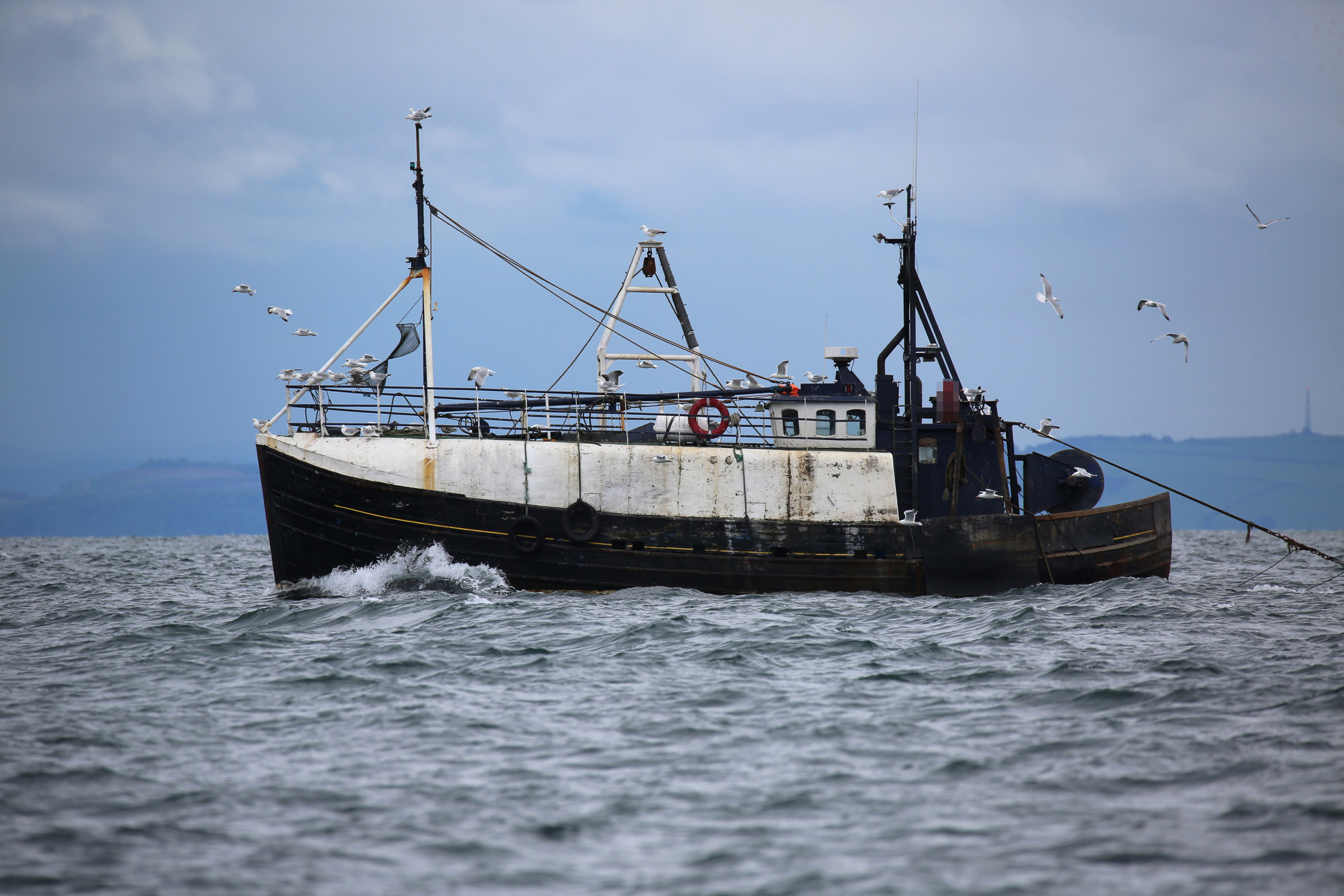
As waves pummeled the hull, the boat met the water’s rhythm. The engine shuddered like a jackhammer striking stone while chains lashed, clanging against anything foolish enough to impede them. The stench of guts and sight of blood was a clear reminder: This wasn’t a sterile factory on land but a mechanised, rusted beast on the hunt.
Today, this cacophony is the daily soundtrack for those navigating Europe’s waters on the fish-strewn decks of nearly 5,000 trawlers operating from the sun-soaked Mediterranean to the icy reaches of the Arctic Ocean, fishing for species like cod, haddock and shrimp, but scooping up sharks, rays and seahorses that are discarded as bycatch once hauled up on deck.
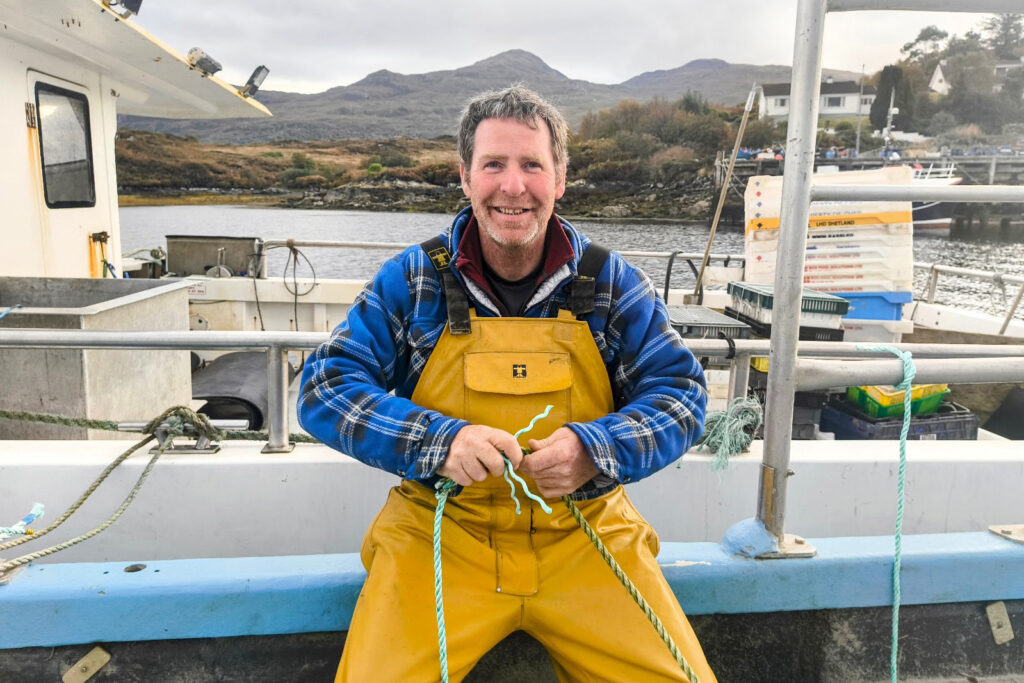
For Bally Philp, a third-generation fisherman from Scotland’s Isle of Skye, it too was the backdrop of his boyhood.
“I wasn’t very happy shoveling dead fish,” said Philp, who worked on prawn trawlers and scallop dredgers as a teenager. Philp, often against the wishes of his skipper, would try to release the living, unintended catch gasping in their first few minutes out of water—an act for which he was ultimately fired from his uncle’s boat. “That was the end of my career trawling. I wasn’t willing to watch perfectly good fish that would have otherwise survived, die.”
Now the chair of the Scottish Creel Fishermen’s Federation, Philp has traded industrial nets for baited pots. Yet, for similar small-scale fishers across Europe, the fight against trawlers isn’t just environmental, it’s also economic.
Bottom trawling in European waters costs up to $18.5 billion annually through disturbing seafloor sediment and releasing carbon dioxide emissions, according to a new report by National Geographic’s Pristine Seas researchers. The continents’ trawlers spend over 5.5 million hours each year fishing, with almost a quarter of all activity occurring inside Marine Protected Areas (MPAs).
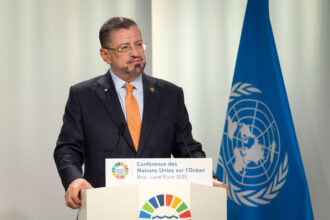
“Our study makes it clear that bottom trawling in European waters is not just an environmental disaster, it’s an economic failure,” said Professor Enric Sala, National Geographic explorer in residence and one of the authors of the study published this week in Ocean & Coastal Management.
“We were shocked to see that the cost to society is so huge,” said Sala, who emphasized that these are merely conservative estimates. “The emitters of carbon dioxide create costs they don’t have to pay for, it is the rest of society who pays for them.”
While the industry generates over $200 million in net profits, European taxpayers are left to foot a bill roughly 90 times higher, according to the report.
“A marine protected area where you allow bottom trawling is like allowing clear cutting the forest in our national parks,” said Sala. “If that happened on land in Europe, people would be up in arms. But in the ocean, nobody sees it.”
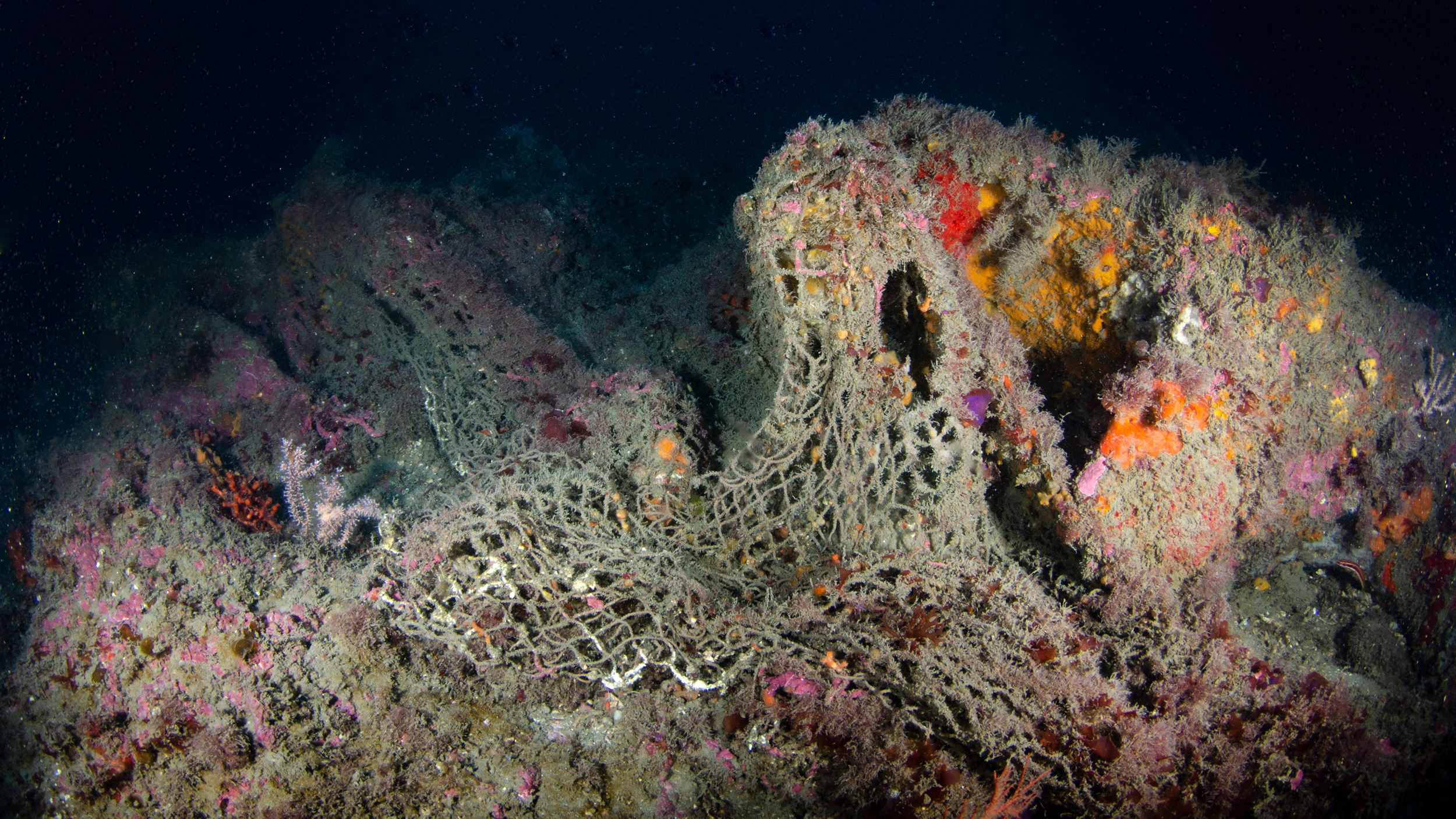
Although fish are some of the last truly wild things people encounter on a daily basis, commercial bottom trawling is worlds away from traditional fishing methods. Marine biologists often refer to the practice as “hunting with a bulldozer,” as nets—some large enough to swallow a dozen Boeing 747s—sweep with indiscriminate destruction over coral reefs, kelp beds and seagrass meadows.
Sometimes searching solely for small, singular species, such as shrimp, the heavy nets gouge sediment from the seafloor in a practice that releases nearly 370 million metric tons of carbon dioxide globally each year. Nearly a third of that comes from European-flagged trawlers, according to researchers.
In the first economic assessment of its kind, Sala and his team discovered that emissions from Europe’s bottom-trawlers far outweigh their fiscal benefit to society. Using the social cost of carbon dioxide—an accounting method for working out the monetary impact of each ton of CO2 released into the atmosphere—the controversial fishing method is a financial black hole.
As Philp has seen firsthand, up to 75 percent of marine life caught in bottom trawling nets die, according to National Geographic. The wholesale capture and discarding of dogfish, rays, bottom-dwelling sharks, sponges and seahorses is valued at a quarter of a billion dollars alone each year.
“You can’t fix the selectivity issue, you can’t fix the seabed abrasion issue, and you can’t fix this carbon issue,” said Philp, highlighting the gross design flaws of trawling gear. “Carbon adds a whole other layer of compelling arguments as to why we might want to restrict trawling.”
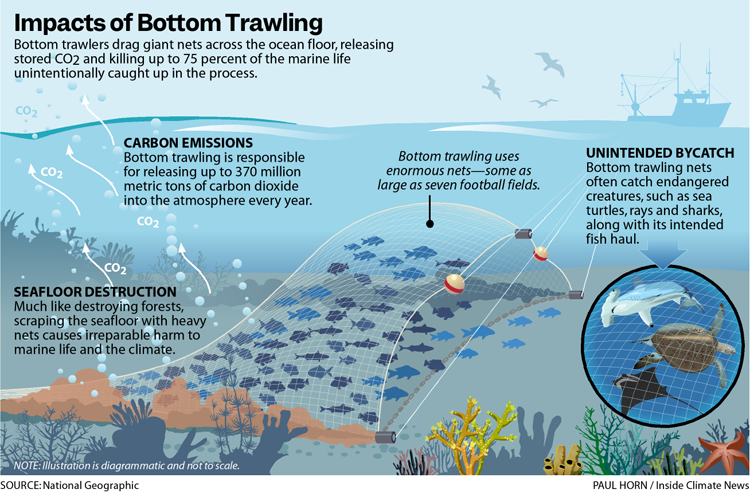
Though supermarkets sell convenience and sustainability, the high levels of bycatch from trawling refute this claim. “When you eat a shrimp, you’re eating a shrimp, but for that shrimp you killed sharks, you killed skates, you released tons of carbon dioxide,” said Michael Sealey, senior policy advisor at Oceana in Europe. “Repeatedly bulldozing marine habitats is not only incompatible with their protection and restoration, it also undermines the EU’s own blue economy objectives.”
The report highlights a wider global blind spot. Over 3,000 different fish species are caught up in bottom trawls around the world, according to research published this month in Reviews in Fish Biology and Fisheries. Statistical modeling suggests this figure could be as high as 5,700 species, with entire branches of the marine “tree of life” enmeshed in trawls. Lead author Sarah Foster, a senior researcher at the University of British Columbia, witnessed the destruction firsthand in Mexico’s Gulf of California.
Foster recalls walking the deck of a trawler watching the catch drop before her like “pieces of a beautiful ocean puzzle.” The crew of nine local fishermen would occasionally tell the then-Ph.D. researcher to turn her head when the catch was particularly unsightly.
“It was my job to shovel everything that we didn’t keep overboard,” said Foster. “It was heartbreaking.”
“When you eat a shrimp, you’re eating a shrimp, but for that shrimp you killed sharks, you killed skates, you released tons of carbon dioxide.”
— Michael Sealey, Oceana in Europe
Her recent report found 95 percent of species caught by trawlers globally were not their intended target, while one in seven species caught were “threatened” or “near threatened” on the International Union for Conservation of Nature (IUCN) Red List.
Much of this “trash fish”—a term used by industry to justify high bycatch levels—is caught in the Global South and ground into fishmeal to feed more expensive farmed fish in the Global North.
Foster predicts the industry will find fault with the exact dollar amount of carbon released, but thinks doing so misses the bigger picture: Bottom trawling isn’t just a fisheries challenge but a climate change challenge.
“The devil’s in the detail,” said Foster. “If you stand back, no one can contest that bottom trawl fisheries are the worst fisheries we have from a climate perspective. They consume the most fuel and release carbon from the ocean floor in a way that no other fisheries do.”
Despite these ecological harms, bottom trawling continues inside Europe’s supposedly protected marine habitats. Since 2020, more than 1.3 million tons of fish have been caught by trawlers inside Britain’s protected waters—enough to fill 500 Olympic-sized swimming pools, according to Greenpeace.
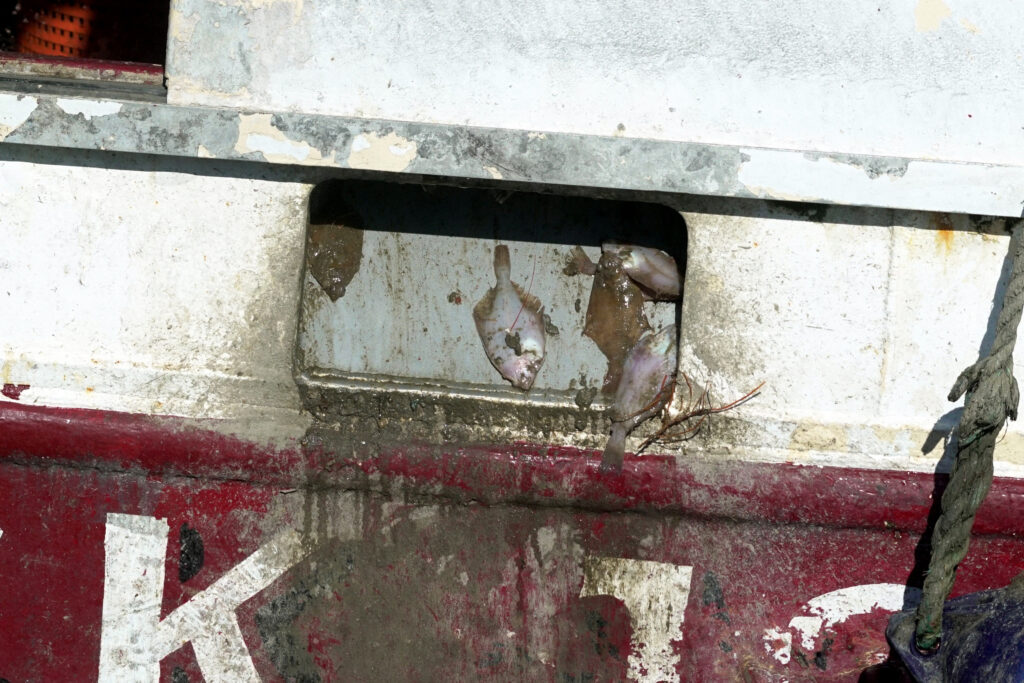
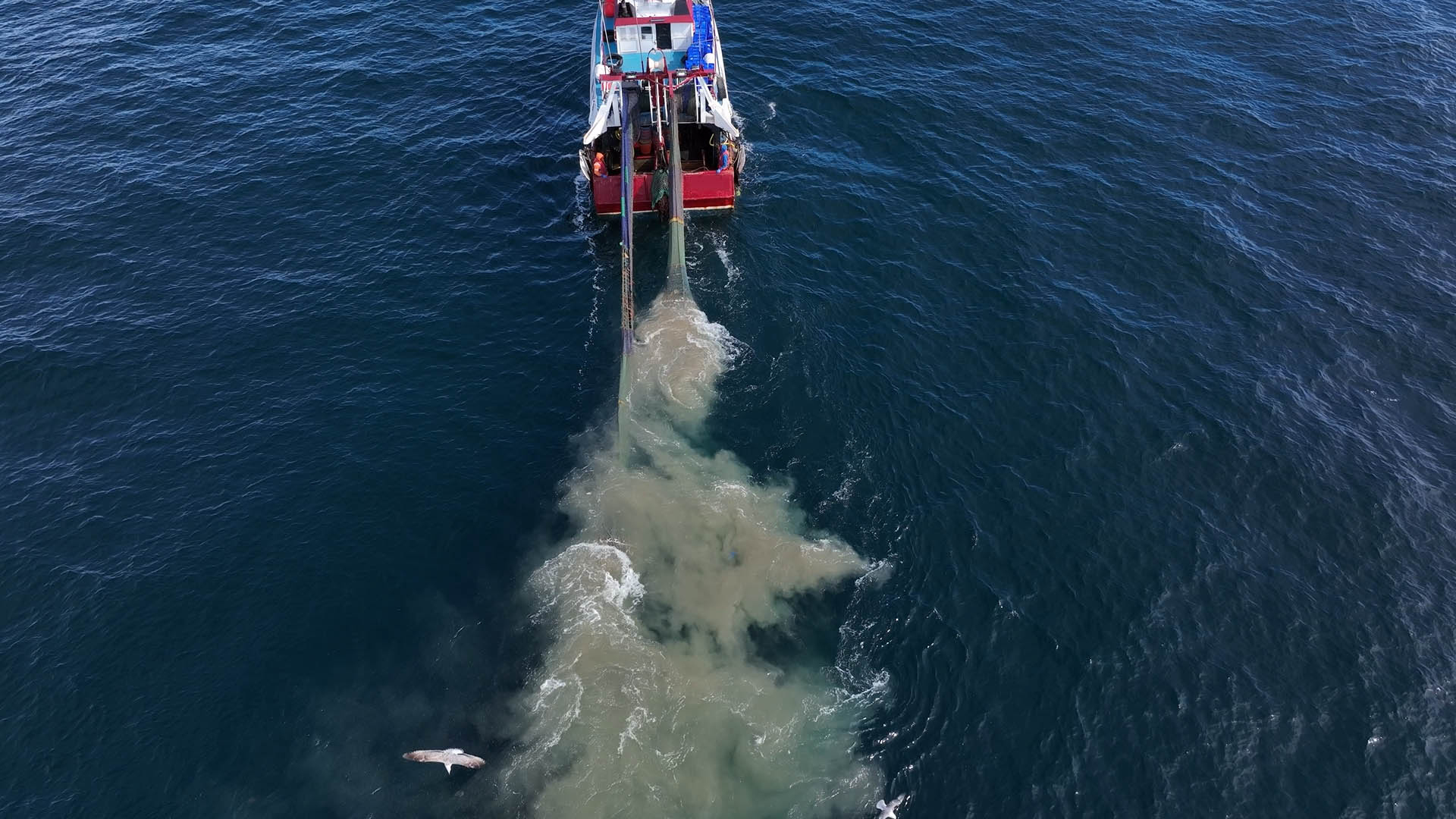
Despite boasting more than 300,000 square miles of marine reserves, only 0.07 percent of Europe’s waters had “full” or “high” protection against trawling, said National Geographic researchers. As a result, populations of sharks, rays and skates are often more plentiful outside MPAs than within them.
In Spain, Oceana and ClientEarth, both prominent environmental nonprofits, have taken the government to the High Court for allowing such destruction inside Natura 2000 sites—areas protected by European Union habitat directives. Now in its third year, the legal case challenges the Spanish fisheries ministry’s ability to issue licenses to trawlers operating knowingly inside MPAs without conducting proper environmental impact assessments.
Part of the issue stems from the political disconnect between the environmental ministry and the fisheries ministry. While the former champions the goal of protecting 30 percent of its waters by 2030, the latter has repeatedly told Oceana, “we manage an activity, we don’t manage the ecosystem,” said Sealey, noting the ministry—who still have environmental obligations to fulfil by law—prioritizes large industrial vessels’ right to fish. This dynamic exposes a powerful corporate control of national policy.
“There is a myth perpetuated by the industrial fishing lobby that we cannot protect more of the ocean because that would harm the fishing industry,” said Sala. “But the worst enemy of fishing is not protection, it’s overfishing.”
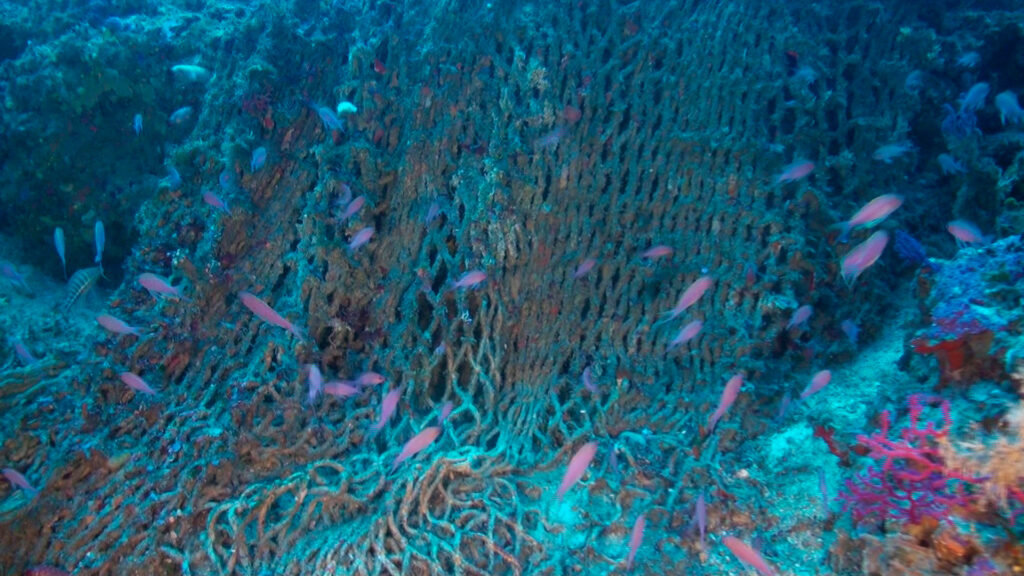
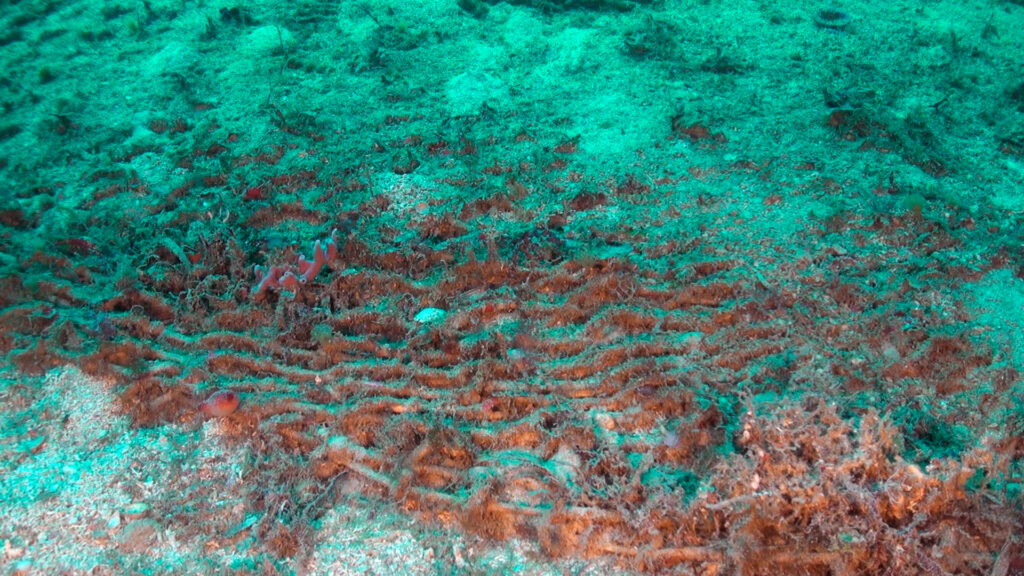
Across Europe, Oceana has found its strongest allies in local, small-scale fishermen. In the Atlantic Ocean’s Tenerife, fishers have pleaded for a marine reserve for almost 20 years, only to be blocked by the central government in Madrid time and time again. Similarly, in Mallorca, the local government’s push for the Tramuntana reserve—a hotspot for rare red coral—remains stalled, despite support from divers and scientists alike.
Britain’s poor patchwork of historic management policies have similarly allowed industrial lobbyists to push the narrative that restrictions on trawling is an “anti-fishing” initiative, said Hugo Tagholm, executive director of Oceana UK.
While the U.K. restricted bottom trawling in 13 additional MPAs in 2024, multinational companies use British fishermen as a shield to fight conservationism all while “sucking the life out of our coastal communities and running away with the profits,” said Tagholm.
The corporate divide is stark: Just 26 boats catch over 50 percent of Scotland’s seafood by value.
“The guys who work on these boats, they don’t even have oilskins,” said Philp, referring to fishermen’s waterproof outergarments to highlight the immensely industrialized nature of Scotland’s largest super-trawlers, which make just a few companies wealthy off the back of public resources. “If the fisherman doesn’t own a pair of bibs and braces, and wellies and a waterproof jacket, then they’re barely a fisherman as far as I’m concerned.”
This story is funded by readers like you.
Our nonprofit newsroom provides award-winning climate coverage free of charge and advertising. We rely on donations from readers like you to keep going. Please donate now to support our work.
Donate NowDespite their immense ecological harm, trawlers provide just 2 percent of Europe’s animal protein. Economically, they also employ less than a third of the number of those working in low-impact, small-scale fisheries, ranging from skillful pole-and-line fishing in Portugal to trapping along Greek wetlands.
Sala emphasizes that the $18.5 billion carbon cost is an underestimate. Industrial bottom trawlers have been churning seabeds since the 1950s and more than half the carbon released is already in the atmosphere.
“It’s a fraction of a fraction of a subset of the CO2 produced by the bottom trawling industry,” said Sala. “The cost to society is probably higher than what we’re reporting.”
Without over $1 billion spent on fuel subsidies each year—a figure almost identical to the total economic value of the jobs provided—the industry would be unprofitable in Spain, the U.K. and Portugal, researchers claim. In March, when fuel prices spiked due to geopolitical crises abroad, half the Dutch fleet stayed in port because it was financially unviable to go to sea without higher subsidies.
In Scotland, Bally Philp’s family has faced its fair share of fish stock failure as finfish landings have dropped more than 95 percent since the 1970s. His grandfather’s generation caught herring to the point of collapse; his father’s generation chased the last of the large cod and haddock populations; and now his generation has been reduced to a “nation of shellfish fishermen,” largely as a result of overfishing by trawlers.
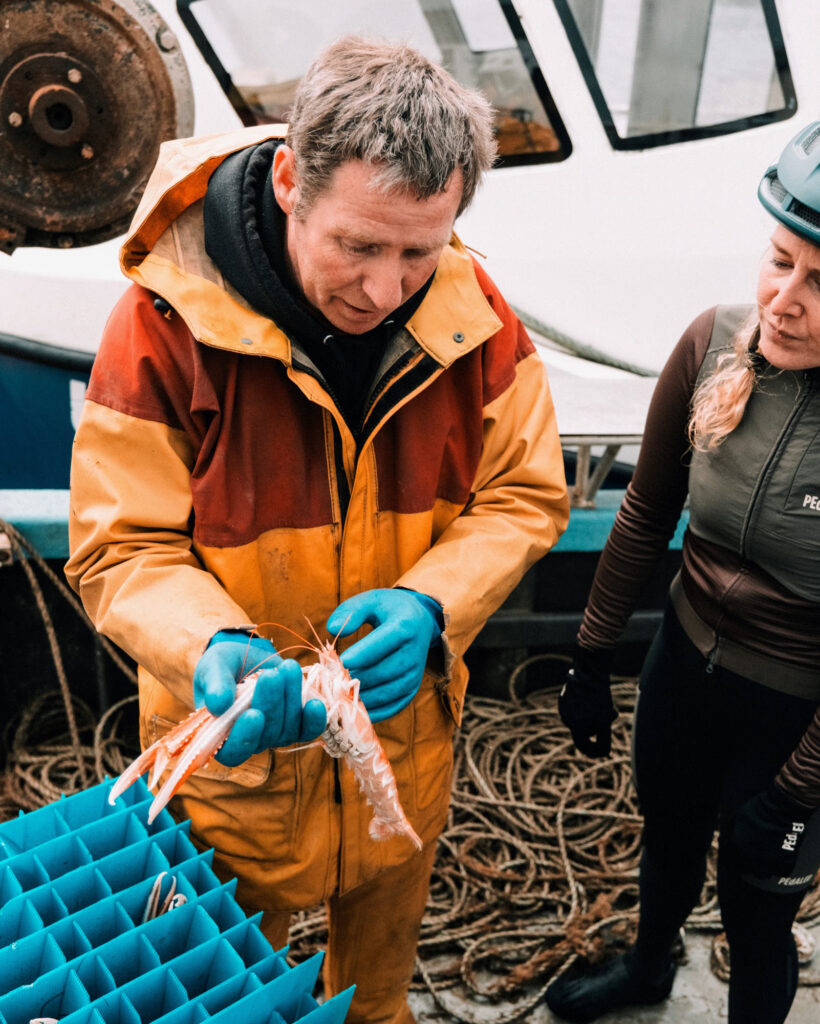
However, Philp remains optimistic that fisheries and conservation remain compatible. And he’s willing to fight for it.
His federation is currently testing “negatively buoyant rope” on more than 100 boats to reduce whale entanglement by up to 80 percent, and are combating “ghost fishing” by introducing perishable panels that allow lost gear to “unzip itself” and release any catch.
More broadly, he’s helped grow the Our Seas coalition to 160 organizations petitioning the Scottish government to reserve 30 percent of the nation’s inshore waters exclusively for lower-impact fishing, as was originally the case with the historic three-mile inshore limit that lasted almost a century from 1889 to 1984.
From the helm of Nemesis, his two-tone navy and light-blue creel boat, Philp now enjoys a far more relaxing fishing environment beneath the shadows of rugged moorlands. His engine quietly ticks over while clean pots emerge from the clear Inner Sound sea loch one at a time. Paid only for what reaches the market alive, animal welfare is paramount.
“It’s more like we’re working in a pet shop. It’s that kind of care,” he said. The prawns are exposed to the air for just a few seconds before being transferred to a tank of running water. Nothing crashes or screeches as any loud noises could stress and kill the prawns.
A world away from the trawling of his youth, he’s taught his two sons to fish but wants them to find a job onshore. A decision rooted in the same realization that ended his trawling career: Neither the health of the ocean nor the fishing industry are guaranteed to last.
“[Trawlers] restrict where we can fish, they give us a bad name and they degrade our environment that we rely on for our future,” said Philp, reflecting on how limiting trawling can be a pro-fishing and pro-economy stance.
“Scotland could have a lot more fishermen making a lot more revenue with a much smaller environmental footprint if we weren’t being physically displaced by trawlers.”
About This Story
Perhaps you noticed: This story, like all the news we publish, is free to read. That’s because Inside Climate News is a 501c3 nonprofit organization. We do not charge a subscription fee, lock our news behind a paywall, or clutter our website with ads. We make our news on climate and the environment freely available to you and anyone who wants it.
That’s not all. We also share our news for free with scores of other media organizations around the country. Many of them can’t afford to do environmental journalism of their own. We’ve built bureaus from coast to coast to report local stories, collaborate with local newsrooms and co-publish articles so that this vital work is shared as widely as possible.
Two of us launched ICN in 2007. Six years later we earned a Pulitzer Prize for National Reporting, and now we run the oldest and largest dedicated climate newsroom in the nation. We tell the story in all its complexity. We hold polluters accountable. We expose environmental injustice. We debunk misinformation. We scrutinize solutions and inspire action.
Donations from readers like you fund every aspect of what we do. If you don’t already, will you support our ongoing work, our reporting on the biggest crisis facing our planet, and help us reach even more readers in more places?
Please take a moment to make a tax-deductible donation. Every one of them makes a difference.
Thank you,
Johnny Sturgeon
Fisheries Reporter
Johnny Sturgeon is a London-based reporter covering fisheries and aquaculture. Joining us from the Outlaw Ocean Project, he has experience producing in-depth maritime investigations for nonprofit newsrooms. A former boatbuilder, he holds a B.A. in History & Politics from the University of Oxford, and an M.S. from Columbia Journalism School.