

After years trying to realize her father’s dream of designating a 4,543-square-mile expanse of California’s coast and ocean waters as the Chumash Heritage National Marine Sanctuary, Violet Sage Walker said she is disappointed with the direction the sanctuary’s leaders are taking amid the Trump administration’s threats to open areas for new offshore oil and gas leases.
“It’s unfortunate that the federal partners and NOAA … are considering prohibited items within the marine sanctuary and protected areas, but it’s not surprising considering what they’ve just recently done, opening up commercial fishing in the Hawaii sanctuaries and protected areas,” Walker, the chairwoman of the Northern Chumash Tribal Council, told Inside Climate News. She nominated the designation of the Chumash Heritage National Marine Sanctuary in 2015.
Despite calls from the Northern Chumash Tribal Council to push back on the administration’s plans, Walker said they are being met with silence and she has yet to hear from the sanctuary’s partners at the National Oceanic and Atmospheric Administration (NOAA). She speculates that because there has been a push to revitalize the state’s economy with oil development, NOAA’s lack of opposition might be because “they don’t want to go against the administration and be on the chopping block.”
“There’s a whole long list of stuff the administration is doing that is bad for any protected area or marine sanctuary that we focused on protecting for generations, and now they’re being reversed under the new administration,” she said.
Five national marine sanctuaries line the coast of California, protecting areas of high conservational or cultural importance from development. The Chumash Heritage National Marine Sanctuary, the most recently designated marine sanctuary, is also the first to be created in conjunction with Indigenous voices. It was finalized during the Biden administration, and while the NOAA advisory board and advocates had proposed a larger area of protection, an area was reserved for offshore wind development.
After NOAA and the Department of Commerce received the nomination and undertook their review, they determined the area was of conservational importance to both the local environment and cultural community. From there, the tribe established a co-stewardship model with NOAA that has been part of the sanctuary’s management plan since its designation in 2024.
The only federally recognized Chumash tribe in the country, the Santa Ynez Band of Chumash Indians, has yet to take any formal stances against the potential offshore oil and gas leasing.
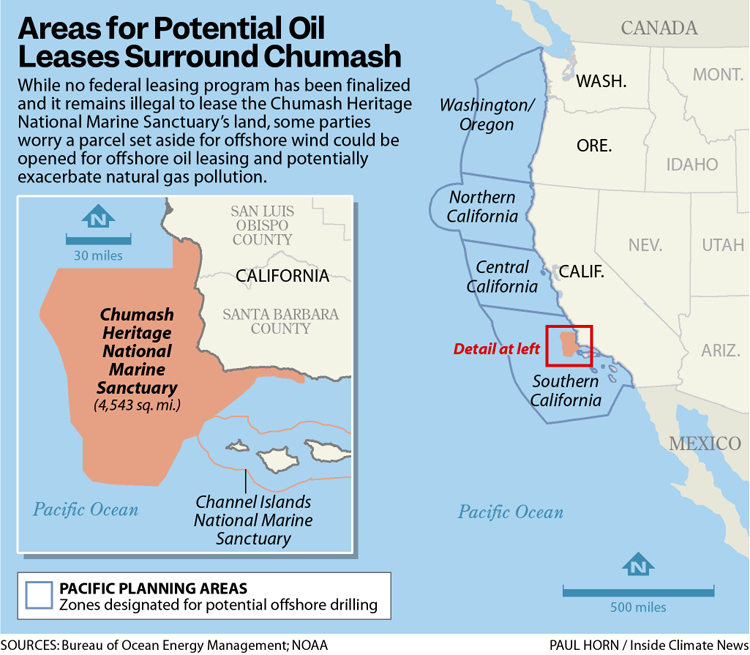
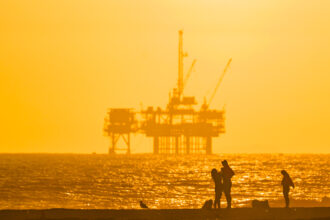
Wind development within the reserved area is now stalled after the Trump administration froze all offshore wind development last year. But the unprotected sanctuary could be exposed to the environmental threats that spills and development pose as the Trump administration aims to lease land out for offshore oil.
NOAA did not respond to Inside Climate News’ request for comment.
The Northern Chumash Tribal Council is working with other organizations in the state, including the Environmental Defense Center, Sierra Club, Surfrider Foundation and the Stanford Environmental Law Clinic, to raise awareness around threats to the sanctuary, Walker said.
Maggie Hall, the deputy chief counsel at the Environmental Defense Center, said her organization first supported the Chumash National Heritage Marine Sanctuary because it would not allow for future oil and gas drilling within the sanctuary’s boundaries. However, they are currently concerned about Trump’s proposal for a new five-year leasing program that could be detrimental to the conservation mission of the marine sanctuary she and other partners worked so hard to build.
Hall grew up in northern Santa Barbara County and said her lifelong appreciation of the outdoors cemented her desire to be an environmental attorney and come back home to help protect the area.
She said that with California included in the Department of the Interior’s proposed 11th National Outer Continental Shelf (OCS) Oil and Gas Leasing Program, they believe it is not only unlawful but inappropriate to allow any new leasing that could test the regulations the marine sanctuary has in place to protect it from any drilling in its vicinity.
Hall said she doesn’t think the Chumash wind leases would be converted to offshore oil drilling projects because of a California law that prevents the development of any new state infrastructure that would support new offshore drilling. In other words, the only oil drilling projects that can be leased out are ones in areas with existing infrastructure.
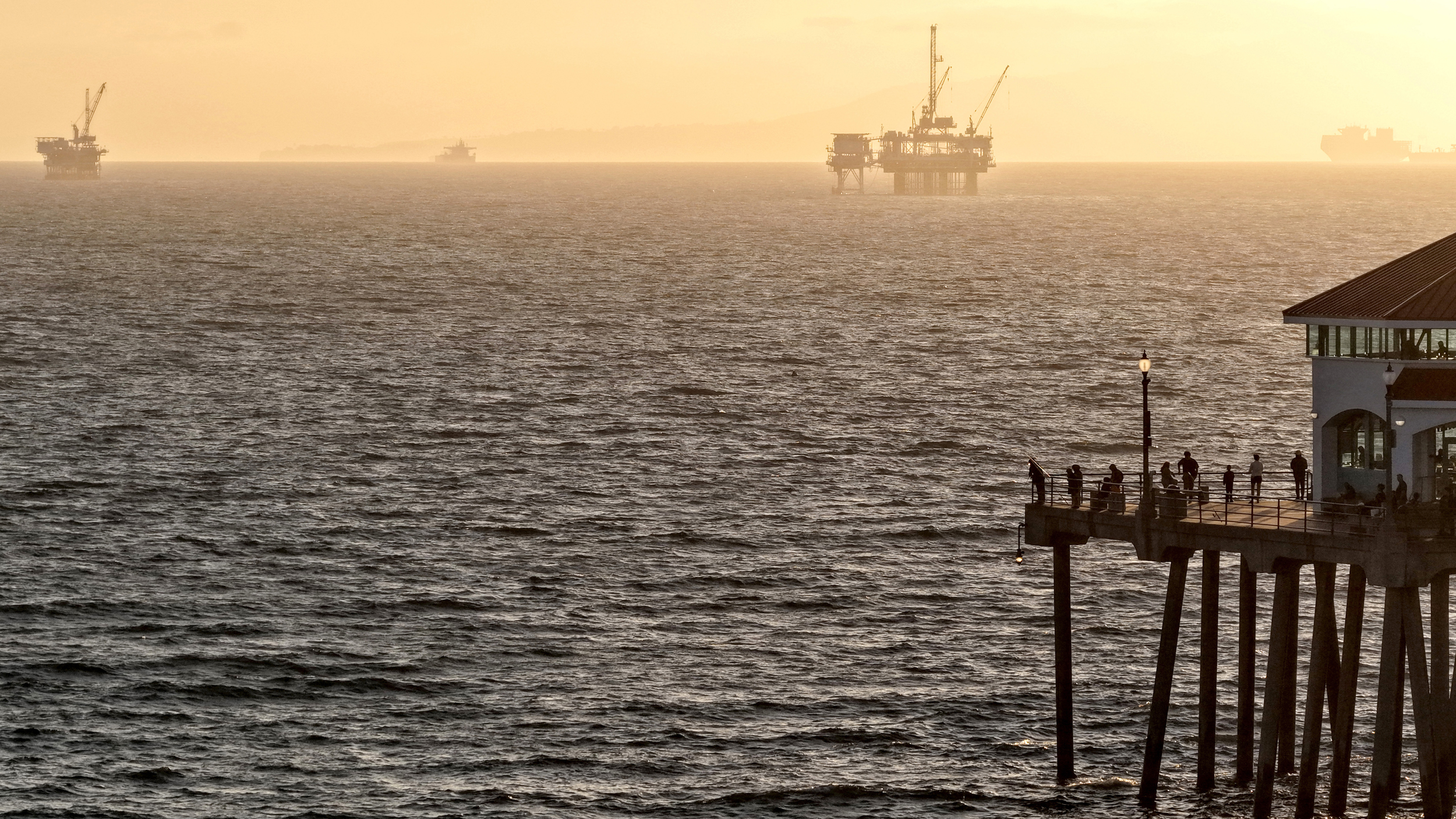
But Victoria Molyneaux, an attorney at the nonprofit Defenders of Wildlife, said the Chumash sanctuary is at a greater risk of being impacted by federal and state leasing than older national marine sanctuaries because it is not protected by the Outer Continental Shelf Lands Act (OCSLA). Established in 2008, OCSLA withdrew parts of the outer continental shelf from oil and gas leasing and made them ineligible to be included in five-year plans for lease sales.
Despite it being protected by the National Marine Sanctuaries Act, which prohibits oil and gas leasing within the boundary of the sanctuary, the ecosystem within the marine sanctuary could still be impacted by the oil leases that come out of areas that were not protected by OCSLA because of oil tanks and vessels that risk spillage into the sanctuary. Molyneaux said that because of this, she and other advocates want to ensure any efforts that come out of the Trump administration or California to lease new areas for offshore oil projects are quashed.
“We want to make sure that it’s clear to the administration that this area is not only really special, but also have protections in place that still prohibit drilling, even if it’s not withdrawn by the president,” Molyneaux said.
Outside of OCSLA and the National Marine Sanctuaries Act, Stephanie Altman, a senior energy and biodiversity specialist at Defenders of Wildlife, said each individual marine sanctuary has its own restrictive statutory and regulatory frameworks that prohibit any oil and gas activity within those areas. This should make it nearly impossible for oil and gas exploration to impact the boundaries inside the sanctuary, but Altman said there is still an open question about what the administration will do.
“It’s a question mark, what this administration is going to do … and whether or not they’d even go as far as potentially revising the regulations that are in place for Chumash National Marine Sanctuary,” Altman said.
Even then, if coastlines that lie outside the marine sanctuary’s limit and are not protected by OCSLA are leased to offshore drilling projects, it could have harmful effects on species such as sea turtles and sea otters inside the sanctuary that the Chumash tribe aim to conserve for fishing and cultural purposes.
“Oil spills don’t know sanctuary boundaries, so if you have an oil and gas or oil or gas lease that’s issued near the sanctuary and a platform gets built or there’s a pipeline and you have a spill, that spill can pretty easily get within sanctuary boundaries with ocean currents and put all of those resources that have been deemed valuable and vulnerable at risk,” Altman said.
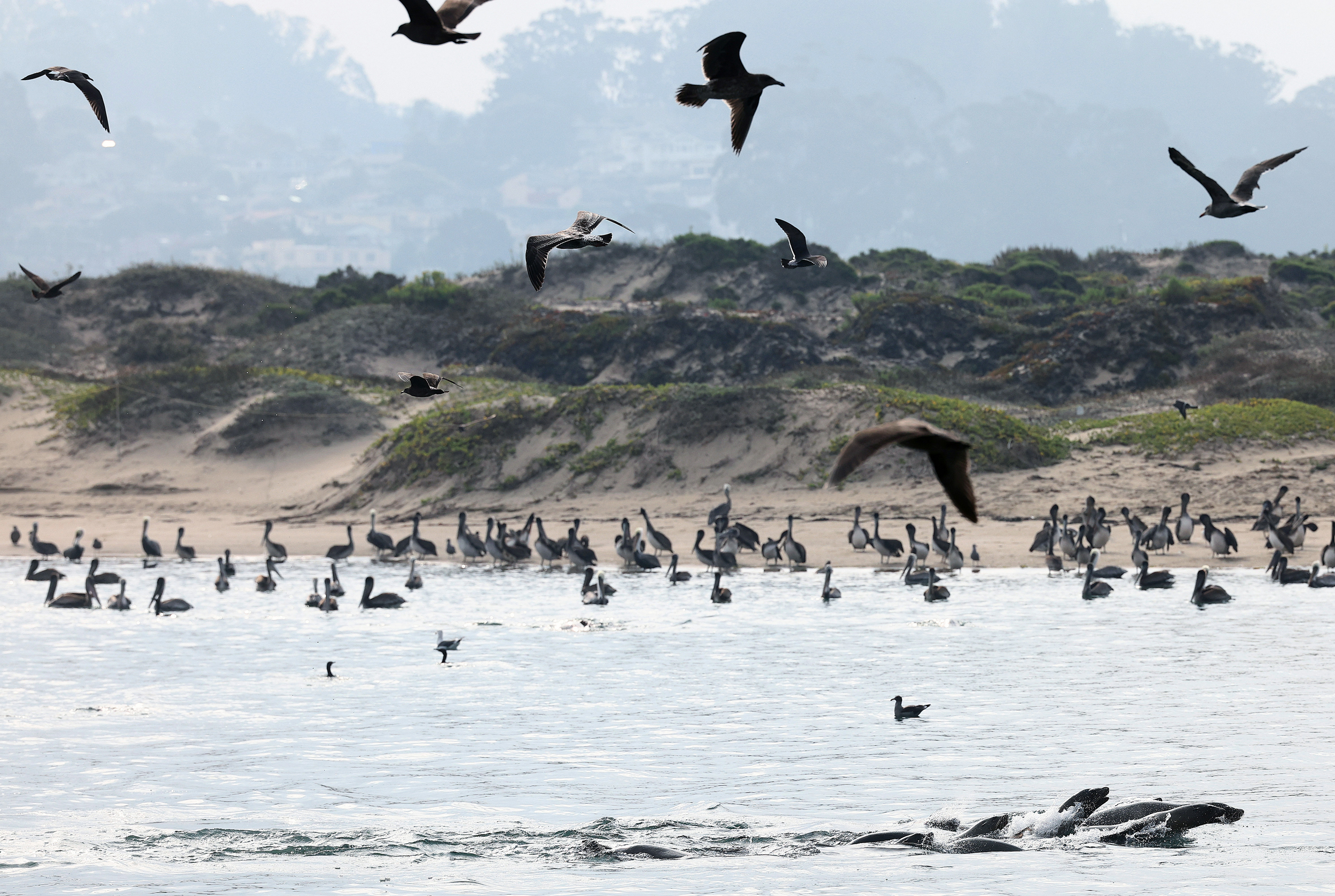
Outside of sea turtles and sea otters, the Chumash National Marine Sanctuary is home to humpback whales, a variety of coastal fish, the California brown pelican and many other species.
This story is funded by readers like you.
Our nonprofit newsroom provides award-winning climate coverage free of charge and advertising. We rely on donations from readers like you to keep going. Please donate now to support our work.
Donate NowThe California State Lands Commission told Inside Climate News they have been following the federal efforts to open California’s coastline and “[oppose] these efforts and new offshore oil and gas development.” They said the Commission directed staff last December to work with the California Natural Resources Agency and others on a joint comment letter opposing the federal government’s efforts owing to a clear and consistent decades-long opposition to new offshore oil and gas development because of “the peril it poses to the economy, environment, and public health.”
In order to seek out new oil and gas development in the area, Altman said the Bureau of Ocean Energy Management would have to go to NOAA to start a consultation process to assess the conditions needed to lease any areas with the proper measures to prevent harm to sanctuary resources, even if a spill or discharge occurs outside of the bounds of the marine sanctuary.
Revitalizing the oil and gas industry in California and encouraging development might not be the worst thing for the state, said Michael Mische, an associate professor at the University of Southern California’s Zage Business of Energy Initiative. He said he believes the benefits to the state—potential economic growth and lowered tax and cost-of-living burdens on residents—overpower his environmental concerns.
“We have some of the best oil and gas operators and the most advanced technologies in the world here in California, and with federal oversight, I’m excited about the prospects for increased production and the resulting capital formation and generation,” he said.
But the potential of spills not only have the potential to harm the environment but economies as well. Altman said any habitat disturbances can undermine the health of marine animals that local economies depend on and marine sanctuaries were designated to protect in the first place.
“Not just a catastrophic spill, but a small spill could have major implications and cause major damage to sanctuary resources, to economy, to tourism,” Altman said.
In the past, Hall said the Environmental Defense Center’s litigation was able to terminate plans for other approved offshore oil leases near the sanctuary, from Point Conception to the border of San Luis Obispo County.
While the newest iteration of Trump’s leasing program proposal has yet to be released, the Environmental Defense Center and Hall are among advocates concerned that these new lease sales could start as early as next year.
“No one is optimistic that California would be taken off the table, and in fact the agency did something quite unusual here, which is that they’ve started moving forward on the California lease sale process before this five-year plan was even finalized,” Hall said. “They put out an announcement and sought comment on the development of new lease sales, which is essentially jumping the gun in the process and showing that you know there is immediacy to this action.”
The Chumash National Marine Sanctuary is not the only marine sanctuary in the area at risk of prospective offshore drilling projects.
The adjacent Channel Islands National Marine Sanctuary is currently at risk of being harmed by fracking interests from an offshore oil company. Hall said that several years of litigation resulted in the court prohibiting offshore fracking permits unless they comply with a slew of environmental laws, but a proposal is going before the California Coastal Commission in August. It is ultimately up to the Bureau of Ocean Energy Management to decide whether to move forward with the proposal, but the Environmental Defense Center has flagged concerns about impacts to the surrounding marine sanctuaries and will be participating in the California Coastal Commission hearing, according to Hall.
Walker is not optimistic about what next steps look like for the sanctuary, especially as other projects that run through the sanctuary’s waters like the Sable pipeline, an offshore and onshore oil pipeline network in California’s Santa Barbara County, are being approved. She hopes that the federal government can take public concerns into consideration as opposed to “executive orders that are circumventing the public” and that a more promising outcome for the sanctuary will come in the years after the Trump administration.
“A five-year lease is three years past when this administration is going to be in power, so hopefully things will change,” she said.
About This Story
Perhaps you noticed: This story, like all the news we publish, is free to read. That’s because Inside Climate News is a 501c3 nonprofit organization. We do not charge a subscription fee, lock our news behind a paywall, or clutter our website with ads. We make our news on climate and the environment freely available to you and anyone who wants it.
That’s not all. We also share our news for free with scores of other media organizations around the country. Many of them can’t afford to do environmental journalism of their own. We’ve built bureaus from coast to coast to report local stories, collaborate with local newsrooms and co-publish articles so that this vital work is shared as widely as possible.
Two of us launched ICN in 2007. Six years later we earned a Pulitzer Prize for National Reporting, and now we run the oldest and largest dedicated climate newsroom in the nation. We tell the story in all its complexity. We hold polluters accountable. We expose environmental injustice. We debunk misinformation. We scrutinize solutions and inspire action.
Donations from readers like you fund every aspect of what we do. If you don’t already, will you support our ongoing work, our reporting on the biggest crisis facing our planet, and help us reach even more readers in more places?
Please take a moment to make a tax-deductible donation. Every one of them makes a difference.
Thank you,

Avril Silva
Fellow
Avril Silva is an award-winning journalist and an Outrider fellow at Inside Climate News. She has experience covering environmental and public health policy and is interested in pursuing investigative political journalism. She is currently pursuing a master’s at NYU’s Science, Health, and Environmental Reporting program. You can find more of her work on the New York Times, CBS News, POLITICO’s E&E News, and more.