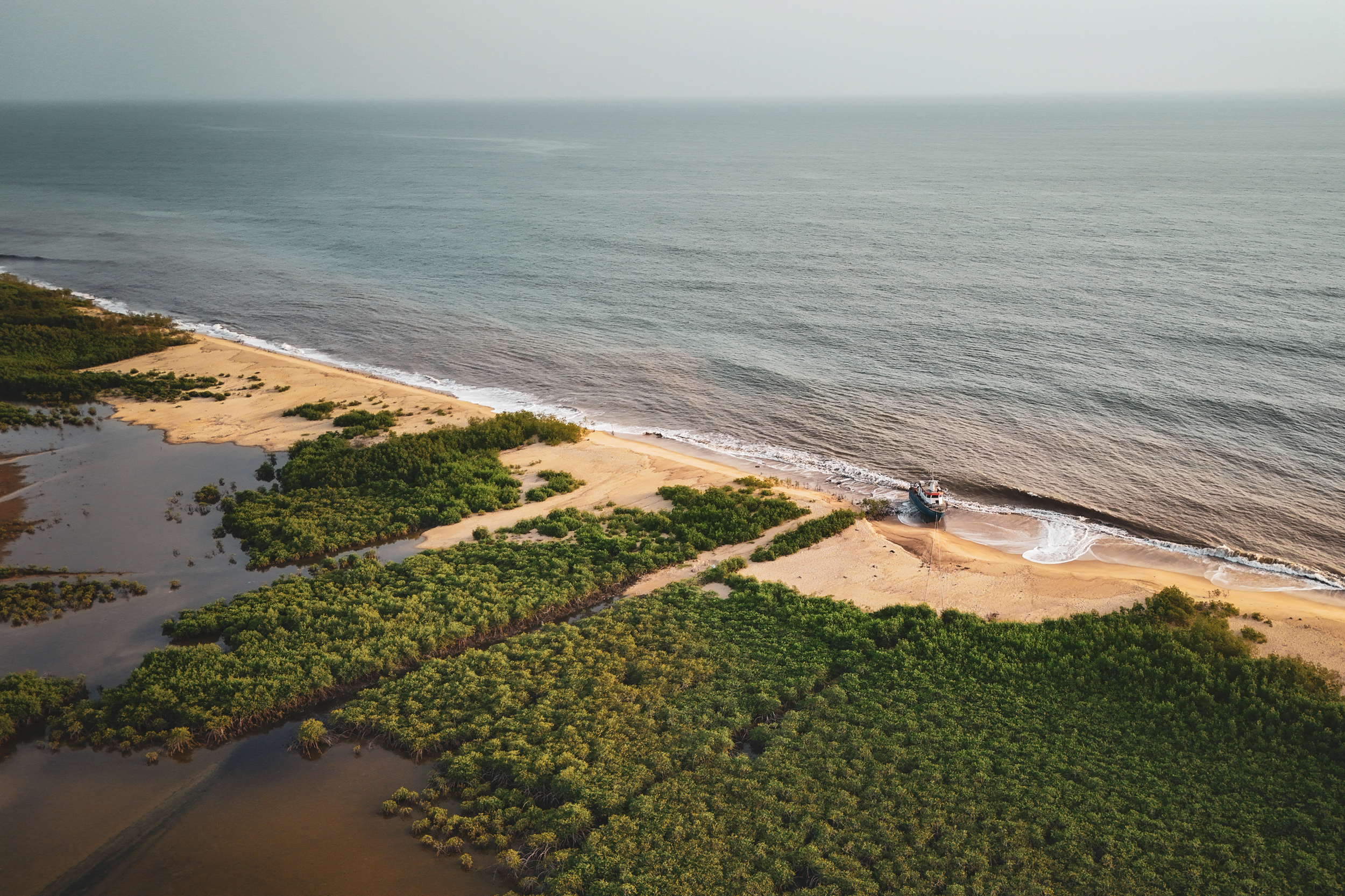


Mangrove forests have adapted over tens of millions of years to survive in harsh flooding from salty seas, while locking away vast stores of climate-warming carbon and protecting the world’s coastlines from storm surge.
But a new modeling study suggests that even these hardy trees may reach their breaking point in the face of rapidly rising seas, with major consequences for the climate.
Mangroves punch well above their weight when it comes to carbon-storing ability. Though they cover less than 1 percent of the Earth’s surface, these coastal forests stash roughly 15 percent of all ocean carbon, mostly in the soil. Mangroves’ dense jumbles of roots trap sediment and help the trees handle inundation amid the daily rise and fall of the tides.
Past research has shown that some sea level rise may actually increase carbon storage and mangrove growth in some parts of the ecosystem. However, the new study, published this week in the journal Earth’s Future, found that carbon storage across an entire mangrove forest will likely decrease as suitable habitat shrinks and more mangroves die. Parts of these forests may even start emitting carbon instead of capturing it, said co-author Barend van Maanen.
“What we’re seeing is that sea level rise can have drastic impacts on mangrove habitats and on carbon,” said van Maanen, a coastal researcher at the University of Exeter in England. “Sea level rise and increased inundation can push [the forests] beyond their limits, and they won’t be able to tolerate this.”
To study this, the researchers developed a new model that incorporates many of the complex physical processes in mangrove ecosystems, including water flow from rivers and the ocean, sediment movement and landscape changes due to erosion and sedimentation. They also incorporated the carbon dynamics playing out across the forest, which includes the reserves stored in the tree itself as well as copious amounts stowed away in the fallen leaves, twigs and roots that accumulate and decompose in the soil.
The researchers then tested their simulation against various rates of sea level rise. The results were clear: the higher the levels, the more negative the impacts.
“So the key message is that local increases in carbon accumulation do not necessarily mean that the whole mangrove ecosystem will store more carbon in the long term,” study co-author Arya Iwantoro, a senior research consultant in coastal modeling at the University of Plymouth in England, said in an email.
“[E]ven within one mangrove ecosystem, different areas can respond differently depending on their position in the landscape, especially their proximity to channels and sediment sources,” he said.
While some areas of the ecosystem may be better buffered against sea level rise, others that face prolonged flooding are likely to drown, as seen in the low-lying mangrove forests of the Maldives.
“It’s like a vase in your house: If you keep putting a lot of water on it, … you’re going to drown the plant, right? The roots are going to rot,” said Andre Rovai, a scientist at the Smithsonian Environmental Research Center who studies mangroves and was not involved in the paper. The mangrove forests “don’t have time to adjust to that,” he added.
Rovai noted that “modeling is really complex, and you can never model everything.” One limitation with the new study, he said, is that it does not account for the organic sediments from rivers flowing into the mangroves, which can also impact carbon storage.
But overall, Rovai said, the study’s authors did “an outstanding job” simulating many of these ecosystems’ real-world conditions and how that may change with sea level rise.
“You have a pretty complicated puzzle,” he said. “They got a feel of the really important pieces, and they beautifully put it together.”
Solving this puzzle could be crucial for better accounting of the carbon gains from healthy mangroves and what’s at risk if they are lost, according to the study. Knowing the impacts of rising seas on mangrove ecosystems can also help guide better management, van Maanen said. For example, many mangrove forests are sandwiched between the ocean and infrastructure such as roads and hotels, which offers little space for them to retreat and grow in new areas as coastlines erode.
“We need to think very carefully about how [we can] create opportunities for mangroves to actually retreat landward and migrate into other suitable areas,” van Maanen said. “But also we need to try and limit sea level rise the most we can. … The less sea level rise, the better.”
About This Story
Perhaps you noticed: This story, like all the news we publish, is free to read. That’s because Inside Climate News is a 501c3 nonprofit organization. We do not charge a subscription fee, lock our news behind a paywall, or clutter our website with ads. We make our news on climate and the environment freely available to you and anyone who wants it.
That’s not all. We also share our news for free with scores of other media organizations around the country. Many of them can’t afford to do environmental journalism of their own. We’ve built bureaus from coast to coast to report local stories, collaborate with local newsrooms and co-publish articles so that this vital work is shared as widely as possible.
Two of us launched ICN in 2007. Six years later we earned a Pulitzer Prize for National Reporting, and now we run the oldest and largest dedicated climate newsroom in the nation. We tell the story in all its complexity. We hold polluters accountable. We expose environmental injustice. We debunk misinformation. We scrutinize solutions and inspire action.
Donations from readers like you fund every aspect of what we do. If you don’t already, will you support our ongoing work, our reporting on the biggest crisis facing our planet, and help us reach even more readers in more places?
Please take a moment to make a tax-deductible donation. Every one of them makes a difference.
Thank you,

Kiley Price
Reporter
Kiley Price is a reporter at Inside Climate News, with a particular interest in wildlife, ocean health, food systems and climate change. She writes ICN’s “Today’s Climate” newsletter, which covers the most pressing environmental news each week.
She earned her master’s degree in science journalism at New York University, and her bachelor’s degree in biology at Wake Forest University. Her work has appeared in National Geographic, Time, Scientific American and more. She is a former Pulitzer Reporting Fellow, during which she spent a month in Thailand covering the intersection between Buddhism and the country’s environmental movement.