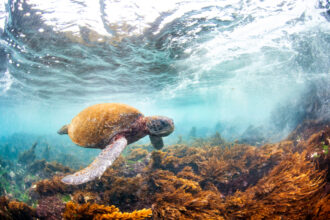
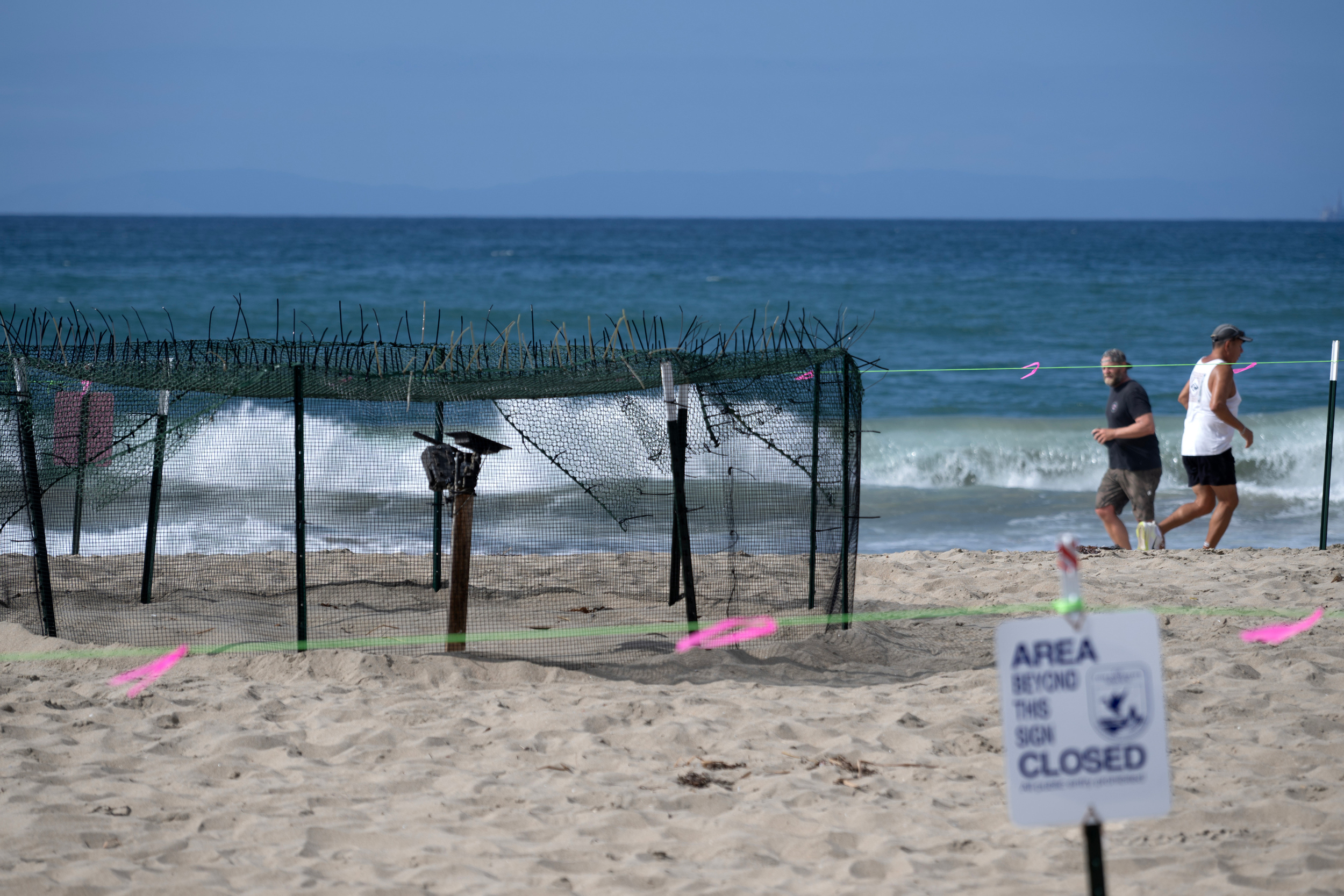


In May, on a dark stretch of beach on the Atlantic coast of Florida, Bo Huff came upon a sea turtle doing something seemingly normal. A moment later, he realized it was actually one of the odder things to happen on this shoreline in years.
Huff, a nighttime research technician with the Loggerhead Marinelife Center, had spent many nights walking this part of Jupiter Beach, one of the densest sea turtle nesting beaches in the world. He had been recording the nests of loggerhead sea turtles, the big, blunt-skulled turtles that haul themselves ashore in Florida by the tens of thousands to nest. The animal in front of him was doing exactly that. He took her, at first, for another loggerhead. Then he looked closer. Her shell was too round, her head too small, the whole proportion of her was just slightly off.
“There’s no way this is a loggerhead,” he remembered thinking.
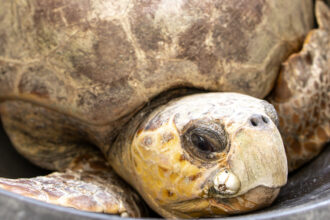
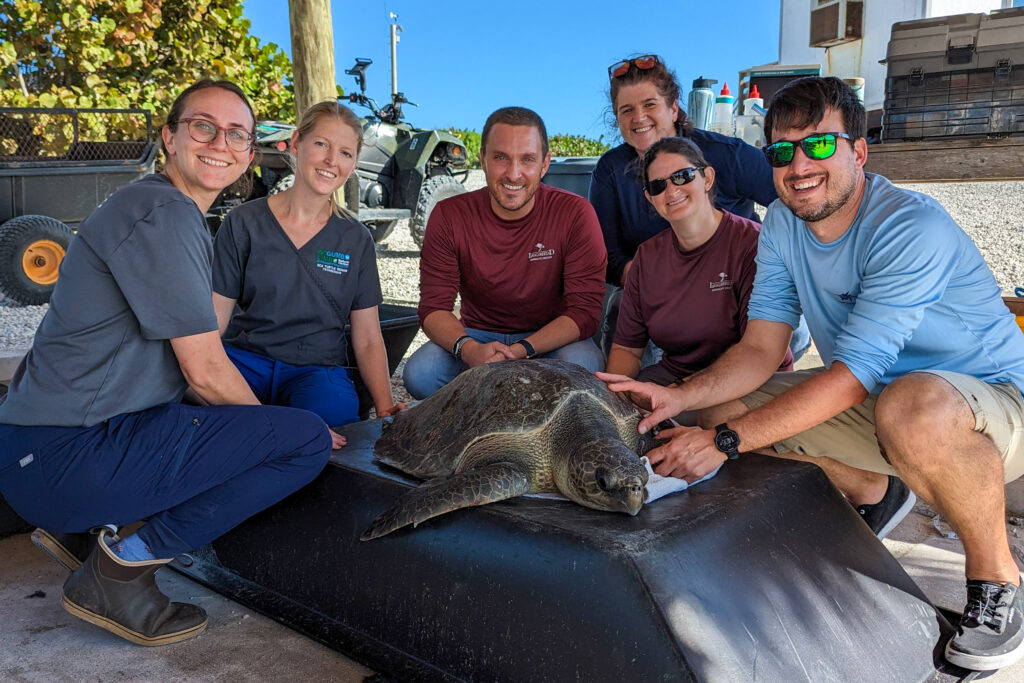
He was right. She was an olive ridley, one of the smallest and most numerous of the world’s sea turtles. Its Atlantic populations usually nest thousands of miles to the south on the beaches of Brazil, Suriname and Gabon. At the time, no olive ridley had ever been documented nesting anywhere in Florida, much less the continental United States. Huff and his research advisor, Justin Perrault, named her Martini—Tini for short, fitting for an olive—and watched her bury a clutch of eggs where none of her kind had been observed doing so before.
There is a kind of disorientation in finding a creature so far from where it’s expected. It almost insists upon an explanation, one that in this case seems to narrate itself. The ocean is warming, and animals are migrating. A tropical turtle turns up on a temperate beach because the sea, year by year, is becoming a more tropical place. It is a tidy story, and a frightening one, and it has a great advantage of being, in its broad strokes, true.
And then it happened again, on the other side of the continent.
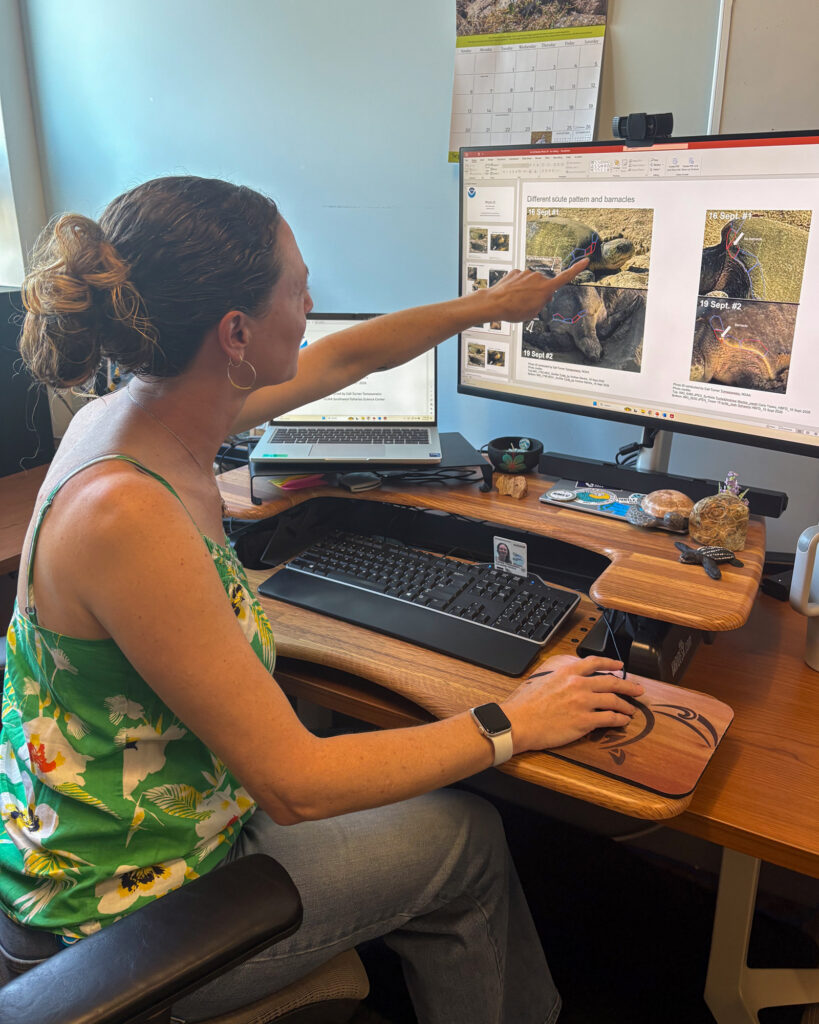
On the morning of Sept. 16, lifeguards in Orange County, California, walked up to what they took for an injured animal thrashing in the sand and found, instead, an olive ridley digging a nest. It was the first sea turtle nest ever documented on the United States’ West Coast, of any species. Three days later, a second olive ridley was found nesting eight miles down the coast, near the Huntington Beach Pier. (Cali Turner Tomaszewicz, a NOAA biologist, later confirmed that, based on analyzing the barnacles on their shells and the shape of their bodies, they were in fact two different turtles.) And then, on the first of November, a third nest appeared, farther north still, on a state beach in Ventura—the northernmost sea turtle nest ever recorded in the country.
A marine heat wave has been building off California since 2025, one of the largest on record; this year, a strong El Niño brought more heat, an event forecasters expected to become the most intense in at least 75 years. At Scripps Pier in La Jolla, California, where the water temperature has been logged for more than a century, the records kept breaking. By late autumn the ocean and the entire California coast stood at or near its warmest ever measured. The water off Southern California, in other words, had crept toward the warmth of the beaches where olive ridleys are supposed to nest—and the turtles, it seemed, had followed it north.
For a sea turtle, temperature isn’t trivial: The heat of the sand a female chooses for nesting doesn’t just incubate her eggs, it determines whether they become males or females. If sands are too warm, the entire nest can turn out female, introducing a skewed population.
Coverage of the turtles’ nests wrote itself accordingly. The New York Times called the first California nest “the latest sign of warming ocean waters” and quoted scientists saying the turtle’s arrival was “a sign of things to come.” Sea turtles, the paper noted, “are expanding their range northward as oceans warm.” A paleoecologist, watching the Pacific heat swing within a single human generation, offered the only word he felt it deserved: “alarming.” By November, The Atlantic had folded the turtles into a sweeping account of tropical fish, manta rays and whale sharks surging north on El Niño’s warm water—“the most profound movement of tropical fishes into California that anyone’s ever seen,” one biologist told the magazine
Here was climate change made legible and charismatic in its clarity—not a graph of rising curves but a hundred-pound reptile on a California beach, laying eggs in a completely different setting.
The scientists who have spent their careers studying these animals were more reluctant to attribute the actions of these four individual turtles to climate change specifically. Jeff Seminoff, who leads the marine turtle ecology and assessment program at NOAA’s Southwest Fisheries Science Center and has studied sea turtles in California for about 25 years, told NPR that when the first nest was reported he “about fell out of [his] chair.” His leading explanation isn’t that the climate has permanently redrawn the turtles’ range but that warm water opened a temporary path that let animals from the tropics slip into temperate habitat and nest.
Asked directly whether the turtles were just lost, he didn’t dismiss the idea. “In fact, they may be lost,” he said. “We’re not quite sure.” Sea turtles navigate home by a kind of inherited memory, returning as adults to nest on the beaches where they themselves hatched, a practice commonly known as “natal homing.”
A female that ends up laying eggs off Southern California is, by that logic, a turtle whose instructions have misfired—less a pioneer, more a wanderer who took a wrong turn in warm water. One nest is an anomaly, two is a coincidence, and three, in a single season, begins to feel like something—but the question of what is harder, and more interesting, than previous headlines have explored.
What can a handful of turtles, appearing where they shouldn’t, actually tell us?
The Pioneer Problem
The answer to this turtle relocation begins with a paradox Peter Dutton has spent much of his career on. Dutton, a geneticist at NOAA’s Southwest Fisheries Science Center, runs the lab that does what he calls “turtle CSI”: reading genetic signatures to trace wandering animals back to where they came from. He has worked on sea turtles for nearly 40 years, and when asked where the California turtles came from, Dutton pointed to a quirk in how sea turtles navigate.
Sea turtles are ruled by fidelity. But perfect fidelity would be a trap. “That’s a sort of evolutionary dead end if they’re always going to come back,” Dutton told Inside Climate News. Beaches erode and vanish over the half-century it takes a turtle to mature. So the homing instinct is imperfect by design. In every generation a few females are, as he put it, “programmed to not be perfect.”
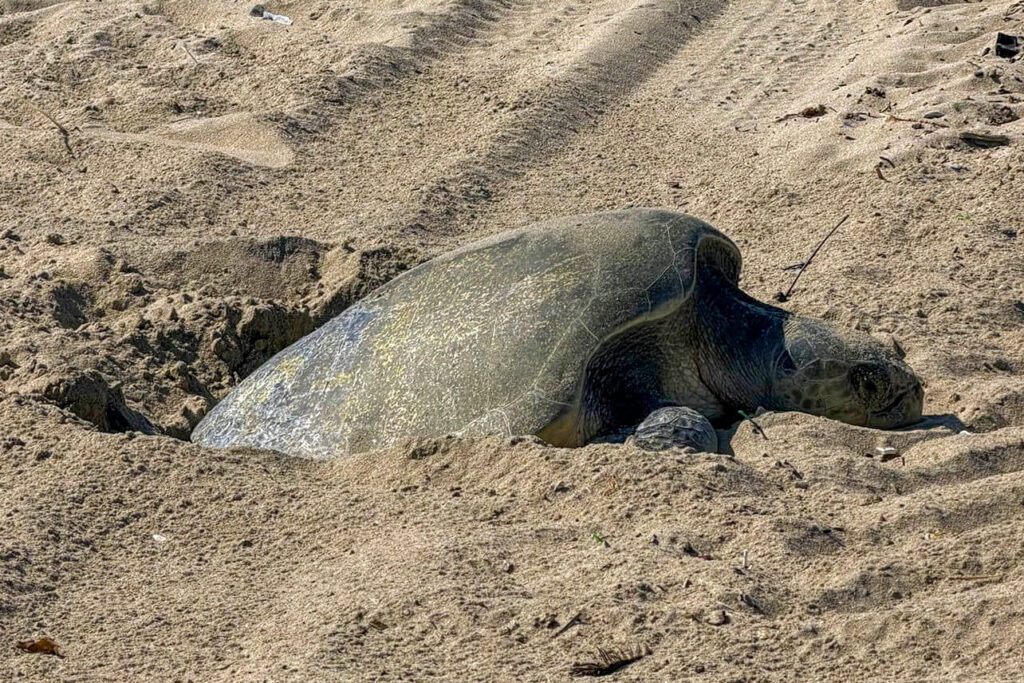
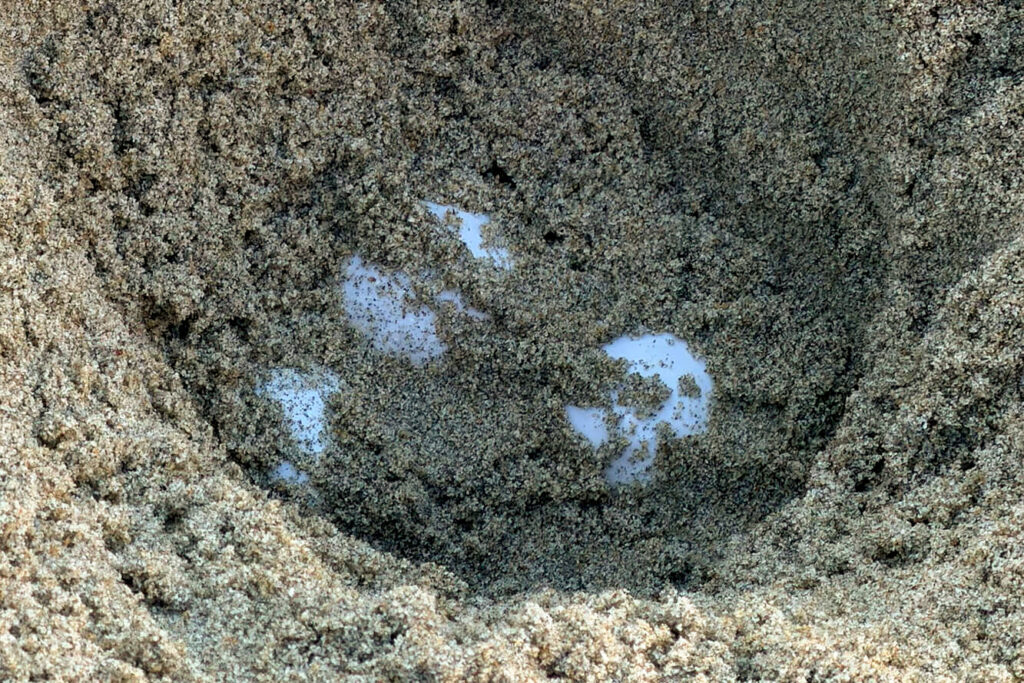
An olive ridley sea turtle nests on a Southern California beach, one of three unprecedented nests documented on the U.S. West Coast this year. Credit: NOAA Fisheries
Usually, getting it wrong leads nowhere; the clutch lands on unsuitable sand and comes to nothing. But occasionally, across centuries, a turtle nests on a beach that works, and her hatchlings imprint on new sand and return to it, and a new nesting ground is born. What a warming ocean changes, in this telling, isn’t the wandering but the odds that a wanderer succeeds. And those odds, Dutton said, turn on the temperature of the sand: too cool, and the eggs fail or yield only males, leaving no females to someday return. “The sand temperatures are what constrain their range expansion,” he said. As the world warms, that constraint loosens.
Which is why Dutton says the story isn’t the same on the East and West coasts. In California, the turtles nested on beaches too cold to hatch them, which is why biologists dug the eggs up: These turtles arrived at the literal edge of the possible, perhaps riding warm El Niño currents until their navigation left them off Southern California instead of Baja. “The beaches will smell different,” Dutton said, “but they still end up laying a nest.”
Florida is a different question. Its beaches are already among the hemisphere’s most productive turtle nesting grounds; the sand works. “The table is set for them,” Dutton said. “It’s just they got to show up.” The puzzle Tini poses isn’t whether a Florida beach can incubate an olive ridley, but why an olive ridley tried the site.
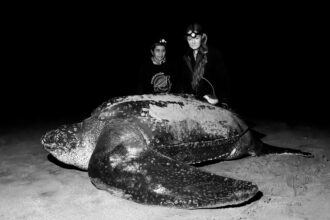
When Dutton was starting out in research, leatherback sea turtles barely nested in Florida; the state wasn’t considered part of their habitat. Then it changed. Florida’s leatherback nests have climbed about 10 percent a year since surveys began in the late 1970s, reaching a record 2,000–plus in 2025—a population built from almost nothing. Tini might be to olive ridleys what those first strays were to leatherbacks.
This story is funded by readers like you.
Our nonprofit newsroom provides award-winning climate coverage free of charge and advertising. We rely on donations from readers like you to keep going. Please donate now to support our work.
Donate NowOr she might be a turtle that got lost. Dutton, like Seminoff, declined to choose; the California nests, he said, are “probably a one-off—but to be continued, to be seen.” He raised another possibility too: There are simply more turtles in the ocean now than there were decades ago, and more turtles means more of them turning up where we wouldn’t expect them.
Tini, though, refused to resolve into any of these readings, and the closer anyone looked at her, the less she did.
Her nest incubated on the beach where she’d laid it, the way a Florida nest is supposed to. But only about a quarter of her clutch hatched successfully, Perrault said—a dismal rate on a coast where olive ridley nests elsewhere can hatch at better than 80 percent.
The real complication was in her blood. The Loggerhead Marinelife Center sent her genetic samples off for analysis, and the first reading was simple: olive ridley, as her body plainly advertised. Then it stopped being simple. The preliminary genetics, Perrault said—relaying still-unpublished work by Brian Shamblin, the University of Georgia geneticist running her DNA—suggest that Tini is not a pure olive ridley at all, but a hybrid, and not a recent one: Some ancestor of hers appears to have bred, generations back, with a different species of sea turtle.
And there was another unusual thing: The father of her Jupiter Beach clutch was most likely a Kemp’s ridley—the olive ridley’s rarer, more endangered cousin. Kemp’s ridleys nest and feed mainly in the Gulf of Mexico and up the U.S. Atlantic coast, while olive ridleys keep to tropical waters far to the south. For these two to have bred, their paths had to cross somewhere they’re not expected to overlap at all.
The analysis is early and unpublished, built on a partial read of her genome; more sequencing could still change it, Perrault cautioned. But if it holds, it’s astonishing. An animal that everyone first took for a clean case—a tropical turtle wandering north—turns out, on inspection, to resist even the category of her own species.
Which is, in miniature, the trouble with all of them. The olive ridleys turning up on American beaches don’t fit the tidy boundaries of this created story. They are not quite where they belong, not quite what they seem, not quite accounted for by the thing we most want to blame.
Hidden in Plain Sight
There is one more explanation: maybe the turtles were here all along.
Matthew Godfrey has run North Carolina’s sea turtle program for more than two decades, at the northern edge of where several species nest. He watched this story play out with another animal: the Kemp’s ridley, which for years seemed not to nest in his state until biologists began genetically testing every nest they found. “I just think possibly that there had been low-level nesting all along,” he told me. “We just didn’t know about it.” Olive ridleys, loggerheads and Kemp’s ridleys are easy to confuse on a dark beach; a crawl is a crawl. Where no one looks closely, a turtle can nest for years and never be counted.
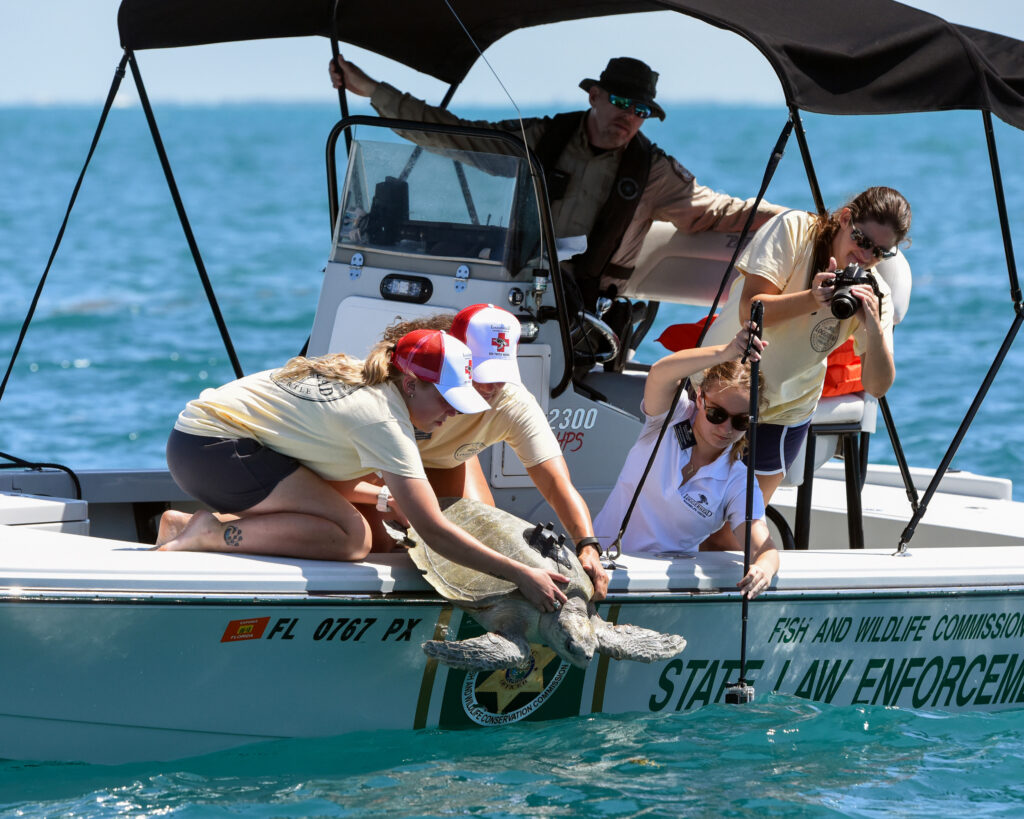
This seems to be the case on the Atlantic coast. In Puerto Rico, Carlos Diez has documented olive ridleys nesting nearly every year since 2017—and when his team analyzed the hatchlings’ DNA, the turtles carried a genetic signature shared by the olive ridleys of Suriname and Brazil, not those from Puerto Rico. They weren’t new arrivals; they were a species that had been using these beaches longer than anyone had confirmed. Diez confirmed that “since 2017, we haven’t found an increase in numbers for sure.”
For Florida and the rest of the East Coast, some of what looks like range expansion could really just be the belated arrival of attention. It does not rule out climate factors—both can be true at once, and a warming ocean can nudge turtles north while sharper monitoring finally catches them in the act. But it should make anyone slower to read a single nest as a verdict.
In Florida, the team at the Loggerhead Marinelife Center did not hold a permit to handle an olive ridley when they found Tini; no one had ever needed one before.
Some of the California eggs ended up viable. On Nov. 14, biologists carried the hatchlings down to the Orange County sand and let them go.
Almost none will survive; of every thousand olive ridley hatchlings, by one estimate, a single one reaches adulthood. But if one of these does—if, in two decades, a female returns to lay her own eggs—she will come back to a warmer California than the one she left.
No one can yet say what that would mean. Jeff Flocken, who runs the Aquarium of the Pacific, noted both the uncertainty and the wonder. “Whether the reason for the nests was our weather patterns, or a simple anomaly, this is an important conservation story,” he said. “Species that change and adapt are the ones that survive.”
The turtles on these beaches may be lost, or they may be pioneers; a sign of a warming sea, or of a species growing numerous again, or both at once. What they are not is simple.
About This Story
Perhaps you noticed: This story, like all the news we publish, is free to read. That’s because Inside Climate News is a 501c3 nonprofit organization. We do not charge a subscription fee, lock our news behind a paywall, or clutter our website with ads. We make our news on climate and the environment freely available to you and anyone who wants it.
That’s not all. We also share our news for free with scores of other media organizations around the country. Many of them can’t afford to do environmental journalism of their own. We’ve built bureaus from coast to coast to report local stories, collaborate with local newsrooms and co-publish articles so that this vital work is shared as widely as possible.
Two of us launched ICN in 2007. Six years later we earned a Pulitzer Prize for National Reporting, and now we run the oldest and largest dedicated climate newsroom in the nation. We tell the story in all its complexity. We hold polluters accountable. We expose environmental injustice. We debunk misinformation. We scrutinize solutions and inspire action.
Donations from readers like you fund every aspect of what we do. If you don’t already, will you support our ongoing work, our reporting on the biggest crisis facing our planet, and help us reach even more readers in more places?
Please take a moment to make a tax-deductible donation. Every one of them makes a difference.
Thank you,

Kate Waxman
Fellow
Kate Waxman is a Florida-based Outrider fellow at Inside Climate News, where she covers climate injustice across the state. She earned her M.S. in journalism from Columbia Journalism School and her B.A. in environmental science from Barnard, with reporting focused on coral reefs, climate science, and the communities closest to the water.