One year ago today, Environmental Protection Agency Administrator Lee Zeldin announced he was terminating the Greenhouse Gas Reduction Fund, one of the biggest climate initiatives of the Biden administration, after weeks of alleging the $20 billion in grants had been awarded in a “criminal” scheme.
But the Trump administration never was able to show the federal courts evidence of wrongdoing with regards to the fund, which Congress created in the 2022 Inflation Reduction Act to spur private investment in clean energy and climate solutions.
Now, the chaos and accusations of those early months of President Donald Trump’s second term are at center stage in the D.C. Circuit Court of Appeals. After an unusual hearing before 10 of the 11 judges last month (Judge Karen LeCraft Henderson is not participating in the case), the court is weighing what next steps are available for the grantees that have been frozen out of their accounts for the past year.
The D.C. Circuit, widely viewed as second only to the Supreme Court in judicial branch importance because of its role in hearing federal agency cases, questioned the Trump administration’s lawyer harshly. Dominated by Democratic appointees, the court seemed inclined to rule in favor of the grantees. But it is not clear that a favorable ruling will be enough to revive the nation’s first national “green bank.” The Trump administration is poised to continue to press a multi-pronged strategy to defend its right to terminate the slew of contractual agreements that established the program.
The case, likely to eventually land before the Supreme Court, has implications for climate policy that could outlive the Trump administration. After years of failed efforts to get a plan to cut greenhouse gas emissions through Congress, Democrats seized the window of opportunity they had during President Joe Biden’s administration to pass climate legislation in 2022 based entirely on government incentives—carrots, not sticks. The green bank case will likely decide whether any future Congress can effectively use federal grants to jump-start the clean energy economy, in a nation where it has proven so difficult to garner political support for policy that would place direct limits on the use or production of fossil fuels.
“The Inflation Reduction Act was an interesting and innovative statute that sought to achieve big policy goals through the use of fiscal incentives,” said William Buzbee, environmental law professor at Georgetown University Law School. “If, in the end, the law allows the government to demolish regulation via grants, then this kind of strategy doesn’t have a long shelf life.”
Freeze and Termination
The unraveling of the Greenhouse Gas Reduction Fund (GGRF) began on Inauguration Day last year, when Trump signed an executive order directing federal agencies to pause disbursement of all funds appropriated under the Inflation Reduction Act. A first step to fulfilling Trump’s campaign vow—to “terminate the Green New Deal, which I call the Green New Scam”—the move signaled an administration prepared to do legal battle. With an assertion of presidential power over government purse strings, contrary to the will of Congress, Trump seemed on track to exact the kind of Constitutional challenge his budget chief, Russell Vought, long had sought.
But Zeldin didn’t invoke novel legal theories when he took on the GGRF. A former Congressman and former prosecutor in the U.S. Army Judge Advocate General’s Corps, Zeldin alleged old-fashioned fraud, waste and abuse, informed by the right-wing messaging machine. He invoked a hidden camera video orchestrated by the conservative group Project Veritas, showing a Biden EPA staffer on a blind date after the November election, using the phrase “throwing gold bars off the Titanic” to describe the rush to distribute money before Trump took office.
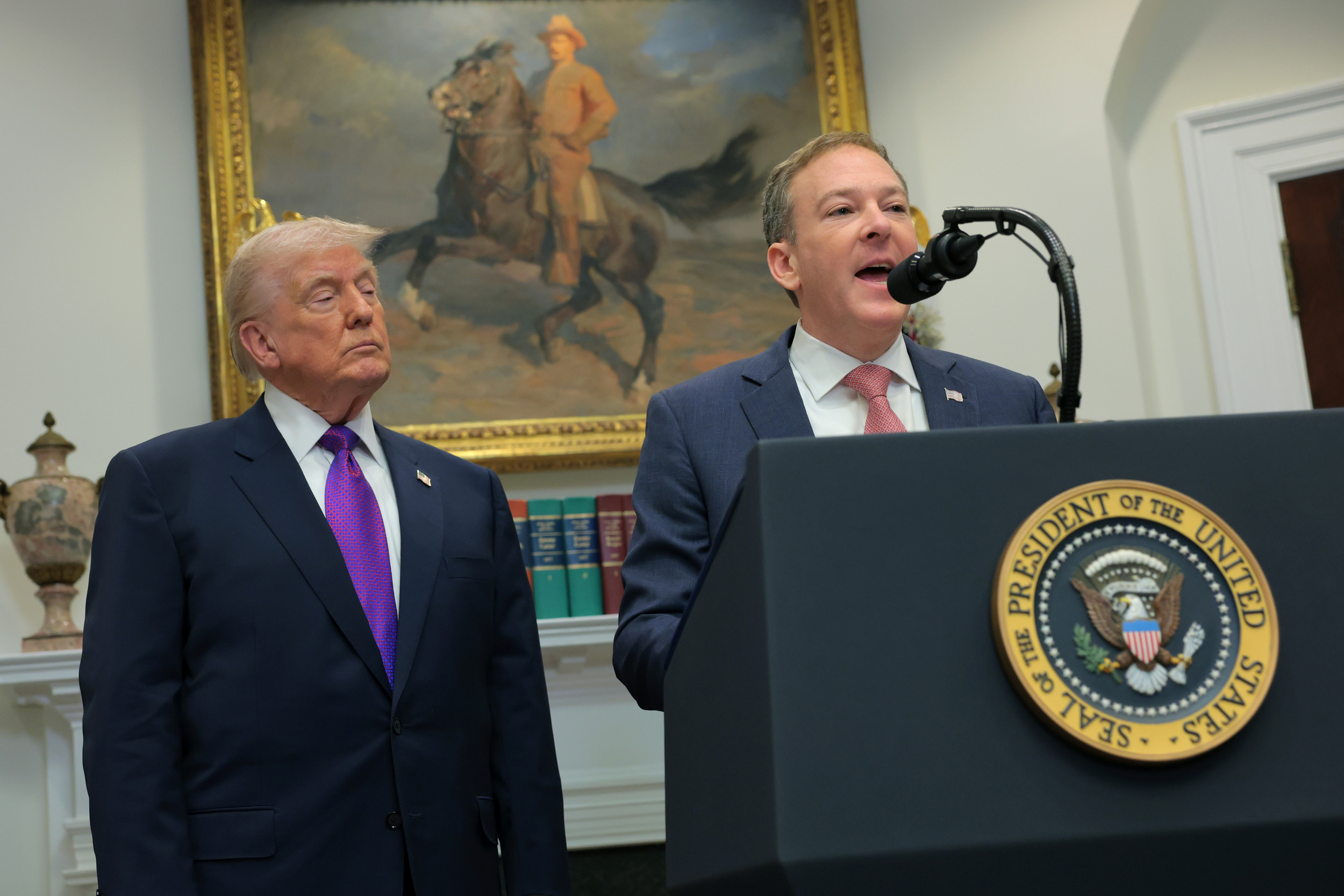
The staffer could not have been talking about the GGRF; the awardees had been announced in April 2024, with the contracts signed in August 2024, months before Trump’s election. Nevertheless, “gold bars” became Zeldin’s mantra soon after he took the helm at the EPA and sought to claw back $20 billion that was in accounts in the names of the grantees at Citibank, which had been designated the financial agent and custodian for the funds.
“We found the gold bars. We want them back,” Zeldin said on Fox News on Feb. 23, 2025. “The entire scheme, in my opinion, is criminal.”
By then, a federal prosecutor in D.C. had resigned under pressure to open what she believed would have been an unsubstantiated grand jury investigation into the program. Citibank, meanwhile, complied with a Trump administration order to freeze the funds, blocking the grantees from accessing the money. The EPA agreed to meet with the grantees, but then repeatedly rescheduled before cancelling meetings without an explanation.
With the nonprofit group Climate United as lead plaintiff, the grant recipients filed suit against Citibank and the EPA, and the first court hearing was set for March 11, 2025. But the EPA asked for a 24-hour delay of the proceeding, and on that day instead, Zeldin announced that he was terminating the entire program. The following day, the EPA asked the court to dismiss the lawsuit as moot, since the program had already been terminated.
The court refused to do that, but the case has dragged on, with the EPA arguing that it ended the grants because they were structured in a way that gave the agency insufficient oversight. The grantees, for their part, argue the Trump administration violated the law and the Constitution by breaching their contracts without due process. A three-judge D.C. Circuit panel ruled 2-1 in favor of the Trump administration last September, with both Trump-appointed judges taking the administration’s side. But in December the court took the unusual step of vacating that ruling and ordering an en banc review.
D.C. Circuit Judge J. Michelle Childs took up the grantees’ argument as she pressed the Trump administration at last month’s arguments in the case.
“First, you start out with no real reason for freezing the funds,” she said to Yaakov Roth, principal deputy assistant attorney general for the Justice Department, who was representing the EPA. “For weeks, these parties don’t even know what was going on. Then you move on to ‘fraud, waste, and abuse,’ without any true proof. Then you move on to lack of oversight. So how are we to take that you actually had an adequate reason at the time of you de-obligating these funds?”
Roth maintained that the Trump administration would be able to investigate the grants further if the court ruled in its favor, and sent the whole case to a different venue, the U.S. Court of Federal Claims.
The Trump administration has had some success in moving cases over its cancellation of Biden-era grant programs to the claims court; the Supreme Court agreed last year that disputes over education and health grants should be re-routed there in two so-called “shadow docket” emergency rulings. But it’s a route that creates greater burdens for the grantees, and establishes a precedent that the executive branch can exit contractual obligations without providing the parties it does business with notice or opportunity to be heard.
“You want to go find something wrong after the fact,” D.C. Circuit Judge Patricia Millett told Roth. “But it seems too late in the day, after you charged criminality and then dropped that. You couldn’t even get anyone to credit that.”
Roth said the EPA wasn’t arguing that the grantees were engaged in fraud, waste or abuse—but the agency wasn’t giving up that argument, either. “There are investigations ongoing, so I don’t want to suggest that there’s no evidence of anything,” he said.
An “In-Your-Face” Assertion
Romany Webb, deputy director of the Sabin Center for Climate Change Law at Columbia University, found the exchange a telling window into the scope of presidential power the Trump administration is asserting.
“The plaintiffs in this case, Climate United and the other grantees, have always said that there is nothing here to justify that termination,” Webb noted. “The government attorney was sort of admitting that, saying, ‘Oh, well, we’ll deal with that when we get to claims court.’ I do think that was much more in-your-face than we’ve seen in previous hearings.”
If the government can cancel such legal agreements without cause and without recourse for the grantees, it has implications beyond the grantees themselves, Webb explained. She and her colleagues at the Sabin Center represent two groups of urban leaders, the National League of Cities and the U.S. Conference of Mayors, who have intervened in the case on behalf of the grantees.
“While for the most part, cities weren’t direct grantees, they expected to receive really significant benefits” from the green bank program, Webb said. “The [grantees] were expected to make investments that would make it easier for cities to achieve their own climate mitigation goals, drive down their emissions, to build the resilience of their communities and to protect all of their residents.”
This story is funded by readers like you.
Our nonprofit newsroom provides award-winning climate coverage free of charge and advertising. We rely on donations from readers like you to keep going. Please donate now to support our work.
Donate NowAmong projects on track to get financing from the GGRF were projects to restore dilapidated housing in Fort Wayne, Indiana, to help homeowners transition away from expensive oil heat systems in Maine and to install solar energy and storage systems throughout Appalachia. Some of these programs have stalled; in other cases, grantees have found other funding to continue their work. One of the grant recipients, the Coalition for Green Capital, reported to EPA last year that its pipeline of loan applicants included a $600 million green steel mill, a $350 million electric truck charging station project and a $150 million portfolio of home improvement loans for financing energy-efficiency upgrades. “CGC could do even more if we were not thwarted by the freezing of bank accounts and efforts to terminate our contract,” the report said.
The “Big Beautiful” Bill’s New Wrinkle
Environmental advocates worked for years to get a national green bank program, similar to institutions already operational in 20 states, to help overcome the lack of financing that is a major hurdle to the clean energy transition. The eight grantees chosen by the Biden administration were supposed to use the fund to finance tens of thousands of projects, providing federal seed money that would give private lenders confidence to back projects designed to reduce greenhouse gas emissions, especially in low-income communities. As these low-interest loans were repaid, the money was to be re-invested in new clean energy and climate projects, giving the program life far beyond the initial Congressional appropriation.
It hasn’t turned out that way. In addition to the Trump administration’s termination of the program, the Republican-controlled Congress repealed all of the “unobligated” funds associated with the GGRF in the One Big Beautiful Bill Act last July. This has created yet another new wrinkle in the green bank legal battle. The grantees argue that their funds are not affected by that action, since their funds were already “obligated.” But the Trump administration argues the new law puts to rest any idea that the program could be revived, even by court order. “At this point, EPA could not restore the program because the statute has been repealed,” Roth, the government lawyer, told the D.C. Circuit last month.
The grantees maintain the new law can’t be applied retroactively to what the EPA did in the first weeks of the Trump administration. “As the court knows, every agency must point to statutory authority for everything that they do,” Adam Unikowsky, lawyer for the grantees, told the D.C. Circuit. “And there’s certainly nothing in the Greenhouse Gas Reduction Fund [law] that says that they can dismantle the entire program. The GGRF says that the agency has to make grants.”
Buzbee, who was in the courtroom for the hearing, said he felt that was an important moment in the arguments, because Unikowsky was citing a legal tenet that has become a kind of signature of the current Supreme Court. In striking down Obama-era climate regulations, the Biden student loan forgiveness program, Trump’s tariffs and other big decisions, the Supreme Court has repeatedly maintained that the executive branch can’t act without clear authority from Congress. “‘Show us the statutory authority, show us where you have the ability to claw back funds’—that was the whole frame of the grantees,” Buzbee said. “And that was, I think, an effective claim.”
It also showed that the grantees already are poised for the next phase in the litigation. The D.C. Circuit is expected to issue its ruling in the coming weeks, and whoever loses would be able to appeal to the Supreme Court. The green bank case is on track to give the justices another chance to weigh in on the reach of executive power, and the limits of Congress to establish a climate policy that endures.
About This Story
Perhaps you noticed: This story, like all the news we publish, is free to read. That’s because Inside Climate News is a 501c3 nonprofit organization. We do not charge a subscription fee, lock our news behind a paywall, or clutter our website with ads. We make our news on climate and the environment freely available to you and anyone who wants it.
That’s not all. We also share our news for free with scores of other media organizations around the country. Many of them can’t afford to do environmental journalism of their own. We’ve built bureaus from coast to coast to report local stories, collaborate with local newsrooms and co-publish articles so that this vital work is shared as widely as possible.
Two of us launched ICN in 2007. Six years later we earned a Pulitzer Prize for National Reporting, and now we run the oldest and largest dedicated climate newsroom in the nation. We tell the story in all its complexity. We hold polluters accountable. We expose environmental injustice. We debunk misinformation. We scrutinize solutions and inspire action.
Donations from readers like you fund every aspect of what we do. If you don’t already, will you support our ongoing work, our reporting on the biggest crisis facing our planet, and help us reach even more readers in more places?
Please take a moment to make a tax-deductible donation. Every one of them makes a difference.
Thank you,

Marianne Lavelle
Bureau Chief, Washington, D.C.
Marianne Lavelle is the Washington, D.C. bureau chief for Inside Climate News. She has covered environment, science, law, and business in Washington, D.C. for more than two decades. She has won the Polk Award, the Investigative Editors and Reporters Award, and numerous other honors. Lavelle spent four years as online energy news editor and writer at National Geographic. She spearheaded a project on climate lobbying for the nonprofit journalism organization, the Center for Public Integrity. She also has worked at U.S. News and World Report magazine and The National Law Journal. While there, she led the award-winning 1992 investigation, “Unequal Protection,” on the disparity in environmental law enforcement against polluters in minority and white communities. Lavelle received her master’s degree from Columbia University Graduate School of Journalism, and is a graduate of Villanova University.