

Republican lawmakers in multiple states and Congress are advancing proposals to shield polluters from climate accountability and prevent any type of liability for climate change harms—even as these harms and their associated costs continue to mount.
It’s the latest in a counter-offensive that has unfolded on multiple fronts, from the halls of Congress and the White House to courts and state attorneys general offices across the country.
Dozens of local communities, states and individuals are suing major oil and gas companies and their trade associations over rising climate costs and for allegedly lying to consumers about climate change risks and solutions. At the same time, some states are enacting or considering laws modeled after the federal Superfund program that would impose retroactive liability on large fossil fuel producers and levy a one-time charge on them to help fund climate adaptation and resiliency measures.
But many of these cases and climate superfund laws could be stopped in their tracks, either by the conservative majority on the U.S. Supreme Court or by the Republican-controlled Congress.
Last month the court decided to take up a petition lodged by oil companies Suncor and ExxonMobil in a climate-damages case brought against the companies by Boulder, Colorado. The petition argues that Boulder’s claims are barred by federal law, and if the justices agree, it could knock out not only Boulder’s lawsuit but also many others like it. The court is expected to hear the case during its upcoming term that starts in October.
There is also a possibility that Republicans in Congress will take action before then to gift the fossil fuel industry legal immunity, similar to that granted to gun manufacturers with the 2005 Protection of Lawful Commerce in Arms Act. Sixteen Republican attorneys general wrote to U.S. Attorney General Pam Bondi in June suggesting that the Department of Justice could recommend legislation creating precisely this type of liability shield. And last month, one Republican congresswoman announced that such legislation is indeed in the works.
The Fossil Fuel Immunity Push
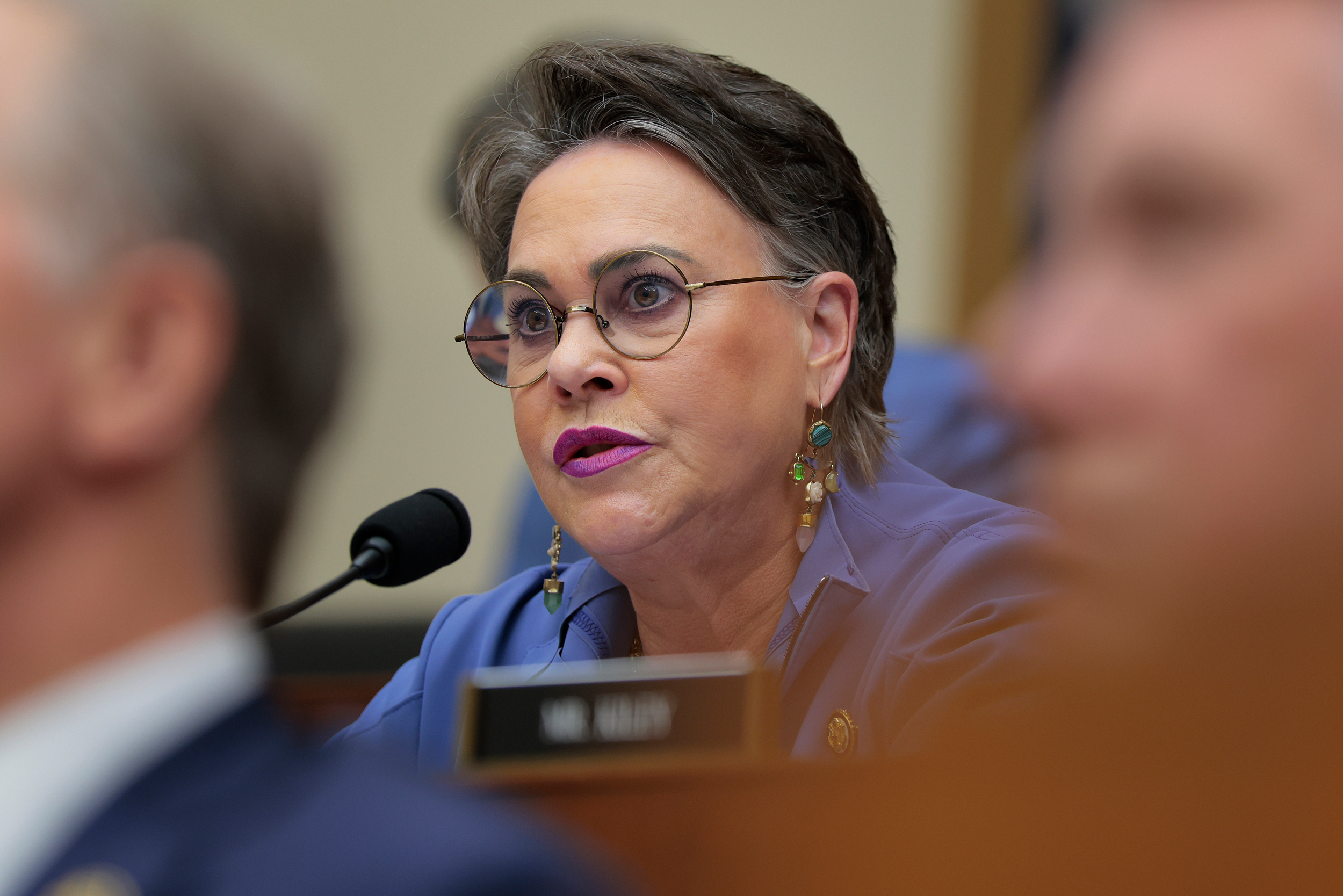
During a House Judiciary Committee oversight hearing last month, Rep. Harriet Hageman (R-Wyo.) used her time in questioning Bondi to denounce state climate laws and lawsuits, or as Hageman described them, “extreme anti-energy policies taken by states and cities that serve only to increase costs on the American people.” Noting that multiple climate lawsuits are now advancing toward trial, Hageman said this is an area where “Congress has a role to play.”
“To that end, I’m working with my colleagues in both the House and Senate to craft legislation tackling both these state laws and the lawsuits that could destroy energy affordability for consumers,” the congresswoman announced.
The details, scope and current status of this draft legislation are unclear. Hageman’s office did not respond to Inside Climate News’ request for an interview nor to questions sent via email.
Hageman told E&E News that she thinks there is “absolutely” interest among her colleagues to take up legislation shielding energy companies from climate liability, and that it “would be a form of preemption” that could bar state and local liability actions. The news organization also reported that Hageman said she had not heard from the industry on the issue.
“If you haven’t done anything wrong, you don’t need immunity”
— Iyla Shornstein, Center for Climate Integrity
But recent lobbying disclosures show that the American Petroleum Institute has been lobbying lawmakers on “draft legislation related to state efforts to impose liability on the oil and gas industry.” The oil lobby is also now stating publicly that stopping “extreme climate liability policies” is one of its top priorities.
“These lawsuits and so-called superfund laws are part of a coordinated campaign against an industry that is vital to everyday life and serves as the engine of America’s economy,” API senior vice president and general counsel Ryan Meyers said in an emailed statement. “Penalizing companies for meeting consumer demand for affordable, reliable energy would set a dangerous new legal precedent, and we will continue to explore all options to correct this type of state overreach.”
Hageman’s announcement “confirms that the fossil fuel industry is escalating its effort to avoid accountability,” said Cassidy DiPaola, communications director of the Make Polluters Pay campaign. She and other climate advocates say this escalation suggests the industry is guilty of the wrongdoing it is accused of.
“If you haven’t done anything wrong, you don’t need immunity,” Iyla Shornstein, political director at the Center for Climate Integrity, an organization supporting climate-accountability initiatives, told Inside Climate News. “It’s a crucial moment for lawmakers who care about accountability and justice to speak out and oppose these efforts.”
Nearly 200 advocacy groups sent a letter last year to Democratic leaders Sen. Chuck Schumer (D-N.Y.) and Rep. Hakeem Jeffries (D-N.Y.), urging them to “draw a line in the sand” and unite their caucuses in opposing any efforts in Congress to shield climate polluters from legal consequences. The Center for Climate Integrity said the letter received no response. Neither the offices of Schumer nor Jeffries responded to inquiries from Inside Climate News.
In 2020, Rep. Jamie Raskin of Maryland led a coalition of 60 House Democrats in a letter opposing a previous attempt by the oil and gas industry to secure legal immunity through draft legislation in Congress.
“Fossil fuel companies are apparently continuing to lobby for legislation that would absolve them of any accountability for their role in endangering people’s health and safety. We rejected these efforts in 2020 and will continue to defeat them if they are proposed in the future,” a spokesperson for the House Judiciary Democrats and Raskin, the ranking member, told Inside Climate News in an emailed statement.
Sen. Sheldon Whitehouse (D-R.I.), who along with Raskin released a joint staff report in 2024 on the industry’s “campaign of deception, disinformation, and doublespeak” to block climate action, told Inside Climate News that he “hasn’t seen any such legislation.”
“But any scheme to let Big Oil mega-corporations off the hook would be an insult to the American people, who are currently footing the bill for the industry’s widespread damages,” Whitehouse added.
State Liability Shield Bills
In addition to federal efforts to immunize the fossil fuel industry from legal liability, Republican lawmakers in at least five states have introduced similar anti-liability bills that would protect the industry or other big greenhouse-gas emitters.
In Oklahoma, state Sen. Julie Daniels introduced a bill called the “Energy Security and Independence Act.” The bill, which has already been approved by the Senate, would prohibit lawsuits relating to climate change against entities that produce, manufacture or sell fossil fuels as well as their trade associations. Daniels did not respond to a request for comment and questions about the bill from Inside Climate News.

A similar bill in Utah has sailed through the Legislature and is on the verge of being enacted. It would prohibit imposing any civil or criminal liability for damage or injury caused by greenhouse gas emissions. There are only narrow exceptions, including if a court finds a person has violated “an enforceable statutory limitation or restriction against emissions of a specific greenhouse gas originating within this state” or has violated express terms of a permit pertaining to greenhouse gas emissions. The bill now awaits the governor’s signature. It is slated to go into effect May 6.
“In Utah we are tired of environmental frivolous lawsuits limiting power generation,” Republican Rep. Carl Albrecht, lead sponsor of the bill, told Inside Climate News in an email. “We want our baseload power which provides Utah the lowest power rates in the country.” He said the policy would “prevent plants being shut down” and that he hopes other states will follow Utah’s example.
In Iowa, a bill very similar to the one in Utah is winding its way through the General Assembly. It would also limit civil and criminal liability for climate change harms caused by greenhouse gas emissions, unless the evidence shows clear violation of statutory emission limits or permits. “Greenhouse gas” is defined by the bill as those that originate from any agricultural, petroleum or renewable fuel source.
Republican Rep. Derek Wulf, a lead sponsor, did not respond to Inside Climate News’ inquiry. But Wulf told E&E News that the proposal is intended to help protect agribusinesses in the state, while still being broad enough so that “we don’t have to come back and do this, year after year, of whatever craziness that a trial lawyer or attorney general from another state decides to sue on.” Wulf also said the bill was a response to climate liability lawsuits and legislation filed in other states, according to E&E News.
Climate liability shield bills are also advancing in Louisiana and Tennessee, states with some of the most climate-vulnerable communities in the country, according to an index from the Environmental Defense Fund and Texas A&M University.
Louisiana’s bill, called the “Louisiana Energy Protection Act,” broadly blocks liability for climate change damages resulting from greenhouse gas emissions. Damage claims based on out-of-state emissions are entirely prohibited, and claims pertaining to exclusively in-state emissions are not allowed unless the claimant can prove the defendant violated statutory emissions limits or terms of a permit.
Additionally, the bill specifies that climate-damage claims are considered preempted by federal law, including by the Clean Air Act, and that any government entity or political subdivision in the state cannot bring a climate liability action unless prior approval is obtained from the governor, the state attorney general and both the House and Senate Committees on Natural Resources.
The bill, introduced by Republican Rep. Brett Geymann, says it is the policy of the state to protect energy producers and related industries from climate-related claims.
Geymann told Inside Climate News in an email that he decided to sponsor the bill after “reading of numerous lawsuits filed against energy companies across the country in relation to climate change.” He said the topic of climate litigation “also came up in our oil and gas working group that was created to find ways to make Louisiana the leader on the gulf coast in oil and gas production.” Geymann said he looked to the bills in Utah and Oklahoma for guidance and added that he is “confident the legislature will agree with this bill and the governor will sign it.”
This story is funded by readers like you.
Our nonprofit newsroom provides award-winning climate coverage free of charge and advertising. We rely on donations from readers like you to keep going. Please donate now to support our work.
Donate NowIn Tennessee, Republican legislators introduced a bill, titled the “Tennessee Energy Freedom Act,” that appears to be nearly identical to a model bill promoted by a group called Consumers Defense, which advocates against environmental, social and governance initiatives and other “woke politics.” The bill prohibits imposing liability in connection with greenhouse gas emissions from fossil fuel activities. It also creates a “right to engage in activities related to coal, oil, and natural gas.” Neither Rep. Chris Todd nor Sen. Shane Reeves, the sponsors, responded to an inquiry from Inside Climate News about their bill.
DiPaola of the Make Polluters Pay campaign said that Republican lawmakers backing these state liability shield bills are putting corporate interests and profits ahead of the interests of their constituents.
“These states are facing significant climate damages, yet the lawmakers introducing these bills are more worried about protecting one of the richest industries in the history of our entire world, rather than protecting the working people in their communities,” DiPaola said. “What the public must ask is whether the law applies equally to everyone, or whether corporations with enough money and access can just carve out exemptions for themselves.”
An “Un-American” Effort
The fossil fuel industry is not alone in its attempts to skirt accountability for harmful products or operations. Similar bids for liability protections have been made by big tech firms, pesticide manufacturers and private prison operators.
“We’re seeing this larger effort for blanket immunity for these corporate entities, and I think that’s very dangerous,” said Caitlin Howard, co-founder of Breach Collective, a nonprofit focused on building power in the climate and labor movements.
Howard said that climate activists across the country are already organizing in opposition to the fossil fuel industry’s push for legal immunity. A new website was launched as a hub for people to plug into this work.
One prominent climate advocate speaking out against liability shield legislation is former Washington Gov. Jay Inslee. “The ultimate democratic institution in America is the jury,” Inslee, also a former trial lawyer, told Inside Climate News. Enacting policies that prevent or block climate-related lawsuits against polluters, he said, would effectively shutter “the doors of the courthouse to Americans that have been injured by oil and gas company pollution and by their lies and deceit about that pollution.”
“I really think it’s an un-American effort to deny Americans the traditional right of access to a jury,” Inslee said. Oil and gas executives are “terrified” by the prospect of having to stand before a jury and face evidence of their climate-change lies and deception, he added. “You’ll see the steam coming out of the jury’s ears when they hear about how they’ve been lied to for decades. [Oil companies] understand why juries will be outraged by it, and they are shaking in their boots. The day of reckoning is coming, and that’s why they’re afraid.”
About This Story
Perhaps you noticed: This story, like all the news we publish, is free to read. That’s because Inside Climate News is a 501c3 nonprofit organization. We do not charge a subscription fee, lock our news behind a paywall, or clutter our website with ads. We make our news on climate and the environment freely available to you and anyone who wants it.
That’s not all. We also share our news for free with scores of other media organizations around the country. Many of them can’t afford to do environmental journalism of their own. We’ve built bureaus from coast to coast to report local stories, collaborate with local newsrooms and co-publish articles so that this vital work is shared as widely as possible.
Two of us launched ICN in 2007. Six years later we earned a Pulitzer Prize for National Reporting, and now we run the oldest and largest dedicated climate newsroom in the nation. We tell the story in all its complexity. We hold polluters accountable. We expose environmental injustice. We debunk misinformation. We scrutinize solutions and inspire action.
Donations from readers like you fund every aspect of what we do. If you don’t already, will you support our ongoing work, our reporting on the biggest crisis facing our planet, and help us reach even more readers in more places?
Please take a moment to make a tax-deductible donation. Every one of them makes a difference.
Thank you,