

Ohio resembles a torture chamber for renewable energy developers, according to new research that examines how regulators in 19 states handle wind and solar project applications.
The Buckeye State had the most projects rejected by state regulators, with seven, and the most withdrawn by developers before a decision, with five, says a paper in the journal Frontiers in Sustainable Energy Policy.
The findings aren’t surprising for anyone paying attention to development trends in Ohio for the last few years. The Ohio Power Siting Board had approved every wind and solar project to come before it until 2021, when it began to give more weight to opposition from local governments and residents.
Some of the change was tied to a state law passed that same year that gave local governments the ability to ban renewable energy development in certain areas. But the results exceeded what the law required, with extreme deference to local opposition, according to developers.
“It’s become a game of Russian roulette, and we’re not going to play it anymore,” said Craig Adair, vice president of development for Open Road Renewables, a Texas-based company that had a project rejected by the board last month and previously withdrew a project ahead of a likely rejection. “We’re not doing any more projects in Ohio.”
The board rejected Republic Wind Farm in 2021 and Birch Solar in 2022, marking the start of this challenging period for applicants.
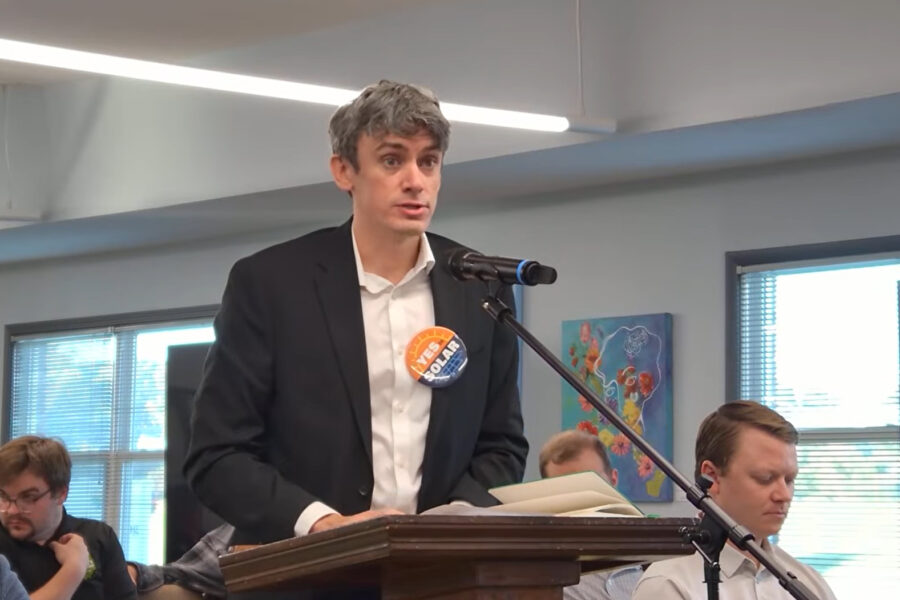
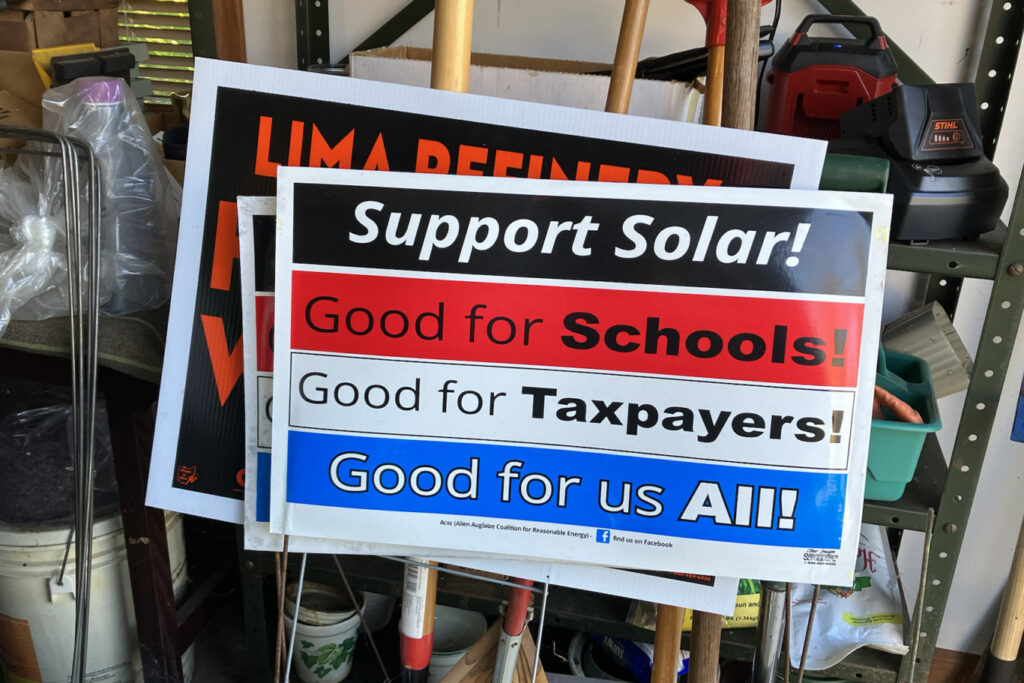
I wrote about Birch Solar when it was decided, looking at how the project had divided people in the Lima, Ohio, area. Supporters of the development felt like the local debate had been taken over by opponents who aggressively and incorrectly argued that solar would harm the health of people and animals and reduce property values.
Asked to respond to the paper, board spokesman Matt Butler noted that Ohio had a comparable project approval rate to other states, at 80 percent, and had approved more than 60 projects, which is more than any other state listed. Ohio now has 9,250 megawatts of utility-scale solar and 1,550 megawatts of onshore wind, he said.
Juniper Katz, a public policy professor at the University of Massachusetts Amherst and a co-author of the paper, said the goal of the research was to understand the timelines and outcomes for states on wind and solar permit applications.
The topline findings: States approved 90 percent of applications and the typical wait for a state to issue a decision was about one year.
“Projects are making it through the pipeline despite well-covered instances of opposition,” Katz said.
The paper’s lead author is Robi Nilson, a research scientist at Lawrence Berkeley National Laboratory.
The research covered 460 U.S. projects spanning applications filed from 2018 to 2024 for solar and from 2015 to 2021 for wind, plus some older projects with decisions since 2021 for solar and since 2018 for wind. So, the authors don’t capture changes that may have happened at the state level since Donald Trump’s return to the presidency in 2025.
About 40 states have state-level boards or offices that oversee permitting for at least some wind and solar projects. The 19 states in the paper are those for which data were available on project timelines and results. Other states give local governments the authority to issue permits for wind and solar projects and many states have a mix of state and local oversight.
The states with the most projects decided at the state level were Kentucky, Maryland, Minnesota, Mississippi, New York and Ohio. Other states in the study included California, Connecticut, Iowa, North Dakota, Nevada, New Hampshire, Oregon, South Carolina, South Dakota, Washington, Wisconsin, West Virginia and Wyoming.
Ohio had the most projects, 61, and an approval rate of 80 percent. Maryland was next with 59 projects and an approval rate of 80 percent. New York had 43 projects and an approval rate of 91 percent.
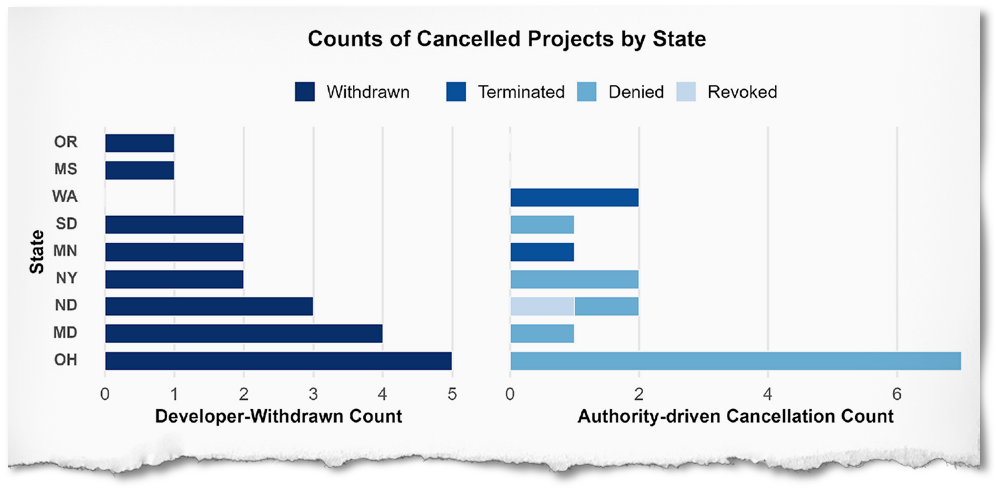
But some of the figures don’t give a clear view of what’s happened in recent years. In Ohio, the approval rate has been lower since 2021. In Maryland, there were 34 projects pending review—the highest of any state in the paper’s findings—whose results weren’t included in the approval rate.
Doug Bessette, a Michigan State University professor who studies the social acceptance of renewable energy, said the research is an important step toward understanding the state permitting process. He was not involved in writing the paper.
Bessette’s not surprised to see that Ohio has the most projects rejected and withdrawn.
“I often tell my students that if they want to see how not to do clean energy, look across the border to Ohio,” he said. “I think the state’s policymakers and many of its local officials are just entirely opposed to renewables, and you can see it in their policy and their permitting decisions. Just a lack of clear, consistent and fair regulations.”
Ohio’s approach to wind and solar shifted with the signing of Senate Bill 52 in 2021. The law allowed local officials to designate parts of their jurisdictions as off-limits to utility-scale renewables.
This story is funded by readers like you.
Our nonprofit newsroom provides award-winning climate coverage free of charge and advertising. We rely on donations from readers like you to keep going. Please donate now to support our work.
Donate NowNotably, the law said that projects that had already taken steps to obtain permits would be grandfathered. For those projects, local officials would have a vote in the state board’s decision, but they would not have veto power. This grandfathering provision was a legislative compromise that solar industry officials and business groups expected would lead to approval of nearly all the pending projects.
But that’s not what happened. Even though local officials didn’t officially have veto power, the Power Siting Board gave greater weight to local objections than before. If local officials unanimously opposed a project, it was as good as dead. If a majority of local officials were against a project, it had slim chances of success.
Key lawmakers who helped to pass Senate Bill 52 said they didn’t intend for the law to be applied this way.
Open Road Renewables is one of several developers with pending cases before the Ohio Supreme Court challenging what they consider an arbitrary standard.
“The opposition groups know exactly what the playbook is,” said Adair, the company’s vice president of development. “All they have to do is yell as loud as they can and storm the township meetings and the commissioners’ meetings and scare them into opposing the project, and they can kill a project, and that’s what’s happening.”
This is contrary to the state’s interests at a time of rising electricity demand, he said.
The paper looks at results that are among the most measurable, leaving much that is more difficult to track, such as permit decisions made by local governments.
My sense from years of covering renewable energy is that local governments are more hostile to renewable energy development than state governments. The obvious next step in the research behind this paper is to look at results at the local level, and that’s exactly what Katz and some of the co-authors are doing.
In addition to the paper on state permitting, they have another in the same journal this month that looks at local decisions in Massachusetts, and some are working on an examination of New York.
The authors found 42 projects in Massachusetts; complete data was available for 26 of them. Of this total, 16 received permits and the rest were either canceled or are the subjects of lawsuits. The average time for a permitting decision was 250 days.
Now, I’d like to see this kind of research for every state.
Other stories about the energy transition to take note of this week:
Renewable Generation Exceeded Coal Globally in 2025: Renewable electricity sources overtook coal last year to become the world leader in terawatt-hours generated, according to the think tank Ember, as Molly Lempriere reports for Carbon Brief. This was in line with the longtime trend and not surprising. The growth in renewables is largely driven by solar power.
Federal Judge Halts Trump Administration Tactics That Stall Renewable Development: A judge in the U.S. District Court for the District of Massachusetts this week granted a preliminary injunction that says the Trump administration can no longer stall on formerly routine steps for obtaining permits to build wind and solar power, as Brad Plumer reports for The New York Times. A coalition of clean energy groups had sued the administration, seeking to end what they said were politicized delays that had stymied development.
Meta Has an Agreement for 1 Gigawatt of Long-Duration Storage: Meta, the company behind Facebook, has an agreement with Noon Energy, a battery energy-storage company, for 1 gigawatt of batteries capable of running for 100 hours on a single charge, as Ryan Kennedy reports for PV Magazine. While the overall order is huge, Noon will start with a 2,500-megawatt pilot project that will go online by 2028, the company said. Noon’s technology uses a “reversible solid oxide fuel cell” to provide several days of storage on a single charge, one of many companies looking at different battery chemistries that exceed what is possible with lithium-ion batteries.
The Trump Administration’s Deal With TotalEnergies to Scrap an Offshore Wind Project Doesn’t Carry the Purported Benefits: The Trump administration touted an agreement with TotalEnergies as paying the company nearly $1 billion to abandon an offshore wind plan and invest in U.S. oil and gas. But newly released documents show that the deal offers essentially no benefits for the United States, as Emily Pontecorvo reports for Heatmap.
Is the New Generation of Highly Efficient Solar Panels Here? Researchers have developed crystal structures that can be used in solar panels that are much more efficient than those now on the market, but some of the most promising technology has been a few steps away from commercialization for a while. Now, the startup Tandem PV has opened a plant in California that may mark the arrival of mass production of panels with “perovskite” coating that could have efficiency close to 30 percent, which is much higher than is typical in today’s market, as Julian Spector reports for Canary Media.
Inside Clean Energy is ICN’s weekly bulletin of news and analysis about the energy transition. Send news tips and questions to [email protected].
About This Story
Perhaps you noticed: This story, like all the news we publish, is free to read. That’s because Inside Climate News is a 501c3 nonprofit organization. We do not charge a subscription fee, lock our news behind a paywall, or clutter our website with ads. We make our news on climate and the environment freely available to you and anyone who wants it.
That’s not all. We also share our news for free with scores of other media organizations around the country. Many of them can’t afford to do environmental journalism of their own. We’ve built bureaus from coast to coast to report local stories, collaborate with local newsrooms and co-publish articles so that this vital work is shared as widely as possible.
Two of us launched ICN in 2007. Six years later we earned a Pulitzer Prize for National Reporting, and now we run the oldest and largest dedicated climate newsroom in the nation. We tell the story in all its complexity. We hold polluters accountable. We expose environmental injustice. We debunk misinformation. We scrutinize solutions and inspire action.
Donations from readers like you fund every aspect of what we do. If you don’t already, will you support our ongoing work, our reporting on the biggest crisis facing our planet, and help us reach even more readers in more places?
Please take a moment to make a tax-deductible donation. Every one of them makes a difference.
Thank you,

Dan Gearino
Reporter, Clean Energy
Dan Gearino covers the business and policy of renewable energy and utilities, often with an emphasis on the midwestern United States. He is the main author of ICN’s Inside Clean Energy newsletter. He came to ICN in 2018 after a nine-year tenure at The Columbus Dispatch, where he covered the business of energy. Before that, he covered politics and business in Iowa and in New Hampshire. He grew up in Warren County, Iowa, just south of Des Moines, and lives in Columbus, Ohio.