

Soon after the U.S. Environmental Protection Agency released a plan to revoke its legal authority to regulate climate pollutants last summer, the nation’s most respected scientific organization fast-tracked a review of the latest evidence on whether greenhouse gas emissions endanger public health and welfare.
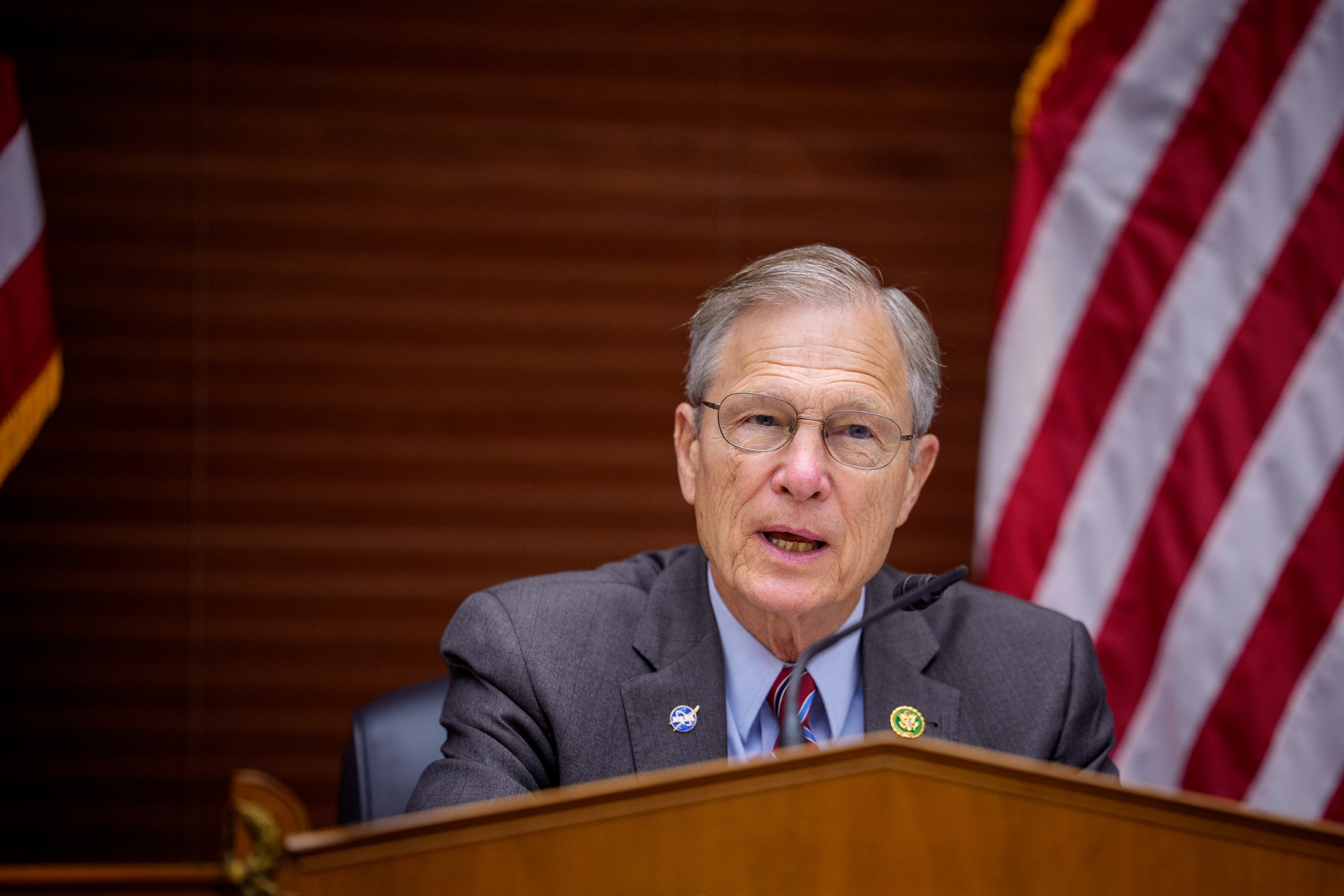
Now Republican leaders of the House science committee—who have received generous campaign donations from the fossil-fuel industry—are questioning the “formation, funding and expedited timeline” of the expert committee that reviewed the evidence of climate pollution’s harms for the National Academies of Sciences, Engineering and Medicine.
The Trump administration said its proposed repeal was justified because the EPA had “unreasonably” analyzed the scientific record in making its 2009 endangerment finding, the legal basis for regulating emissions from vehicles and other climate-pollution sources under the Clean Air Act. Developments since then, the administration claimed, “cast significant doubt on the reliability of the findings.”
For the National Academies—private, nongovernmental institutions obligated by an 1863 congressional charter to provide the nation with objective scientific advice—such significant claims about the scientific record demanded careful review. Climate science has advanced considerably since the Obama administration made its endangerment finding.
The National Academies sprang into action to review the latest science to “best inform” the EPA’s decision-making. They tapped several experts who had contributed to reports by the Intergovernmental Panel on Climate Change and the National Climate Assessment, which facilitated a speedy review of the evidence.
Its consensus study report, released just under the EPA’s deadline for public input last September, concluded that the evidence for current and future harm to public health and welfare created by human-caused greenhouse gases “is beyond scientific dispute.”
“Much of the understanding of climate change that was uncertain or tentative in 2009 is now resolved, and new threats have been identified,” the authors of the report noted. “The United States faces a future in which climate-induced harm continues to worsen and today’s extremes become tomorrow’s norms.”
The report aligns with conclusions from preeminent climate assessments that greenhouse gases are warming the Earth’s surface and changing the climate; that human activity and resulting climate change are harming health and welfare; and that unabated emissions will further alter the climate in ways that could trigger dangerous tipping points.
Yet leaders of the GOP-run House Committee on Science, Space and Technology are casting doubt on the credibility of the nation’s premier science organization and its report.
“The United States faces a future in which climate-induced harm continues to worsen and today’s extremes become tomorrow’s norms.”
— National Academies consensus study report
Over the past week, SST committee leaders sent two letters “raising serious concerns regarding independence and objectivity” to Marcia McNutt, president of the National Academy of Sciences, which funded and oversaw the consensus report. The letters also demanded reams of documents and correspondence with the institution’s donors to investigate “potential conflicts of interest.”
The academy panel was made up of people with a lot of background and expertise in evaluating climate science, drawn from industry as well as academics, said physicist Drew Shindell, a Duke University earth science professor and climate expert who contributed to the consensus report. “There was no disagreement about the overall conclusions,” said Shindell, who also worked on IPCC and NCA reports.
Those much larger reports had far more authors who also agreed on the overall findings, he said, “because the science is very well established.”
The three Republican leaders of the SST committee who are questioning the objectivity of the National Academies have collectively received nearly $550,000 in donations from the oil and gas industry, campaign finance records show.
After the Trump administration finalized its decision to repeal the groundbreaking tool to regulate climate pollution in February, SST committee Chair Brian Babin, R-Texas, called the move “a long-overdue step toward restoring the proper limits of federal regulatory authority.”

The committee’s communications director, Sarah Reese, did not respond to questions about the fact that congress members who are accusing a nonpartisan, independent science organization of bias for producing a report confirming human contributions to climate change have received generous donations from fossil fuel interests or whether the Republican leaders thought the three panel members who had worked for the oil and gas industry should have been disqualified for conflicts of interest.
As for the EPA’s claim that developments have “cast significant doubt on the reliability” of the 2009 endangerment finding, Shindell said, “the complete opposite is true.”
“Developments since then greatly clarify the damages to Americans from climate change caused by greenhouse gases,” he said. “And those damages are even more certain and larger than what was known at the time of the original endangerment finding.”
“Never in Question”
Scientists have understood the basic causes of climate change and the role of human influence on Earth’s climate for decades. But in recent years they’ve made great gains in understanding how these changes are harming human health and welfare.
Science usually advances “quite slowly,” Shindell said. “But for the impacts of climate change and our ability to quantify them, that has just expanded enormously in the last decade.”
The first models to describe the economic toll of a warming planet were developed by William Nordhaus in the 1990s, an innovation that earned him a Nobel Prize. Now, since the impacts of climate change have become “all too real,” Shindell said, scientists can see the harm to society in far clearer focus than was possible even a decade ago.
This story is funded by readers like you.
Our nonprofit newsroom provides award-winning climate coverage free of charge and advertising. We rely on donations from readers like you to keep going. Please donate now to support our work.
Donate Now“Now we can map out where heat exposure changes and what it does to people all around the nation,” Shindell said. “We can map out storm damage. We can map out agricultural crop response to both changes in temperature and rainfall.”
Researchers can also connect rising insurance prices to catastrophic storms, wildfires and other natural hazards, and measure the impacts of climate change on specific sectors of the economy, he said.
Republicans first accused the National Academies of serving partisan aims for conducting a fast-tracked climate review last September. The fact that the institution was relying on private funds to conduct the study, a letter from the House Committee on Oversight and Government Reform noted, “raises concerns that this study is being conducted at the behest of private donors, the largest of which hold radical-leftist views about climate change.”
The short timeline of the review, the letter charged, raised concerns that the results of the study “have been predetermined.” It ignored the fact that several panelists had worked on the IPCC or NCA just two years earlier.
Republicans also said concerns had been raised about the National Academies’ “compromised objectivity” beyond the climate report, citing its role in co-publishing a climate science chapter in the Federal Judicial Center’s Reference Manual on Scientific Evidence. Republicans on the SST committee claimed the chapter was “retracted” after an analysis—featured in a Wall Street Journal editorial calling the incident a “science scandal”—alleged that “a significant portion” of the chapter had been ghostwritten by a lawyer involved in climate-liability lawsuits. One of the listed co-authors publicly disputed the allegation, yet the Republicans repeated the claim in their most recent letter to the National Academy of Sciences.
It’s a misrepresentation to say the climate change chapter was retracted, said Michael Green, a legal scholar at Washington University in St. Louis who joined more than two dozen experts in condemning the partisan attack on a reference manual designed to help judges parse complex science.
Retraction is where there’s a question about the reliability or validity of the contents of documents, Green said. “That was never in question.”
The chapter was pulled in response to pressure from a coalition of Republican attorneys general and additional pressure from Republicans in Congress, which funds the Federal Judicial Center, he said.
The National Academies declined to respond to questions about Republicans’ charges of bias and conflicts of interest. A spokesperson for the National Academies said only, “We look forward to building on our longstanding relationship with the House Committee on Science, Space and Technology to address the issues they have raised.”
McNutt expressed concern in an editorial in the journal Science following President Donald Trump’s re-election that “science has fallen victim to the same political divisiveness tearing at the seams of American society.”
“This is a tragedy because science is the best—arguably the only—approach humankind has developed to peer into the future, to project the outcomes of various possible decisions using the known laws of the natural world,” she wrote.
As Republicans continue to cast doubt on the science of climate change, scientists continue documenting the toll it’s taking on ecosystems, food supplies, water availability, air quality and people’s susceptibility to contaminants and disease.
“It’s just so, so much clearer now, all the harms that Americans really face from greenhouse-gas-induced warming,” Shindell said.
About This Story
Perhaps you noticed: This story, like all the news we publish, is free to read. That’s because Inside Climate News is a 501c3 nonprofit organization. We do not charge a subscription fee, lock our news behind a paywall, or clutter our website with ads. We make our news on climate and the environment freely available to you and anyone who wants it.
That’s not all. We also share our news for free with scores of other media organizations around the country. Many of them can’t afford to do environmental journalism of their own. We’ve built bureaus from coast to coast to report local stories, collaborate with local newsrooms and co-publish articles so that this vital work is shared as widely as possible.
Two of us launched ICN in 2007. Six years later we earned a Pulitzer Prize for National Reporting, and now we run the oldest and largest dedicated climate newsroom in the nation. We tell the story in all its complexity. We hold polluters accountable. We expose environmental injustice. We debunk misinformation. We scrutinize solutions and inspire action.
Donations from readers like you fund every aspect of what we do. If you don’t already, will you support our ongoing work, our reporting on the biggest crisis facing our planet, and help us reach even more readers in more places?
Please take a moment to make a tax-deductible donation. Every one of them makes a difference.
Thank you,

Liza Gross
Reporter, California
Liza Gross is a reporter for Inside Climate News based in Northern California. She is the author of The Science Writers’ Investigative Reporting Handbook and a contributor to The Science Writers’ Handbook, both funded by National Association of Science Writers’ Peggy Girshman Idea Grants. She has long covered science, conservation, agriculture, public and environmental health and justice with a focus on the misuse of science for private gain. Prior to joining ICN, she worked as a part-time magazine editor for the open-access journal PLOS Biology, a reporter for the Food & Environment Reporting Network and produced freelance stories for numerous national outlets, including The New York Times, The Washington Post, Discover and Mother Jones. Her work has won awards from the Association of Health Care Journalists, American Society of Journalists and Authors, Society of Professional Journalists NorCal and Association of Food Journalists.