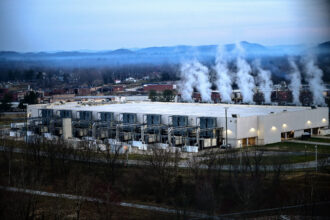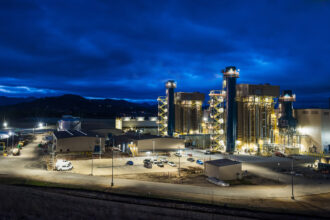


Duke Energy has received tax breaks for three data centers that it owns, state Commerce Department records show, while the utility is proposing an 18 percent rate hike on its North Carolina customers and reported $4.9 billion in gross profits last year.
Duke Energy owns data centers in Charlotte and Garner, as well as in Huntersville at the McGuire nuclear plant. The utility declined to provide specific details about the facilities, such as energy and water usage, the amount of its tax breaks and whether it is still receiving them.
“These data centers provide support for Duke Energy operations and enable Duke Energy to deliver the high quality of service and reliability our customers expect,” Duke spokesman Jeff Brooks said. “Our goal is to keep costs as low as possible for customers, and we pass along tax savings to customers, when available, to help keep bills lower. Any changes to federal, state, or local taxes, whether they be increases or decreases, are passed to customers.”
Lawmakers enacted sales and use tax breaks for data centers in 2010 and expanded them in 2015. To qualify for the exemptions, data center owners must apply to the N.C. Department of Commerce to be certified. The certification letters are public.
In North Carolina, qualifying data centers don’t pay sales tax, which ranges from 6.75 to 7.25 percent, depending on the county, on certain equipment: heating and air conditioning, computer hardware and software and electrical infrastructure. To receive the tax exemptions, the data centers must meet county wage standards, provide health insurance to full-time employees and invest $75 million in private funds in a project within five years.
Nor do qualifying data centers pay taxes on electricity use.
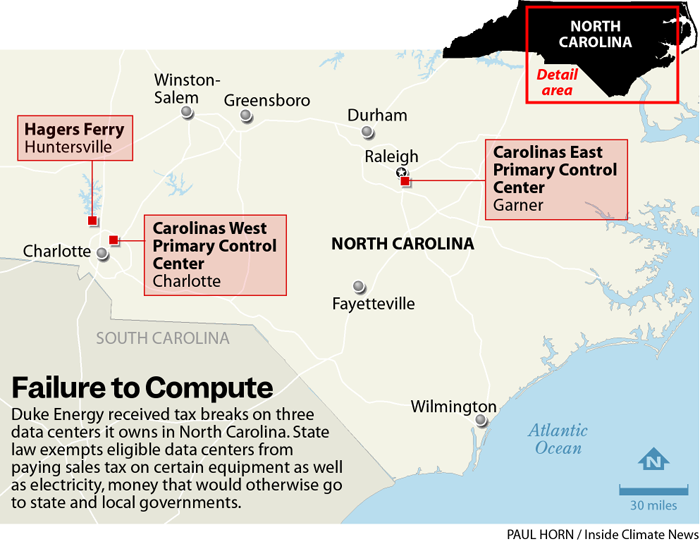
Duke reported nearly $300 million in investments at its data centers:
- $95 million at Hagers Ferry in Huntersville from 2016 to 2020; certified in 2018
- $144.7 million at the Carolinas West Primary Control Center in Charlotte from 2014 to 2019; certified in 2020
- $126 million at Carolinas East Primary Control Center in Garner from 2019 to 2023; certified in 2020
Sales and use taxes are the second-largest source of revenue for local governments, behind property taxes, according to the Department of Revenue. A third of the state’s general fund comes from these taxes.

Tax exemptions for data centers in North Carolina keep as much as $57 million each year from state and local government coffers, state figures show. Earlier this month, Gov. Josh Stein told his Energy Policy Task Force, which includes several lawmakers, that the legislature should reconsider the exemptions.
Seven Democratic state lawmakers introduced legislation Monday that would repeal sales tax exemptions for data centers.
“It is infuriating, but not surprising, that Duke Energy both benefits from getting sales and usage tax incentives,” said Rani Masri, co-director of the NC Environmental Justice Network, which organizes communities against data centers. “We’re giving Duke Energy money to build something and then we’re paying Duke Energy higher utility rates. It is absolutely absurd. We don’t even know how much money we’re giving away.”
Despite these generous subsidies, data center owners are legally allowed to shield many of their financial details from state oversight. They aren’t required to prove their ongoing eligibility for the tax exemptions unless they are audited by the state Department of Revenue.
The Department of Revenue could not release information about the audits, a spokesperson said, because of confidentiality laws.
Electric bills in North Carolina have surged by 22 percent since 2020. If the N.C. Utilities Commission approves Duke’s rate increase, customers using 1,000 kilowatt hours per month would pay an additional $34 each month on their bills.
Duke has justified the rate hikes in part by saying they are necessary to pay for its immense natural gas buildout of as many as a half-dozen new plants and other infrastructure to meet the demand for energy-hungry data centers and other large-load customers.
Microsoft plans to build a data center on 1,350 acres in north Roxboro near Duke’s coal plants at Hyco Lake. There, Duke is constructing two natural gas plants to eventually replace its coal-fired facilities—although it could burn both types of fuels simultaneously during the transition.
Earlier this month, the Utilities Commission held a public hearing in Roxboro about the proposed rate hikes. Hope Taylor, executive director of Clean Water for North Carolina, told the commission Duke has exaggerated its load forecast, including that of data centers, to justify the natural gas buildout and the increases.
The explosive growth of data centers is waning as public pressure has forced more than a dozen local governments in North Carolina to enact temporary moratoria on their construction.
Taylor’s comments echo those of the Public Staff, a government agency that represents customers before the Utilities Commission. In public documents filed earlier this month, Blaise Michna, engineering manager at the staff’s Energy Division, testified Duke’s plans for natural gas were “overly aggressive” and constructed its forecast modeling to favor natural gas.
Duke is expected to file its rebuttal by May 12.
About This Story
Perhaps you noticed: This story, like all the news we publish, is free to read. That’s because Inside Climate News is a 501c3 nonprofit organization. We do not charge a subscription fee, lock our news behind a paywall, or clutter our website with ads. We make our news on climate and the environment freely available to you and anyone who wants it.
That’s not all. We also share our news for free with scores of other media organizations around the country. Many of them can’t afford to do environmental journalism of their own. We’ve built bureaus from coast to coast to report local stories, collaborate with local newsrooms and co-publish articles so that this vital work is shared as widely as possible.
Two of us launched ICN in 2007. Six years later we earned a Pulitzer Prize for National Reporting, and now we run the oldest and largest dedicated climate newsroom in the nation. We tell the story in all its complexity. We hold polluters accountable. We expose environmental injustice. We debunk misinformation. We scrutinize solutions and inspire action.
Donations from readers like you fund every aspect of what we do. If you don’t already, will you support our ongoing work, our reporting on the biggest crisis facing our planet, and help us reach even more readers in more places?
Please take a moment to make a tax-deductible donation. Every one of them makes a difference.
Thank you,

Lisa Sorg
Reporter, North Carolina
Lisa Sorg is the North Carolina reporter for Inside Climate News. A journalist for 30 years, Sorg covers energy, climate environment and agriculture, as well as the social justice impacts of pollution and corporate malfeasance.
She has won dozens of awards for her news, public service and investigative reporting. In 2022, she received the Stokes Award from the National Press Foundation for her two-part story about the environmental damage from a former missile plant on a Black and Latinx neighborhood in Burlington. Sorg was previously an environmental investigative reporter at NC Newsline, a nonprofit media outlet based in Raleigh. She has also worked at alt-weeklies, dailies and magazines. Originally from rural Indiana, she lives in Durham, N.C.