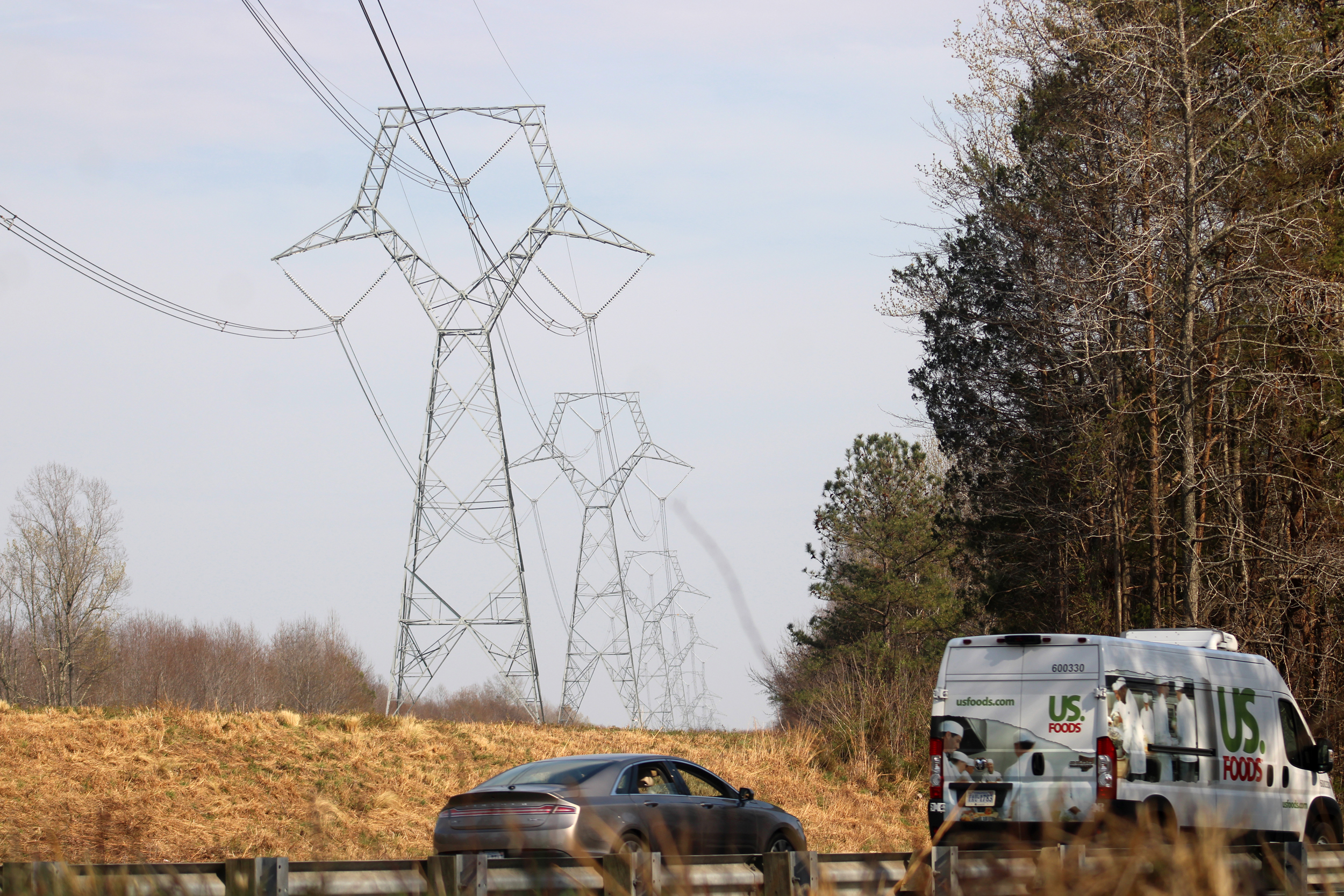


GOOCHLAND, Va.—Deborah Blackburn leaned on her cane in a line to enter the Central High Cultural and Educational Complex, angst-ridden over a giant transmission line proposal for reasons that are common refrains here: It’s all to benefit data centers in Northern Virginia, and it will disrupt the rural character here outside Richmond.
“We don’t want it,” Blackburn said about the Valley Link transmission project. “I kept as much of my acreage natural. I like seeing my deer, even though they eat my hosta plants.”
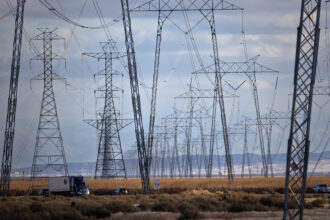
Valley Link is a 765-kilovolt system of transmission lines to be hung from towers the height of 12-story buildings by Dominion Energy, Transource and FirstEnergy. Transource is a transmission company jointly owned by American Electric Power and Evergy.
Up for public discussion in Goochland at the recent meeting Blackburn attended was a segment that would start at the Joshua Falls substation in Campbell County, about 115 miles west of Richmond.
From there, several cables and dozens of giant towers will run northeast over 100 miles through the state’s agricultural Piedmont to deliver electricity to the proposed Yeat substation in Culpepper County, just outside Northern Virginia. That portion of Valley Link is called Joshua Falls to Yeat.
It will tie into an ever-growing network of smaller transmission lines and substations in Northern Virginia to serve the state’s data center market, dubbed the data center capital of the world.
The Goochland Board of Supervisors in November approved a technology overlay district to limit development of the server farms to certain areas of the county. The district comes with varying requirements, like 300-foot setbacks and 250-foot vegetative buffers for the land within it zoned for light industrial. Meeting some requirements allows a facility to be built by right, more easily without a public hearing.
But residents who would live next to the district are suing in Goochland County Circuit Court because the district, they say, would create an inconsistency. For land zoned for light industrial within the district but next to homes, a conditional use permit would still be required. Anywhere else in the district zoned light industrial is open for a data center to “set up shop” without the public review, said Steve Levet, a Goochland resident concerned about data center sprawl.
“That’s a problem,” said Levet. “The county can’t have two sets of standing for the same zoning district.”
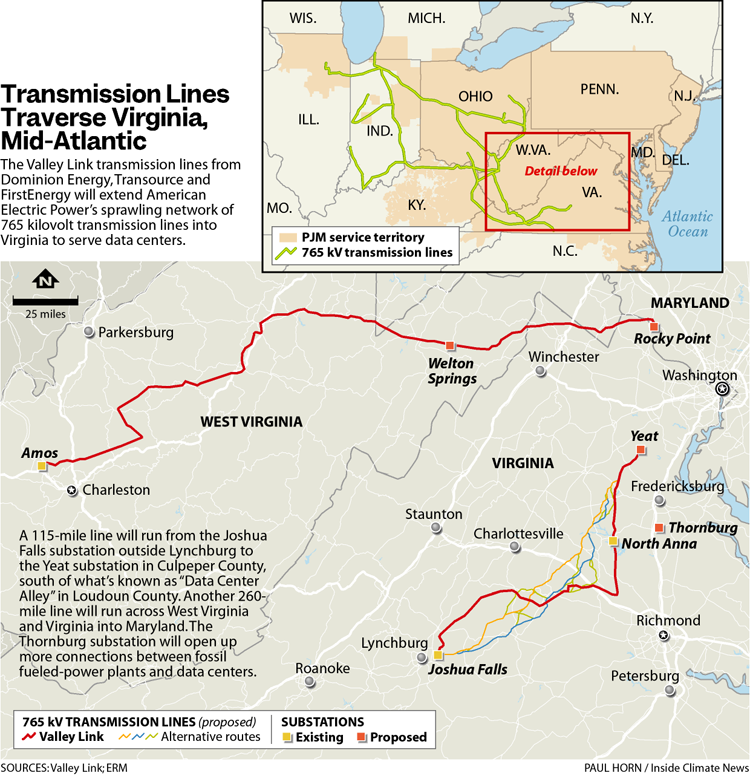
The two other components of Valley Link are a Valley North transmission line running from West Virginia across Virginia to Maryland and a Thornburg substation in Caroline County north of Richmond that a separate line would connect to via an existing North Anna substation. The latter would allow for connections between a nearby nuclear power plant, fossil fuel generating sources and more data center development in that county, as well as Stafford and Spotsylvania counties.
The Joshua Falls to Yeat line is emblematic of the quandary many Virginians find themselves in —a divide between rural and Northern Virginia. Homeowners and farmers say they are losing their natural environments and, in some cases, their livelihoods to serve a digital world that demands land, electricity and water for the data centers that power it.
Dominion Energy jointly proposed the Valley Link project after receiving requests from data centers to hook up to the grid in its transmission zone. Based on those requests, the utility will determine whether smaller transmission lines can be built to maintain reliability of the grid or if larger projects like Valley Link need to be approved by PJM Interconnection, the regional grid operator for Virginia, 12 other states and the District of Columbia.
PJM approved the proposal in 2025 as part of its Regional Transmission Expansion Plan, but the ultimate route and permit to construct it will be determined by a Virginia regulator, the State Corporation Commission. Changes to how PJM approves projects need to be implemented, critics say. Many want pauses on data center development to evaluate the impact of these transmission lines and adhere to clean-energy requirements.
The Joshua Falls to Yeat line will cost about $1 billion and run near Blackburn’s property by 2029. The smaller transmission lines, substations and data centers they serve would come online around that time.
Advocacy groups like the Louisa County Farm Bureau, which is concerned with the loss of farmland, the National Parks Conservation Association and the Piedmont Environmental Council are vocally opposing the project.
Preservation Virginia, a nonprofit historic preservation group, on Tuesday added several counties to its 2026 list of most endangered historic places because the project could impact 11 historic districts and seven battlefields.
Jon Gordon, senior director at Advanced Energy United, a trade group for clean-energy developers, said the data centers are driving the need for these lines.
“The data centers have really changed the grid map. They’ve created these huge load centers in these random places,” said Gordon. The cost of the Valley Link “is going to hit consumer rates through the transmission charges on consumer bills, slowly and eventually, over time, as this project gets constructed.”
The Data Center Coalition, a group representing industry members including Amazon, Meta, Microsoft and Google, did not respond to a request for comment.
Locally, along with concerns over the cost, communities subject to the Joshua Falls to Yeat line want to keep their countryside rural, which they say will be difficult with transmission line towers that are between 135 and 165 feet tall. The towers will have right of way clearings the length of two football fields.
Residents in the counties of Campbell, Appomattox, Buckingham, Fluvanna, Goochland, Louisa, Spotsylvania, Orange and Culpeper are also worried about just compensation for easements on their land to build the line’s towers. There could be eminent domain takings.
This story is funded by readers like you.
Our nonprofit newsroom provides award-winning climate coverage free of charge and advertising. We rely on donations from readers like you to keep going. Please donate now to support our work.
Donate NowOfficials in those communities held a meeting last month to address concerns. Louisa County leaders in May allocated $250,000 to cover legal expenses to fight the project, according to the Substack newsletter Engage Louisa.
“I want to assure our citizens that Louisa County will continue to protect its residents at every level,” Louisa County Board of Supervisors Chair Duane Adams said, according to Engage Louisa. “This board hears our citizens. This board understands what our citizens are saying, and this board is committed to working with our citizens in regard to Valley Link.”
Craig Carper, a Dominion Energy and Valley Link spokesperson, said at the Goochland open house that the project is about maintaining grid reliability by ensuring electricity can be used by new customers, which include manufacturers.
“This is the first 765 kV line in the [Dominion] Zone,” Carper said. “This furthers our connectivity with other states.”
The Joshua Falls to Yeat route would connect the 765 kilovolt network running from Michigan, Indiana and Ohio to Virginia. Appalachian Power, Virginia’s second largest utility behind Dominion, is owned by American Electric Power, which has over 2,200 miles of 765 kV lines in the U.S., more than any other utility. Those lines deliver more than six times the amount of electricity than the typical 138 kV line they are replacing.
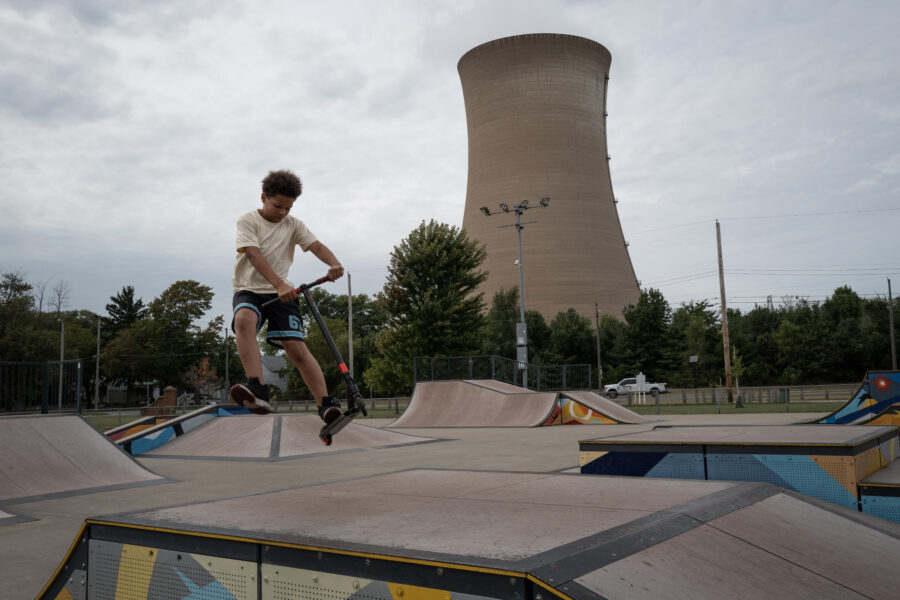
Appalachian Power is also planning a small modular nuclear reactor near the Joshua Falls substation in Campbell County. Small modular reactors, or SMRs, are a yet-to-be used technology that utilities and developers are eyeing for the early 2030s for round-the-clock, zero-carbon-emission electricity.
Anne Dennis, 40, of Goochland said that, beyond the proposed modular nuclear reactor, it’s a mystery where the electricity that will flow through all these new transmission lines will come from. She said she now has about 25 acres for gardening and chickens, after moving a few years ago from Richmond. At the open house, she stopped by the posterboards presenting information on environmental stewardship, since that’s important to her.
“We have questions about this modular nuclear reactor, whatever that is. Maybe it is better,” said Dennis, who’s also trying to cut down on her reliance on the digital world prompting the need for data centers. “I just feel very uneducated. I don’t know who’s responsibility it is to educate us all. … I wish they’d take a step back.”
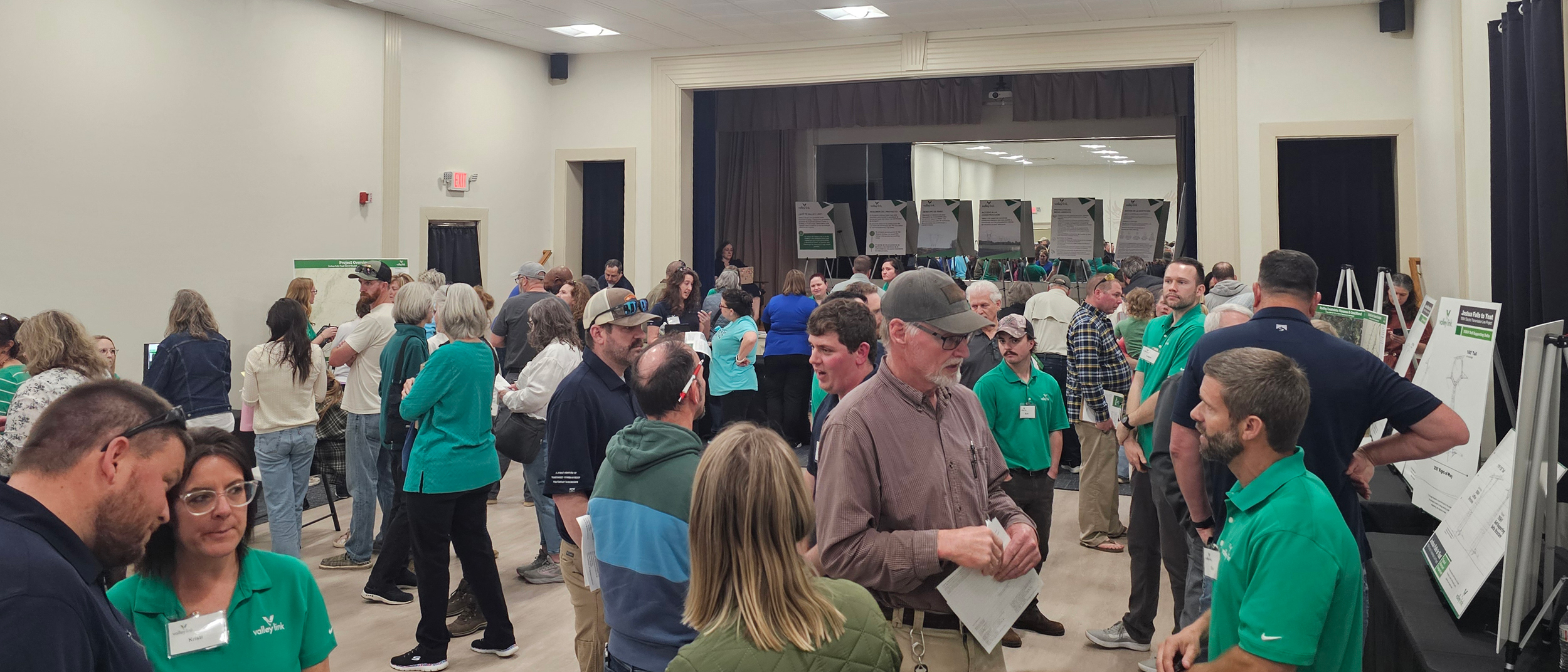
Valley Link’s open house allowed residents to discuss any route conflicts. More opportunities will happen around late May to early June before the State Corporation Commission reviews a selected route in September.
“The Virginia State Corporation Commission will ultimately decide the future of this project,” Carper said. “Localities, communities and residents will have the opportunity to engage with Valley Link and the SCC as part of that process.”
Asked by Inside Climate News if there’s any chance for residents to stop the project or change the route, Carper said, “Public engagement is a very important part of this process.”
Sarah Schmidtke, 64, who retired after 40 years as a county employee, wondered about the public’s ability to influence the project. Standing along Dogtown Road, on the greening grass as the sun settled, she said she saw no benefit from it to local housing or businesses in rural Virginia beyond serving artificial intelligence dreams.
Warning those in her community about data center construction and all the related infrastructure development, Schmidtke said, “This is going to be the change that’s coming your way.”
About This Story
Perhaps you noticed: This story, like all the news we publish, is free to read. That’s because Inside Climate News is a 501c3 nonprofit organization. We do not charge a subscription fee, lock our news behind a paywall, or clutter our website with ads. We make our news on climate and the environment freely available to you and anyone who wants it.
That’s not all. We also share our news for free with scores of other media organizations around the country. Many of them can’t afford to do environmental journalism of their own. We’ve built bureaus from coast to coast to report local stories, collaborate with local newsrooms and co-publish articles so that this vital work is shared as widely as possible.
Two of us launched ICN in 2007. Six years later we earned a Pulitzer Prize for National Reporting, and now we run the oldest and largest dedicated climate newsroom in the nation. We tell the story in all its complexity. We hold polluters accountable. We expose environmental injustice. We debunk misinformation. We scrutinize solutions and inspire action.
Donations from readers like you fund every aspect of what we do. If you don’t already, will you support our ongoing work, our reporting on the biggest crisis facing our planet, and help us reach even more readers in more places?
Please take a moment to make a tax-deductible donation. Every one of them makes a difference.
Thank you,

Charles Paullin
Charles Paullin is a Richmond, Virginia-based reporter focusing on energy and environment issues. He’s won several awards for his previous work covering state policy with the Virginia Mercury and local news with the Northern Virginia Daily in the Northern Shenandoah Valley. His first reporting gig was with the New Britain Herald in Connecticut, a couple years after attending the University of Hartford, where he first studied sports journalism.