

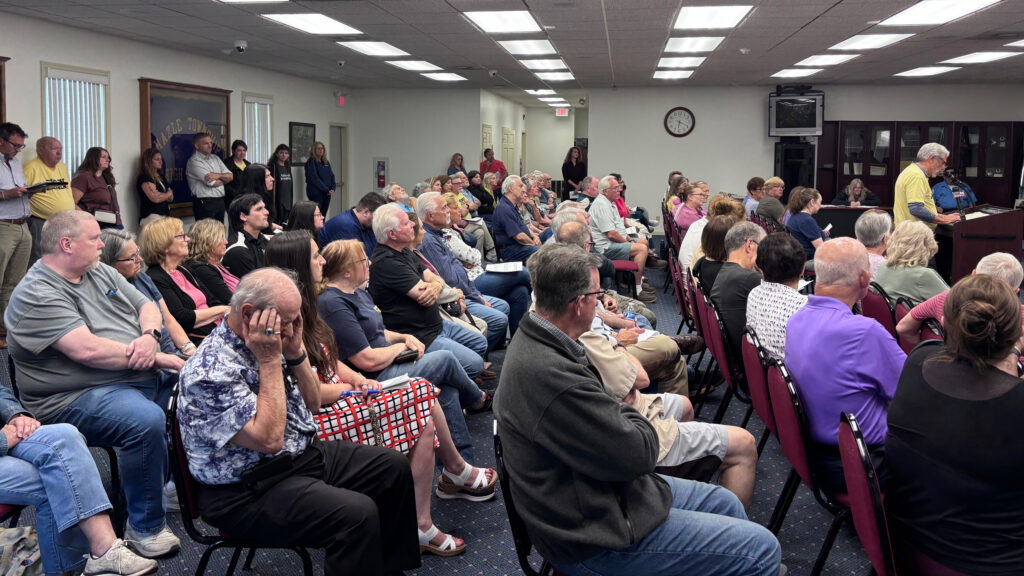
HAZLETON, Pa.—The Hazle Township Supervisors faced a packed room. Hanging on the wall behind them, black lettering spelled out “We the People.” In front of them sat and stood about a hundred community members, some wearing yellow T-shirts that read “Project Hazelnot,” with a red circle and backslash for the “o.”
Their shirts were a message to the developers of Project Hazelnut, who want to build a massive data center complex on the township’s coal-rich plateau. The proposal includes plans for 15 data center buildings and an electrical substation across a nearly 1,300-acre site.
The project came up against what may be its final barrier that night on June 8 when the board voted on a zoning ordinance that would put a pause on data center applications in the town for 180 days. During this time, the board plans to update its zoning rules and add specific restrictions for data centers.
Hazle Township’s push for a local pause came weeks after state legislators introduced a Senate bill that would block data center development for three years. That bill is part of a wider backlash against plans for the controversial facilities cropping up in residential and rural areas across the state and the country.
Proposals for data centers in Hazle Township and nearby Kline Township are just two of over 60 that have sprung up in the last year in Pennsylvania. Most of them face opposition from those who live nearby. Residents are concerned about the speed of development and the potential health and environmental impacts.
This resistance represents a unified front during a time of deep political division. Ginny Marcille-Kerslake, an organizer for Food & Water Watch who has been calling for moratoriums in northeastern Pennsylvania as part of her organization’s national campaign, said that in this fight, party lines have been “obliterated.”
While this amendment was new, the audience’s concerns weren’t. Those who live in Pennsylvania’s coal regions are all too familiar with industry deals that break ground fast and leave destruction and little economic opportunity behind. Starting in the 19th century, this region of Pennsylvania, in the northeastern corner of the state, produced large quantities of coal, helping power the Industrial Revolution but also polluting the water and land. As the local coal industry declined, manufacturing, waste and warehousing facilities moved in, some of them bringing new health hazards. Luzerne County, where Hazleton is located, is home to three Superfund sites.
This history means that the buildout from the AI boom brings added alarm. According to recent polling, 33 percent of residents in this region strongly oppose data center development in or near their communities–the highest percentage in the state.
“We have a beautiful area here. First, it was scarred by coal mines, and we don’t want any more damage done,” said Joanne Balay, a Hazle Township resident who attended the meeting. Her main concerns about data centers are “the amount of power that they take, the amount of water they use, and the land that is totally raped.…It’s just destroyed.”
In this area tucked along the southern edge of the Pocono Mountains, abandoned mine shafts and coal ash piles serve as a reminder of an uglier side of American ambition. For those who live in these forested valleys, proposals for data centers are reopening old wounds.
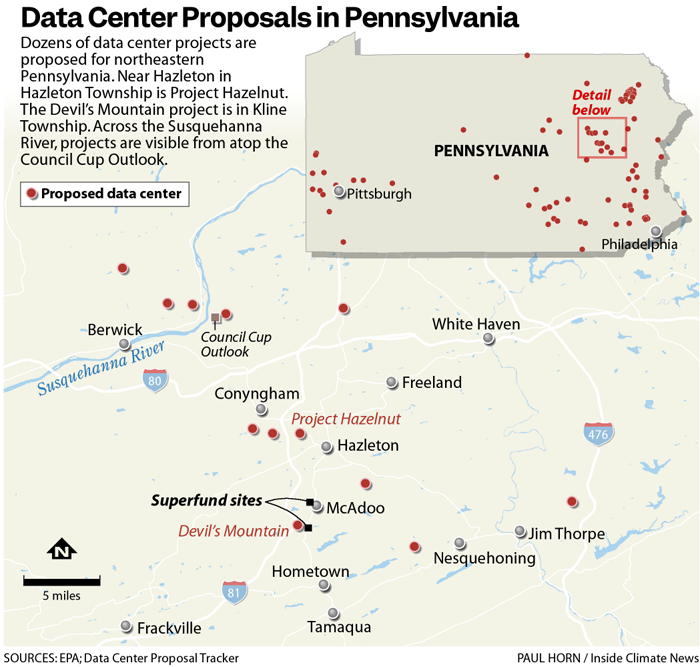
In Kline Township, a few miles from Hazleton, residents have questions about a data center proposal that would include up to 10 buildings across more than 300 acres.
“They are moving so fast that people are not aware, and a lot of it is being done behind closed doors,” said Lynn St. George, a Kline Township resident in favor of a moratorium. “This has to stop.”
Seventeen years ago, St. George and her husband bought 105 acres of land to build their dream home. Now their house is within an aerial mile of a potential future site of an Amazon Web Services data center.
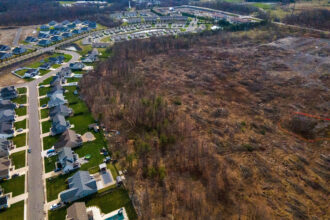
At the site, a clearing of gravel, dirt and felled trees is encircled by red fences. They mark where a handful of wooded backyards end and the project, in an area named “Devil’s Mountain,” begins.
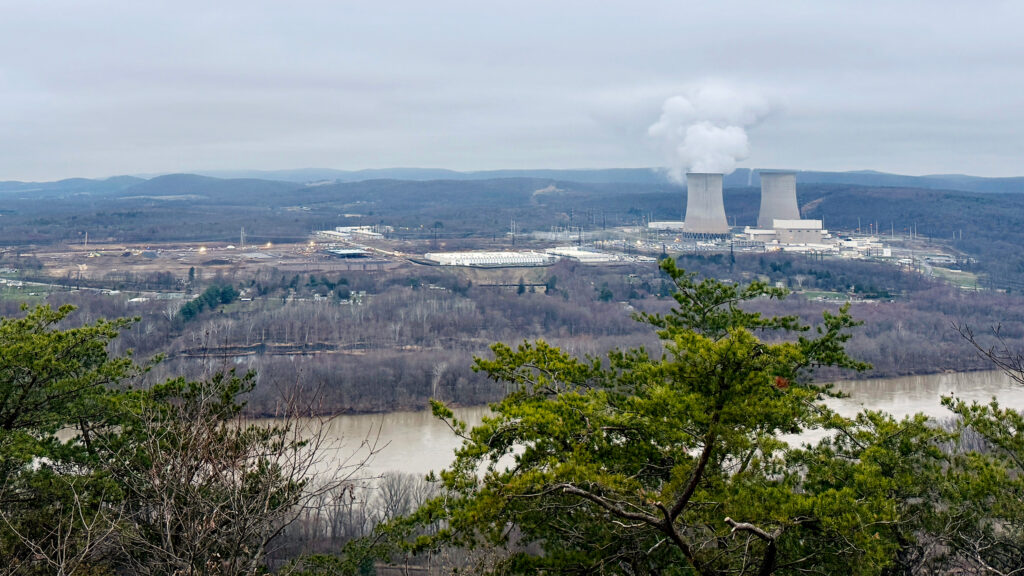
This area used to be a natural expanse of forest where people hunted, and the adjacent neighborhood, Haddock, was a quiet place where kids played. St. George said she hasn’t run into a single resident who wants a data center in the area.
“We’ve had polluted streams, we’ve had waste coal piles a hundred feet tall. There’s public health risks around coal mining—that’s our history,” said Nate Eachus, a former professional football player for the NFL’s Kansas City Chiefs, who lives near Kline Township.
After seeing what he calls “horror stories” of development done wrong, Eachus is joining the call for a statewide moratorium on data centers. “People may say three years is a long time but this is our air. These are our basic natural resources,” he said.
During the Kline meeting, police officers escorted Eachus outside when he tried to speak during the public comment period in violation of a new code that says only residents may participate. Eachus had previously spoken at township meetings. While not a resident in the township of roughly 1,600, he lives 7 miles away and grew up in the area.
He said he sees a pattern of silencing, especially after Amazon Web Services put in an application for Devil’s Mountain. But residents hope that by continuing to speak out, their voices might be amplified in Harrisburg.
“Every community has a voice,” St. George said. “This community has a little voice and they need somebody to amp that voice up so that they can be protected.”
Hazleton Hits the Brakes on the Governor’s Fast Track
While Kline Township’s proposed data center shows no signs of slowing down, just north of them in Hazle Township, residents succeeded in halting the plans for the next 180 days.
Under pressure, the Hazle Township board voted unanimously on June 8 to temporarily stop all consideration of data center proposals.
This marks the latest chapter in Hazle Township residents’ opposition to Project Hazelnut. Gov. Josh Shapiro introduced the data center proposal last November as one of the flagship projects under the state’s “Fast Track” program, which the governor first announced during a visit to Hazle Township. Project Hazelnut was touted as an investment that would bring 900 jobs and boost tax revenue under the statewide initiative to speed up the permitting process.
On the project’s website, the developer, NorthPoint Development, wrote that it is “committed to creating local jobs, protecting our environment, and being a quiet, valued neighbor.” On June 24, NorthPoint announced a $165 million community benefits fund as part of a revised version of the proposal, including $10,000 grants to eligible households in the township. “It isn’t difficult to see this as little more than a bribe, an incentive to look the other way while another company does whatever it wants to do in our backyards,” the Scranton Times-Tribune wrote in an editorial about the fund on June 28. NorthPoint did not respond to requests for comment from Inside Climate News.
The governor has since introduced more protective but voluntary standards for data centers, but many residents aren’t reassured. Data center opponents argue the standards are performative and written with tech companies’ interests in mind rather than the public’s.
While “Project Hazelnut” started on the state level, pushback on the local level has ended it for now.
Showing up to meetings in the hundreds, residents stopped the project from going forward in November after finding that the board and developers hadn’t complied with the township’s procedures. NorthPoint filed an appeal in response, in which about a hundred residents intervened on behalf of the town. The town’s move in July to suspend data center proposals came after the county court ruled against the developer in May.
Pushing for a Moratorium
State Sen. Katie Muth, a Democrat, is calling for a statewide pause on data center projects with Senate Bill 1359, introduced on June 4. The three-year moratorium would halt all hyperscale data center projects that don’t yet have full approval to give local governments time to update their ordinances.
The impact of building on ground that might be contaminated by toxic chemicals from earlier industrial booms is one of her concerns. “A lot of these sites are proposed to be built on brownfields and Superfund sites that have not achieved full remediation,” she said. A data center was proposed for the Foote Mineral Co. Superfund site in Chester County’s East Whiteland Township.
In Kline, proposed development isn’t far from a Superfund site. Down the road from Devil’s Mountain lies part of the former McAdoo chemical waste dump. When federal officials stepped in nearly half a century ago to clean up, they called it the worst environmental hazard in the state. In 2007 the federal government found a cluster of rare blood cancer cases in the surrounding counties but said it could not confirm an environmental link.
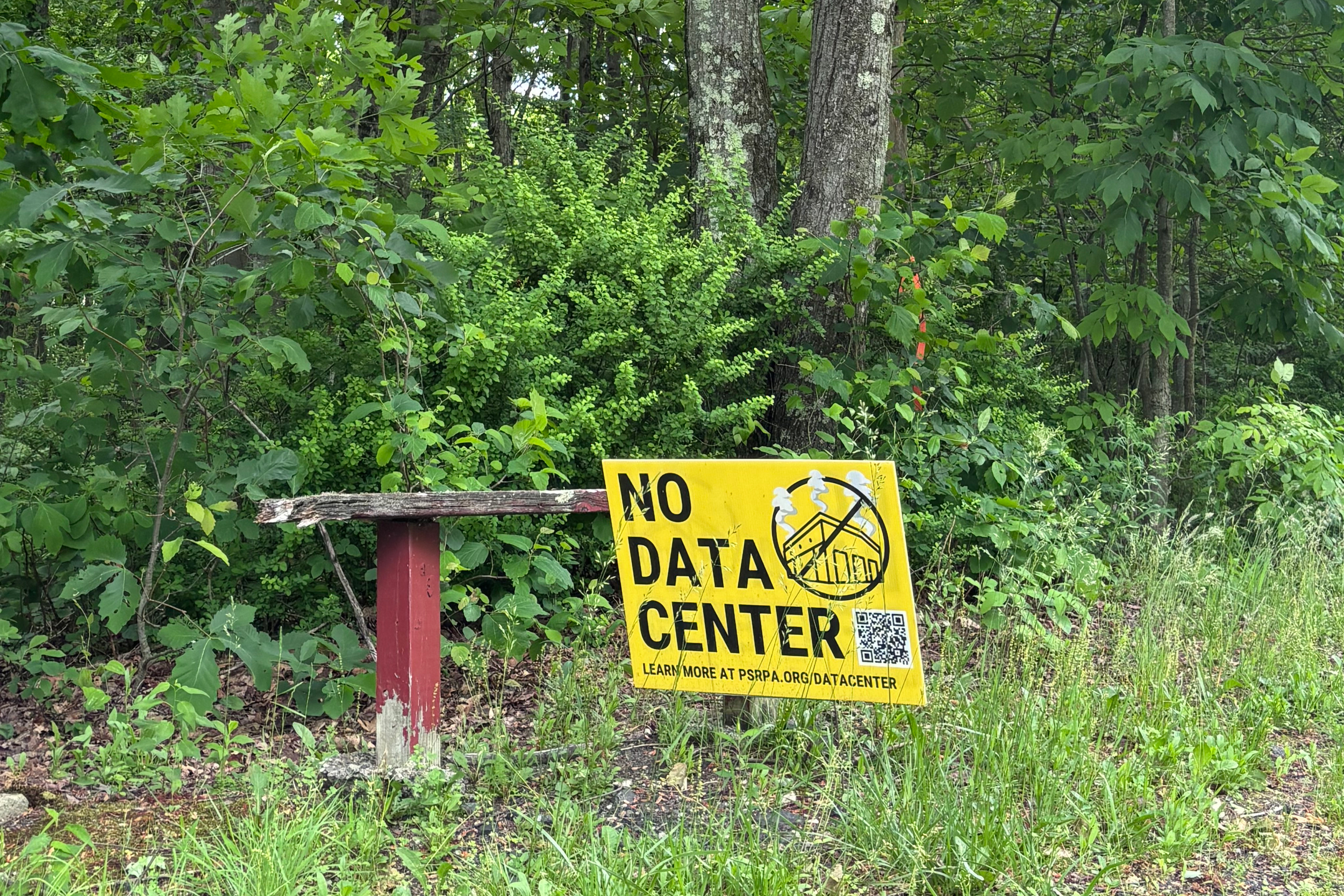
Muth’s bipartisan bill, co-sponsored by Sen. Rosemary Brown, a Republican, and Sen. Carolyn Comitta, a Democrat, would allow the state to research and implement better practices for where and how data centers are built. Muth’s bill and similar, less stringent, Republican-sponsored bills are part of a nationwide trend. Pennsylvania is one of 14 states with bills calling for a freeze in data center development. But for such a fast-moving industry, time is money.
“Statewide or local moratoriums on data centers would discourage investment and send a signal that Pennsylvania is closed for business,” Dan Diorio, vice president of state policy for the Data Center Coalition, an industry group, wrote in a statement to Inside Climate News. “Such a moratorium is concerning in light of all the significant benefits data centers provide to the communities where they operate.” Diorio said the benefits include significant economic investment, especially for rural areas.
In northeastern Pennsylvania, Amazon Web Services has committed to awarding $250,000 in community grants as part of its plan to invest $20 billion in data center expansion statewide. “When our data centers become part of local communities, they serve as catalysts for opportunity, sparking job creation, and propelling economic growth,” a spokesperson for Amazon Web Services said in a statement to Inside Climate News. “At Amazon, we take pride in being a good neighbor and using our scale and resources to strengthen communities where our employees live and work.”
But the facilities typically don’t employ many people after construction is done, and locals must weigh the tax revenue benefits against potentially high levels of water and energy use.
Residents say deals for these projects can mean rezoning farmland, clearing hundreds of acres of countryside, and constraining elected officials via non-disclosure agreements.
Community members worry that without guidelines in place, rushed development could hurt their health, disrupt their way of life and set back the local economy.
While Muth’s bill aligns with this growing grassroots movement, she says that a bipartisan majority of politicians in Harrisburg support the data center buildout.
“It is really disheartening to know that your government is using your money to promote the development of something that’s going to harm you,” Muth said. “They’re supposed to be there for the people, not for big tech bros.”
This story is funded by readers like you.
Our nonprofit newsroom provides award-winning climate coverage free of charge and advertising. We rely on donations from readers like you to keep going. Please donate now to support our work.
Donate NowSixty-three percent of Republicans and 75 percent of Democrats oppose local data center construction, according to a May Gallup poll. Americans are worried about the strain on the energy grid, the pollution from new on-site power plants and diesel backup generators, the usage of hundreds of thousands of gallons of water, and the constant noise from these facilities. Both Hazleton and the borough of McAdoo lean conservative in the broader swing region of northeastern Pennsylvania.
“It doesn’t matter whether you’re far left, far right, or anywhere in between, we are seeing people in these communities working together,” Food & Water Watch’s Marcille-Kerslake said.
Instead of a split along party lines, the fight over data center proposals is often between the people whose environment and energy bills are affected by the facilities and the corporations that stand to profit from them.
“I just don’t see anything that is positive about these data centers except for the people that are putting them in,” St. George said. “They’re the ones that are going to get rich and they’re not caring about the people that are living nearby.”
As the world shifts to make way for the generative AI boom, she’s demanding that the health and safety of communities come first. For St. George, it’s the matter of where and how they’re built that’s a heated debate, not whether they’re needed at all.
“I think that it’s very important to understand that we do need data centers. AI is the wave of the future,” St. George said after the Kline Township meeting. Data centers help power banking, air travel, online shopping and telehealth, according to the Data Center Coalition.
But bulldozing over local resistance to build them, Marcille-Kerslake worries, would result in a bleak future.
She’s visited Data Center Alley in northern Virginia, the world capital for data center buildout. Standing at the top of a parking garage in the suburb of Ashburn, she could see high-voltage cables strung over the streets and hear the unrelenting hum of hundreds of facilities. The view that met her was empty roads and warehouses as far as the eye could see.
“I just didn’t realize until I got there the general feel of the place, and dystopian is the word for it,” Marcille-Kerslake said. “It’s not a place you want to call home.”
“We Are Ready”
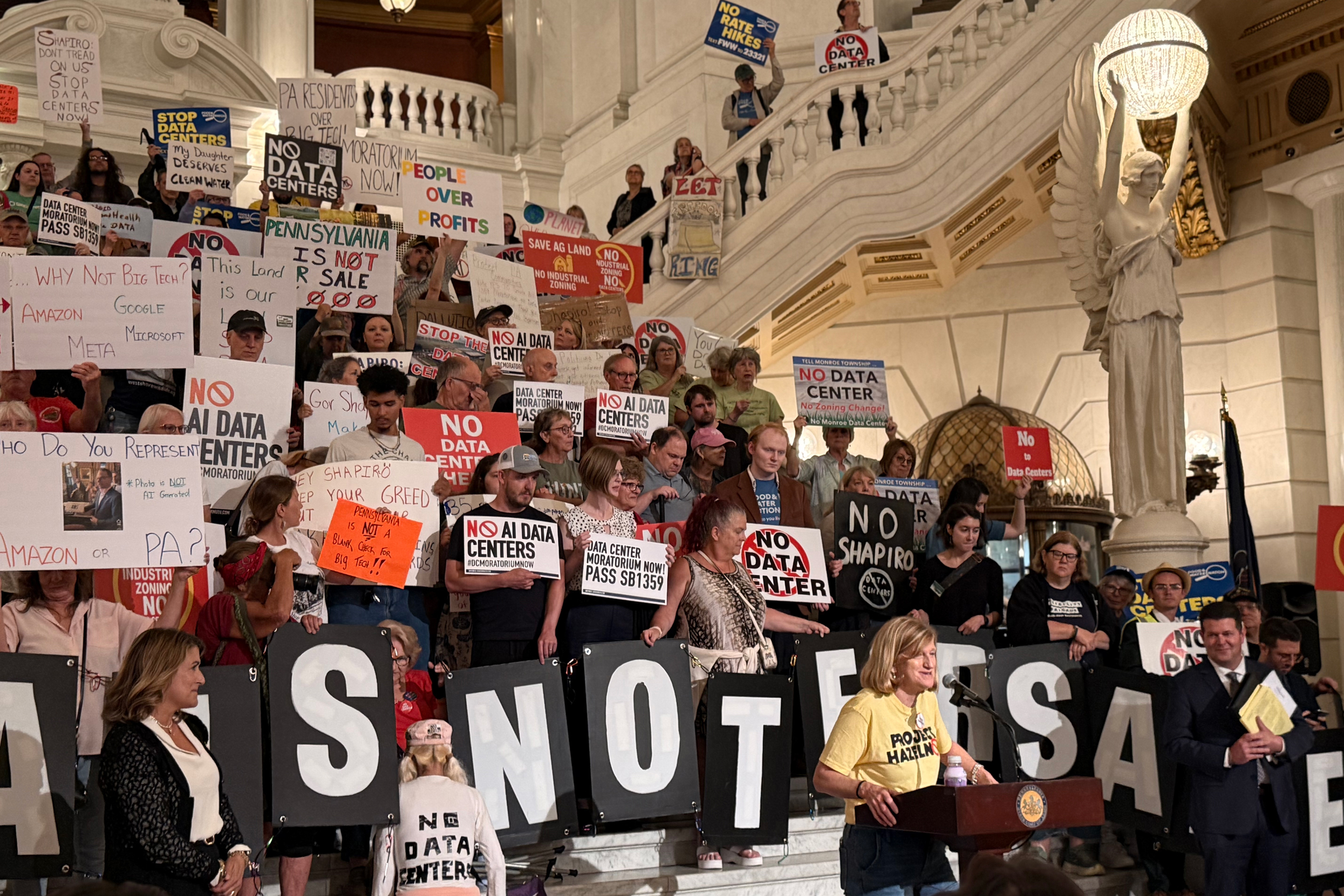
At a rally in Harrisburg last week for the moratorium bill, supporters spoke about reclaiming the future of Pennsylvania’s small towns from large-scale industry and returning it to the will of the people who live in them.
“The lesson of Pennsylvania’s history is clear: when government fails to ask hard questions at the beginning, communities pay the price for generations,” Muth, who introduced the bill, said at the rally. “We cannot afford to repeat those mistakes, not with our water, not with our air, not with our families and our communities and not with our future.”

A southwestern Pennsylvania resident, Megan McDonough, Pennsylvania state director at Food & Water Watch, said environmental harm has been an intergenerational problem for her and many in the state. “I know this playbook because I’ve lived it. My kids have lived it, and I’ll be damned if my granddaughter lives it,” she said.
She addressed the crowd of almost 200 organizers who, just over a year ago, had not heard of these proposals but have since filed right-to-know requests, prevailed in courts and pressured local governments to update regulations to reflect the new risks that data centers bring.
McDonough said they opposed secrecy and corruption, not progress.
“And this time we are ready,” she said. “We know their tactics, we know their lawyers, we know their lobbyists and we know their consultants. We know the language they use to make destruction sound harmless, and we know how to fight back.”
Wearing a yellow “Project Hazelnot” T-shirt, Annie Vinatieri, a resident of Luzerne County, took to the podium afterward to speak of what she has witnessed of the buildout in the countryside she calls home.
Vinatieri described seeing plywood covering the windows of houses, an abandoned chicken coop, an empty swing set and a “caution children at play” sign along the Susquehanna River, where a project bought out 96 landowners. In a window of one house was a note that recounted 55 years of memories.
Addressing the industry at the rally, Vinatieri said everything was on the line for those fighting for a moratorium. “Something dark has descended on our state and on my region,” she said. “It’s not just your business. It’s our lives.”
This article was updated on July 2, 2026, to correct a statement about how far Nate Eachus lives from Kline Township. It is 7 miles, not half a mile.
About This Story
Perhaps you noticed: This story, like all the news we publish, is free to read. That’s because Inside Climate News is a 501c3 nonprofit organization. We do not charge a subscription fee, lock our news behind a paywall, or clutter our website with ads. We make our news on climate and the environment freely available to you and anyone who wants it.
That’s not all. We also share our news for free with scores of other media organizations around the country. Many of them can’t afford to do environmental journalism of their own. We’ve built bureaus from coast to coast to report local stories, collaborate with local newsrooms and co-publish articles so that this vital work is shared as widely as possible.
Two of us launched ICN in 2007. Six years later we earned a Pulitzer Prize for National Reporting, and now we run the oldest and largest dedicated climate newsroom in the nation. We tell the story in all its complexity. We hold polluters accountable. We expose environmental injustice. We debunk misinformation. We scrutinize solutions and inspire action.
Donations from readers like you fund every aspect of what we do. If you don’t already, will you support our ongoing work, our reporting on the biggest crisis facing our planet, and help us reach even more readers in more places?
Please take a moment to make a tax-deductible donation. Every one of them makes a difference.
Thank you,

Nina Sablan
Fellow
Nina Sablan is a Pennsylvania-based fellow at Inside Climate News with a passion for local journalism, and environmental justice and law. She was previously a reporting intern for Seven Days in Vermont and is a current student at Swarthmore College, majoring in philosophy and minoring in peace and conflict studies in the honors program. Her work has appeared in The Philadelphia Inquirer, as well as campus publications at Oxford University and Swarthmore College.