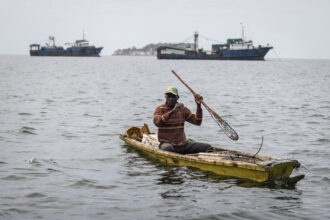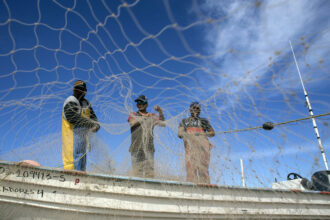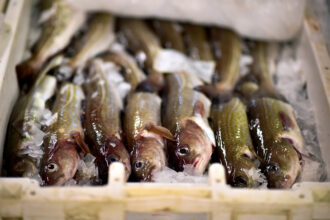
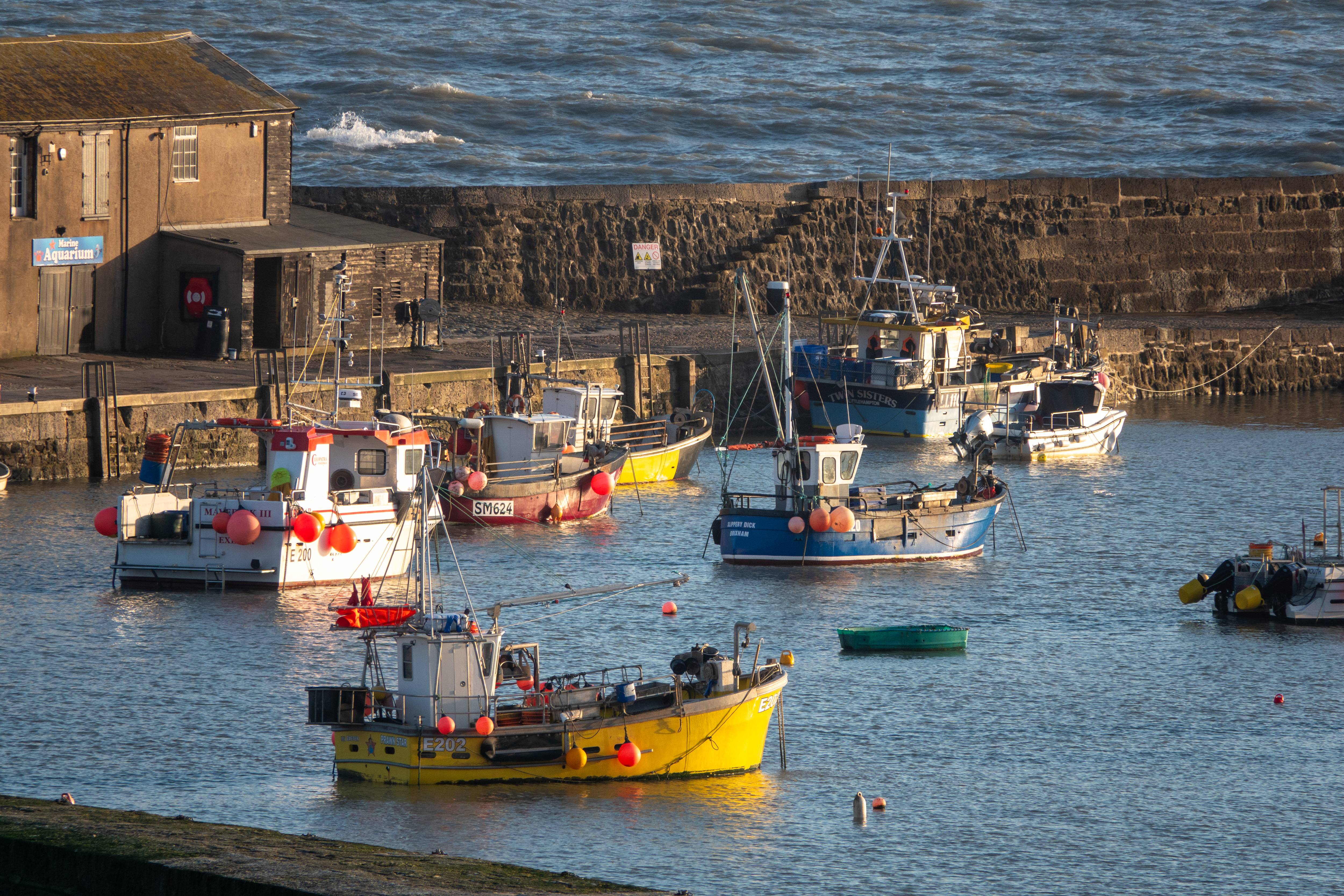


Regulations governing British fishing are supposed to keep it “environmentally sustainable in the long term.” But fish stocks in the United Kingdom are on the brink of collapse.
For those watching the industry closely, this is not a surprise: For decades, U.K. and European Union governments have regularly ignored fishing quota research recommendations. Almost 60 percent of all U.K. fish quotas set last year flouted scientific advice. Rather than sustainable management, governments are effectively overseeing their fishing industries’ slow-motion decline.
Some experts think a more robust conservation framework like the one operating in the United States could provide a model for solving this growing problem.
Despite sustained warnings by environmental nonprofits such as Greenpeace and Oceana, British fish stocks are collapsing at alarming rates, diminishing marine biodiversity and uprooting aquatic food chains as they drop.
Assessments by the International Council for the Exploration of the Sea (ICES)—whose data is used by the U.K. government to determine annual catch limits—are calling for a new zero-catch limit for well-loved species like Irish Sea plaice, while maintaining zero-catch warnings for already severely depleted stocks like Celtic Sea cod, whiting and haddock.
“If you replace the word cod with the word tiger, people would be outraged at the declines,” said Jonny Hughes, senior policy manager at Blue Marine Foundation, a British ocean conservation charity.
While ICES has recommended a zero-catch limit for Celtic Sea cod since at least 2020, the government established a bycatch quota of over 640 tons this year despite scientists projecting a total population of less than 590 tons.
Along England’s southern shores, adult cod populations have plummeted 99 percent since 2012 with the Marine Conservation Society warning British consumers to “completely avoid” all home-caught cod this spring.
“The fundamental problem is a weird belief that [governments] can negotiate with maths,” said Hughes, highlighting decades of “gross mismanagement” by successive U.K. and EU administrators who have prioritized short-term economic gain over long-term ocean health.
Last week’s reports also called for Irish Sea haddock quotas to be cut by 69 percent and North Sea whiting catch quantities to be halved.
Preventing stock collapse is not just about ensuring Brits can keep eating local fish and chips. Overfishing triggers knock-on consequences for wider marine ecosystems, severely disrupting predator-prey ratios. For example, historic overfishing of sandeels tanked seabird populations in Northern England, leading to their catch being banned in 2024.
“If you replace the word cod with the word tiger, people would be outraged at the declines.”
—Jonny Hughes, senior policy manager at Blue Marine Foundation
Tucked within the ICES reports is also a warning of a disastrous waste crisis plaguing regional flatfish fisheries. Across EU-U.K. waters, two-thirds of all plaice caught are being chucked back into the ocean. In the Irish Sea, six plaice are returned to the water for every one that ends up in the hold. Too small to sell, juvenile plaice often die on deck before being dumped back into the already decimated waters, severely hampering the species’ reproductive capacity.
When asked for comment, a spokesperson for Britain’s Department for Environment, Food and Rural Affairs told Inside Climate News: “We are committed to restoring our fish stocks to sustainable levels and supporting the long-term viability of the UK fishing industry.” The spokesperson said catch limits are set based on the “best available scientific advice, alongside balancing the social and economic impacts they have on the fishing industry.”
However, historic data shows otherwise: Since 2021, the U.K. has failed to align its catch limits with scientific recommendations for even half of all species quotas.
“Successive governments have not been willing to tell the fishing industry ‘no’, even though it’s, quantifiably, not in the fishing industry’s best interests to destroy [fish stocks],” said Hughes. “The fishing industry prioritizes making as much money as it can this year over any future scenario, and politicians don’t tend to last more than about 18 months in the fisheries department.”
While the U.K. Fisheries Act 2020 looks strong on paper, with a robust list of sustainability objectives at the start, later clauses relegate such targets to optional aims rather than legal requirements.
Unlike Britain, the U.S. has a structural backstop for its fisheries management regulations in the form of the 1976 Magnuson-Stevens Act. Eight regional fisheries management councils rely on Scientific and Statistical Committees to provide accurate data that forms a ceiling on catch limits.
While still susceptible to the will of industrial lobbying groups, the Act has proven largely effective in protecting fish stocks, according to Andrea Treece, the senior attorney in the Oceans Program at Earthjustice, an American environmental nonprofit.
This story is funded by readers like you.
Our nonprofit newsroom provides award-winning climate coverage free of charge and advertising. We rely on donations from readers like you to keep going. Please donate now to support our work.
Donate Now“There is some sense [in the U.S.] of not exchanging a short-term bonanza for long-term debt,” said Treece, who branded the U.K. system “a recipe for long-term pain.”
Even with this stronger law, however, fishing often occurs ahead of science in the U.S.: “A lot of the time, we don’t see the effects of fishing or maybe even understand the role of a particular fish in the ecosystem until we’ve vacuumed them out,” said Treece.
America’s Magnuson-Stevens Act tries to balance fish health with economic and social pressures of coastal communities, however: “The ecosystem’s going to lose out every time when you stack it up against money coming off the dock,” said Treece, highlighting the political difficulties of effective fisheries management on either side of the Atlantic.
The U.K.’s current fisheries minister, Stephen Morgan MP, has been in the post just over two weeks. With a change in government expected by mid-July, the U.K. might soon endure its fourth fisheries minister in a single year. It’s the kind of short-termism that leaves Blue Marine Foundation’s Jonny Hughes pessimistic about the future.
“There’s not a lot of good news in [the report],” said Hughes. “And what worries me the most is the fact it’s going to be worse next year, because the fundamental problems are not remotely close to being solved.”
About This Story
Perhaps you noticed: This story, like all the news we publish, is free to read. That’s because Inside Climate News is a 501c3 nonprofit organization. We do not charge a subscription fee, lock our news behind a paywall, or clutter our website with ads. We make our news on climate and the environment freely available to you and anyone who wants it.
That’s not all. We also share our news for free with scores of other media organizations around the country. Many of them can’t afford to do environmental journalism of their own. We’ve built bureaus from coast to coast to report local stories, collaborate with local newsrooms and co-publish articles so that this vital work is shared as widely as possible.
Two of us launched ICN in 2007. Six years later we earned a Pulitzer Prize for National Reporting, and now we run the oldest and largest dedicated climate newsroom in the nation. We tell the story in all its complexity. We hold polluters accountable. We expose environmental injustice. We debunk misinformation. We scrutinize solutions and inspire action.
Donations from readers like you fund every aspect of what we do. If you don’t already, will you support our ongoing work, our reporting on the biggest crisis facing our planet, and help us reach even more readers in more places?
Please take a moment to make a tax-deductible donation. Every one of them makes a difference.
Thank you,

Johnny Sturgeon
Fisheries Reporter
Johnny Sturgeon is a London-based reporter covering fisheries and aquaculture. Joining us from the Outlaw Ocean Project, he has experience producing in-depth maritime investigations for nonprofit newsrooms. A former boatbuilder, he holds a B.A. in History & Politics from the University of Oxford, and an M.S. from Columbia Journalism School.