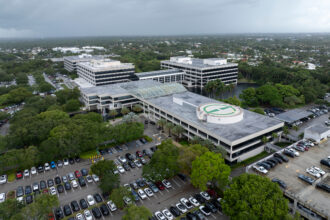


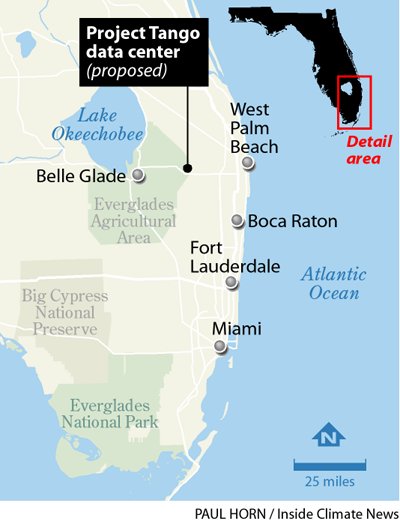
On a stretch of former farmland near the eastern edge of the Everglades, about 1,250 feet from a two-year-old elementary school, one of the region’s largest artificial-intelligence data centers could rise.
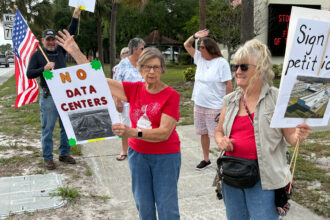
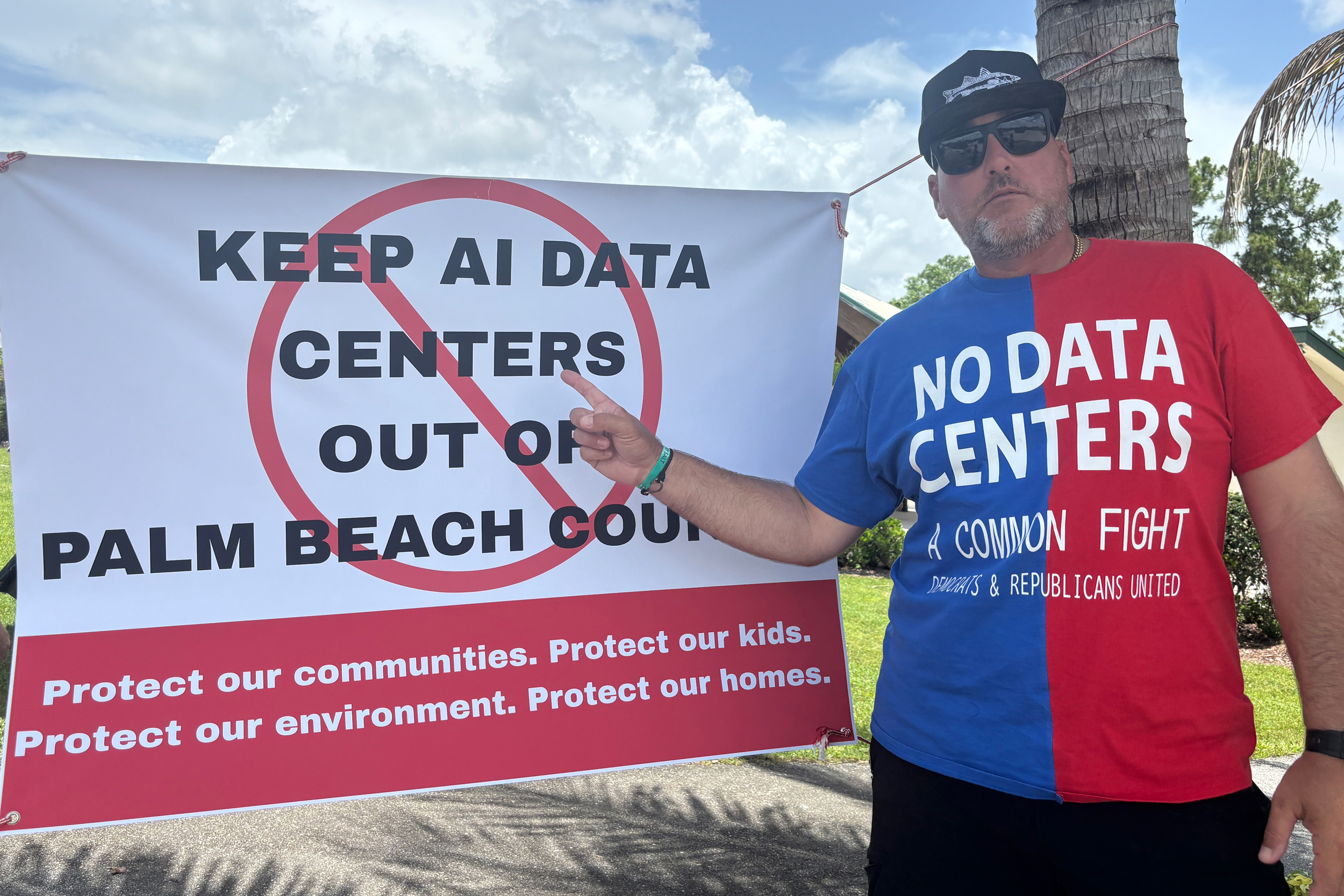
On July 15, Palm Beach County commissioners will take a final vote on Project Tango, a hyperscale AI campus proposed for a 202-acre site north of Southern Boulevard. The commissioners will decide whether to let the developer amend its approved master site plan to build the AI campus—a request that wouldn’t rezone the land, but would transform what gets built on it. On July 2, after a hearing at which 39 residents spoke against it, the county’s zoning commission voted 6-0 to urge county commissioners to deny the project—breaking with planning staff, who had recommended approval.
At the center of the fight is a question the county has never had to answer: What, exactly, is a hyperscale AI data center, and what would it do to the water, the air and the children next door?
When the county approved this land for development in 2016, it was zoned as an “employment center” of warehouses and a 206,000-square-foot server farm, a use the code treats as light industrial. Hyperscale AI data centers did not yet exist.
In November 2025, the developer, PBA Holdings, filed to amend that plan. The total footprint would stay roughly the same—about 3.6 million square feet—but the mix would change fundamentally: Warehouse space would shrink, and the data center would grow nearly fivefold, to 1 million square feet, to house a hyperscale AI campus. Opponents estimate the campus could draw more than 600 megawatts of electricity; by their calculation, that’s more than 17 times the power of the largest traditional data center in Florida.
Opponents, led by the environmental law group Earthjustice, on behalf of the grassroots Western Palm Beach Community Alliance, argue the county cannot legally call that light industrial. The county’s comprehensive plan defines light industrial as uses that don’t send “noise, vibration, light” beyond their property lines. Heavy industrial, barred on this site, covers uses that “may cause or result in” exactly those effects. A facility running around the clock on industrial cooling and backup generators, they contend, is heavy industrial by the county’s own definition.
The campus would be powered from the grid. The developer says it has a binding power service agreement with Florida Power & Light, whose 3,750-megawatt West County Energy Center—one of the largest natural gas plants in the country—sits directly across the canal. On its project website, PBA says on-site backup generation likely won’t be needed, and that if it is, it would run on batteries or natural gas rather than diesel. Opponents dispute that, pointing to the weekly generator testing typical of hyperscale facilities.
They also point to the developer’s own words. In its application to the county, PBA described the cooling systems, backup power and electrical infrastructure as “ancillary features”—while the same application elsewhere calls that same equipment “integral” and “needed to power and cool the data center.” It cannot be both, opponents say.
The proposed data center would sit at a hydrologically sensitive spot. The site and the surrounding region’s stormwater drains into the L-12 canal, which the Friends of the Arthur R. Marshall Loxahatchee National Wildlife Refuge told county planners in a December letter “is one of the primary sources of freshwater flow from north to south through the Refuge,” a 145,000-acre stretch of Everglades habitat. That makes “any discharges of coolant water,” the group wrote, “of particular, high-level concern to this sensitive wetland ecosystem.”
The stakes extend beyond wildlife. The Everglades isn’t just a wetland, but also a water supply. Rain filtering through its marshes recharges the aquifers that provide drinking water for roughly one in three Floridians, and the state has spent decades and billions of dollars building the canals, reservoirs and treatment areas—the same system the site drains toward—to keep that water clean.
The county itself once drew the same line. In 2016, planning staff wrote that heavy industrial uses were precluded here “given the site’s close proximity to the L-8 canal … as well as the C-51 canal and the water conservation stormwater treatment areas,” the infrastructure built to clean water for the Everglades.
How much water Project Tango would use, and where its waste would go, remains unclear. PBA says the facility would draw about 5,000 gallons of potable water a day, mostly for employee use, and rely on a recirculating “closed-loop” cooling system. Yet the plans also include a 20,000-square-foot on-site water treatment building, and the county’s December staff report concedes the cooling method has “not been determined.” An earlier version of the company’s proposal contemplated evaporative cooling, which consumes far more water. Commissioners will vote without a settled answer.
The agency that regulates the region’s water, meanwhile, has seen nothing. As of July 10, the South Florida Water Management District said it “has not received any consumptive use or [environmental resource] permit applications for Project Tango.” A state law that took effect July 1 requires the district’s governing board to hold a hearing before issuing a water permit to a data center with a peak demand of at least 50 megawatts—a threshold Project Tango would far exceed—and because no application has been filed, that hearing has not occurred.
This story is funded by readers like you.
Our nonprofit newsroom provides award-winning climate coverage free of charge and advertising. We rely on donations from readers like you to keep going. Please donate now to support our work.
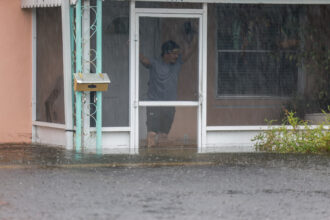
Donate NowWho would bear the risk is not evenly distributed. Arden, the master-planned neighborhood beside the site, and nearby Westlake draw treated county water. But much of the surrounding rural area—The Acreage, Loxahatchee, Loxahatchee Groves—relies on private wells tapping a shallow aquifer.
“Almost all of this area of Northwest Palm Beach County is on well water,” said Ben Brown, an Arden resident who has helped lead the opposition, describing the prospect of the aquifer being drained or contaminated as an urgent worry. Those residents, who are generally older and less affluent than those living in the newer communities, would have no buffer if the water table dropped.
Rachel Smith, who built the opposition coalition’s website and relies on a private well herself, shares that fear. The company has not said how it would dispose of cooling wastewater, leaving residents afraid of the potential outcomes. “I’m on a well,” she said. “If the aquifer were to get contaminated due to potential deep-well injection, I’m out of luck.”
The project’s economic promise is contested, too. Publicly, developer Ernie Cox has said Project Tango would create 500 to 600 permanent jobs. But in its zoning application, PBA argued for a reduced-parking variance on the grounds that the facility would have “a much lower employee count” and a “low number of employees,” and county staff agreed it “will not require an extensive number of employees.” Research has repeatedly found data centers generate few permanent jobs relative to their cost. An analysis by the advocacy group Food & Water Watch estimated that as few as 23,000 people nationwide held a permanent data center job in 2024, and found that data centers built in Virginia since 2020 have created roughly one permanent job for every $54 million invested.
PBA says the criticism is misplaced. The land was zoned for industrial and data uses years before Saddle View Elementary opened, its representatives note, and the site already sits in an industrial corridor beside a Florida Power & Light gas plant and an active rock mine. Cox has said publicly that the project would deliver hundreds of millions of dollars a year in tax revenue and that its scaled-back, closed-loop design limits its footprint.
PBA Holdings, Cox and its land-use attorney, Joseph Verdone, did not respond to written questions about the facility’s cooling method, water source, employment figures or land-use classification before publication.
Project Tango lands amid a statewide backlash to data center development. At least 10 local governments in Florida have passed moratoriums, and three counties have rejected projects outright. The issue has reached the Republican primary for governor, where at a July debate two of the three candidates onstage called for stopping Project Tango. Former Florida House Speaker Paul Renner vowed to call a special session to stop hyperscale projects and businessman James Fishback promised to “ban every data center in all 67 counties.” The race’s frontrunner, U.S. Rep. Byron Donalds, who skipped the debate, supports the industry’s expansion, saying data centers “are going to be a function of American life going forward.”
For the families near the site, the July 15 vote is a more immediate concern. Brown measures it in his children’s days. Whatever the data center brings, he said, they would “never get any respite or break from this … It will be all day long—at school, outside at recess [and when] they come home.”
About This Story
Perhaps you noticed: This story, like all the news we publish, is free to read. That’s because Inside Climate News is a 501c3 nonprofit organization. We do not charge a subscription fee, lock our news behind a paywall, or clutter our website with ads. We make our news on climate and the environment freely available to you and anyone who wants it.
That’s not all. We also share our news for free with scores of other media organizations around the country. Many of them can’t afford to do environmental journalism of their own. We’ve built bureaus from coast to coast to report local stories, collaborate with local newsrooms and co-publish articles so that this vital work is shared as widely as possible.
Two of us launched ICN in 2007. Six years later we earned a Pulitzer Prize for National Reporting, and now we run the oldest and largest dedicated climate newsroom in the nation. We tell the story in all its complexity. We hold polluters accountable. We expose environmental injustice. We debunk misinformation. We scrutinize solutions and inspire action.
Donations from readers like you fund every aspect of what we do. If you don’t already, will you support our ongoing work, our reporting on the biggest crisis facing our planet, and help us reach even more readers in more places?
Please take a moment to make a tax-deductible donation. Every one of them makes a difference.
Thank you,

Kate Waxman
Fellow
Kate Waxman is a Florida-based Outrider fellow at Inside Climate News, where she covers climate injustice across the state. She earned her M.S. in journalism from Columbia Journalism School and her B.A. in environmental science from Barnard, with reporting focused on coral reefs, climate science, and the communities closest to the water.