

Forecasts of U.S. data center growth defy belief—and common sense.
“The math isn’t mathing,” as many observers have said.
Growth forecasts continue to climb, but there is little evidence that AI data center developers have profitable, sustainable business models. And nearly every major project is facing local opposition over concerns about land, power and water use.
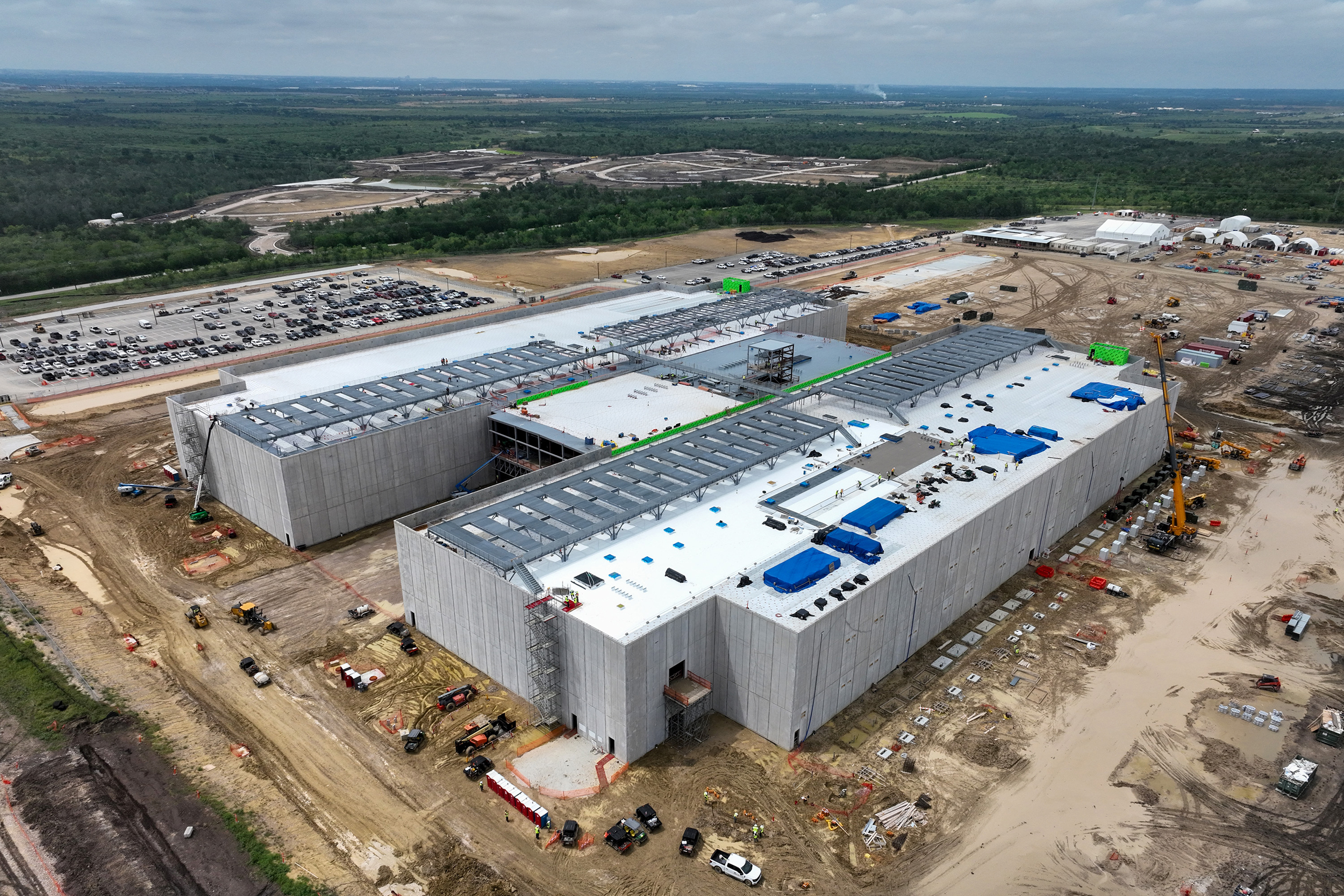
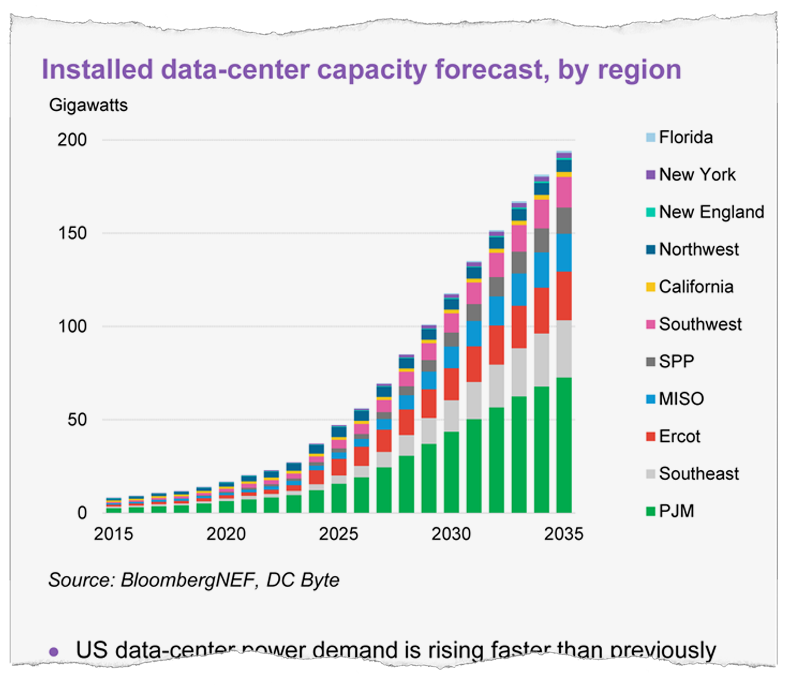
On Tuesday, BloombergNEF revised its estimate for data center electricity demand to 194 gigawatts by 2035, an 83 percent increase from its estimate six months ago. Under this model, data centers would use about 20 percent of the country’s electricity, up from 5.9 percent today. For context, the U.S. industrial sector—essentially all factories for all industries—used 25.7 of electricity last year.
To have data centers responsible for such a large share of projected growth is … well, “insane” is the first word that comes to mind.
There are three main reasons why I am skeptical of the growth forecasts:
- The AI data center business model is a work in progress. One recent example comes from an AdWeek report showing OpenAI is on track to fall short of its advertising revenue target by about 90 percent. AI companies will need hundreds of billions in revenue to cover costs, and it’s not clear where that money will come from.
- Voters loathe data centers. It’s easy to see why the public is wary of gigantic, noisy developments that consume massive amounts of power and water and require few people—so few jobs—to operate. Almost every state has projects that turned into a quagmire of local protest. One such story can be found in Janesville, Wisconsin, where an attempt to redevelop a former General Motors factory site for a data center was rejected by city officials in response to public concerns, as reported by The (Janesville) Gazette. And, voters who oppose data centers will elect like-minded leaders, as happened this year in Janesville and elsewhere in the state, according to Wisconsin Public Radio.
- The country will struggle to add enough power plants to serve such a large increase in electricity demand. The system has several impediments to growth on this scale, including long waits for new power plants to obtain grid connections and the related concern that there aren’t enough transmission lines to handle a substantial increase. PJM Interconnection, the country’s largest regional grid, is among those struggling to respond, with Joseph Bowring, PJM’s independent market monitor, saying this week that the grid’s managers don’t completely grasp the paradigm shift created by data centers, according to Utility Dive.
To help make sense of this moment, I spoke with Marc Conte, a Fordham University economist whose research explores the environmental effects of AI tools and data centers. Fordham is in the Bronx, New York, where the state government last week was the first in the country to adopt a moratorium on data center development.
Conte said the race to develop data centers is being described by the companies and the Trump administration as part of competition between the United States and China. He thinks the more consequential race is between AI companies, and they want to curry favor with the government to try to gain an advantage.
The companies “don’t have time to follow the standard procedures,” Conte said. They also may overstate the tax benefits of data centers to increase the speed of project approval.
“In many ways, this is like the quandary that local municipalities, who are desperate for revenue, face when a professional sports team talks about building a new arena,” he said. “It’s pitched as a huge influx of future tax revenues.” AI companies, like the team owners, often ask for a big tax rebate in advance.
He noted that many of the largest developers are using their lobbying experience to try to speed up the construction process, which might include looking for shortcuts and cozying up to political leaders.
Tech companies with AI aspirations, such as Meta and Microsoft, contributed to funding for the White House ballroom and also have been lobbying for relief from regulations, such as Section 404 of the Clean Water Act, because developers don’t want to be slowed down by laws designed to protect nearby waterways.
This isn’t going to endear the companies to the public.
“We are seeing communities realize that there are a number of costs to society that the firms are not taking into account, which may require them to change their behavior in costly ways,” Conte said. So, he sees a possibility “for a delay in the expansion of AI that these firms may not have predicted.”
This story is funded by readers like you.
Our nonprofit newsroom provides award-winning climate coverage free of charge and advertising. We rely on donations from readers like you to keep going. Please donate now to support our work.
Donate NowThe growth of data centers is an opportunity for renewable energy companies, as it is for anyone selling electricity. But much of the initial investment is in dirtier, less efficient options that can come online faster, as Elon Musk is doing with his notorious xAI developments in Tennessee and Mississippi.
In a briefing held on Wednesday, BloombergNEF analysts explained how they are assessing the uncertainty that could lead to gaps between forecasts and actual results.
Nathalie Limandibhratha, a co-author of this week’s report, displayed a slide showing a gap of about 100 gigawatts between forecasts from various firms. For perspective, the country currently has 98 gigawatts of nuclear power capacity. This is “quite significant uncertainty,” she said.
She said public opposition is a factor, but not a major one so far, with 20 data centers canceled this year compared to a much larger number that continue to move forward.
One challenge is that the majority of the new project capacity is in an early stage of development, with few details available. Also, many of the companies doing projects have no experience with building data centers, said Lloyd Arnold, a co-author of the report.
“That doesn’t mean there will be more cancellations, but it does raise execution risks,” Arnold said.
It will be telling to see what these forecasts look like a year from now and two years from now, when the effects of public opposition are clearer and AI companies have had more time to show how their data center investments can generate profits.
Other stories about the energy transition to take note of this week:
States Are Making It Harder to Save Money With Solar Panels: Policy changes across many states are leading to a shift away from net metering for rooftop solar, a policy that reimburses solar owners for sending excess electricity back to the grid. Instead of paying consumers the full retail rate or something close to it for excess electricity, states and utilities are now paying much less in many cases, as Francesca Paris reports for The New York Times. This story is a useful, data-driven explainer of net metering and the true costs of the policy changes.
Tesla Falls Short of Earnings Expectations: Tesla reported earnings that were less than analysts expected, but the company exceeded expectations on revenue, as Lora Kolodny reports for CNBC. Revenue from the company’s automotive segment, which is its largest, increased 23 percent compared with the same quarter a year earlier, though the average selling price of its vehicles declined. Tesla is the leading EV manufacturer in the United States, and has seen its sales battered by a variety of factors, including a downturn in U.S. sales and public disapproval of close ties between CEO Elon Musk and President Donald Trump.
States Are Teaming With Industry in Lawsuit to Stop Trump Obstruction of Wind Projects: A coalition of 18 states and Washington, D.C., has joined with clean energy industry groups in a lawsuit challenging the Trump Administration’s actions that have delayed permits for more than 150 onshore wind farms, as Dan McCarthy reports for Canary Media. The delay is due to the Department of Defense not issuing national security approvals for projects, a step that used to be routine for most applicants.
Longi Sets a New Record for Solar Panel Efficiency: Longi, the Chinese manufacturer of solar panels, announced that its new photovoltaic cell has a power conversion efficiency of 35.5 percent, a record for a silicon-perovskite tandem solar cell, as Vincent Shaw reports for PV Magazine. A solar panel is made up of many cells. The result was verified by an independent testing body in Europe. While this cell isn’t available for commercial use, its development shows the opportunity to continue to increase the amount of energy that solar panels can generate.
Energy and Climate Researchers Need to Emphatically Call for a Fossil-Fuel Phaseout: Emily Grubert, a sustainable energy professor at the University of Notre Dame and a frequent interview subject for this newsletter, has a new opinion piece in Environmental Resource Letters in which she calls for researchers to clearly communicate that the main solution to climate change is to phase out fossil fuels. Chris Nelder, writing on his Transition Times website, has a thoughtful commentary on Grubert’s argument, agreeing with her and providing useful context for why climate modeling and communication have often fallen short of the challenge at hand.
Inside Clean Energy is ICN’s weekly bulletin of news and analysis about the energy transition. Send news tips and questions to [email protected].
About This Story
Perhaps you noticed: This story, like all the news we publish, is free to read. That’s because Inside Climate News is a 501c3 nonprofit organization. We do not charge a subscription fee, lock our news behind a paywall, or clutter our website with ads. We make our news on climate and the environment freely available to you and anyone who wants it.
That’s not all. We also share our news for free with scores of other media organizations around the country. Many of them can’t afford to do environmental journalism of their own. We’ve built bureaus from coast to coast to report local stories, collaborate with local newsrooms and co-publish articles so that this vital work is shared as widely as possible.
Two of us launched ICN in 2007. Six years later we earned a Pulitzer Prize for National Reporting, and now we run the oldest and largest dedicated climate newsroom in the nation. We tell the story in all its complexity. We hold polluters accountable. We expose environmental injustice. We debunk misinformation. We scrutinize solutions and inspire action.
Donations from readers like you fund every aspect of what we do. If you don’t already, will you support our ongoing work, our reporting on the biggest crisis facing our planet, and help us reach even more readers in more places?
Please take a moment to make a tax-deductible donation. Every one of them makes a difference.
Thank you,

Dan Gearino
Reporter, Clean Energy
Dan Gearino covers the business and policy of renewable energy and utilities, often with an emphasis on the midwestern United States. He is the main author of ICN’s Inside Clean Energy newsletter. He came to ICN in 2018 after a nine-year tenure at The Columbus Dispatch, where he covered the business of energy. Before that, he covered politics and business in Iowa and in New Hampshire. He grew up in Warren County, Iowa, just south of Des Moines, and lives in Columbus, Ohio.