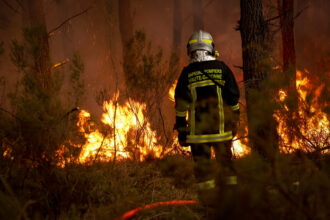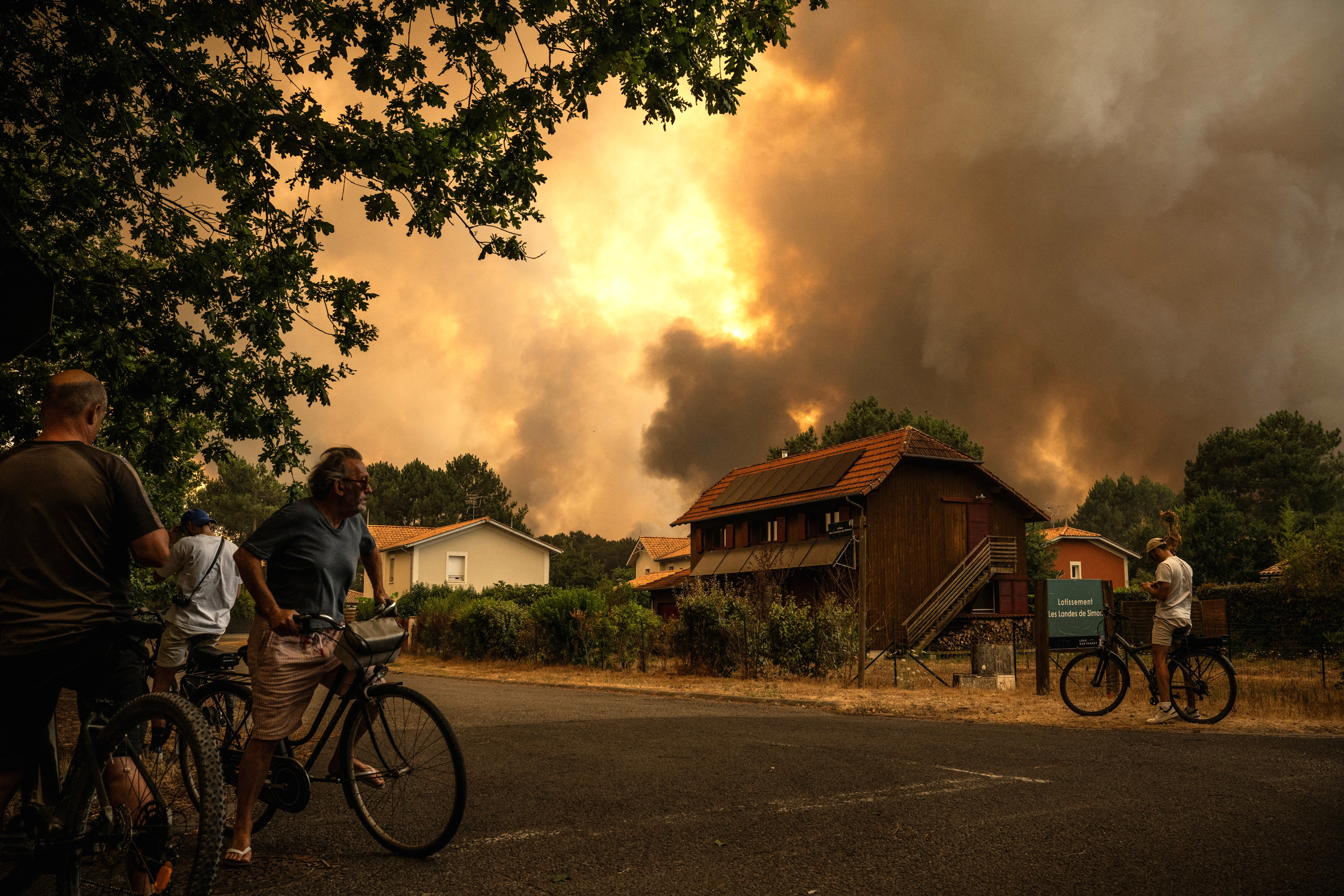


Wildfires in Europe could burn across about 39 percent more land by the end of the century, even if greenhouse gas emissions decline rapidly over the next few decades, new research shows. With continued high emissions, the burned area could increase as much as 192 percent.
Emissions reductions are the key to reducing wildfire impacts, the study, published Thursday in Global Change Biology, concluded. Improvements in fire prevention, early detection and firefighting could help limit the damage, but ultimately, Europe can’t fight its way out of a worsening climate, the authors warned.
“Our results indicate there could be widespread increases in burned area even under comparatively low warming of around 1.8 degrees Celsius (3.24 degrees Fahrenheit),” said lead author Maik Billing, a researcher at the Potsdam Institute for Climate Impact Research. With more warming, wildfires become more prevalent around the Mediterranean and across much of Western and Central Europe, “including areas that to date have not experienced many fires,” he said.
It’s clear that human-caused global warming, mostly from burning fossil fuels, is driving the fire risk, said co-author Matthew Forrest, a researcher at Senckenberg Society for Nature Research.
“We’re already seeing fires in places we haven’t seen before, and of a size and intensity that we haven’t seen before,” Forrest said. “And we’re seeing tremendous fires even in countries which are in principle well prepared, but where they just can’t cope. We can do a lot to stop it, but we can’t stop it completely.”
The fact that wildfires have been rare in Central Europe has fostered complacency, he said, adding that global warming, drier summers and forestry practices like planting tree plantations of Norway spruce are changing the equation and pushing wildfires into “unexplored territory.”
“We need action on both fronts. We need to bring down our emissions to reduce the climate risk … and we need to keep investing in fire management and in landscape management,” he said.
In addition to projecting larger wildfire scars due to changing weather and fuel conditions, the study also modeled the effects of human action to prevent, detect and fight fires in a world with higher temperatures. Sustained investments in wildfire management, training, equipment and international coordination have the potential to reduce burned area by 92 percent in a low-emissions future, and by 72 percent with continued high emissions and more drastic warming.
But the authors cautioned that their findings may overstate the effectiveness of fire management.
“If fires become really extreme, our ability to contain them might break down, and we do not know yet where this point is,” said co-author Thomas Hickler, vice-director of the Senckenberg Biodiversity and Climate Research Centre. “The recent record fires in France clearly show that we cannot simply extrapolate from the experiences of the past,” he said.
The question is whether Europe can adapt faster than its fire climate is changing. The paper suggests there is still time to act, but that the window is narrowing as the climate warms, roughly twice as fast in Europe as the global average.
This summer’s wildfires have burned across more than 2,000 square miles, more than double the 20-year average, and caused more than $3.5 million in damage, according to a Financial Times estimate. Copernicus, the European Union’s climate change service, has estimated that millions of people in Europe have been exposed to unhealthy levels of wildfire smoke this summer.
Through mid-August, about 300,000 people had been evacuated as wildfires burned from forest and brushlands into towns in France and Croatia. In mid-July, a fire in the normally cool and moist mountains of northern Scotland devastated protected ecosystems and threatened rare species. Another unusual fire is currently burning in Belgium, where the hot, dry summer dried fen wetlands.
Co-author Kirsten Thonicke, an Earth scientist with the Potsdam Institute for Climate Impact Research, said this summer’s fires in France, Spain and Greece revealed how quickly the limits of firefighting capacity can be reached.
“With climate change, conditions could become so extreme that we really hit limits to what we can do to prevent and fight fires once they get to a certain size,” Thonicke said. “So, reducing emissions is absolutely essential, together with strengthening local fire management.”
About This Story
Perhaps you noticed: This story, like all the news we publish, is free to read. That’s because Inside Climate News is a 501c3 nonprofit organization. We do not charge a subscription fee, lock our news behind a paywall, or clutter our website with ads. We make our news on climate and the environment freely available to you and anyone who wants it.
That’s not all. We also share our news for free with scores of other media organizations around the country. Many of them can’t afford to do environmental journalism of their own. We’ve built bureaus from coast to coast to report local stories, collaborate with local newsrooms and co-publish articles so that this vital work is shared as widely as possible.
Two of us launched ICN in 2007. Six years later we earned a Pulitzer Prize for National Reporting, and now we run the oldest and largest dedicated climate newsroom in the nation. We tell the story in all its complexity. We hold polluters accountable. We expose environmental injustice. We debunk misinformation. We scrutinize solutions and inspire action.
Donations from readers like you fund every aspect of what we do. If you don’t already, will you support our ongoing work, our reporting on the biggest crisis facing our planet, and help us reach even more readers in more places?
Please take a moment to make a tax-deductible donation. Every one of them makes a difference.
Thank you,

Bob Berwyn
Reporter, Austria
Bob Berwyn is an Austria-based reporter who has covered climate science and international climate policy for more than a decade. Previously, he reported on the environment, endangered species and public lands for several Colorado newspapers, and also worked as editor and assistant editor at community newspapers in the Colorado Rockies.