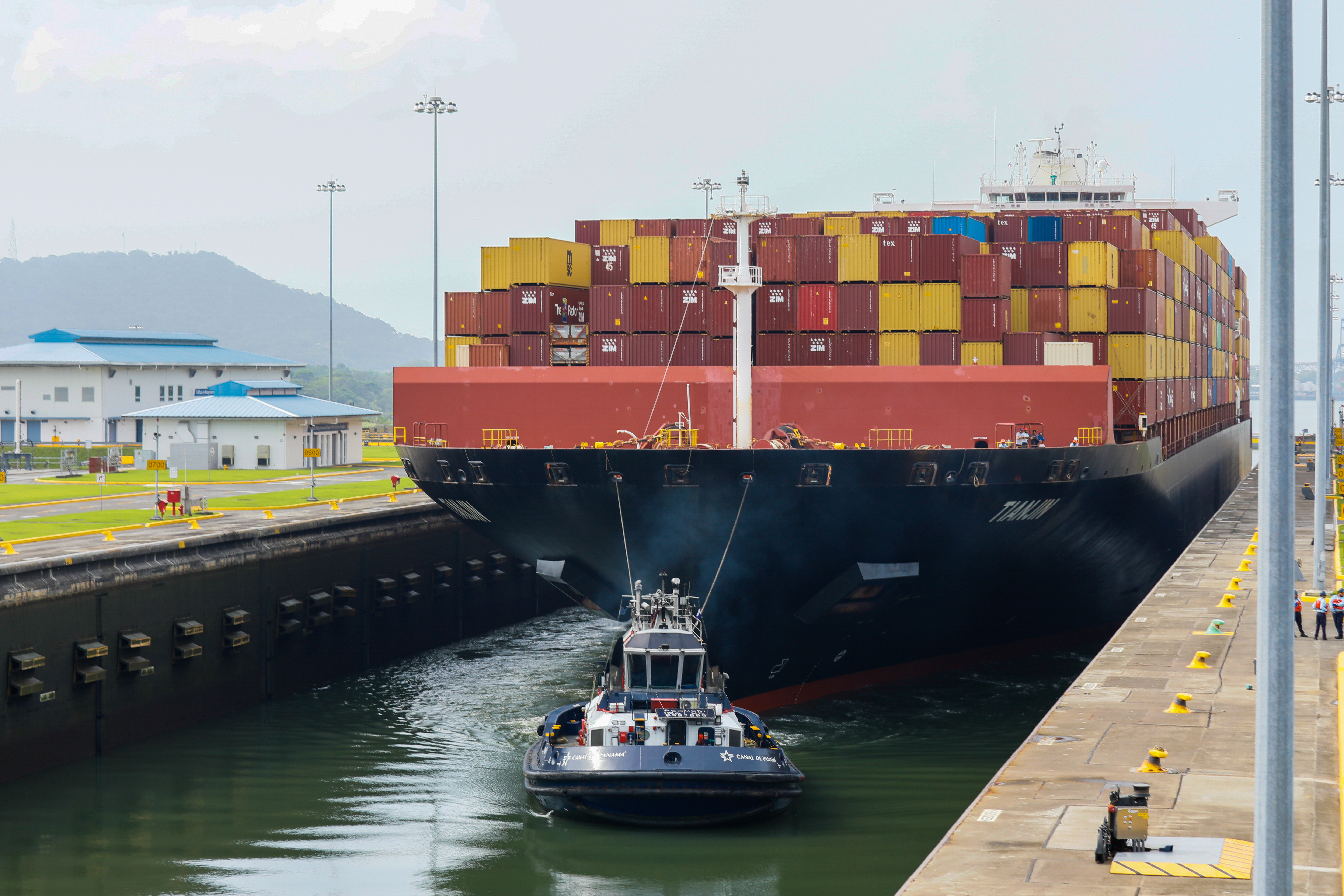


One of the world’s most-used shortcuts is at risk as a severe drought plagues Central America.
Starting in early September, the Panama Canal will reduce the number of ships allowed to pass through each day due to low water levels in the artificial lakes that feed the lock system. Experts say the reason for the water shortage is largely the El Niño weather pattern, which typically brings dry spells to Central America.
Connecting the Atlantic and Pacific Oceans, the Panama Canal handles 5 percent of global maritime trade and about 40 percent of all U.S. container traffic. But this marine thoroughfare—already seeing more traffic amid conflict in the Strait of Hormuz—may soon transform into a choke point, with ships waiting longer and carrying less cargo to accommodate restrictions.
It’s not the first time this has happened, and it’s very unlikely to be the last, particularly as research shows climate change further stoking drought in this region. While the Panamanian government and shipping companies try to adapt, consumers may be forced to pay the price. Experts expect this situation will increase costs associated with shipping goods worldwide.
El Niño Hits the Panama Canal
For more than a century, the Panama Canal has essentially acted as a giant elevator across the continental divide. Supplied by the Gatún Lake and another artificial reservoir, a series of locks fill with freshwater to raise a ship to the next level when ascending, then drain it to lower the vessel on the way down. The water is eventually released into the ocean.
Since the locks rely on water to buoy the boats, drought is a big problem—especially because it’s not the only system depending on this resource, said Samuel Muñoz, an associate professor at Northeastern University. The reservoirs also support other systems, such as hydropower generation, and provide drinking water for roughly 2 million people—nearly half of Panama’s population.
“When water levels get too low in those reservoirs, they have to restrict the number of ships that go through because they want to conserve water for those other uses that are also critical,” Muñoz told me.
In May, the Panama Canal Authority said it was not planning vessel passage limits in 2026 despite El Niño, Reuters reports. But last week, the agency backpedaled, announcing that starting Sept. 3, the canal will reduce traffic from 36 to 34 vessels daily, and introduce the equivalent of weight limits to lighten the loads on the locks. Operators will further decrease traffic to 32 vessels by Sept. 15.
Vessel congestion has already surged in the region following disruptions in the Strait of Hormuz, a key shipping route embroiled in conflict amid the Iran War. The Panama Canal’s deputy administrator, Ilya Espino de Marotta, said in May that the resulting rise in demand increased average auction prices to pass through the lock system without a pre-booked reservation from about $100,000 to about $380,000.
Earlier in August, dozens of vessels clogged the area around the Panama Canal while waiting for their turn to pass, with one ship paying $4 million to hop the line, CNN reports. These delays and reduced shipping loads could have profound impacts on shipping companies’ costs, which would trickle down to consumers, experts say. The longer wait times are especially risky for goods that aren’t shelf stable, such as fruits, meats and certain pharmaceuticals, which may force companies to pay higher fees to pass or seek alternative—and more costly—methods of transport.
“The ripple effects are significant through supply chains and all the way to consumer prices at stores,” Benjamin Gedan, senior fellow and director of the Latin American program at the nonpartisan think tank Stimson Center, told CNN.
More Droughts Ahead
It’s not the first time the Panama Canal has been forced to slash ship traffic. In early 2023 through mid-2024, Panama experienced one of its worst-ever droughts, also exacerbated by an El Niño event.
Operators reduced ship traffic to even lower levels than they are now, resulting in weeks-long wait times to cross, lighter cargo loads and high demand for shipping alternatives such as trucking and rail services, which increased costs and greenhouse gas emissions.
After this extreme event, the government implemented new procedures to reduce strain on the lock system and reservoirs, and approved plans for a new reservoir that’s estimated to cost $1.6 billion and displace thousands of people.
“The experience of 2023 and 2024 has prepared us well for what we know and has given us the discipline to deal with what we do not know,” Panama Canal administrator Ricaurte Vásquez Morales said on Wednesday. “The canal does not improvise.”
More restrictions may be imposed if the El Niño-fueled drought worsens, the Panama Canal Authority said. Experts say another looming threat could compound the issue in the long term: climate change.
A 2024 study did not conclude that anthropogenic global warming caused the severe drought that strained the Panama Canal earlier, and no studies have yet assessed climate change’s influence on the current drought.
However, a 2025 modeling study led by Muñoz found that climate change under a high-emissions scenario could substantially lower Gatún Lake levels through the 21st century, a disruptive change for canal operations. The model looked at precipitation and reservoir evaporation, the two things most likely to affect water levels, Muñoz said. But he acknowledged that it did not account for other factors that could influence water levels, such as the newly planned reservoir.
Muñoz also noted that researchers are still investigating how El Niño itself will respond to anthropogenic climate change. Some studies suggest that global warming may be intensifying it.
However, this impact remains “a huge open question in climate science,” Muñoz said. For the Panama Canal, that uncertainty “will be challenging to manage,” he added.
For now, some shipping companies are avoiding the canal entirely by instead traveling around the Cape of Good Hope in Africa, which could add more than 15 days to their journeys, Reuters reports. Longer journeys mean more emissions.
“Businesses will find ways to move their cargo in a globalized world,” Muñoz said. “The Panama Canal is really a symbol of globalization. It has facilitated it by helping us move things around the planet more easily, but then at the same time, is now vulnerable to the consequences of that globalization, which is climate change.”
More Top Climate News
The Trump administration moved on Monday to eliminate a federal requirement that states notify the public and solicit input for air pollution permit applications at new data centers, Maxine Joselow reports for The New York Times. The proposal would also exempt the power plants these facilities rely on, which are in high demand as AI use surges. It’s been met with major pushback from nearly 200 advocacy groups and more than a dozen states, reflecting bipartisan outrage over data center construction across the country.
Thousands of Muslim residents in Indonesia met in the South Sumatra province to perform a special prayer for rain on Tuesday as drought and wildfires grip the nation, Muhammad Hatta reports for The Associated Press. Fueled by El Niño, wildfires have been rapidly spreading in many parts of Indonesia, and smoke is blanketing the country and parts of Malaysia. On Sunday, authorities arrested 72 people suspected of starting some recent forest and peatland fires.
Average global ocean temperatures broke a heat record on Saturday at around 70 degrees Fahrenheit, Jackie Flynn Mogensen reports for Scientific American. Experts point to El Niño and human-caused climate change as the culprits for cranking up the heat, which can have catastrophic consequences for marine life and the fishing industry. My colleague Teresa Tomassoni has reported on the negative impacts ocean warming has on coral reefs, which are struggling to survive worldwide.
About This Story
Perhaps you noticed: This story, like all the news we publish, is free to read. That’s because Inside Climate News is a 501c3 nonprofit organization. We do not charge a subscription fee, lock our news behind a paywall, or clutter our website with ads. We make our news on climate and the environment freely available to you and anyone who wants it.
That’s not all. We also share our news for free with scores of other media organizations around the country. Many of them can’t afford to do environmental journalism of their own. We’ve built bureaus from coast to coast to report local stories, collaborate with local newsrooms and co-publish articles so that this vital work is shared as widely as possible.
Two of us launched ICN in 2007. Six years later we earned a Pulitzer Prize for National Reporting, and now we run the oldest and largest dedicated climate newsroom in the nation. We tell the story in all its complexity. We hold polluters accountable. We expose environmental injustice. We debunk misinformation. We scrutinize solutions and inspire action.
Donations from readers like you fund every aspect of what we do. If you don’t already, will you support our ongoing work, our reporting on the biggest crisis facing our planet, and help us reach even more readers in more places?
Please take a moment to make a tax-deductible donation. Every one of them makes a difference.
Thank you,

Kiley Price
Reporter
Kiley Price is a reporter at Inside Climate News, with a particular interest in wildlife, ocean health, food systems and climate change. She writes ICN’s “Today’s Climate” newsletter, which covers the most pressing environmental news each week.
She earned her master’s degree in science journalism at New York University, and her bachelor’s degree in biology at Wake Forest University. Her work has appeared in National Geographic, Time, Scientific American and more. She is a former Pulitzer Reporting Fellow, during which she spent a month in Thailand covering the intersection between Buddhism and the country’s environmental movement.