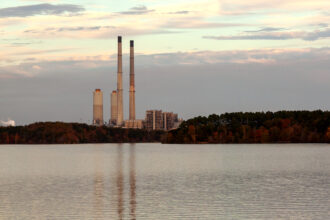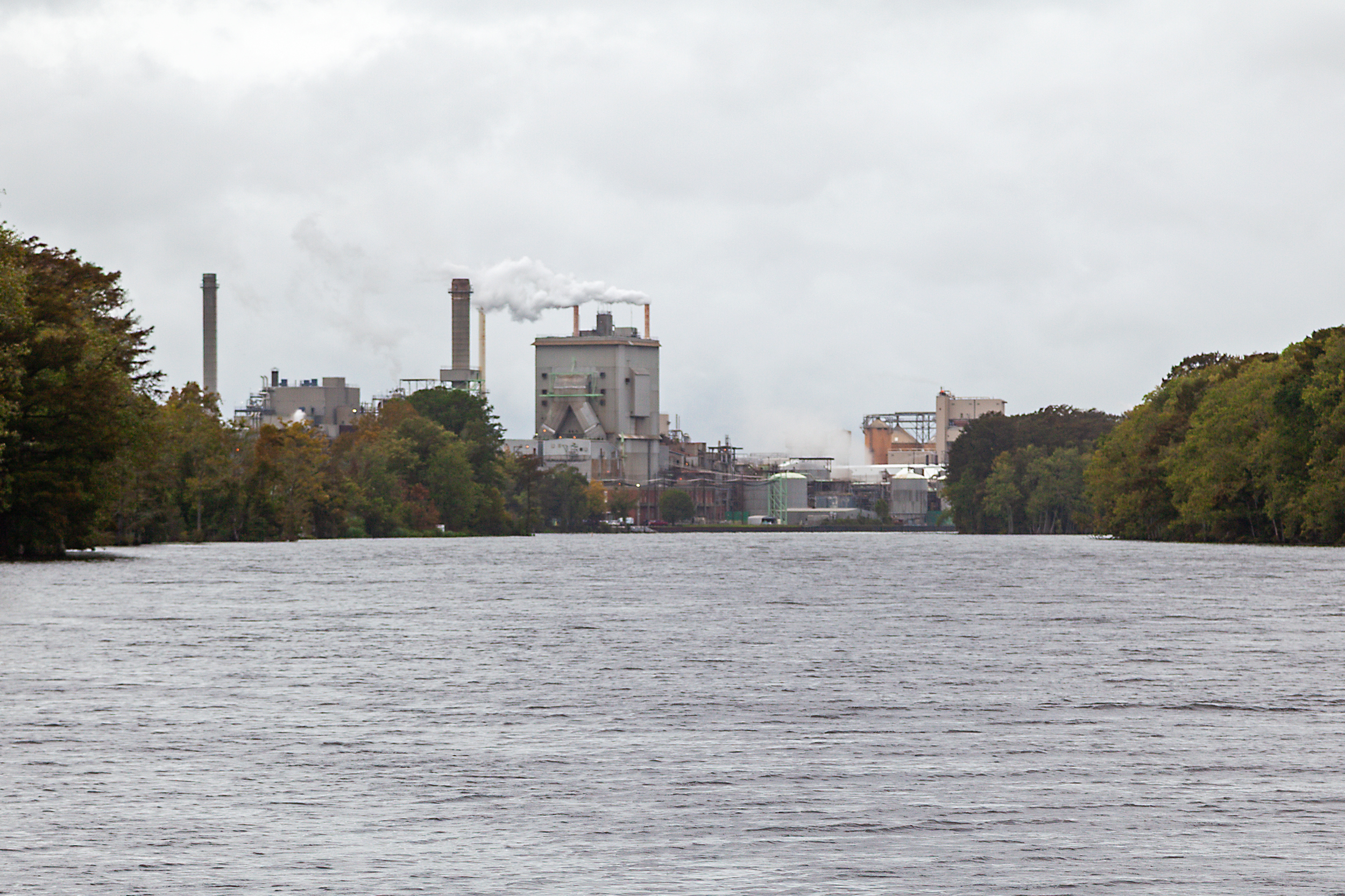


PLYMOUTH, N.C.—Fall had just arrived when a nor’easter began stewing in the Atlantic Ocean, its gale-force winds carrying the pungent smell of chlorine westward, away from downtown. Against the backdrop of dingy stratus clouds, the Domtar pulp mill loomed.
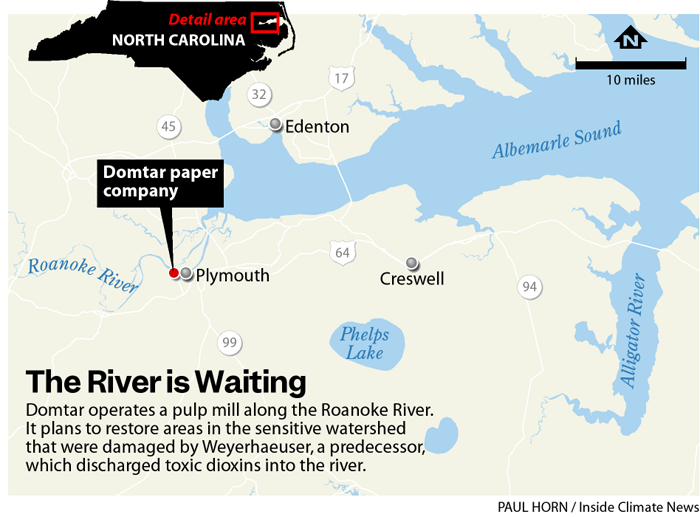
The plant occupies 2,400 acres at the confluence of Welch Creek and the Roanoke River, where logs are turned into absorbent materials used in diapers and other paper hygiene products. But those goods come at an environmental cost.
For 50 years, Domtar’s predecessor, Weyerhaeuser, discharged toxic dioxins, furans and mercury—byproducts of the bleaching process—into the Roanoke River. Scientists have found dioxins in river sediment, wood duck eggs and fish.
Federal and state regulators have now reached a tentative agreement with Domtar to restore and protect natural areas in the Roanoke River watershed. A federal court has issued a proposed consent decree and restoration plan to correct the damage that Weyerhaeuser caused.
Although Domtar isn’t responsible for the original damage, the company assumed liability for the cleanup after buying the property from Weyerhaeuser in 2007.
Fish can absorb dioxin through their gills. The contaminant accumulates in the fatty tissues of larger, predatory fish that rank higher on the aquatic food chain. Large fish eat smaller, bottom-feeding species that have consumed even tinier, contaminated organisms.
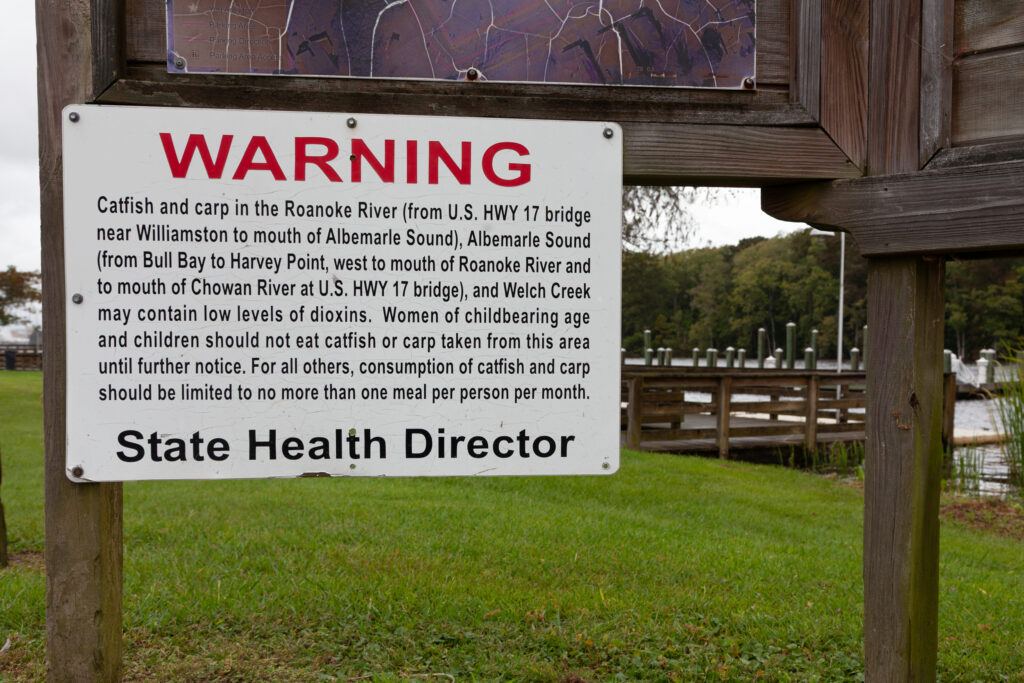
Since 1990, dioxin levels in and near the river have declined, but state health officials still recommend limiting consumption of car and catfish caught there to no more than one meal per month.
Even at very low levels, dioxin can cause reproductive and developmental problems, damage the immune system and cause cancer, according to the World Health Organization. The U.S. Environmental Protection Agency has set limits for dioxin in drinking water and requires facilities to report their releases as part of their pollution permits.
In addition to the toxic dioxin discharges, state records show Weyerhaeuser withdrew water from the river as part of the manufacturing process. Those withdrawals killed larval fish by inhaling them into cooling tanks, reducing the total number of striped bass, river herring and white perch by 100,000 each day, state and federal records show.
The Nature Conservancy in North Carolina owns and protects about 2,000 acres near Domtar. The group is reviewing the draft restoration plan and plans to submit comments, said Julie DeMeester, Freshwater and Coastal Plains director.
The Roanoke River boasts the largest intact systems of bottomland forests on the Atlantic Coast, as well as diverse populations of diadromous fish—species that travel between fresh water and salt water.
The river’s last 137 miles, which include the segment that passes Domtar, are exceptional habitat, DeMeester said, which prompted the Nature Conservancy to begin protecting the lands in 1982.
“There are many imperiled fish that use this river,” DeMeester said. “It’s truly one of the wildest remaining rivers,” with floodplains as much as five miles wide in the lower basin.
How to comment on the proposed restoration plan
The agreement between Domtar and state and federal regulators would require the paper company to fund the restoration of more than 1,000 acres of sensitive habitat along the Roanoke River.
- A proposed conservation deed restriction protecting 760 acres of Warren Neck forested wetlands. The tract provides fish nursery habitat important to the river’s health.
- Roughly $1.75 million to reconnect floodplains, protect wetlands and install water crossings and culverts to help fish passage. The project will reconnect three miles of historic stream channels to their natural flow and improve more than 600 acres of habitat.
The public can comment on the proposal through Oct. 16.
By mail: Howard Schnabolk
National Oceanic and Atmospheric Administration
2234 South Hobson Avenue Charleston, SC 29405
By phone: 854-429-2252
By email: [email protected]
“Residents of Plymouth and downstream communities deserve a healthy and clean Roanoke River,” said North Carolina Secretary of the Environment Reid Wilson. “This settlement ensures protection of fish and wildlife habitat, abundant recreational opportunities and strengthened resilience to flooding.”
Domtar did not respond to a request for comment, but issued this statement to WCTI, a television station in New Bern: “We are aware of the consent decree that has been filed and reserve further comment until the public comment period is concluded and the decree is ordered.”
The Roanoke is often overshadowed by its more well-known river peers, the Neuse and the Cape Fear, but it is equally important. The Roanoke begins in the Blue Ridge Mountains of Virginia and squiggles for 410 miles before it empties near Plymouth into the Albemarle Sound, among the largest estuaries in North Carolina.
This story is funded by readers like you.
Our nonprofit newsroom provides award-winning climate coverage free of charge and advertising. We rely on donations from readers like you to keep going. Please donate now to support our work.
Donate NowMore than 200 bird species live or breed in the Roanoke River floodplain, among them yellow-throated vireos, American redstarts and cerulean warblers. The river supports one of the most diverse fish communities in North Carolina, including striped bass, alewife and Atlantic sturgeon, which is on the endangered species list.
“It’s a lifeblood for North Carolina,” said Larry Baldwin of the North Carolina Environmental Advocacy Corps, a new nonprofit group.
The Importance of the Roanoke
Pulp and paper mills, as well as the chemical and metals industries, routinely discharged dioxin into waterways until the late 1980s, when the EPA National Dioxin study found the contaminant in fish and sediment. Those findings prompted the federal and some state governments to more closely regulate dioxin releases.
Dioxin releases have fluctuated over the last decade. Most emanated from the chemical industry, while pulp and paper mills accounted for less than 1 percent.
In 2024, Domtar released 3 grams of dioxin into waterways, a third of the state’s total, EPA data show. Dioxins are measured in grams because they are usually produced in very small quantities; they are also toxic at much lower concentrations than many other chemicals.
The Weyerhaeuser site in Plymouth was so contaminated that the U.S. Environmental Protection Agency considered it eligible for the Superfund program, based on its hazard score. However, since Domtar has been willing to pay for the cleanup, the site is being remediated under the Superfund Alternative Approach, which does not require federal funds.
Weyerhaeuser excavated contaminated material from the landfill and former chlorine plant before Domtar purchased the property in 2006, EPA records show. Since 2011, Domtar has spent at least $5.5 million on remediation. That includes installing a thin cap of sand to contain contaminated sediment in Welch Creek.
Baldwin, of the N.C. Environmental Advocacy Corps, said his group’s mission is to monitor overlooked river basins, including the Roanoke, Chowan and others in the northeastern part of the state, as well as environmental justice communities. Census data show two-thirds to 90 percent of residents living in neighborhoods near the Domtar plant are people of color.
The area has more than 50 hog CAFOs, including two that produce swine gas, and an unknown number of poultry operations. Enviva’s wood pellet plants in the region have been linked to deforestation. Much of the Albemarle Sound, which receives water from the Roanoke, Chowan and Alligator rivers, is on the federal list of impaired waters.
“The Roanoke is the major player when it comes to impacts to the Albemarle,” Baldwin said.
“We can’t neglect the importance of that river.”
About This Story
Perhaps you noticed: This story, like all the news we publish, is free to read. That’s because Inside Climate News is a 501c3 nonprofit organization. We do not charge a subscription fee, lock our news behind a paywall, or clutter our website with ads. We make our news on climate and the environment freely available to you and anyone who wants it.
That’s not all. We also share our news for free with scores of other media organizations around the country. Many of them can’t afford to do environmental journalism of their own. We’ve built bureaus from coast to coast to report local stories, collaborate with local newsrooms and co-publish articles so that this vital work is shared as widely as possible.
Two of us launched ICN in 2007. Six years later we earned a Pulitzer Prize for National Reporting, and now we run the oldest and largest dedicated climate newsroom in the nation. We tell the story in all its complexity. We hold polluters accountable. We expose environmental injustice. We debunk misinformation. We scrutinize solutions and inspire action.
Donations from readers like you fund every aspect of what we do. If you don’t already, will you support our ongoing work, our reporting on the biggest crisis facing our planet, and help us reach even more readers in more places?
Please take a moment to make a tax-deductible donation. Every one of them makes a difference.
Thank you,

Lisa Sorg
Reporter, North Carolina
Lisa Sorg is the North Carolina reporter for Inside Climate News. A journalist for 30 years, Sorg covers energy, climate environment and agriculture, as well as the social justice impacts of pollution and corporate malfeasance.
She has won dozens of awards for her news, public service and investigative reporting. In 2022, she received the Stokes Award from the National Press Foundation for her two-part story about the environmental damage from a former missile plant on a Black and Latinx neighborhood in Burlington. Sorg was previously an environmental investigative reporter at NC Newsline, a nonprofit media outlet based in Raleigh. She has also worked at alt-weeklies, dailies and magazines. Originally from rural Indiana, she lives in Durham, N.C.