

In 1991, Random House published a picture book called “Teenage Mutant Ninja Turtles: ABC’s for a Better Planet,” in which the masked cartoon turtles trade in their signature nunchucks for signs bearing environmental slogans.
For “A,” the turtles explain the sources of acid rain. Under “B,” the concept of biodegradability.
“Don’t Pollute Dudes!” the turtles exhort under “D.” They designate the letter G for “Green Power!”
Then the book reaches the letter “M”—for meat.
“A lot of the world’s cereal crop is fed to cattle, when it could be used to feed to starving people instead,” the book says. “And cattle expel methane, a gas that makes the greenhouse effect worse.” Underneath is a drawing of one of the turtles, Donatello, eating a salad.
“What can you do?” Donatello says, instructively. “How about not eating so much meat in the first place?”
This message and its potential to harness the power of early-’90s “Turtlemania” did not sit well with the meat industry. Its top lobbying group, then the National Cattlemen’s Association, now the National Cattlemen’s Beef Association (NCBA), publicly called for Random House to cease publication.
This example of meat industry pushback is one of many that Jennifer Jacquet, a researcher with the University of Miami, and her colleague Loredana Loy unearthed while researching the association’s influence, much of it in archives at the University of Wyoming. On Wednesday, they published a new paper in the journal PLOS Climate, in which they document a string of instances of the NCA attempting to tamp down messages and distort facts about the climate impacts of livestock, the researchers say.
“What we found in the archives really reveals the lack of concern about global warming,” Jacquet said, “and yet an incredible concern about the public’s view of the role of livestock in global warming.”
Jacquet and others have long researched the industry’s attempts to downplay its greenhouse gas emissions. Some of Jacquet’s recent research documents that the industry knew about its climate impacts long before the public became broadly aware of them, but worked to obstruct policies and campaigns meant to reduce emissions and consumption.
If those dietary or policy shifts had happened, they could have significantly lowered emissions: Jacquet and her colleagues calculated that lowering meat consumption in the United States by 50 percent per capita could have been up to 80 times more effective in reducing methane emissions than all the efforts to limit methane from the oil and gas industry over a 30-year period, starting in the early 1990s.
The latest paper adds details to the record, citing more examples of the industry’s efforts and specifically homing in on the National Cattlemen’s Association.
The NCBA did not respond to requests for an interview or for comments.
Jacquet said she wanted to look at the period immediately after 1986, when researchers published a major paper estimating the significant emissions of methane from enteric fermentation—the burps of ruminant animals. In 1988, NASA’s James Hansen famously testified about the “greenhouse effect” before a U.S. Senate subcommittee, saying that “non-CO2” gases, including methane, were also warming the atmosphere.
In the years that followed, as a new wave of environmental action arose and governments across the world started to act on climate, influential books advised people to eat less livestock-based food for both health and planetary reasons. “Diet for a New America” by John Robbins advocated a shift toward vegetarian diets and “Beyond Beef: The Rise and Fall of the Cattle Culture” by Jeremy Rifkin traced the long history of beef production, railing against intensive factory farms.
This story is funded by readers like you.
Our nonprofit newsroom provides award-winning climate coverage free of charge and advertising. We rely on donations from readers like you to keep going. Please donate now to support our work.
Donate NowAs these books became popular, NCA began strategizing its rebuttal. After the actors Lisa Bonet and River Phoenix appeared on the Phil Donahue Show in support of Robbins’ book and vegetarian diets, the NCA asked researchers at Texas A&M University to refute its main points. When “Beyond Beef” was published in 1992 and Rifkin launched a related campaign urging 16 countries, including the U.S., to reduce beef consumption by 50 percent, the NCA launched the “Food Facts Coalition” to fight “anti-cow” arguments.
F.M. Byers, a researcher at Texas A&M, became the go-to scientist the NCA called on to challenge the mounting evidence behind livestock emissions from cattle. “Cattle are not a significant source of greenhouse gases,” Byers wrote in an opinion piece for USA Today.
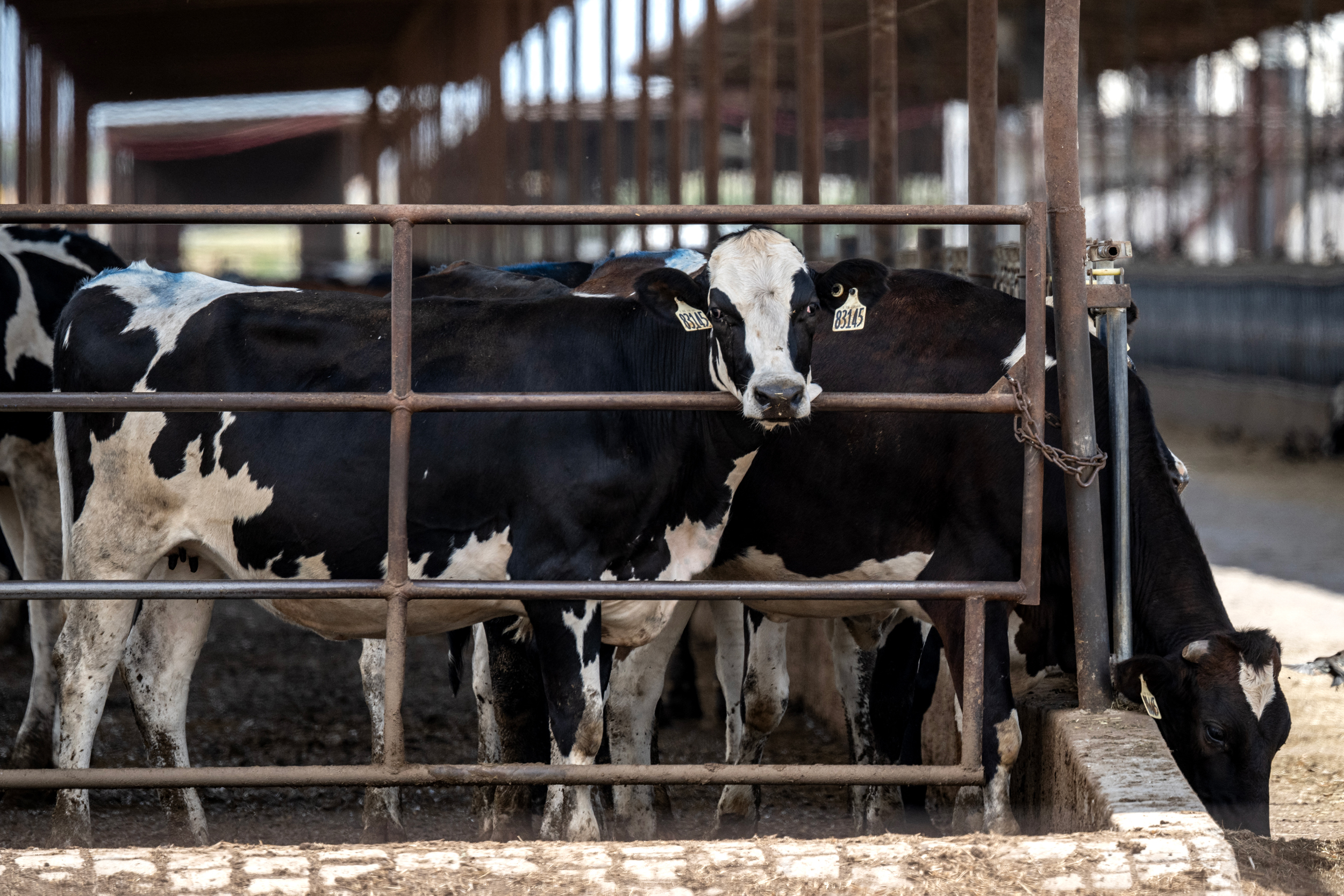
Livestock are estimated to produce about one-third of all human-caused methane, and in the U.S. are the biggest source.
As the NCA worked on the public relations front, its members were sufficiently concerned about the growing awareness of livestock methane, to the point that some attended a workshop on “Methane Emissions from Ruminants,” held by the Environmental Protection Agency in 1989. That same year the NCA published its “Strategic Plan on the Environment,” outlining how the industry should respond to growing concerns about its environmental and climate impacts.
At that time, the NCA said climate change was a real threat and was concerned that incoming Republican President George H.W. Bush would enact policies to address it.
“Recent events like the Alaskan oil spill and potentially global catastrophes like global warming have broadened and deepened public concern with the whole gambit of environmental issues,” the document says. “President Bush has proclaimed more commitment to environmental issues than his predecessor and to promoting international action on global issues such as climate change.”
In a press release accompanying the report, the chairman of the NCA said a “key component of the plan is to solicit technical papers on the relationship between the cattle industry and the environment.”
Subsequent reports and mainstream media stories frequently cited Byers findings.
Last month, adding to the growing literature and research on the meat industry’s strategies, the Netherlands-based Changing Markets Foundation, a long time critic of the livestock industry, published “The New Merchants of Doubt,” a book based in part on its investigation into the industry’s tactics to delay climate action.
Nusa Urbancic, the book’s author, said Jacquet and Loy’s new paper “provides valuable insights into the formative years of the meat industry’s playbook … Instead of investing in workable climate solutions, they treated climate science as a PR problem and spent millions of dollars on strategic communications to fix it.”
About This Story
Perhaps you noticed: This story, like all the news we publish, is free to read. That’s because Inside Climate News is a 501c3 nonprofit organization. We do not charge a subscription fee, lock our news behind a paywall, or clutter our website with ads. We make our news on climate and the environment freely available to you and anyone who wants it.
That’s not all. We also share our news for free with scores of other media organizations around the country. Many of them can’t afford to do environmental journalism of their own. We’ve built bureaus from coast to coast to report local stories, collaborate with local newsrooms and co-publish articles so that this vital work is shared as widely as possible.
Two of us launched ICN in 2007. Six years later we earned a Pulitzer Prize for National Reporting, and now we run the oldest and largest dedicated climate newsroom in the nation. We tell the story in all its complexity. We hold polluters accountable. We expose environmental injustice. We debunk misinformation. We scrutinize solutions and inspire action.
Donations from readers like you fund every aspect of what we do. If you don’t already, will you support our ongoing work, our reporting on the biggest crisis facing our planet, and help us reach even more readers in more places?
Please take a moment to make a tax-deductible donation. Every one of them makes a difference.
Thank you,