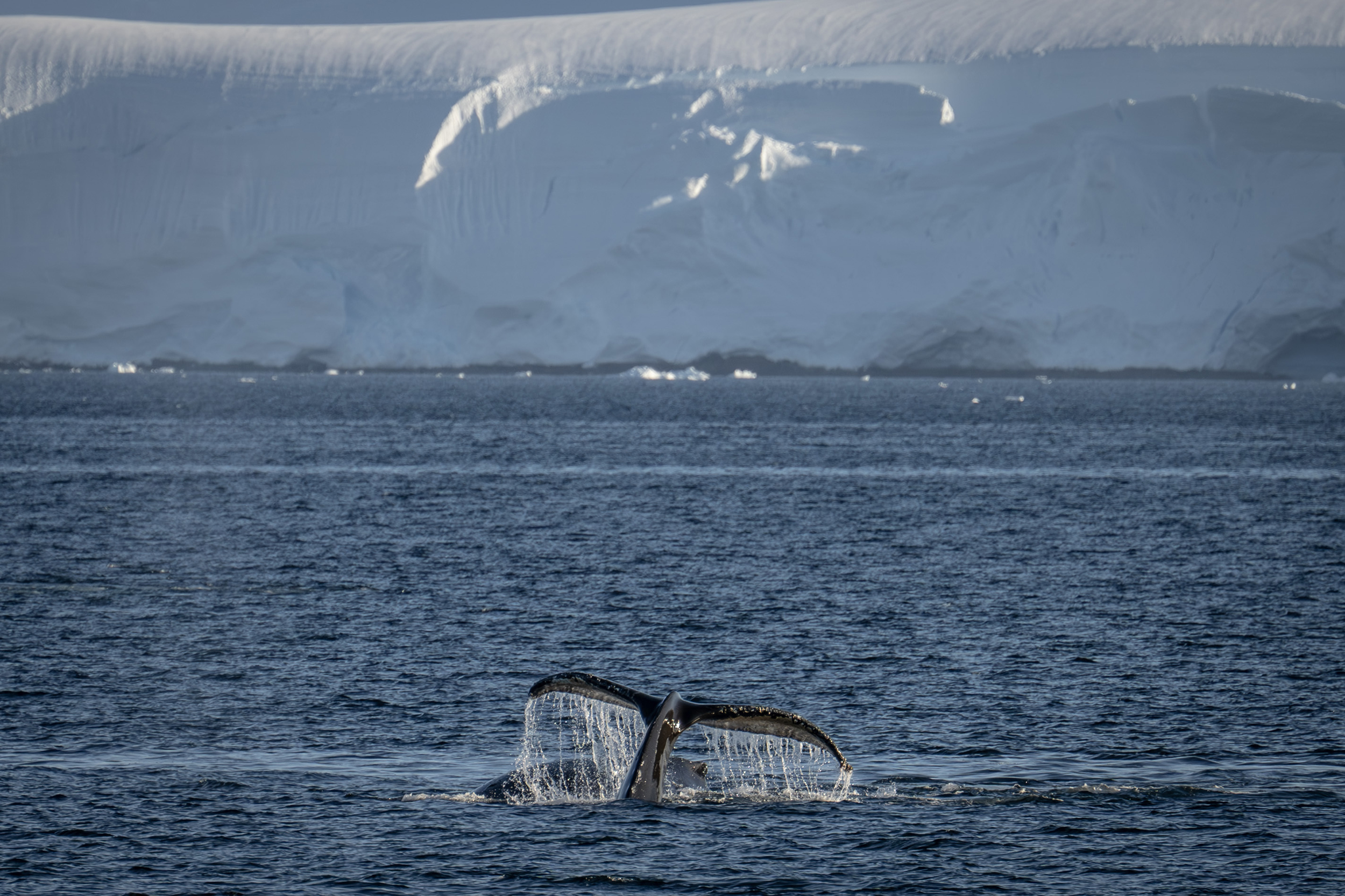


In the Southern Ocean, whales, penguins, seals and seabirds feast on massive swarms of krill that underpin much of the region’s marine food web. Meanwhile, a growing fishing industry in Antarctica is also targeting the tiny crustaceans, used to make Omega-3 supplements, pet food and feed for farm-raised salmon. Now, a coalition of more than 30 scientists and ocean advocates, who call themselves the Antarctic Avengers, are asking shoppers to boycott these products to protect marine life.
“We are now witnessing the expansion of industrial fishing into one of Earth’s last great wildernesses. This is happening at a time when these waters are already under immense pressure from climate change, making it all the more urgent that we act to protect them rather than open them up to further exploitation,” said Sylvia Earle, a renowned marine biologist who is part of the Antarctic Avengers group and founder of a global marine conservation nonprofit, Mission Blue. “Krill are not a commodity to be extracted at scale for aquaculture feed, consumer supplements and cosmetics,” she said in a statement.
Krill populations are already suffering as sea ice continues to disappear due to rising temperatures. This loss of critical habitat, which krill depend on for food and shelter, has a direct impact on predators that feed on the crustaceans, like whales. Some research shows whales may not be getting enough food in years where there is less sea ice, and are consequently less likely to reproduce.
“We have shown that in years with poor winter sea ice extent there is a reduction in subsequent pregnancy rates that we believe is the direct result of prey limitation,” said Ari Friedlaender, an ecologist and professor at UC Santa Cruz who has studied whale foraging behavior in Antarctica for more than two decades. Industrial fishing, he said, could further add to the pressure whales face by reducing krill availability in key feeding grounds.
For this reason, Friedlaender said he is in favor of boycotting krill-based products even though he is not part of the Antarctic Avengers group. “It represents an opportunity that we have to reduce a known threat to krill predators,” he said.
The Antarctic Avengers are asking consumers to avoid buying Omega-3 supplements that advertise Antarctic krill as a key ingredient, as well as pet food and treats made from krill meal and oil.
“This is one of the few environmental problems where the fix is genuinely in our hands: read the label, put it back on the shelf, buy the algae version instead,” said Antarctic Avenger and National Geographic explorer and filmmaker Andy Mann, in a statement.
As alternatives, campaigners urge shoppers to seek out krill-free alternatives that include algae, flaxseed, hemp and chia oils. Consumers are also encouraged to reconsider purchasing farmed-raised salmon or other fish that are raised on krill meal.
Other marine conservation groups like Sea Shepherd, which has an ongoing campaign to stop industrial krill supertrawlers from overfishing the Southern Ocean called Operation Antarctica Defense, are also calling on major retailers to stop selling krill products in their stores to help change consumer behavior. Several have agreed.
Last year, as a result of Sea Shepherd’s advocacy, Holland & Barrett, a leading health and wellness retailer in the United Kingdom, committed to phasing out krill supplements.
“Our decision to exit krill products is part of our ongoing journey to become a more sustainable, nature-positive business that protects the ecosystems we all depend on,” said Jessica Long, sustainability and impact director at Holland & Barrett, in a statement.
This year, one of Germany’s largest drugstore chains, commonly known as dm, confirmed that it will stop selling krill products. Two of Australia’s large supermarket chains, Woolworths and Coles, have also stated they will no longer be stocking their shelves with krill supplements.
About This Story
Perhaps you noticed: This story, like all the news we publish, is free to read. That’s because Inside Climate News is a 501c3 nonprofit organization. We do not charge a subscription fee, lock our news behind a paywall, or clutter our website with ads. We make our news on climate and the environment freely available to you and anyone who wants it.
That’s not all. We also share our news for free with scores of other media organizations around the country. Many of them can’t afford to do environmental journalism of their own. We’ve built bureaus from coast to coast to report local stories, collaborate with local newsrooms and co-publish articles so that this vital work is shared as widely as possible.
Two of us launched ICN in 2007. Six years later we earned a Pulitzer Prize for National Reporting, and now we run the oldest and largest dedicated climate newsroom in the nation. We tell the story in all its complexity. We hold polluters accountable. We expose environmental injustice. We debunk misinformation. We scrutinize solutions and inspire action.
Donations from readers like you fund every aspect of what we do. If you don’t already, will you support our ongoing work, our reporting on the biggest crisis facing our planet, and help us reach even more readers in more places?
Please take a moment to make a tax-deductible donation. Every one of them makes a difference.
Thank you,

Teresa Tomassoni
Oceans Correspondent
Teresa Tomassoni is an environmental journalist covering the intersections between oceans, climate change, coastal communities and wildlife for Inside Climate News. Her previous work has appeared in The Washington Post, NPR, NBC Latino and the Smithsonian American Indian Magazine. Teresa holds a master’s degree in Journalism from the Craig Newmark Graduate School of Journalism at CUNY. She is also a recipient of the Stone & Holt Weeks Social Justice Reporting Fellowship. She has taught journalism for Long Island University and the School of the New York Times. She is an avid scuba diver and spends much of her free time underwater.