

The Arizona Department of Water Resources filed a motion Friday to join in a lawsuit against the federal government’s plan for Colorado River operations over the next 10 years.
“Arizona believes the federal government’s new operating framework ignores basic elements of the law of the river and could result in cuts to the state apportionment that would devastate Arizona’s economy,” said Tom Buschatzke, director of the Arizona Department of Water Resources, in a press conference announcing the legal action.
The state joins Nevada in suing the Department of the Interior and Bureau of Reclamation, alleging the federal government’s plan unfairly places the brunt of water cuts on Arizona and its Lower Basin peers, Nevada and California. The Colorado River Basin is split into lower and upper halves, and the Bureau of Reclamation’s reductions in water allocations over the next 10 years fall solely on the Lower Basin states.
“Arizona has always been willing to do our part to protect the Colorado River, but we will not accept a forced federal plan that solves this crisis on the backs of our families, farmers, and businesses,” said Arizona Gov. Katie Hobbs in a statement. “We are drawing a line in the sand. I am taking this legal action alongside Nevada because the federal government refuses to hold the Upper Basin accountable for the water deliveries they owe Arizona, and is threatening to force draconian cuts that go well beyond the Lower Basin Agreement.”
In a joint statement, Nevada Gov. Joe Lombardo and Southern Nevada Water Authority General Manager John Entsminger welcomed the news Arizona was joining its lawsuit.
“Arizona’s decision to join our lawsuit is an important step in challenging a federal plan that unfairly burdens the Lower Basin and fails to require the Upper Basin to make meaningful reductions,” Lombardo said. “Nevada will not accept a framework that puts our water supply and the future of our communities at risk.”
Arizona has long stood to lose the most in the tense negotiations over how to reduce the use of water from the Colorado River. One of the biggest users of Colorado River water, the state has some of the least senior water rights on the river, meaning it takes far larger cuts than other states in times of drought.
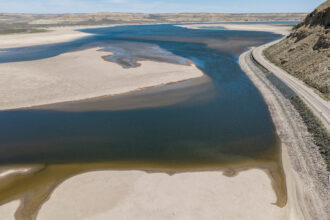
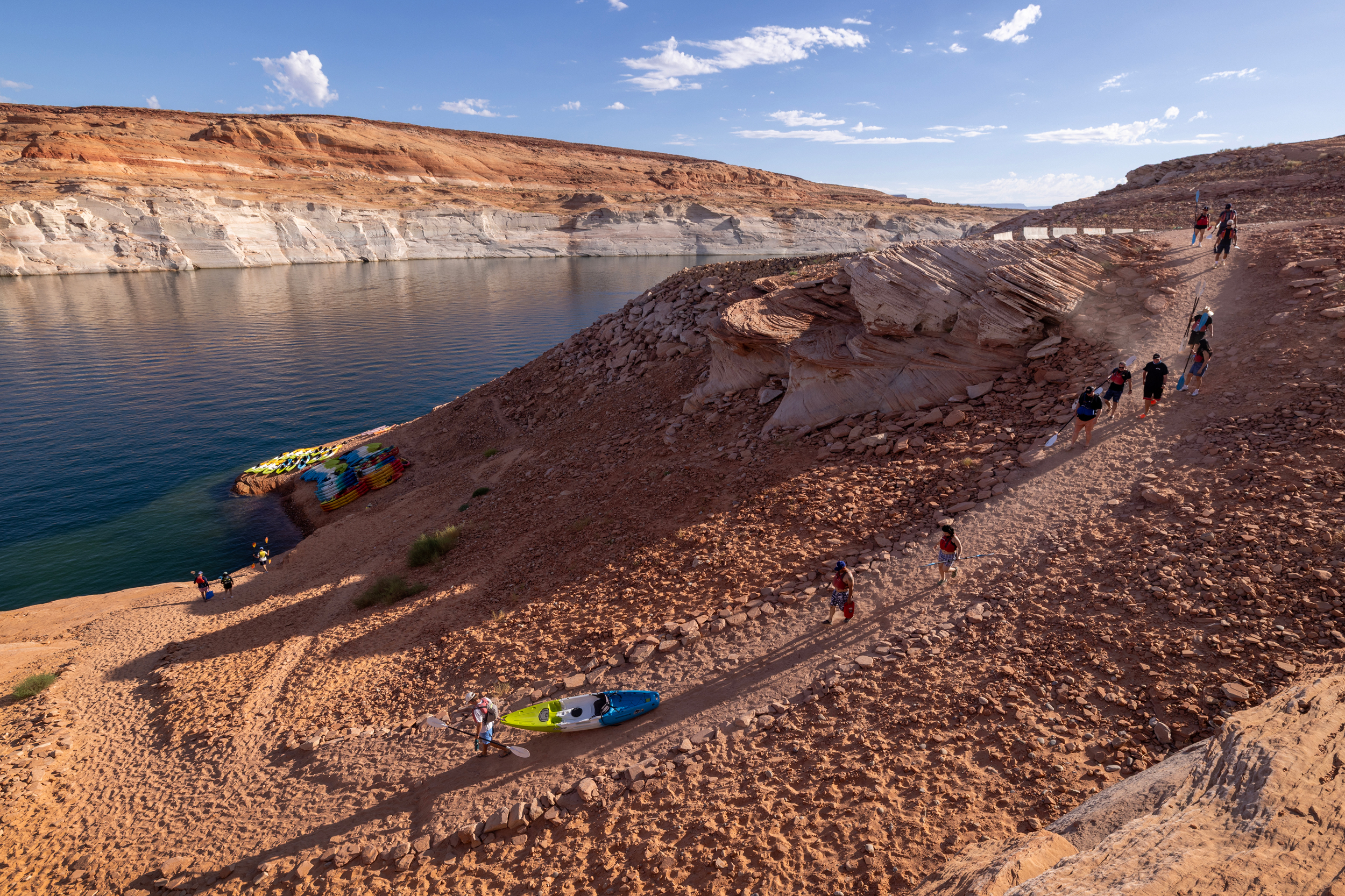
The Colorado River provides water to between 35 and 40 million people across seven Western states, 30 tribes and two Mexican states as it wends its way through the Southwest, home to some of the country’s most arid and drought-stricken landscapes. Dams on the river provide electricity to millions.
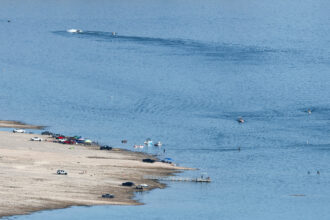
The 1922 compact between the river’s users assumed roughly 17.5 million acre feet of water was available to the two basins and Mexico, but the historical average of its natural flow has only been roughly 14.7 million acre feet. That number plummeted to an average of 11.2 million acre feet between 2020 and 2024 due to climate change, according to provisional data from Reclamation, with demand outpacing supply. The seven states that depend on the river have been in tense, deadlocked negotiations for years over how to distribute water cuts, and have missed their deadlines to come to an agreement, leading to the federal government’s decision.
This story is funded by readers like you.
Our nonprofit newsroom provides award-winning climate coverage free of charge and advertising. We rely on donations from readers like you to keep going. Please donate now to support our work.
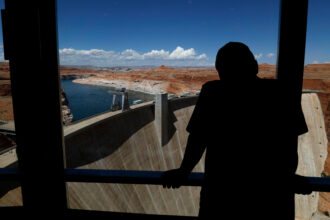
Donate NowIn July, the federal government issued its record of decision for operations of federal infrastructure, like Glen Canyon Dam and Lake Powell, which dictates how much water is released to the Lower Basin. The plan outlines a 10-year management approach beginning in 2027 that could adjust to changing hydrological conditions that affect the river’s flow, with operations updatable every two years. The cuts imposed by the plan, however, are limited to the Lower Basin states, which consume the lion’s share of the river’s water. The Upper Basin states of Colorado, Wyoming, Utah and New Mexico, which have argued they don’t yet use their full allocation of water, face no mandatory cuts under the plan, a point of contention between the two sides.
The first two years of cuts are based on a plan submitted by Arizona, California and Nevada, and reduce Arizona’s allocation of water from the Colorado River by 760,000 acre feet, California’s by 440,000 acre feet and Nevada’s by 50,000 acre feet (one acre foot is roughly 326,000 gallons—enough water for two-to-four households a year).
Arizona and the Lower Basin states are still working to implement those cuts, and the lawsuit exists on a parallel track to address the state’s concerns with operations after the first two years, Buschatzke said. The federal plan has outlined future cuts to the Lower Basin totalling up to 3 million acre feet, more than twice what will be implemented in the initial two years of the plan.
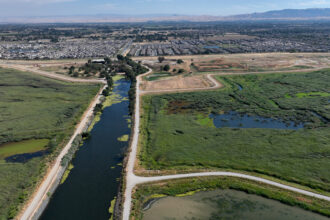
The issues Arizona hopes to deal with in the lawsuit are twofold, Buschatzke said. First, the federal government’s plan fails to deliver what Arizona and the other Lower Basin states are owed under the rules and regulations that guide Colorado River use, known as the “Law of the River.” Second, he said, the federal plan “could effectively dry up the Central Arizona Project,” the canal system that delivers Colorado River water to Phoenix, Tucson and other communities.
Legal action, he said, is needed to protect Arizona’s water.
“The Lower Basin states have contributed millions of acre-feet of water towards stabilizing the river system, with more than 5.5 million acre-feet of Arizona water left in Lake Mead since 2014,” Buschatzke said. “No state has sacrificed more … but the United States decision puts the entire burden of sacrifice on the shoulders of three states, and we are joining Nevada in challenging that framework.”
About This Story
Perhaps you noticed: This story, like all the news we publish, is free to read. That’s because Inside Climate News is a 501c3 nonprofit organization. We do not charge a subscription fee, lock our news behind a paywall, or clutter our website with ads. We make our news on climate and the environment freely available to you and anyone who wants it.
That’s not all. We also share our news for free with scores of other media organizations around the country. Many of them can’t afford to do environmental journalism of their own. We’ve built bureaus from coast to coast to report local stories, collaborate with local newsrooms and co-publish articles so that this vital work is shared as widely as possible.
Two of us launched ICN in 2007. Six years later we earned a Pulitzer Prize for National Reporting, and now we run the oldest and largest dedicated climate newsroom in the nation. We tell the story in all its complexity. We hold polluters accountable. We expose environmental injustice. We debunk misinformation. We scrutinize solutions and inspire action.
Donations from readers like you fund every aspect of what we do. If you don’t already, will you support our ongoing work, our reporting on the biggest crisis facing our planet, and help us reach even more readers in more places?
Please take a moment to make a tax-deductible donation. Every one of them makes a difference.
Thank you,

Wyatt Myskow
Reporter, Phoenix
Wyatt Myskow covers drought, biodiversity and the renewable energy transition throughout the Western U.S. Based in Phoenix, he previously reported for The Arizona Republic and The Chronicle of Higher Education. Wyatt has lived in the Southwest since birth and graduated from Arizona State University with his bachelor’s degree in journalism.